 |
 Tree: 1 G5RV: 0
 3 December 2010 | by
 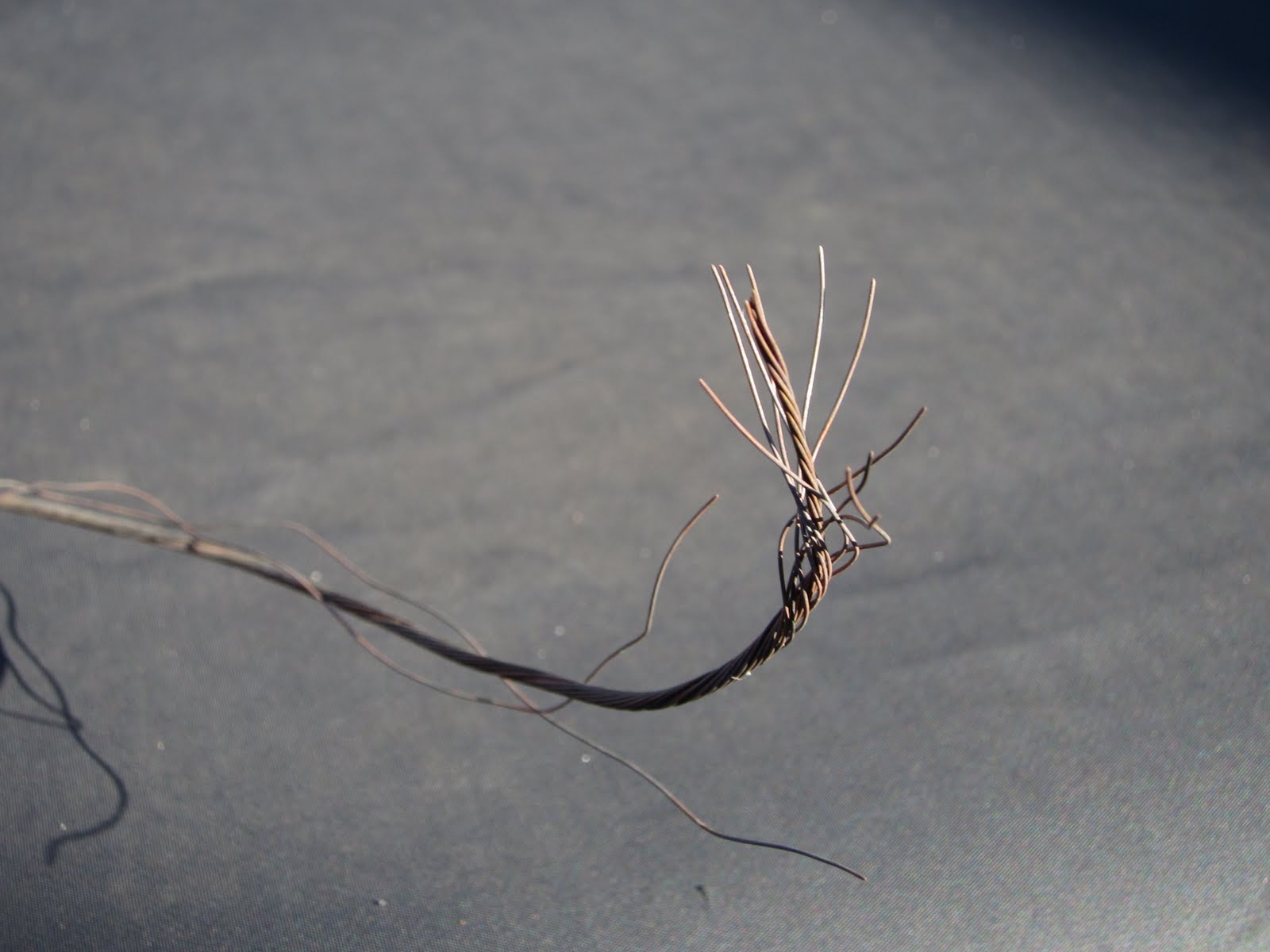 It was bound to happen sooner or later, but that doesn’t really make it feel any better. At the edge of my backyard there is a tree that I was pretty sure had died (given the lack of leaves through the past spring and summer), and I’d planned on having a tree service look at it next spring. A series of rainstorms with a lot of wind passed through my part of the world yesterday (I’ll bet you can guess where this is going). One of the three small trunks from that dead tree snapped off about 8 feet in the air and fortunately fell parallel to my house so the house was OK. Unfortunately, my G5RV antenna passed through the upper branches of the tree and unsurprisingly was unable to withstand the force of the falling tree. The image you see to the right is a piece of one of the wire legs that use to be up in the air. It is, alas, no longer up in the air.
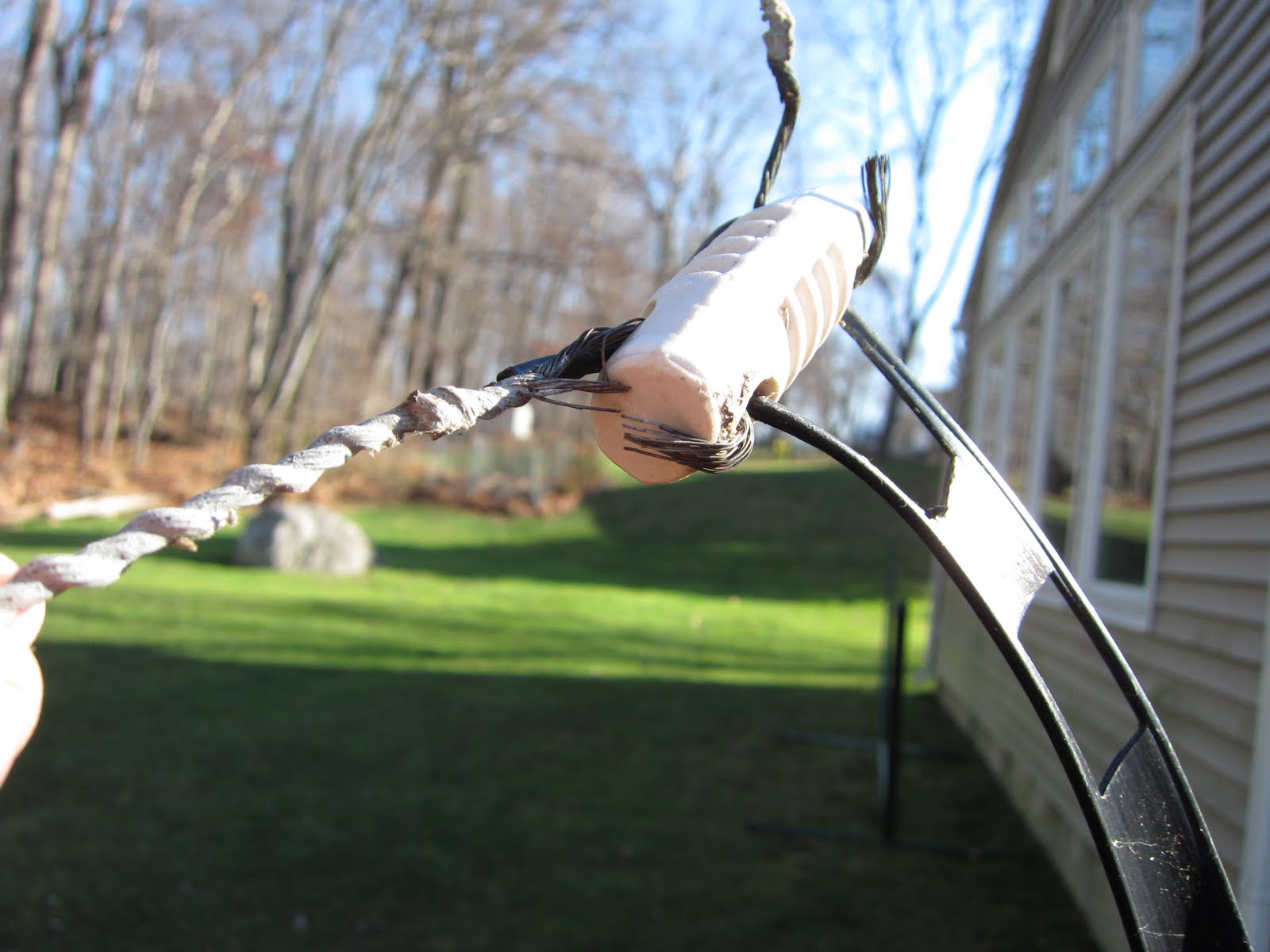
The force of the stress on the wire not only snapped one of the wire legs but also pulled hard enough to break the solder joints at the insulator where the bare wire connects to the ladder line, as you can see in the next photo. Both ends of the soldered joint were broken, but the non-broken wire leg appears to be OK otherwise and is still attached to the “near end” tree where it was originally attached. The remaining few feet of the other leg appear to have snapped back after breaking and look to be up in the branches of the other supporting tree at probably around 50 feet in the air. I’m hoping that I can get a line over that and pull it down, since that way I can use the existing rope (which is still over a nice high branch) to support the replacement.
For at least the short-term, I am going to try to salvage what’s there. Although this has been up in the air for over 10 years (I didn’t think it was that long, but I realized that every HF QSO that I’ve made from my home station starting in August 2000 has been on that antenna) the other parts of the antenna seem to be in fine shape. (And it was certainly working very well until it came down.) The G5RV is, without question, a compromise antenna, but in the 10 years that I’ve been using it I’ve managed to work all states, all zones, and gotten DXCC on all bands from 10m to 80m (I still need a few more confirmations for 30m) and on all three modes, and have worked 300+ DXCC entities using this compromise. Would I like a tower with a nice Steppir on it? Sure, but that’s not happening anytime soon, so I’ll stick to what I know works. I have another G5RV that a friend gave me before he moved out of the country, and while I need to verify that the wire is the correct length, it’s been sitting in my garage out of the elements and the wire legs look like perfect candidates for a “transplant”. The big advantage of repairing what’s there is that it will be zero cost and with a little luck, I should be able to get it done over the weekend.
If I can’t repair it for whatever reason, then most likely I’ll run over to KJI Electronics and pick up a new one and put it up in the same place. I have discussed with some friends the possibility of replacing this with something like an Alpha-Delta DX-CC or possibly even an Alpha-Delta DX-LB Plus (I have the horizontal room, the question is whether I can get it high up enough to function properly), but for now I think I’m going to stick with what I know works.
I hope to have an update with good news soon, stay tuned.

David Kozinn, K2DBK, is a regular contributor to AmateurRadio.com and writes from New Jersey, USA. Contact him at [email protected].
Tree: 1 G5RV: 0
It was bound to happen sooner or later, but that doesn’t really make it feel any better. At the edge of my backyard there is a tree that I was pretty sure had died (given the lack of leaves through the past spring and summer), and I’d planned on having a tree service look at it next spring. A series of rainstorms with a lot of wind passed through my part of the world yesterday (I’ll bet you can guess where this is going). One of the three small trunks from that dead tree snapped off about 8 feet in the air and fortunately fell parallel to my house so the house was OK. Unfortunately, my G5RV antenna passed through the upper branches of the tree and unsurprisingly was unable to withstand the force of the falling tree. The image you see to the right is a piece of one of the wire legs that use to be up in the air. It is, alas, no longer up in the air.
The force of the stress on the wire not only snapped one of the wire legs but also pulled hard enough to break the solder joints at the insulator where the bare wire connects to the ladder line, as you can see in the next photo. Both ends of the soldered joint were broken, but the non-broken wire leg appears to be OK otherwise and is still attached to the “near end” tree where it was originally attached. The remaining few feet of the other leg appear to have snapped back after breaking and look to be up in the branches of the other supporting tree at probably around 50 feet in the air. I’m hoping that I can get a line over that and pull it down, since that way I can use the existing rope (which is still over a nice high branch) to support the replacement.
For at least the short-term, I am going to try to salvage what’s there. Although this has been up in the air for over 10 years (I didn’t think it was that long, but I realized that every HF QSO that I’ve made from my home station starting in August 2000 has been on that antenna) the other parts of the antenna seem to be in fine shape. (And it was certainly working very well until it came down.) The G5RV is, without question, a compromise antenna, but in the 10 years that I’ve been using it I’ve managed to work all states, all zones, and gotten DXCC on all bands from 10m to 80m (I still need a few more confirmations for 30m) and on all three modes, and have worked 300+ DXCC entities using this compromise. Would I like a tower with a nice Steppir on it? Sure, but that’s not happening anytime soon, so I’ll stick to what I know works. I have another G5RV that a friend gave me before he moved out of the country, and while I need to verify that the wire is the correct length, it’s been sitting in my garage out of the elements and the wire legs look like perfect candidates for a “transplant”. The big advantage of repairing what’s there is that it will be zero cost and with a little luck, I should be able to get it done over the weekend.
If I can’t repair it for whatever reason, then most likely I’ll run over to KJI Electronics and pick up a new one and put it up in the same place. I have discussed with some friends the possibility of replacing this with something like an Alpha-Delta DX-CC or possibly even an Alpha-Delta DX-LB Plus (I have the horizontal room, the question is whether I can get it high up enough to function properly), but for now I think I’m going to stick with what I know works.
I hope to have an update with good news soon, stay tuned.
David Kozinn, K2DBK, is a regular contributor to AmateurRadio.com and writes from New Jersey, USA. Contact him at [email protected].
Defeated by Microsoft
I have never understood why Microsoft has become the most successful software company in the world. When compared to similar products the underlying design of their software, to me, seems unnecessarily complex. And the company couldn’t care less about backward compatibility and breaking something when bringing out a new version. Microsoft software development tools, compared to third party products like Delphi or Lazarus, are far more difficult to use in my opinion. Visual Basic long ago ceased to be a “basic” programming language for amateurs like myself.
I had an idea for a program to run on my HTC Touch Pro smartphone that needed to access the phone’s internal GPS. A couple of months ago I actually got a good way towards implementing it for the Android platform (even though I’d never programmed in Java before) just by downloading the source code of someone else’s GPS application and modifying it using the free development tools. But because my phone was running an unofficial port of Android on which not all features worked I could only run it in an emulator, not transfer the app to the phone. In any case, the XD Android port was unstable and ate battery power even worse than Windows Mobile did, so I had to go back using WM 6.1 despite the fact that under Android it was a much nicer phone.
So I thought I’d have a go at writing my program for Windows Mobile. I had a copy of Visual Studio 2005 sitting on the shelf. So as before, I started Googling for example programs for accessing a GPS.
If I am writing a program for Windows desktop using Lazarus / Free Pascal I can Google for what I am trying to do and nearly always find code I can use. Even if it was written for Borland Delphi in 1996 it usually still works. The problem with the Windows smartphone / PDA platform is that it has been through many incompatible incarnations in less time than that. There is Windows CE, Pocket PC, Windows Mobile versions 4, 5, 6 and 6.1, Windows Smartphone, Windows Phone 7, Compact Net Framework 1.0, Compact Net Framework 2.0 and Compact Net Framework 3.5. If you do manage to find a relevant example there is no guarantee that it is actually compatible with the development tools and SDKs you have installed on your PC, or with your mobile device.
The first program I tried that actually did anything came with two DLLs, one for serial port access and one to decode the GPS data. That would print out a few NMEA strings and then fail with an exception. None of the other examples I tried would do anything at all. The problem with the first program appeared to be in the serial port DLL, so I tried to upgrade it to version 2.0 of the .Net Compact Framework which had built-in serial port support. I copied examples of serial port access code but although the program didn’t crash it never received anything from the GPS at all, even though I knew it was working (e.g. by running APRSISCE.) Unfortunately when run from Visual Studio the Net CF 2.0 programs would display an error on the phone that “this device has a newer version of the Compact Framework installed that must be uninstalled first.” I wasn’t about to do that since who knows what it would break. So much for backward compatibility.
One of the reasons implementing my idea was so easy on the Android platform is that Google had provided a GPS object that gave you ready to use data. On Windows Mobile you have to listen to the GPS via a serial port and then parse the NMEA data that comes out. So, having failed to find a GPS example that would run for more than a couple of seconds I decided to look for serial port examples. None of those would receive any data from the GPS either. I even found a free GPS test application. That would receive several lines of data from the GPS then disappear without trace.
At this point I started to wonder if there was a problem with the internal GPS of my HTC Touch Pro. I did some more Googling and found that users of some GPS apps on HTC smartphones with internal GPS had found these apps did not recognize the internal GPS or timed out while waiting to get data from it. Presumably these apps had been written based on the same code examples I had been trying. One user had found the only way to get the GPS data into the program was to use a program called GPSGate. But this was a commercial program, costing money, which I had no wish to spend just to see if this worked when everything else hadn’t.
After a couple of days of fruitless effort my interest in continuing with this project had evaporated completely so I gave up. At least, unlike with abortive hardware projects, no components were wasted. I restored the PC back to a couple of days earlier to remove all the hundreds of megabytes of APIs, SDKs and examples I’d installed. And I have gained a new respect for people who actually manage to develop software using Microsoft tools.

Julian Moss, G4ILO, is a regular contributor to AmateurRadio.com and writes from Cumbria, England. Contact him at [email protected].
Handiham World for 01 December 2010
Welcome to Handiham World!
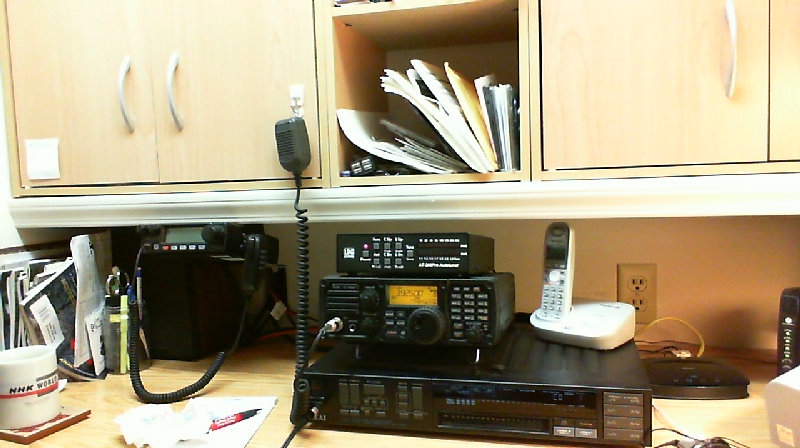 Yes, this morning’s web cam photo reveals that the WA0TDA ham shack is still not as tidy as it might be.
The magazines on the left are ones I use for researching equipment and recording for our blind members, the IC-7200 is in the center and an LDG AT-200PRO tuner sits on top of the rig and takes care of touching up the SWR on the Windom and vertical antennas. Mounted below the cabinet to the left of the Icom is a Yaesu FT-2800M, a 2 meter radio that’s just plain reliable and easy to use. If you have sharp eyes, you might be able to make out the NHK World coffee mug my son Will, KC0LJL, brought back from Tokyo for me. The IC-706M2G is out of sight below the edge of the desk. Tidying up the ham shack is always something that needs doing, but is generally scheduled for “tomorrow”. Now that the new year is so close, I can make it a new year’s resolution. That’s called creative procrastination!
December already.
It hardly seems possible that we are nearly at the end of 2010. When I think back on all of the things I had planned to do this year, it seems that many of them are still on the “to do” list, especially the work I knew needed to be done to bring my ham shack up to par. The one big thing I did manage was acquiring and installing the new ICOM IC-7200 transceiver, a vast improvement over my aging and cranky Yaesu FT-747GX. The main ham shack computer was also replaced and both ham shack computers were outfitted with Windows 7, bringing much-needed updates to the operating systems. Left undone were all but the most essential antenna maintenance, and this leaves me with antennas that really should be upgraded or replaced altogether. Well, it’s 15°F with a stiff wind and snow out there in the backyard right now, so the chances of getting the motivation to do antenna work seem pretty slim. I miss having my EchoLink node operational, but have simply not had the time to set it up and put it on the air. The node had been working just fine, but when I replaced the ham shack computer that ran the node, I ran into some configuration problems with the new machine and with many other things clamoring for my attention, the node simply had to go silent. On the positive side I was able to configure Ham Radio Deluxe to control two rigs at the same time to simplify logging. Now that I have written all of this stuff down, maybe I didn’t do so badly this year after all.
Meanwhile, back at the office…

2010 has been a challenging year economically for nonprofit programs like ours. Still, when I think back to what we accomplished during 2010, we managed pretty well. We completed the office move to Camp Courage, which was no small accomplishment. Thanks to help from volunteers, we were able to get an excellent wire antenna strung up so that remote base station W0ZSW could be on the air from Camp Courage. Remote base station W0EQO was maintained in working order throughout the year and remains an excellent resource at Courage North. We managed to run a successful Minnesota Radio Camp at Camp Courage, the first radio camp in many years to return to that location after a long run of successful sessions at Courage North. We maintained and even expanded the online audio offerings available to our members any time from the Handiham website. Again, thanks to volunteer assistance, we were able to maintain the audio cassette tape availability to our members who still do not have access to computers. We were able to publish the Handiham World Weekly E-Letter all year long with very few interruptions in all of its various formats including the weekly podcast. A summer print edition of Handiham World with a giving envelope was also published and distributed.
In your mailbox soon…
Now, as we approach the end of the year, a new print edition of Handiham World will soon be arriving in your mailbox. It has Handiham news, but it also contains that all-important giving envelope. Please consider using the giving envelope to send your tax-deductible gift in support of the Handiham System again this year. As I said, it has been a challenging year for nonprofits. Our parent organization, Courage Center, has worked hard to be as efficient as possible, and all of us have had to work very hard to provide a high standard of service. That includes the Handiham program, which has seen its share of belt-tightening over the past year. If you support what we do it really is critical to step up to the plate at this time of year and use that giving envelope.
We really appreciate it, and thank all of our members, volunteers, and supporters.
Patrick Tice, WA0TDA
Handiham System Manager

Pat Tice, WA0TDA, is the manager of HANDI-HAM and a regular contributor to AmateurRadio.com. Contact him at [email protected].
December 2010: Win 1,000 QSL Cards!

AmateurRadio.com is offering a free prize drawing!
He’s back! Our last QSL card giveaway was so successful, Randy asked if we could do it again! If you didn’t win last time, here’s another chance to get some of the nicest photo QSL cards available anywhere — FREE!
The best part? This giveaway is available to our ham friends anywhere in the world!
With the help of our generous sponsor, KB3IFH QSL Cards, we’re holding a drawing for 1,000 free full-color photo QSL cards. This is a US$100 value.
Enter now to win!
Matt Thomas, W1MST, is the managing editor of AmateurRadio.com. Contact him at [email protected].
D-STAR symposium was a success

Last Saturday the Ottawa Amateur Radio Digital Group had their first Ottawa D-STAR symposium at Carleton University. As a co-organizer I may be a little biased but I think this was a great success. Despite snow flurries in the morning, causing bad weather conditions for some driving in, the day went very smoothly. We used the internet to the full, with one presentation coming in via Skype from the UK; wireless access was provided for delegates; we had live streaming of the presentations as well as running a DVAP dongle too.
We had a full room and the presentations were excellent. The final list of presentations were as follows:
- Welcome, Logistics, Agenda – VA3STL
- Introductions – VE3CVG
- D-STAR Past, Present, Future – VE3EI
- The VA3ODG System – What Is – VE3CVG
- Linking and Routing – VA3KA
- DVAPs, Dongles and HotSpots – M0GRU
- Lunch
- The Spaghetti Bowl – VE3CVG
- Overview of Gateway Technologies – VE2BFW
- FREESTAR – VA3OMP
- ID1 and High Speed Data – VA3YH
- D-RATs Overview- VA3STL
- DPRS Overview – VA3YH
- The YMCA-YWCA – VE3CVG
- Plans: Almonte Amateur Radio Club – VE3UIX
- Discussion
The slides of the talks can be found at the West Carleton Amateur Radio Club website and there is a link to some recordings of the streaming.
Andrew, M0GRU, was the presenter from the UK and he was displayed on a large screen TV whilst he could see the delegates by two web-cams in the room. We were lucky to be joined by Greg who had managed to fly back from Regina,SK the previous night. It was also good to be joined by Andrew’s father Rob, VE3UIX, who gave an update on the Almonte, D-Star repeater project. Eric, VE3EI, of Icom Canada travelled up from the Niagara region to give the first talk of the day and an excellent overview of D-STAR’s past and future (watch for the IC-9100 being available in December/January, but start saving the money!).
The symposium ran from 10am to 4pm and because of many questions and full presentations there was little time for discussion at the end.
Feedback so far has been good and so I am very pleased with a successful day.
Thanks have to go to my co-organizer, Rick, VE3CVG; the Ottawa Amateur Radio Digital Group; the Dept. of Electronics for kindly providing the facilities; the Carleton University Amateur Radio Club members for helping guide the attendees around the campus; Maurice-Andre, VE3VIG, who unfortunately could not attend but did provide directions over the air to those that needed it; and of course all the presenters and participants.


Alan Steele, VA3STL, is a regular contributor to AmateurRadio.com and writes from Ottawa, Ontario. Contact him at [email protected].
LoTW tools
I have assembled some of my tools for massaging logs for upload to the ARRL’s Logbook of the World (LoTW). They’re written in perl and should run with just about any modern perl distribution, including that found on Macs and GNU/Linux distributions.
The principal features are: conversion from TRLog log.dat and mangled Cabrillo files to ADIF and fixing hour offsets.
Ethan Miller, K8GU, is a regular contributor to AmateurRadio.com and writes from Maryland, USA. Contact him at [email protected].
 Ham Radio Deluxe |
 W5SWL Electronics |
 Ham Radio Prep |
 KB3IFH QSL Cards  Hip Ham Shirts  HamRadioAuctions HamRadioAuctions Reliance Antennas Reliance Antennas Enigma Shop Enigma Shop |  morseDX  Ni4L Antennas  R&L Electronics R&L Electronics antennas.us antennas.us QRV QRV |
- Matt W1MST, Managing Editor
