 |
 Great portable operating video by Craig, VK3VCM
 11 January 2011 | by
 Many who know me in the New England area know I love to go to a park or an open field and play radio. Often on the Appalachian trail or state or federal park. Simple to do, tons of fun. It is also a great opportunity to talk up radio for those that are curious. When I operate, I often carry some brochures from the ARRL with my contact information so I can help them get in a class, if interested.
Field day, every time. Go out, throw up your antenna in a tree and play. It doesn’t get any simpler than that. I’ve also worked the world on HF, 100 watts this way as well (OK, believe it or not, still no JA, but I’m working on it!!!).
Craig, VK3VCM has put up a great video (in HD too!!!) that goes over just how to set up and operate portable if you haven’t done so. If you’ve been curious, this is a great introduction to portable HF operating, but also the new Kenwood TS-590.
I put all of my equipment in a go box and I’ll work on getting a post up with that rig setup soon. I essentially plug in power and antenna and I’m off and running.
If you find any other great videos, post them below.
Jonathan Hardy, KB1KIX, is a regular contributor to AmateurRadio.com and writes from Connecticut, USA. Contact him at [email protected].
Official: Verizon announces iPhone 4

Big news today for Apple fans. After years of speculation — it’s here. The Verizon iPhone. The cost? $199 for the 16GB version. $299 for the 32GB version. Both require a contract, of course. No word what the Verizon iPhone plans are going to cost or whether they’ll be different than other smartphone plans.
The new CDMA iPhone will be available to existing Verizon Wireless customers on February 3rd. Everyone else will have to wait until February 10th.
Will you be switching? Why or why not?
What are your favorite ham radio apps for iPhone/iPod Touch?
Matt Thomas, W1MST, is the managing editor of AmateurRadio.com. Contact him at [email protected].
Problem with gPodder Resolved
It’s come to our attention several times over the last few months that listeners who use gPodder to download the Linux in the Ham Shack podcast have had a problem with missing episodes. After a very lengthy investigation we have traced the problem to a bug in one of the plugins that we use for our WordPress site. That problem was leading to a <lastBuildDate> tag in our RSS feed that was far into the future. This meant that gPodder wouldn’t update its feed information until that date arrived, causing new episodes not to show up.
We have taken care of the feed building issue, but those who use gPodder must still delete and re-add the Linux in the Ham Shack feed to their podcatcher in order to fix this problem. That will ensure that your version of gPodder has the correct RSS feed build date and you will receive new episodes as they are released.
Thank you for your attention, and if you have any further questions make sure to send them our way!
73 de The LHS Guys
Russ Woodman, K5TUX, co-hosts the Linux in the Ham Shack podcast which is available for download in both MP3 and OGG audio format. Contact him at [email protected].
Automatic Voice Relay System
One of the reasons why I have not been an enthusiast of the D-Star system is that it creates a separate class of activity incompatible with existing voice modes just for the dubious benefit (from an amateur point of view) of using digital voice instead of analogue. Using EchoLink, IRLP and APRS we already have a global network that allows one ham to contact another anywhere in the world using ham radio, one that does not require anyone to purchase expensive new equipment from Icom or anyone else. What we have not done is put it together in a way that makes it work seamlessly as a coherent network.
Automatic Voice Relay System (AVRS) is an idea by Bob Bruninga, WB4APR, the inventor of APRS, first published in 2000, to create a system that allows users of EchoLink, IRLP and even D-Star to inter-communicate. APRS provides the location and identification information for the analogue FM EchoLink and IRLP users, something that is already built in to the D-Star system. As is often the case, those who have the great ideas don’t always have the skills needed to bring them to fruition, so AVRS remained little more than an idea for ten years.
Now, apparently, a developer has been found who is able and willing to write the software that will enable AVRS version 2 to come into being. You can read more about AVRS here. For seamless one-button operation you will need one of the new generation of APRS-capable radios (Kenwood TM-D710, TH-D72 or Yaesu FTM-350) that are able to QSY to a frequency contained in an APRS packet. Some will argue that if you are going to buy one of those, why not buy a D-Star radio instead? But AVRS capability, being based on APRS, can easily and inexpensively be added to any analogue FM radio. AVRS will not leave analogue FM users out in the cold because their local repeater converted to D-Star, as has happened in some parts of Britain.
One of the interesting aspects of AVRS version 2 is the development of A-Star repeaters. These are analogue FM repeaters with a D-Star gateway that use the D-Star network to link them together. Callsign and location (if known) information is transmitted as a 0.3sec APRS packet burst at the end of each over. A-Star users will appear to D-Star users just like other D-Star users and can easily intercommunicate. A-Star users can initiate a contact with another A-Star or D-Star user just by sending an APRS message starting with A*. A-Star users don’t even need to be monitoring a repeater in order to be contactable: they will receive the message as an ordinary APRS message and can QSY to the repeater (with one button press if using one of the radios mentioned above) using the information contained in it.
AVRS looks like a great idea with the potential to bring digital and analogue voice users together. It might even erode some of the analogue vs D-Star conflict.

Julian Moss, G4ILO, is a regular contributor to AmateurRadio.com and writes from Cumbria, England. Contact him at [email protected].
Warbler exceeds 1000 miles per Watt
This evening conditions were good and I managed to have a nice QSO with Jaume, EA3NE in Terrassa, near Barcelona, Spain on 80m PSK31 using the Warbler. That is nice DX for a such a simple rig as the Warbler, although Jaume’s station clearly helped.

From Greely, ON, Canada to Terrassa, Spain
Copy was good as can be seen in the screenshot below.

Screenshot of QSO with EA3NE
The distance comes in at around 6027 km or 3745 miles. Given the Warbler puts out 3W then this QSO exceeds 1000 miles per Watt. Very pleasing!
Distance calculators can be found using Google Maps, Open Street Maps as well as a useful ‘miles per Watt’ calculator at the QRP ARCI website.


Alan Steele, VA3STL, is a regular contributor to AmateurRadio.com and writes from Ottawa, Ontario. Contact him at [email protected].
Recent tinkerings (9 Jan 2011 edition)
Several people have commented over the years that I should “write more” on the blog. I usually respond that I could spend my free time tinkering/hamming or blogging, but not both. Here are a month’s worth of blog posts as freestyle poetry:
- A section on my workshop has been added to k8gu.com under Engineering.
- Discovered that although the SoftRock VHF Ensemble II won’t fit (barely) into the Bud CU-473 diecast box I bought for it, it will fit into an extruded enclosure that housed an ancient X-band radar detector I picked up at Dayton in 2002 in hopes of stripping the Gunn diode assembly and getting on 10 GHz. Bonus points for thriftiness. Photos will follow once I finish the project.
- Did not observe Quadrantid meteor pings with the SoftRock VHF Ensemble II, but did notice something interesting about the W3APL beacon. Need to investigate.
- Have more CE/K8GU QSL cards again, finally. Tonight, I might finish the bureau (and, ashamedly one direct) cards languishing. Some K8GU (and AA8UP, no kidding) bureau cards are sitting here staring at me, too. Not a big project, though.
- Operated the NAQP CW on Saturday (8 January 2011) for four hours and twenty minutes and made 318 QSOs x 128 multipliers for 40,740 points before log-checking discounts. This total is pleasing to me especially considering that it was almost all leap-frogging SO2R search-and-pounce, which can be very fatiguing. It’s fun to see the rate meter stay over 100 when you’re S&Ping. Good Sprint practice.
- Still the best 30 minutes on the radio every week: I operated the NS Ladder on Thursday (6 January) night and made my customary 30 QSOs x 24 multipliers for 720 points. Hopefully, adding 160 will give me some momentum to increase this score back over 1000.
- We had a spell of 50F (10C) weather on New Years’ Eve. So, I put the 2-meter beam back up on the chimney. It was formerly mounted on a steel mast that was ratchet-strapped to the chimney. A strong wind (>50 mph gusts) before Christmas bent the mast (actually a fence top-rail) and I had removed it. I cut the bent lower portion of the mast off and attached the remaining top portion with rotator to a “girder” constructed from two pieces of treated 2″ x 4″ x 10′ lumber joined with a half-dozen lag screws. Again, I ratchet-strapped the entire assembly to the chimney. The present configuration is much stronger and less prone to damage. The 3-element 50-MHz Yagi is still on the ground until I actually get the transverter finished, which should be soon (as it has been for 12 months now).
- Repaired a SoftRock v6.2 downconverter for WF1L and learned that you can solder leads back onto SOIC packages if you’re careful.
- Have had delightful exchanges with KN6X and ZL1CDP about repairing the TS-930S. Some of these discussions (and their fruits) may make it onto the site at some point.
- Back in December, I started integrating the W1GHZ transverters using UT-141 semirigid jumpers with pre-installed SMA connectors obtained on attractive terms from Max-Gain Systems. Mitsubishi RA18H1213G (1296 MHz) and RA30H0608M (50 MHz) modules arrived from RF Parts. May have a lead on something less expensive with more gain for 903 MHz via HA1AG. The big remaining tasks in all three transverter projects are the sequencer and IF interfacing.
- Also in December, I had dinner with NS Ladder father Bill, N6ZFO, in San Francisco at the Hyde Street Seafood House & Raw Bar, which is a favorite of NA Sprint father, Rusty, W6OAT. Yes, I did feel that I was in the presence of greatness. (I had their excellent pork chops since I’m not into seafood, especially raw seafood.) Like most contesters, Bill’s a super, fascinating guy apart from his radio contesting interests.
Ethan Miller, K8GU, is a regular contributor to AmateurRadio.com and writes from Maryland, USA. Contact him at [email protected].
A short vertical for 160 meters
160 meters, Topband, …the names conjure all sorts of visions of grandeur, enigmatic propagation modes, and big antennas in the minds of hams everywhere. Since I have lived on suburban lots for the past five and a half years and in an apartment for two years before that, it has been the better part of a decade since I’ve had my own permanent 160-meter antenna system at my “home” station. (Despite this, I did manage to get 160-meter WAS from NO9Z’s station and if my Rhode Island and Delaware contacts ever upload to LoTW, I’ll request the certificate from ARRL.)
So, the story at hand. Just before the November Sweepstakes contest, I put up a secondary 80-meter antenna—the open-wire fed dipole I used at K8GU/9. Its performance was underwhelming and the vertical seemed to play just fine. But, I got busy and just left it up in the trees. Somewhere in the annals of the Blog, I may or may not have described this antenna, which was designed to also operate on 160 by shorting the feeder and feeding the whole mess against ground. I never used this functionality because I had to lay radials on top of the patio and that was a pain to take them up and put them down.
The North American QSO Party was this weekend and I’ve been participating in the NCCC Sprint Ladder, both of which include 160 meters. Around about last Thursday, after the NS Ladder, I decided it might be fun to have 160 for the NSL and NAQP. So, I ducked out of the office early on Friday afternoon and set about stripping the old tuning network from the K8GU/9 incarnation of the antenna.
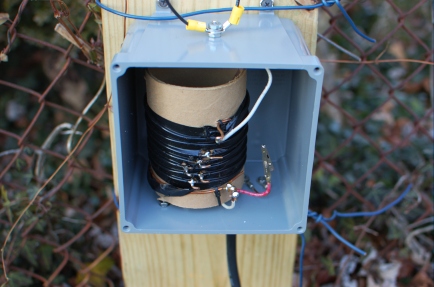
We have a lot of AM broadcast stations in the DC area. And, because of that, antenna analyzers are not always too useful on the low bands. So, knowing already that the antenna was near self-resonance after my K8GU/9 efforts, the first thing I did was just hook the antenna up to a TS-930 and give it a 5-10 watts fed against my nearby 80-meter vertical’s radial field. Sure enough, the VSWR was about 3 at 1.999 MHz and off-scale at 1.801 MHz. So, I inserted the loading coil from the old matching box. The coil is just #14 THHN solid wire in approximately the optimum-Q configuration of diameter to length and wound on a cardboard shipping tube. (As is clear from the photograph, it’s not really pretty nor the lowest-loss possible. But, it was great for what I had on-hand.)
The coil has four taps on it. I clipped the fourth tap, shorting the bottom half of the inductor and did the VSWR sweep, finding a dip at 1.950 MHz or so. Each successive tap brought the minimum lower and lower. With no taps clipped, it was tuned to the bottom of the band. I got lucky (erm, did a lot of tweaking at the previous QTH).
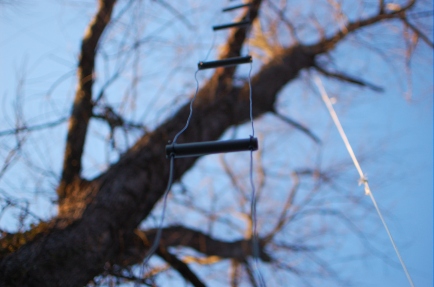
The best news of all of this is that there is enough RF actually being radiated (not just as heat, either!) to make some contacts! Further good news is that even though the antenna is between three and five feet from my 80-meter vertical, with the W3NQN filters, I can operate SO2R on both bands simultaneously. Of course, the RX noise level may just be hiding the trash. I haven’t tried the K9AY because I had that portion of the station torn-up during the conversion of all my DC accessories to PowerPoles and the preamp popped a fuse in my RigRunner when I plugged it back in.
The bottom line is that it’s not a full-sized 4-square, but it gets me on 160 from my lot in a way that’s compatible with my operating style.
Ethan Miller, K8GU, is a regular contributor to AmateurRadio.com and writes from Maryland, USA. Contact him at [email protected].
 Ham Radio Deluxe |
 W5SWL Electronics |
 Ham Radio Prep |
 KB3IFH QSL Cards  Hip Ham Shirts  HamRadioAuctions HamRadioAuctions Reliance Antennas Reliance Antennas Enigma Shop Enigma Shop |  morseDX  Ni4L Antennas  R&L Electronics R&L Electronics antennas.us antennas.us QRV QRV |
- Matt W1MST, Managing Editor
