 |
 Sporadic-E on 6m
 28 January 2011 | by
 The first bit of live data I received from my APRS VHF propagation alert reflector was a warning of a possible Sporadic-E opening on six metres. I was rather surprised that there was Sporadic-E this early in the year, but I went to the DX Sherlock website and sure enough contacts had been reported between a station even further north than here and one in the Czech Republic. I then clicked on the map to see the actual contact details and was surprised to find they were WSPR spots!
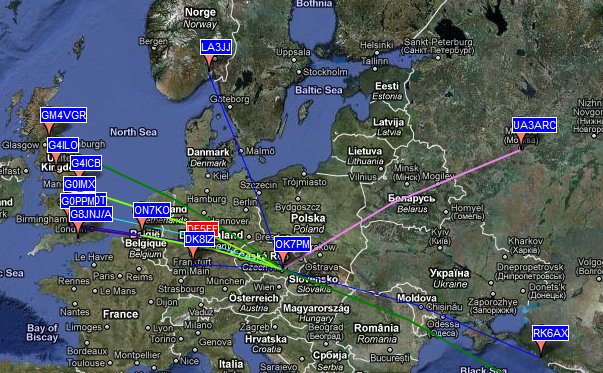
I went to the WSPR website and sure enough the same signals were shown. I decided to fire up WSPR on 6m myself but by then the OK station had gone and no new spots appeared from anywhere.
I have been, and still am, somewhat sceptical of the value of WSPR in showing VHF Sporadic-E propagation. One of the characteristics of Sporadic-E, particularly at the start and end of the season or on the higher frequencies like 2m is that it is very fleeting. A signal can be there for one minute, literally, and gone the next. On the other hand, signals can be really strong when reflected by Sporadic-E. WSPR is designed for detecting weak signals under steady propagation conditions and uses a 2 minute transmit cycle during which the data is transmitted very slowly. It seems to me that what you want to detect Sporadic-E is a mode with short transmit cycles where the data is transmitted quickly, perhaps something more akin to the modes used for meteor-scatter. I wonder if K1JT could come up with something?
Nevertheless I am very interested in anything that helps to detect VHF openings that might otherwise go undetected. I plan on WSPRing more on the 6m band, as long as there are others doing likewise so there is a chance of being received!

Julian Moss, G4ILO, is a regular contributor to AmateurRadio.com and writes from Cumbria, England. Contact him at [email protected].
VHF propagation alerts over APRS
I have just set up an ANSRVR notification group (the APRS equivalent of an email reflector) called CDGVHF. The purpose of the group is to alert interested subscribers in the Cumbria, Dumfries and Galloway area to possible openings on the 6m, 4m, 2m and 70cm bands.
The APRS alerts make use of the email alert service of DX Sherlock which sends alerts of possible band openings customized to the subscriber’s location, based on DX Cluster spots and other reverse beacon information. I have set up a subscription to send alerts of possible band openings workable from the IO84 grid locator to a special email address on the G4ILO’s Shack web server. Using a feature of the cPanel web hosting, the email is “piped” to a script written by me in the PHP language. This extracts the subject header of the email which contains a succinct description of the alert, shortens it as much as possible and then sends it as a message to the CDGVHF ANSRVR group, which then forwards it to all interested subscribers.
Why is this better than just subscribing directly to receive the alert emails? Because I can now receive the alerts on my APRS-equipped hand-held, which should greatly reduce the chance of missing a good band opening because I wasn’t in the shack at the right moment.

Julian Moss, G4ILO, is a regular contributor to AmateurRadio.com and writes from Cumbria, England. Contact him at [email protected].
60m WSPR using 500mW QRP
I have been beaconing WSPR using 500mW all day today. The KAT3 didn’t want to repeat its trick of matching my multi-band dipole so the best SWR I could manage was about 1.8:1. I don’t know how much of the 500mW ended up warming up the ATU or the coaxial feeder.
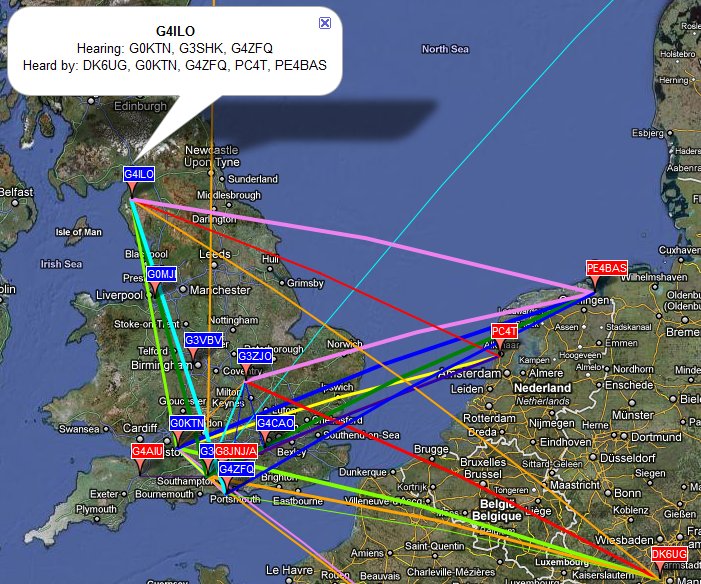
This is a shot of the WSPR propagation map taken just before 1800z today. As you can see, the 500mW is getting out pretty well. I think I have been received by all the G stations that have been monitoring at some time during the day, and a few others. And it was nice to see fellow bloggers Paul PC4T and Bas PE4BAS monitoring even though they can’t transmit on 60m, and better still spotting me!
Just after I posted this, my 500mW was also spotted by LA3JJ!

Julian Moss, G4ILO, is a regular contributor to AmateurRadio.com and writes from Cumbria, England. Contact him at [email protected].
Ice Snake
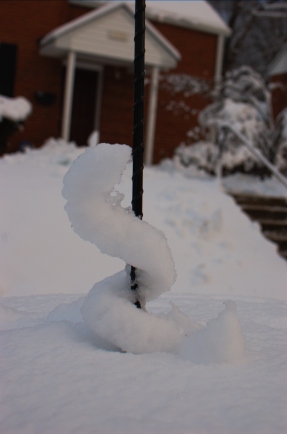
More ice formation on the car—this time on the helical windings of my 40-meter mobile antenna. That ought to tell us something about the structure of ice.
Ethan Miller, K8GU, is a regular contributor to AmateurRadio.com and writes from Maryland, USA. Contact him at [email protected].
Handiham World for 26 January 2011
Welcome to Handiham World!

Can ham radio help promote science education?
Last night many of us watched the proceedings from Washington, DC as Congress and the President gathered for the State of the Union address. I don’t think any of us were surprised to hear some of the comments about how the United States needs to stay competitive in a new world where science, technology, engineering, and math are more important than ever. It seems to be something that everyone can agree on. These four subjects are sometimes referred to by their acronym, “STEM”. There has been much talk lately about how to energize and motivate our young students to learn more science and math, which will ultimately lead to a better understanding of technology and perhaps more students of science and engineering later on down the road. For quite some time now the United States has been importing highly educated scientists. I live in a neighborhood that is close by a well-known Fortune 500 company that employs a lot of scientists. It is no surprise to me that some of them have come from other parts of the world.
“What”, you may ask, “does this have to do with ham radio?”
Well, if you think about it, ham radio encompasses STEM – science, technology, engineering, and math – all in one fun and interesting activity. All of us know that ham radio has many different facets. You can have an interest in public service communications and earn your Technician license in order to participate in the types of communications exercises and responses that serve the public interest. Following 9/11, many people did just that because interest in public service was so strong. That fundamental reason for the existence of the Amateur Radio Service is still there and still attracts and holds many participants.
There are, however, lots of amateur radio operators who simply like to do other things. Some may be interested in just getting on the air to make contacts and make friends in the process. Others may get on the air because they are competitive and like to participate in contests and chase awards. One traditional interest area is in engineering, which will frequently involve designing and building one’s own equipment. It is also necessary to recognize that writing software is another amateur radio activity that holds the interest of a small but important minority. All of us know that every level of the amateur radio licensing process involves learning some science and math. The Extra Class exam takes math understanding to a much higher level than what might be found in the typical population. I guess we could say that ham radio does sometimes serve as an entry point to learning about how science, technology, engineering, and math can be applied to an activity that is both fun and educational. Furthermore, the options for learning in amateur radio are virtually open-ended. I feel that I will never, ever stop learning new things in amateur radio. Because it is a technical activity by its very nature, it will always be evolving and there will always be a necessity to learn about new technologies and the science and engineering that make them possible. In ham radio, I can learn in a “hands-on” way that will reinforce the knowledge and make it more useful to me.
We saw a definite surge in the interest of the general public about amateur radio after the twin towers fell in New York City. Today we face another crisis where our students are falling behind in science and math. Perhaps amateur radio has a role to play in recruiting more people, young and not so young, to learn more about these vital subjects and in the process to make our country and our world a better place. And when you talk about making the world a better place, what could be a better way to start than by communicating via amateur radio worldwide?
One final thought: When I am asked about what I think is the most important thing that I can contribute in my local amateur radio club, my answer is always the same. Teaching. Every time our club holds classes, I volunteer to teach at least some of them. Amateur radio operators who teach in the public schools have even more opportunity than I do to position amateur radio as a fun learning activity. ARRL has long supported outreach to teachers and has many useful resources. If amateur radio can be used to help promote learning in the four STEM topics, it can be one more tool in the successful teacher’s toolbox.
Patrick Tice, WA0TDA
Handiham System Manager
[email protected]
Proposal for a Skype study hall
We have an ongoing need for some kind of forum in which technical assistance or study assistance can be offered to our members. One idea that crossed my mind was to run a Skype conference with up to 10 participants. This would allow a number of people to discuss some topic of interest in a small group setting in a more private forum than one could find on EchoLink, for example. Does anyone out there have any ideas or experience with this kind of a project? I have taken several webinars where we are all connected in a small group audio session. Generally there is also a shared computer screen operated by the presenter of the webinar. I think a Skype audio forum for a small group would work pretty well. We are mainly interested in audio because we will pretty much always have blind participants and would not want to bother showing screens. In order to make this work, participants would have to sign up for a free Skype account and share their Skype contact information with the presenter.
One use for something like this might be to get questions about the remote base stations out there into a discussion group. Participants could discuss any issues they might have and benefit by learning what others have done to get something working. The same could be said about EchoLink or any other technical topic. The thing about a conference like this that is completely different than an e-mail exchange or even two people talking on the telephone is that the conversation is spontaneous and when you put more heads together you are more likely to get a variety of useful and creative responses.
We could probably start with a scheduled conference at a particular time each week and see how it goes. If anyone is interested in this idea and is willing to get in on the ground floor while we test it out, please let me know at [email protected]. Of course we will have to work out details like whether we should start a new Skype account specifically for this purpose and if so, what we should call it. One of the things that has always been true about ham radio is that “hams helping hams” advances our hobby and makes us all feel good. A Skype conference might just be another way to do that.
Tapes reach the end of the line – sort of
This question was put out this morning on the Handiham Radio Club list, but I want to let those of you who are not members of our radio club know what we are discussing. I want to get your opinion on tape cassettes. Over the years we have offered various manuals and other audio books on tape. I’m sure all of you know that the use of cassette tape has gone down each year, and now we are at the point of filling very few member requests for anything at all on cassette tape. We still do have a small but significant number of users who get the monthly magazine digests on tape. Most of our members are able to simply download the material from our website. In fact, prices have not changed for tapes in years. Nancy and I feel that it is time to discourage the use of tape manuals by increasing the price to reflect the fact that these are special order items that must be custom made one at a time. It is no longer the old days when we had bins of instruction manuals on tape and it was simply a matter of picking one out and mailing it. A typical cassette tape manual on a single tape is priced at five dollars, which is the minimum price for a tape order. However, some are three tapes long and sell for six dollars. This amounts to giving them away, considering all of the effort that needs to go into them. (It has never really been about the cost of the tape itself. The work and mailers add most of the cost.)
Can any of you tell me what a similar book would cost from another agency or provider? While we are happy to help folks find what they need in terms of resources, it doesn’t seem fair to put a lot of effort into an old medium like cassette tapes just because a few people don’t want to change to digital.
Thank you for your thoughts on this matter. We look forward to hearing from you. Unless you are replying via the radio club list, you should send me an email. Please don’t just hit “reply” to this message. I get a lot of mail, and I will be watching for an email to [email protected] with Tapes in the subject line. When I get replies to newsletters that are sent via the distribution list, they will probably be last to be looked at, and then only to change subscription properties.

Pat Tice, WA0TDA, is the manager of HANDI-HAM and a regular contributor to AmateurRadio.com. Contact him at [email protected].
Handiham World for 26 January 2011
Welcome to Handiham World!
Can ham radio help promote science education?
Last night many of us watched the proceedings from Washington, DC as Congress and the President gathered for the State of the Union address. I don’t think any of us were surprised to hear some of the comments about how the United States needs to stay competitive in a new world where science, technology, engineering, and math are more important than ever. It seems to be something that everyone can agree on. These four subjects are sometimes referred to by their acronym, “STEM”. There has been much talk lately about how to energize and motivate our young students to learn more science and math, which will ultimately lead to a better understanding of technology and perhaps more students of science and engineering later on down the road. For quite some time now the United States has been importing highly educated scientists. I live in a neighborhood that is close by a well-known Fortune 500 company that employs a lot of scientists. It is no surprise to me that some of them have come from other parts of the world.
“What”, you may ask, “does this have to do with ham radio?”
Well, if you think about it, ham radio encompasses STEM – science, technology, engineering, and math – all in one fun and interesting activity. All of us know that ham radio has many different facets. You can have an interest in public service communications and earn your Technician license in order to participate in the types of communications exercises and responses that serve the public interest. Following 9/11, many people did just that because interest in public service was so strong. That fundamental reason for the existence of the Amateur Radio Service is still there and still attracts and holds many participants.
There are, however, lots of amateur radio operators who simply like to do other things. Some may be interested in just getting on the air to make contacts and make friends in the process. Others may get on the air because they are competitive and like to participate in contests and chase awards. One traditional interest area is in engineering, which will frequently involve designing and building one’s own equipment. It is also necessary to recognize that writing software is another amateur radio activity that holds the interest of a small but important minority. All of us know that every level of the amateur radio licensing process involves learning some science and math. The Extra Class exam takes math understanding to a much higher level than what might be found in the typical population. I guess we could say that ham radio does sometimes serve as an entry point to learning about how science, technology, engineering, and math can be applied to an activity that is both fun and educational. Furthermore, the options for learning in amateur radio are virtually open-ended. I feel that I will never, ever stop learning new things in amateur radio. Because it is a technical activity by its very nature, it will always be evolving and there will always be a necessity to learn about new technologies and the science and engineering that make them possible. In ham radio, I can learn in a “hands-on” way that will reinforce the knowledge and make it more useful to me.
We saw a definite surge in the interest of the general public about amateur radio after the twin towers fell in New York City. Today we face another crisis where our students are falling behind in science and math. Perhaps amateur radio has a role to play in recruiting more people, young and not so young, to learn more about these vital subjects and in the process to make our country and our world a better place. And when you talk about making the world a better place, what could be a better way to start than by communicating via amateur radio worldwide?
One final thought: When I am asked about what I think is the most important thing that I can contribute in my local amateur radio club, my answer is always the same. Teaching. Every time our club holds classes, I volunteer to teach at least some of them. Amateur radio operators who teach in the public schools have even more opportunity than I do to position amateur radio as a fun learning activity. ARRL has long supported outreach to teachers and has many useful resources. If amateur radio can be used to help promote learning in the four STEM topics, it can be one more tool in the successful teacher’s toolbox.
Patrick Tice, WA0TDA Handiham System Manager [email protected]
Proposal for a Skype study hall
We have an ongoing need for some kind of forum in which technical assistance or study assistance can be offered to our members. One idea that crossed my mind was to run a Skype conference with up to 10 participants. This would allow a number of people to discuss some topic of interest in a small group setting in a more private forum than one could find on EchoLink, for example. Does anyone out there have any ideas or experience with this kind of a project? I have taken several webinars where we are all connected in a small group audio session. Generally there is also a shared computer screen operated by the presenter of the webinar. I think a Skype audio forum for a small group would work pretty well. We are mainly interested in audio because we will pretty much always have blind participants and would not want to bother showing screens. In order to make this work, participants would have to sign up for a free Skype account and share their Skype contact information with the presenter.
One use for something like this might be to get questions about the remote base stations out there into a discussion group. Participants could discuss any issues they might have and benefit by learning what others have done to get something working. The same could be said about EchoLink or any other technical topic. The thing about a conference like this that is completely different than an e-mail exchange or even two people talking on the telephone is that the conversation is spontaneous and when you put more heads together you are more likely to get a variety of useful and creative responses.
We could probably start with a scheduled conference at a particular time each week and see how it goes. If anyone is interested in this idea and is willing to get in on the ground floor while we test it out, please let me know at [email protected]. Of course we will have to work out details like whether we should start a new Skype account specifically for this purpose and if so, what we should call it. One of the things that has always been true about ham radio is that “hams helping hams” advances our hobby and makes us all feel good. A Skype conference might just be another way to do that.
Tapes reach the end of the line – sort of
This question was put out this morning on the Handiham Radio Club list, but I want to let those of you who are not members of our radio club know what we are discussing. I want to get your opinion on tape cassettes. Over the years we have offered various manuals and other audio books on tape. I’m sure all of you know that the use of cassette tape has gone down each year, and now we are at the point of filling very few member requests for anything at all on cassette tape. We still do have a small but significant number of users who get the monthly magazine digests on tape. Most of our members are able to simply download the material from our website. In fact, prices have not changed for tapes in years. Nancy and I feel that it is time to discourage the use of tape manuals by increasing the price to reflect the fact that these are special order items that must be custom made one at a time. It is no longer the old days when we had bins of instruction manuals on tape and it was simply a matter of picking one out and mailing it. A typical cassette tape manual on a single tape is priced at five dollars, which is the minimum price for a tape order. However, some are three tapes long and sell for six dollars. This amounts to giving them away, considering all of the effort that needs to go into them. (It has never really been about the cost of the tape itself. The work and mailers add most of the cost.)
Can any of you tell me what a similar book would cost from another agency or provider? While we are happy to help folks find what they need in terms of resources, it doesn’t seem fair to put a lot of effort into an old medium like cassette tapes just because a few people don’t want to change to digital.
Thank you for your thoughts on this matter. We look forward to hearing from you. Unless you are replying via the radio club list, you should send me an email. Please don’t just hit “reply” to this message. I get a lot of mail, and I will be watching for an email to [email protected] with Tapes in the subject line. When I get replies to newsletters that are sent via the distribution list, they will probably be last to be looked at, and then only to change subscription properties.
Pat Tice, WA0TDA, is the manager of HANDI-HAM and a regular contributor to AmateurRadio.com. Contact him at [email protected].
First emissions on 60m
On looking through the mail at lunch time I saw that I had received a letter from Ofcom. My NoV permitting me to operate on the 60m experimental band had arrived!
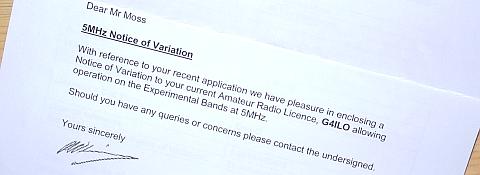
Until now I hadn’t been bothered about operating on 60m because I couldn’t see how I could possibly find room for an antenna for that band. However a couple of weeks ago I heard someone activating a SOTA summit in the Lake District on 60m and was frustrated that I could not reply to them. So I decided to put in an application for permission to operate and here I am.
I don’t have an antenna that is resonant on 60m so I tried tuning up my multiband dipole using the K3 auto ATU. After a lot of persuasion it managed to find an acceptable match on the higher frequency channels but it gave up on the lower ones. So I should be able to manage some activity on the new band.
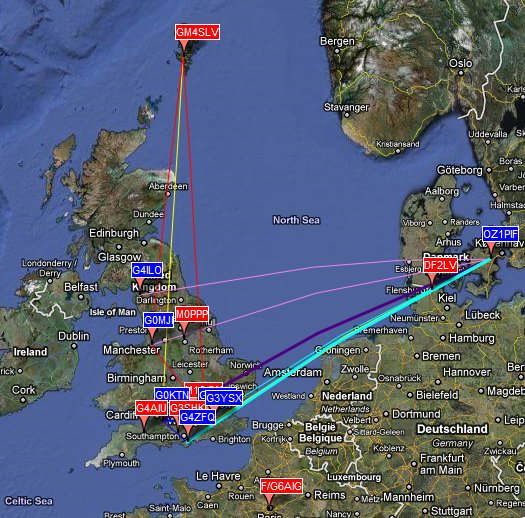
Fortunately, the channel allocated for beacon and WSPR use is one of the ones I was able to match. And today just happened to be a 60m WSPR activity day. So I fired up the WSPR software and beaconed on 60m using 2 watts, increasing to 5 watts in the evening when propagation went long and most of the traces faded out. The 5 watts did me no good at at all, but my 2 watt signal was heard by 7 different G stations all around 400km distance from me plus F/G6AIG at 760km. I received 6 different G stations including G4ZFQ at 458km running 20mW, plus OZ1PIF (my best DX at 984km) and LA3JJ.
Tomorrow is QRP day on 60m when everyone is supposed to run 500mW or less. I have not decided yet how little power I will run but I will be WSPRing on 60m all day. Hopefully there will be a few more people who manage to spot me.

Julian Moss, G4ILO, is a regular contributor to AmateurRadio.com and writes from Cumbria, England. Contact him at [email protected].
 Ham Radio Deluxe |
 W5SWL Electronics |
 Ham Radio Prep |
 KB3IFH QSL Cards  Hip Ham Shirts  HamRadioAuctions HamRadioAuctions Reliance Antennas Reliance Antennas Enigma Shop Enigma Shop |  morseDX  Ni4L Antennas  R&L Electronics R&L Electronics antennas.us antennas.us QRV QRV |
- Matt W1MST, Managing Editor
