 |
 D-STAR one route for traffic into Christchurch, New Zealand
 26 February 2011 | by
New Zealand flag (from Wikimedia Commons)
Tonight, before heading home I dropped by the VA3CUA station at the University where I work. I used the Icom ID-1 to link the 1.2GHz module of VA3ODG to reflector REF003C, an Australian reflector. Linked also to the reflector was the repeater ZL1VHD in Auckland, New Zealand. After making a call out on the reflector I had a reply from Marlene, ZL1MYL. We had a nice but brief chat and she told me that there had been messages passed through the Auckland D-STAR repeater for people in the earthquake damaged city of Christchurch. Messages received were being relayed on via other modes on VHF to Christchurch, as that city does not have a D-STAR repeater. The chat with Marlene was short as she had to take a phone call, but I did then talk to her husband Laurence, ZL1ICU.
Later tonight I saw the message from the ARRL that confirms that 2m is being used to support the recovery efforts and currently not HF.
If you have traffic for someone in Christchurch then one possible route in is via the Auckland D-STAR repeater ZL1VHD.


Alan Steele, VA3STL, is a regular contributor to AmateurRadio.com and writes from Ottawa, Ontario. Contact him at [email protected].
An FM/AM/SSB handheld for 10 and 12m
I love handheld radios. The “holy grail” for me is to make long distance contacts using a handheld radio with attached antenna. Ten metres is probably the best band to achieve this. Six metres might give stronger signals when conditions are right but it is open too rarely. Lower frequencies are open more often but a practical hand-held antenna is too short and inefficient for voice contacts using low power to be possible. You can put up a ground mounted vertical or hang a dipole in the trees but then it isn’t portable.
Last year I got an Intek H-520 which I used on 10m FM but although I did make some nice contacts with it I was disappointed with the radio itself. It was very power-hungry for 6 NiMH AA cells to the extent that the radio would shut down when used on maximum power unless the batteries had just been charged up. There is another problem with 10m FM in general which is that there are not all that many channels. There is a lot of QRM when the band is open, you are competing with people running a lot more than 4W to a whip antenna and in the FM mode “capture effect” means the strongest signal wipes out all others. So when I saw that a multimode handheld including SSB and covering both the 10m and 12m amateur bands was available, I decided that this was the toy for the forthcoming summer months. SSB offers the chance for some exciting handheld contacts.

The Albrecht AE2990AFS is a multimode multi-standard CB handheld radio that is readily configurable for amateur band use. There are instructions on the web and even a YouTube video on how to do the modification but the supplier included a printed copy in the box. Briefly, you pull out the rubber PTT cover which reveals five contacts next to the PTT switch. Using a soldering iron and solder wick you remove a bridge between two contacts (preferably without touching the hot solder wick on the case and melting it like I did!) then you short out two other contacts while turning the radio on. You can then choose various channel options including three for hams: Code 0 (10m + 12m switching between them using the CH9 button), Code 1 (10m band only with home frequencies 29.300 and 29.600 selected using CH9) and Code 2 (12m band only.) I chose Code 0 to get the benefit of two amateur bands.
No batteries are supplied and no charger either. The lack of a charger is a bit annoying as the charger socket is a fairly small barrel type that isn’t easily obtainable (even after you’ve guessed the dimensions.) The battery pack takes 9 NiMH AA cells and has contacts on the bottom. A drop-in charger is available as an optional extra. I will probably make one as I did for the old TH-205E. But first I have to establish what the charging voltage is. The box the radio came in suggests the charger/DC socket on the side of the battery pack takes 12V. You can certainly run the radio off that, but when it is switched off it draws no current. It looks as if you would have to crank the voltage up to about 18V to charge 2400mAH NiMH cells at 240mA, which would probably have dire consequences if you switched the radio on with the charger connected. But with the lack of propagation on 10 and 12 metres I probably have a few weeks to figure it out.
The antenna supplied is about 8 inches long. I checked it using my antenna analyzer and was pleased to find that it was resonant on 28.5MHz with quite a sharp SWR curve. However such a small antenna is probably little better than useless for making contacts over more than a few miles. I have a 45in telescopic 10m antenna and that is what I plan to use with this radio.
The Albrecht AE2990AFS is ready for the new European harmonized CB frequency allocation (which the UK wants to opt out of) so the output is rated at 4W on FM and 4W PEP on SSB. The actual power measured on 10m FM from this radio was only 2.13W. This is similar to what I found with the Intek H-520. With the Intek I was able to get inside, find the power adjuster and tweak it up to 4W. That’s when I discovered why it had been set lower in the factory – the current draw at 4W is just too high for many AA rechargeables to sustain. Most CB users would never know their radio was giving less power than claimed because they have nothing to measure it with, so they would never complain. If it cut out whenever they press the PTT then they would. We hams complain that our radios are expensive but they are built to a higher standard than CB radios. You get what you pay for.
With its 9 cell battery pack the Albrecht doesn’t need to draw so much current as the Intek for the same power. While it was on the bench power supply I measured the current draw on FM “high power” (2W) as 800mA. On the low power position which is meant to be 1W but was actually 0.51W the draw was 500mA. Unlike the Intek there is a “warranty is void if you remove this” sticker over the two halves of the case so I can’t delve inside undetected. As I have heard of people who bought similar radios under other brand names which broke and had to be returned under warranty I don’t want to void it, so I’ll have to live with 2W output, at least until next year.
On SSB the modulation out of the box was almost nonexistent. This is dependent on the mic gain setting, which can be adjusted from the front panel. After increasing it the SSB modulation was much improved and although I don’t have a peak reading meter the average level gave me to believe I was getting 4W PEP.
The audio on SSB sounded clean but if you increase the mic gain in order to get reasonable talk power there is noticeable frequency modulation on the signal. I am guessing that the battery voltage sags a bit on speech peaks and this pulls the local oscillator. I had read about this issue in some forums discussing the other incarnations of this radio and someone stated that in the Albrecht versions this problem had been fixed. It appears this may not be the case. I doubt that the fault would make the audio unreadable but I would expect to receive comments about it.
I recorded a number of audio samples at different mic gain settings for comparison. You can hear the FM increase on voice peaks as the mic gain increases.
- Albrecht AE2990AFS SSB audio – mic gain 7
- Albrecht AE2990AFS SSB audio – mic gain 8
- Albrecht AE2990AFS SSB audio – mic gain 9
- Albrecht AE2990AFS SSB audio – mic gain 10
- FT-817 audio (for comparison)
When configured for ham band use the radio displays frequency as you would expect. The display has an attractive blue backlight. Tuning is by up/down buttons at the side. There is an annoying beep at every button press, but this can easily be silenced. The standard tuning step is 10kHz which is a bit large for convenient band scanning. You can change the step size for fast or slow tuning – the steps are 100kHz, 10kHz and 500Hz. The 500Hz step size is still a bit large for satisfactory SSB tuning. There is a clarifier control but it works on receive only. So some people you call will complain you are off frequency.
There are five memory channels which store frequency and mode, so you can switch quickly between FM and SSB calling frequencies for example. You can select a shift or offset of up to 990kHz for repeater use. There is also a CTCSS tone for repeater access, but the manual implies it is a fixed 88.5Hz tone which (apparently) is used by 10m repeaters in the USA. This is straight from the manual – I can’t vouch for it.
With the lack of any propagation on 10 or 12 metres I obviously haven’t had a chance make any contacts with the radio or evaluate the receiver sensitivity. The RF gain and squelch sensitivity can also be adjusted from the front panel in the same way as the mic gain. There is even a roger beep!
So there you have it. The below-specification power and FM-y SSB audio are fairly major faults, all things considered. But the Albrecht AE2990AFS is the only true handheld SSB-capable radio for any amateur band currently available. If that’s what you want, it’s your only option.

Julian Moss, G4ILO, is a regular contributor to AmateurRadio.com and writes from Cumbria, England. Contact him at [email protected].
Unreliable connection
The webmaster of Summits On The Air kindly gave me permission to access the SOTA Spots RSS feed from the Wainwrights On The Air website so that spots for SOTA summits that are also Wainwright summits can automagically appear in the WOTA system. I started work on that the day before yesterday. I also noticed that APRS objects for the position of Mads, M/LA1TPA/P, were not appearing because the length of his call exceeded the maximum length of an APRS object name. I implemented a fix for that by lopping off the /P if the name would exceed 9 characters. Yesterday morning I did not receive any SOTA alerts over APRS at all so I wondered if I had broken something.
It didn’t help that I had trouble accessing aprs.fi to see whether the APRS spots were getting out. That might have given me a clue as to where the problem lay. As it was, it took quite a lot of time before I realized that the problem was my internet connection. Although the ADSL was up and working, I was having trouble connecting to various sites including the APRS-IS Tier 2 servers and packets were being lost along the way.
This forced me to address another problem. Currently all the APRS packets are sent by the WOTA website calling a file on a web server running on a network attached storage (NAS) backup device running in G4ILO’s shack which is actually a little Linux computer that runs Apache. This server hosts the script that sends the packet to the APRS network. I had tried running the script on the WOTA web server itself but it hadn’t worked and I didn’t know why so I decided to go for the path of least resistance since life is too short for making computers work the way I want them to.
Apart from the problem of connectivity with this solution there is also one of continuity. I don’t like to run computers 24/7 because it adds a significant amount to an electricity bill that is already high due to the fact that there are two people using even more computers and equipment home all day. Also, Olga is not happy about leaving any equipment running when we go away. Whilst it is unlikely that anyone will activate summits in the middle of the night they are certainly going to do so while we are on holiday. So I really need to send the APRS alerts entirely from the web server.
After another couple of hours of getting nowhere I filed a support ticket with the web hos. They replied that they block port 8080 which is the one used to post APRS packets to the network using HTTP. When you are paying $8 a month for web hosting there is a limit to the amount of help you can expect particularly when it comes to changing the configuration of the server (which no doubt hosts hundreds of sites) just for my convenience. The last reply said “please try now” but I did and it still didn’t work. So it looks as if I might have to live with having APRS spot functionality that goes QRT when we are on holiday.
Meanwhile I am waiting for someone to activate a SOTA summit in the Lake District so I can see whether my script to check the SOTA spots RSS file is doing what it supposed to.

Julian Moss, G4ILO, is a regular contributor to AmateurRadio.com and writes from Cumbria, England. Contact him at [email protected].
First 12m contact in a long time

Grand Cayman (photo by NASA)
On Wednesday I was working from home and took a little time on the K3 during a break. On 15m I heard a strong signal from ZF2UL who was making North American contacts one after the other. Bob, ZF2UL, then said they were going on to the 12m band and gave the frequency they were QSYing to. I followed and continued listening. After a short run of QSOs there was a brief hiatus in the replies to “QRZ?”, at which point I called with my 10W on SSB. I soon obtained a reply and a 55 report and my first contact with Grand Cayman was logged.
Good to see the higher frequency HF bands are opening up more regularly. It has been a long time since I made a contact on 12m.


Alan Steele, VA3STL, is a regular contributor to AmateurRadio.com and writes from Ottawa, Ontario. Contact him at [email protected].
And now it’s off again….MB7FM off air
The Tring ‘parrot’ repeater has been quite handy for testing the MyDel-5189 70MHz rig that I’m currently reviewing. Tried to call it up on Tuesday evening without any success, so I wondered if the aerial had fallen off, but I was still able to work some local stations at the usual signal strength.
I checked with Selim, 2E0CKF in London to see if he was hearing MB7FM and he wasn’t either. So looks like there’s a problem.
Hopefully MB7FM will be back again before long – it’s a nice aid to 70MHz FM activity in the South-East. In the meantime, it’s always good to make simplex QSOs, in any case.

Tim Kirby, G4VXE, is a regular contributor to AmateurRadio.com and writes from Oxfordshire, England. Contact him at [email protected].
Handiham World for 23 February 2011
Welcome to Handiham World!
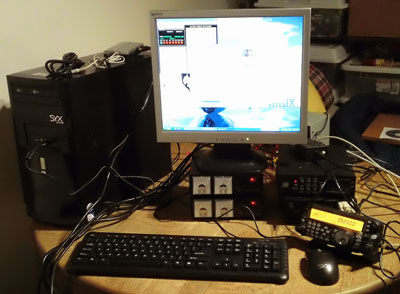
Last week was pretty busy and included a painful and inconvenient fall on the ice, so I was really late with the usual Technician Class audio lecture, which finally came out yesterday. We have only the final safety lecture to finish this week, then the Tech class is completed, aside from some possible review lectures. Lyle, K0LR, and I have been working on the remote base station. As we reported earlier, the W0ZSW remote went silent at Camp Courage when a router failed. The Echolink system continued to work, but the W4MQ remote control interface did not. I have been intending to put a new station into service anyway, and had done the preliminary setup at Camp Courage. The old TS-570 station did not support audio frequency announcements for our blind members, and the old computer was sometimes a bit sluggish. The new station features a Kenwood TS-480HX with the VGS1 voice chip and a Systemax computer from TigerDirect that is well-resourced and speedy. An LDG AT-200 Pro autotuner does the job of matching, and twin SEC 1235M switching supplies power the 200 Watt station. The rig to computer sound interface is a RIGblaster Nomic. Those of you who have compared the two Kenwood radios know that the HX model runs 200 watts but does not include the internal automatic antenna tuner. The HX mode l also requires a much larger power supply than does the 100 watt SAT model. In this case, we are using two switching power supplies, as is recommended in the manual. Only one of these supplies would have been required for the 100 watt radio. There definitely are some choices to make when deciding to buy one radio or the other. Operation and rig control through software is otherwise pretty much identical whether one uses the HX or the SAT models. Outside the shack, you have to make sure that your feedline, any baluns or other matching devices and accessories, and your antenna can all handle the higher power.
Lyle and I began putting the project together months ago, but it stalled after I did a preliminary setup on Nancy’s desk at Handiham headquarters. The idea was to set the new station equipment up in parallel to the old station, which would allow us to initially do testing with little or no interruption to the existing station. The problem was that I got really busy, making it difficult to devote time to testing the new station and getting the equipment to work the way we wanted. Every time I went to the office, something new would come up. The project sat and sat. Then a router failed at the main camp Internet distribution point. The station was inaccessible via the Internet, so we shut it down and I got serious about testing the new equipment, which I packed up and brought to our secret, undisclosed testing location. (Hint: It’s really close to my QTH.)
Last weekend proved to be pretty productive, and Lyle and I made some good progress. The station is now up and running during daylight hours (approximately 7:00 to 22:00 hours USA Central Time.) Users must visit the W0ZSW setup pages again and re-enter the IP address information for W0ZSW only. We would appreciate feedback from users. You will notice immediately upon connecting that the VGS1 voice module is now enabled and providing voice frequency readout. The antenna currently in use is a crummy Windom that doesn’t tune on all bands. Checking into PICONET on 3.925 MHz is pretty easy, though. Transmit is disabled on 160 m, where the antenna cannot tune. All of this will be fixed once the station is moved back to its regular location at Camp Courage when the router out there is replaced.
Remote base users who are already registered but who need a link to the W0ZSW setup pages may email me. (The links are available in the members section of the website.) Use of the stations is a member service that is not open to the public.
One other consideration: W0ZSW Echolink receive, which is open to any licensed amateur, is working intermittently due to a port forwarding issue. The W0EQO-L Echolink control is working well and should be used instead.
Oh, and be careful on the ice. The combination of a low coefficient of friction and gravity almost did me in, but I’m feeling great now, thank you very much. Spring can come anytime, though.
Patrick Tice, WA0TDA
Handiham System Manager
[email protected]

Pat Tice, WA0TDA, is the manager of HANDI-HAM and a regular contributor to AmateurRadio.com. Contact him at [email protected].
Another Notcom opt-out
A few weeks ago the European Union’s Frequency Management Working Group agreed a harmonized specification for Citizens’ Band Radio across Europe to include AM, FM and SSB modes. It will now go to public consultation before being passed to national governments to become law. However Ofcom, the radio regulatory authority in the UK, is expected to live up to its nickname of Notcom by saying “no” to allowing AM and SSB, claiming there is a potential for harmful interference to other services. How absurd!
Now some readers may be wondering why a ham radio blog is concerning itself with whether CB users should be allowed to use the AM and SSB modes. After all, if they want to use those modes they could just get a ham radio license, surely? The test is so easy even a child could pass it, and many do. So what’s to complain about?
But that isn’t the point. The point is this is one more example of how we in Britain always seem to get the mucky end of the stick when it comes to European legislation. We’re told we can’t opt out of European human rights law that seems to attach more importance to the rights of criminals, rapists, murderers and paedophiles than their victims. But when it comes to something as unimportant as giving a few hobbyists the right to use the same modes as their counterparts across the North Sea, opt out we can. Are we in Europe or aren’t we?
If allowing CBers the use of AM and SSB isn’t a problem for the rest of Europe then it isn’t going to be a problem in the UK. If there was “a potential for harmful interference to other services” then that would surely have been proven by now, since there are plenty of people illegally using SSB on 27MHz already. How many people have been caught and prosecuted for using SSB on 27MHz? Hint: it’s a very round number. And if there is a risk of harmful interference to other services from allowing people to use 12W of SSB on 27MHz, why is there no risk from allowing hams to use 400W a few hundred kHz higher?
There is no sound basis for preventing British CBers from enjoying the same frequencies and modes as their counterparts in the rest of Europe, just as there is no sound basis for restricting the use by British radio amateurs of digipeaters and internet connected nodes. It is about time we had a more open regulatory system in this country so that radio users cannot be denied something for false or risible reasons.

Julian Moss, G4ILO, is a regular contributor to AmateurRadio.com and writes from Cumbria, England. Contact him at [email protected].
 Ham Radio Deluxe |
 W5SWL Electronics |
 Ham Radio Prep |
 KB3IFH QSL Cards  Hip Ham Shirts  HamRadioAuctions HamRadioAuctions Reliance Antennas Reliance Antennas Enigma Shop Enigma Shop |  morseDX  Ni4L Antennas  R&L Electronics R&L Electronics antennas.us antennas.us QRV QRV |
- Matt W1MST, Managing Editor
