 |
 Handiham World for 2 March 2011
 2 March 2011 | by
 Welcome to Handiham World!
Lyle, K0LR, and I have made really good progress with the W0ZSW remote base beta test, so this afternoon the station will go off the air as I prepare to transport it to its new location at Camp Courage. We still have a few problems to iron out, so the old TS-570SAT will probably have to go back on the air for a while.
When I get out to camp tomorrow, I will be working to get the network problem repaired. After that, we can get the TS-570 back on line and into service for our members. Now, you must be wondering what issues still remain with the TS-480HX setup, right?
Well, there are several:
 | The TS-480HX is, of course, the 200 Watt version of the popular TS-480 series by Kenwood. Most users opt for the SAT version, which runs 100 Watts. We figured that the 200 Watt version would add some extra punch to the signal, and it would be especially useful in the summertime when interference levels from summer thunderstorms around the country are higher. The problem is that the W4MQ rig control software keeps dropping the power level back to 100 Watts. Of course this is not a deal-killer, since the 3 dB drop in signal strength is not going to be a problem most of the time. I have posted the issue on the N2JEU remote base development website in hopes of getting some help with this issue. |
| The receiver audio equalization always defaults to “high boost”, which makes the sound a little on the screechy side for my taste. Those with hearing deficits may prefer the high boost, though, so this is not necessary a bad thing. To get a mellower sound you have to change the receiver equalization to “normal” after logging in. When you log out, it returns to the default “high boost” setting. We would prefer that it worked the other way around, where the normal audio setting would be the default. |
| The radio is supposed to turn off shortly after the control software on the host machine is disconnected from the W4MQ interface by the control operator’s log off. Instead, the radio may indeed turn off, but it always turns itself back on after about a minute even though no one is using it, whether through the W4MQ software or to listen to the receiver via Echolink. This is a bit of a headache, because we would rather the radio were off when not being used. Left to its own devices, the radio will run 24/7. This problem seems unique to our new beta test setup since we don’t have any problem with the W0EQO station or the old W0ZSW station using the TS-570SAT. |
Those are the main concerns with the new system. As you can tell, since the radio and computer are actually working quite well otherwise, we could put the station on the air any time. Still, I’d rather try to get things working just a little better and have the system the way it should be as we “go live” so to speak.
If I am unsuccessful getting the network problem resolved, W0ZSW will be offline for a while but hopefully the Echolink receive function will still be enabled through a proxy server.
I provide a short overview video of the W0ZSW remote base beta test on YouTube. Look for WA0TDA’s channel.
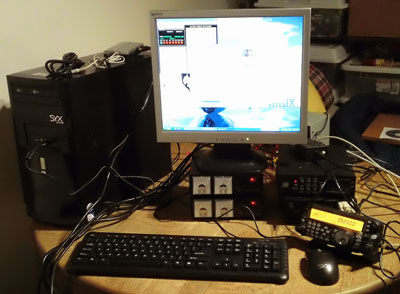
Photo: The W0ZSW beta station as featured on YouTube.
Patrick Tice, WA0TDA Handiham System Manager [email protected]

Pat Tice, WA0TDA, is the manager of HANDI-HAM and a regular contributor to AmateurRadio.com. Contact him at [email protected].
LHS Episode #057: Fumbling Your Foo Dog
 In this very late episode, Linux in the Ham Shack gets back to some basics. For those listeners who haven’t been around ham radio that much, we take a look at some of the basic concepts of radio communication. Then, we get all up in arms about how long our…antennas are. Explore with us some of the concepts of antenna modeling, different types of antenna design and what they’re good for, and some software that might help you make sense of Smith Charts. As if that isn’t enough, we through in some good-natured ribbing, feedback from our listeners and a whole heap of fun. Tune in and let your worries disappear. LHS Top Tip: Don’t fumble your foo dog too hard, it might go off prematurely.
73 de The LHS Guys
Russ Woodman, K5TUX, co-hosts the Linux in the Ham Shack podcast which is available for download in both MP3 and OGG audio format. Contact him at [email protected].
Foiling the copper thieves
The price of copper has risen by 300 percent over the last two years. Other metals have also risen in value. According to GB2RS News, this is making radio amateurs targets for copper thieves. An amateur in Yorkshire had all his cabling stolen including the coax and ladder line for his G5RV antenna.
I presume the action of an irate neighbour fed up with receiving TVI has been ruled out. The RSGB is encouraging amateurs to make sure access to cables is restricted and that their installations are as secure as possible. Looks like another benefit of stealth operation and attic antennas!

Julian Moss, G4ILO, is a regular contributor to AmateurRadio.com and writes from Cumbria, England. Contact him at [email protected].
Back to the drawing board
The weather forecast wasn’t promising, even though the morning was fine. But I was keen to get out on the fells. Yesterday I spent a couple of hours making an antenna specifically for Wainwrights On The Air operating and I wanted to try it out. So I headed for Broom Fell, LDW-169.

I’d had the idea for this antenna for a couple of years but hadn’t got around to making it. I was going to call it the WOTA Pole. As, for reasons I will come to, I’m unlikely to be publishing a detailed description of it, I’ll give you the outline of it now. It’s a Slim Jim made from 300 ohm flat ribbon cable, housed in a tube made of white UPVC electrical conduit. The tube breaks down into four sections for easy carrying using UPVC jointing pieces. It’s a similar idea to the SOTA Beams MFD except that is a half wave dipole and has a T piece with a coaxial balun and can be used vertically or horizontally. The Slim Jim should theoretically have some gain over the dipole but it can’t be used horizontally, which is no disadvantage as 99% of WOTA activating is done on FM.
One reason I haven’t used the MFD very much is the difficulty in deploying it. The antenna is provided with two velcro straps so it can be attached to a convenient fence post. Unfortunately our hilltops don’t often have convenient fence posts on the summit. My intention with the WOTA Pole had been to stuff the antenna in my rucksack for support so the radiating element would be above head height. Unfortunately UPVC jointing pieces aren’t very strong and it’s impossible to lift a rucksack onto your back whilst keeping a 2 metre long antenna perfectly vertical to minimize the strain on the joins. As I lifted it up I heard a crack and the antenna fell to pieces!
I didn’t see any damage. It was quite windy up there and I thought the culprit was the wind, plus perhaps I hadn’t pushed the jointing pieces tightly enough together. So instead I decided to strap the antenna to a convenient fence post which fortunately Broom Fell just happened to be equipped with right by the summit cairn. You can see the result in the photo. Lords Seat is the fell on the right in middle distance, with the Skiddaw range further away on the left.
Sunday lunchtime is not the best time to go WOTA activating. I think many chasers are busy filling themselves with roast beef and yorkshire pudding and nowhere near their radios. However Colin 2E0XSD was on frequency having been following my progress via APRS. He gave me a 59 plus report on the new antenna. After a couple of fruitless CQs I started to think that was going to be the lot, then Geoff GM4WHA came up, followed by Malcolm M0XAT. Then no-one. As the wind was bending the WOTA Pole rather a lot I took it down. I then tried a couple more calls using a helical antenna and got Mark MM1MPB and Tony G1OAE. Finally Colin 2E0XSD came up again to say I was only 4 by 3 on the helical antenna. The WOTA Pole had made a huge difference. It’s just a pity there hadn’t been anyone further afield listening at the time.
I walked down the hill a short way to get out of the wind and have the sandwiches and coffee that Olga had made for me. While I was down there I thought I would have another try at hoisting the antenna on to my back in the rucksack. Then I noticed that one of the UPVC jointing pieces – the one at the top of the lowest tube that takes most of the strain – had cracked. When I tried to get it aloft a piece broke away completely and the antenna fell to the ground. Another idea bites the dust. Literally!

On the way down I was pondering what I could do to make this idea work. Clearly the Slim Jim itself performed very well. In fact if anything it worked a bit too well on receive. The VX-8GR receiver exhibited clear signs of overload. I’d noticed this before when I’d used that radio with the MFD. I should really use the Motorola GP-300. Ironic that a radio that cost me £1 at a rally works better than a fancy Yaesu costing more than £300!
The problem with my WOTA Pole idea is the mechanical design. If I’d made the tube two one metre pieces instead of four 50cm lengths it would be stronger. But having something sticking 50cm above the top of my rucksack would be a nuisance when walking under low branches or ducking under fallen trees as I actually had to do on this walk.
Perhaps I should give up the idea entirely and try to make a rucksack mount for BNC fitting antennas. Then I could use the telescopic 5/8 wave that I usually use on less windy days fitted directly to the radio. What do you think?

Julian Moss, G4ILO, is a regular contributor to AmateurRadio.com and writes from Cumbria, England. Contact him at [email protected].
RYRYRY O RLY?
A few readers of this blog may have been surprised to contact me on a new mode last night…RTTY. I’ve tried radioteletype once before in the past (also in the NAQP contest) but rather unsuccessfully the first time. The second outing was a bit better. I suppose with practice it becomes fun, but the primary motivation here is ARRL’s Triple Play award for contacting all 50 states each three times, using CW, SSB, and digital. CW was, of course, easy. And, I’m making good progress on the SSB totals. So, I figured I would stop putting RTTY off and give it a shot.
As you are probably well familiar, I normally contest with two TS-930s. Their prior owners (who were CW contest/DX types like myself) made various “improvements” to them, most of which I appreciate, but I have no idea how they affect FSK. One radio simply does not work on FSK (need to look into this) and the other has the passband shifted about 50-100 Hz off-center of the normal RTTY frequencies. So, when I was running AFC in MMTTY, it would “walk” to the point that having a lock on the other station would put me at the edge of their passband. I had a terrible time making QSOs for the first hour until K0TI told me I was off-frequency (thanks, Dan!!!) and then I started paying attention to all of the numbers in MMTTY and turned off the AFC, which had some deleterious effects that I overcame thanks to the occasional repeat. Typical analog op becomes digital lid op.
I sent the MacBook (our “home” computer) with Sarah to a conference yesterday. Since that’s the only place I have LoTW’s Trusted QSL installed and I failed to export a .p12 file, I’ll have to hold tight for a couple of days until they return. (This is not entirely true, I have an old .p12 file, but I haven’t backed it up again since I renewed the certificate a few weeks ago. Bad backup practices…although I just got a new external drive so the old drive can be used to do a Time Machine back up…finally. Another day, another project.)
This post mostly mirrors my 3830 post, but here are the numbers for the curious. My grepping missed one QSO on 80 meters when I did the totals (N1MM rounded the frequency up to 3600 kHz) for 3830. So, these numbers are right, aside from log-checking discounts:
Call: K8GU
Operator(s): K8GU
Station: K8GU

Class: Single Op LP
QTH: MD
Operating Time (hrs): ~3

Summary:
 Band  QSOs  Mults
-------------------
   80:   37    21
   40:   58    27
   20:   35    18
   15:
   10:
-------------------
Total:  130    66  Total Score = 8,580

Club: Potomac Valley Radio Club

Team: PVRC #1
Ethan Miller, K8GU, is a regular contributor to AmateurRadio.com and writes from Maryland, USA. Contact him at [email protected].
ICQ Podcast S04 E05 – Portable Power (27 February 2011)
Series Four Episode Five of the ICQ Amateur / Ham Radio Podcast. News Stories include:
- NZ proposes changes to 27 MHz band
- Ham Radio promoted on TV in New Zealand
- New country added to CEPT reciprocal agreement
- New SA amateur radio regulations
- 1st Portuguese DStar reflector
- RSGB looking for EMC volunteer
- RSGB AGM to be held in Derby
- Revalidating UK Amateur Radio Licence
- Radio-active solar flare
- UK Six Metre Group launch newsletter
- Data across the Atlantic on 502kHz
Your feedback, upcoming events, Ed Durrant's (VK2ARE) VK report and Martin (M1MRB) features portable power.
Colin Butler, M6BOY, is the host of the ICQ Podcast, a weekly radio show about Amateur Radio. Contact him at [email protected].
ICQ Podcast S04 E05 – Portable Power (27 February 2011)
Series Four Episode Five of the ICQ Amateur / Ham Radio Podcast. News Stories include:
- NZ proposes changes to 27 MHz band
- Ham Radio promoted on TV in New Zealand
- New country added to CEPT reciprocal agreement
- New SA amateur radio regulations
- 1st Portuguese DStar reflector
- RSGB looking for EMC volunteer
- RSGB AGM to be held in Derby
- Revalidating UK Amateur Radio Licence
- Radio-active solar flare
- UK Six Metre Group launch newsletter
- Data across the Atlantic on 502kHz
Your feedback, upcoming events, Ed Durrant's (VK2ARE) VK report and Martin (M1MRB) features portable power.
Colin Butler, M6BOY, is the host of the ICQ Podcast, a weekly radio show about Amateur Radio. Contact him at [email protected].
 Ham Radio Deluxe |
 W5SWL Electronics |
 Ham Radio Prep |
 KB3IFH QSL Cards  Hip Ham Shirts  HamRadioAuctions HamRadioAuctions Reliance Antennas Reliance Antennas Enigma Shop Enigma Shop |  morseDX  Ni4L Antennas  R&L Electronics R&L Electronics antennas.us antennas.us QRV QRV |
- Matt W1MST, Managing Editor
