 |
 Time to ditch Dimension 4
 17 April 2011 | by
 Digital modes such as WSPR and JT65A are time-synchronous and require the computer clock to be accurate to within a second. New users frequently don’t realize this and find that they aren’t decoding any signals. When they go to a forum for advice they are inevitably advised by well-meaning helpers to run a bit of software called Dimension 4.
Once upon a time there may have been a good reason for using this program but today it is not a good idea at all. I have seen several forum threads where people have installed Dimension 4 and believed that their PC clock was now accurate, but were still not decoding signals. I suspect that this is because newer versions of Windows have tightened the security controlling whether programs are allowed to do things like change the system clock. Dimension 4, being last updated in 2004 according to its website, knows nothing of this.
There may or may not be ways to make Dimension 4 work under Windows 7 or Vista but there is no reason to bother with them. Instead, just install Meinberg NTP for Windows. Not only is this every bit as free as Dimension 4, it is also the official Network Time Protocol client software. Nothing is ever going to keep your computer clock more accurate than this, and if installed using the default settings it will “just work” even on the latest versions of Windows.
So please, computer Elmers, stop telling people who need to get their clocks synchronized to install an old and unsupported program.

Julian Moss, G4ILO, is a regular contributor to AmateurRadio.com and writes from Cumbria, England. Contact him at [email protected].
“Drive-in” antenna hookup? That’s cool!
 The Green Valley Amateur Radio Club located in Green Valley, Arizona has one of the coolest antenna setups around.
Located at the site of a former Titan missile base, this 80-foot discone antenna was built by the Collins Radio Company in the early 1960s for the Air Force. Adjacent to the Titan Missile Museum in Sahuarita, Arizona, the discone antenna is enclosed by a barbed wire fence but conveniently has a junction box with a roll of RG8U and attached PL-259, all readily accessible by vehicle.
 According to both the museum’s and GVARC’s websites, hams are welcome to use it provided that they check in with the visitor’s center and exercise good manners (roll the coax back up when they’re done). By the way, according to GVARC, the discone has a SWR of 2:1 over the entire 6-30MHz range.
Can you say “plug and play?” If you visit the missile museum while you’re there, please don’t press any of the big red buttons…. Enjoy the video below featuring the museum.
Matt Thomas, W1MST, is the managing editor of AmateurRadio.com. Contact him at [email protected].
Follow-up from Brian, KP2HC
Last night, Brian, KP2HC, left a comment on my original post about the passing of his wife Ann, KP2YL. Because many of you might not see it otherwise, I wanted to provide a direct link to that original post where you can now read Brian’s remarks: Ann, KP2YL, SK. I was very touched that Brian posted such a wonderful message about Ann, and I wanted to make sure that as many people saw it as possible. Please spread the word so that others might see it.

Follow-up from Brian, KP2HC
Last night, Brian, KP2HC, left a comment on my original post about the passing of his wife Ann, KP2YL. Because many of you might not see it otherwise, I wanted to provide a direct link to that original post where you can now read Brian’s remarks: Ann, KP2YL, SK. I was very touched that Brian posted such a wonderful message about Ann, and I wanted to make sure that as many people saw it as possible. Please spread the word so that others might see it.
David Kozinn, K2DBK, is a regular contributor to AmateurRadio.com and writes from New Jersey, USA. Contact him at [email protected].
Marrying the TI-85 and the DJ-580T
The May issue of QST arrived in the mail today and an article about building a “fox” for hidden-transmitter hunting was included. That brought back memories of a teenage project of mine that I had once thought of writing up for QST, but now just makes a good story for the blog.
The first (and only) handheld radio I’ve owned is an Alinco DJ-580T. Like most HTs of a certain age, it has provision for an external (“speaker”) microphone. The microphone input is a sub-miniature (3/32-inch, “2.5 mm”) stereo phone plug. As a high school student, one of my passions was tinkering with a graphing calculator—the venerable Texas Instruments TI-85—do kids these days even use this stuff or have they gone the way of slide rules and nomograms? The TI-85 offered the provision to link to a computer or another calculator through a similar sub-miniature stereo phone plug.
Well, one afternoon in probably 1997, I was sitting with the DJ-580T in one hand and the TI-85 in the other…and it hit me…I wonder if I can use the the TI-85 to drive the DJ-580T microphone input?
A few preliminaries are now in order. Thanks to a helpful (and still operational, albeit now with a CMS and the attendant spam) web site called ticalc.org, a few friends and I had learned to load our TI-85s with third-party binary machine code programs with considerably faster execution times than the built-in scripting language. This allowed us to play relatively powerful video games surreptitiously on a school-sanctioned platform…a tactic that worked well until the English teacher wisened up to the fact that the five students with their calculators out were not typing essays on them. Not satisfied to just play games—although I did set a very high score in Tetris during Spanish class—I sought to harness the power of the Z80 microprocessor in the TI-85 for myself. Recall that this was before widely-available and inexpensive microcontroller development systems like the PIC, Arduino, and AVR.
I gathered the tools and eventually managed to write some fairly sophisticated (given my utter lack of formal training in computing) software in Z80 assembly language, including a crude clone of Space Invaders and a crude adventure game I called “Kashmir.” Maybe some screenshots or stories about them will come later.
But, for the story at hand, I learned how to manipulate the link port. Fortunately, the sleeve was ground on both the TI-85 and the DJ-580T. So, it was just a matter of tip and ring—one was audio and the other was PTT on the radio, and both were settable on the TI-85 for some kind of two-wire communication link. So, I reasoned that I could write up a bit of assembly code that would key the PTT by pulling it low, then toggle the audio line back and forth at 500 Hz or so to generate a rough audio tone. It worked!
This was an expensive, although trivially so since I had the hardware, way to build a hidden transmitter. So, I modified the software to send my callsign in Morse code (using a look-up table) and stuffed the whole thing in a cigar box. It was good fun for a few of us teenage boys.
And, for the interested, I found the original source code, which is sadly not well commented or dated. But, it does have my old callsign (AA8UP) listed by the lookup table.
Ethan Miller, K8GU, is a regular contributor to AmateurRadio.com and writes from Maryland, USA. Contact him at [email protected].
Review: K4ZA Tower Book
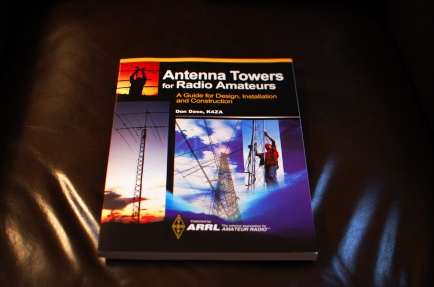
As I have commented before, I don’t generally review or endorse products on the blog. However, I was organizing my aluminum/steel pile in the back yard recently and posed a question to the PVRC reflector about potential improvements to a 402BA-S that I uncovered. One of the responses came from K4ZA, who is a well-known “tower-guy.” (His blog is a pretty good read, too!) I’ve been meaning to buy a copy of his book Antenna Towers for Radio Amateurs and I told him as much when I thanked him for his reply. He offered a copy at a small discount from the cover price and I bought it. It’s the second autographed ARRL book I have, the other being the 4th edition of ON4UN’s Low Band DXing, but I digress.
I’ve been at this whole radio thing for a few years now and have picked up a lot of the tricks. Since most of what I know about towers comes from a high-school summer job in the two-way business, chatting with “The Good Reverend,” and installing HF research radars, Don’s book really filled in the gaps for me. It is good…I read it cover-to-cover.
Don spent a career in video production before getting into the tower business full-time and it shows. He knows the importance of telling the story to impart a trade. He also includes candid stories from tower owners and workers explaining techniques and nearly-averted disasters from their own perspective. Not only is it informative, the book entertains as well.
Antenna Towers for Radio Amateurs pretty much covers everything you need to know about planning, procuring, constructing, and maintaining your tower and antenna system—everything from how to evaluate the ubiquitous used tower sections to which tools and safety equipment to buy. After reading it, you should be in a good position to understand how much of the tower-building process you are able to do yourself and how much to rely on local experts and professionals. It is an excellent book and deserves a spot on the shelf of every ham who owns or dreams of owning a tower—and a few research radar scientists and engineers…
Ethan Miller, K8GU, is a regular contributor to AmateurRadio.com and writes from Maryland, USA. Contact him at [email protected].
Handiham World for 13 April 2011
Welcome to Handiham World!

Have you ever participated in a poll or survey about a product or policy?
There are plenty of surveys out there, covering everything from political candidates to laundry soap. They are used to help make decisions about how to best improve and market candidates and products. It would be unthinkable for a company to refuse to poll its customer base about product preferences. By querying the consumers, the company finds out what is working and what is not, so that they can fine tune a product or service and ultimately sell more of it.
Recently my local radio club sent out a survey designed to find out what the club members think is most important in terms of club activities. In all my years of belonging to all sorts of clubs, especially radio clubs, this is the first club I have encountered that conducts such periodic surveys. What a great idea!
Some clubs are focused on a very specific mission and stray very little from a path toward their goal, but most radio clubs at least have some flexibility in their mission and can happily sponsor a variety of activities that might include on the air nets, ARES training and deployment, SKYWARN, classes in amateur radio, hidden transmitter hunts, Field Day, a club repeater, and… Well, you get the idea. Where the survey comes in is when the club has so many ideas for projects that they cannot all reasonably be given enough time and support to be successful. While the club leadership may decide for the entire group, it is always better to gain the confidence and support of the membership in deciding which projects to put at the top of the list and which might be better off tabled until some later date.
A properly designed survey can be a valuable tool to help a club chart its future. It is not going to be enough to simply ask for ideas in an open meeting. Not every member is present at every meeting, and some members may speak more persuasively than others, even though a survey done in private, when each member has a chance to think about what he or she really would prefer the club to do, might be entirely different. Another thing a survey can do is to lay out a variety of choices as well as to solicit original ideas from members. When I looked at the well-designed survey our club sent out, I was reminded of many good and worthy projects that our club has supported over the years. If pressed to remember all of that stuff on my own, I know I would have forgotten many projects, which would have made it more difficult for me to help the club make decisions on what to do. When I wanted to comment on a couple of items, I found comment space available so that I could put my thoughts down in my own words. Our survey asked for members to “rate” each project idea from one to five, based on whether the item was of no importance all the way up to great importance to the member. A couple of entries were blank, allowing each member to add a couple new items in the rate by number list. Although I can see the survey to complete it on paper if I wish, it was nice to see that the survey was available via email in an accessible format. That method also saves printing costs.
I realize that my preferences on the club survey may not be what others want, but I know I had my say and that it is likely at least some of what I like will become club policy. If your radio club seems to be stuck in a rut and lacking in direction, why not suggest that the club conduct a survey to find out what club members would like to do for projects and activities? It is a great way to stimulate thinking and bring out new ideas. Everyone will have more fun and the club and the greater amateur radio community will be the better for it.
For Handiham World, I’m…
Pat Tice
[email protected]

Pat Tice, WA0TDA, is the manager of HANDI-HAM and a regular contributor to AmateurRadio.com. Contact him at [email protected].
 Ham Radio Deluxe |
 W5SWL Electronics |
 Ham Radio Prep |
 KB3IFH QSL Cards  Hip Ham Shirts  HamRadioAuctions HamRadioAuctions Reliance Antennas Reliance Antennas Enigma Shop Enigma Shop |  morseDX  Ni4L Antennas  R&L Electronics R&L Electronics antennas.us antennas.us QRV QRV |
- Matt W1MST, Managing Editor
