 |
 More silly things heard on the radio
 23 April 2011 | by
 This is a follow-on post to my recent post “Weird things heard on the radio“. If this keeps up, perhaps I’ll make this a series, though I’m not sure that “weird” is quite the right word. Silly is more like it, and I’ve adjusted the title of this post accordingly.
As I write this at about 18:30 GMT on 23 April, I am attempting to work 9M2TO from West Malasia on 17m phone. He’s got a good-sized pileup and of course, there’s the usual guys who can’t figure out how to turn their VFO to tune up their amplifier off the frequency. For non-hams who might be reading, this sounds like a high-pitched squeal on the frequency, and is pretty annoying. Aside from it being rude, it’s in violation of FCC rules against intentionally interfering with ongoing transmissions. (I’m sure that it’s against the rules for amateur radio operators in any country, of course.) That’s not the silly part, that’s the annoying part.
Here’s the silly part: As usual, the DX Cops are present, and one of them said the following: “Hey, don’t tune up on the frequency”. Some of you will immediately know why this is silly, but I’ll elaborate: Under normal circumstances, when you are transmitting you are not receiving. Aside from the fact that the guy who was tuning up likely doesn’t care what anyone else thinks, he’s not going to hear the guy yelling at him. All it does to yell is to add to the noise, which is as bad as the guy tuning up.

More silly things heard on the radio
This is a follow-on post to my recent post “Weird things heard on the radio“. If this keeps up, perhaps I’ll make this a series, though I’m not sure that “weird” is quite the right word. Silly is more like it, and I’ve adjusted the title of this post accordingly.
As I write this at about 18:30 GMT on 23 April, I am attempting to work 9M2TO from West Malasia on 17m phone. He’s got a good-sized pileup and of course, there’s the usual guys who can’t figure out how to turn their VFO to tune up their amplifier off the frequency. For non-hams who might be reading, this sounds like a high-pitched squeal on the frequency, and is pretty annoying. Aside from it being rude, it’s in violation of FCC rules against intentionally interfering with ongoing transmissions. (I’m sure that it’s against the rules for amateur radio operators in any country, of course.) That’s not the silly part, that’s the annoying part.
Here’s the silly part: As usual, the DX Cops are present, and one of them said the following: “Hey, don’t tune up on the frequency”. Some of you will immediately know why this is silly, but I’ll elaborate: Under normal circumstances, when you are transmitting you are not receiving. Aside from the fact that the guy who was tuning up likely doesn’t care what anyone else thinks, he’s not going to hear the guy yelling at him. All it does to yell is to add to the noise, which is as bad as the guy tuning up.
David Kozinn, K2DBK, is a regular contributor to AmateurRadio.com and writes from New Jersey, USA. Contact him at [email protected].
2m HT antenna shootout
I’ve been wanting to do this for a long time. I wanted to try to compare the difference between various antennas for 2 metre band handhelds so as to see how much you lose using a small inconspicuous antenna or how much you gain by using an extra long one. The results were broadly as expected. The longer the better. But there were a couple of surprises.
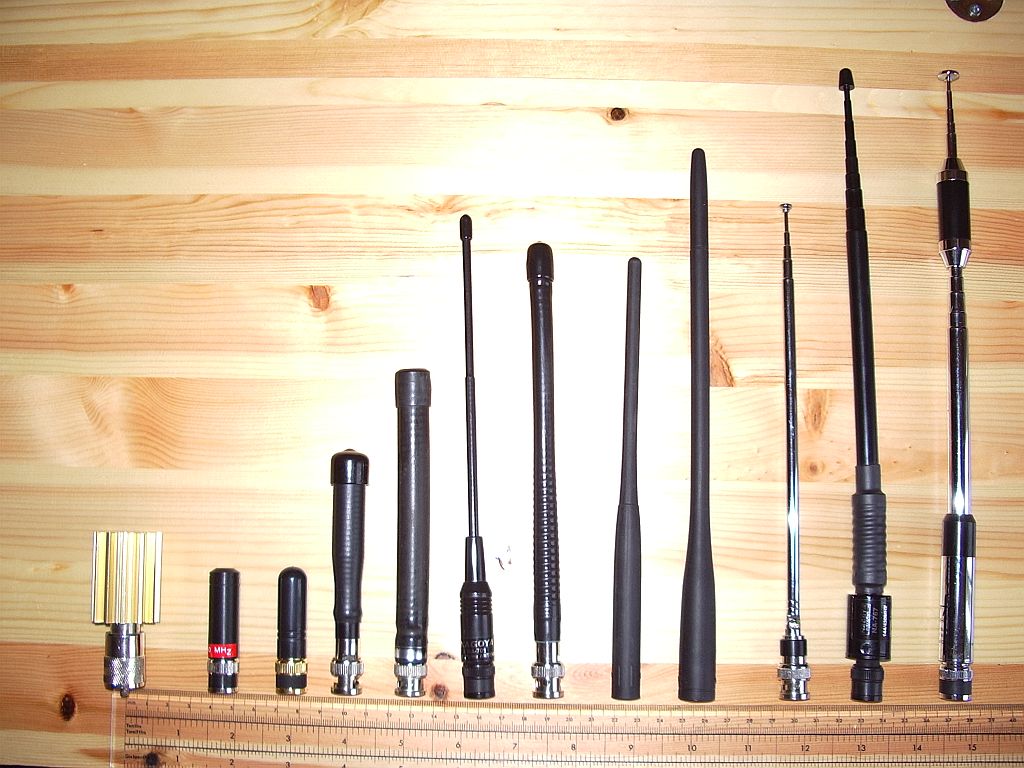
The efficiency of the antennas was compared using my Yaege FC-1 frequency counter, which has a relative dBm scale. I transmitted into each of the antennas in turn, noting the dBm reading on the FC-1 which was positioned a couple of metres away. This is hardly an antenna test range. However, the results were validated in on-air tests where various local amateurs were asked to report on my signal strength as I swapped antennas. The on-air results were in agreement with the measurements, which allow me to believe that they are a fair representation of the performance of these antennas in the real world.
As an aid to comparison, the performance is given as effective power out relative to a manufacturer supplied antenna driven with 5 watts. The antenna provided with the Yaesu VX-8GR is used as the reference antenna. Choosing a manufacturer supplied antenna turned out to be rather a poor reference, as although the Yaesu standard antenna performs very well, the antenna supplied with the Kenwood TH-D72 performed very poorly. It was 5dB down on the Yaesu antenna, putting it in the same range as the short stubby antennas. This is probably because the Kenwood antenna’s resonant frequency, as checked on my antenna analyzer, is around 158MHz. Although it would be reasonable to suspect a fault with the antenna supplied with my TH-D72, the one supplied with my Kenwood TH-F7E (which I have since sold) was identical. If you are using a Kenwood radio then you have even more reason to throw away the supplied antenna and buy a better one.
The antennas in the picture from left to right are:
- A dummy load. This is just my little joke! Many “experts” like to say that the short stubby antennas are no better than dummy loads. In fact, my results suggest that they perform quite well for their size and are much better than dummy loads. However, as with all of these antennas, the best results depend on the antenna being resonant (having a good SWR) at 145MHz. All these antennas have quite a narrow bandwidth and if they are off-frequency it has a significant effect on their performance.
- A 2in. 144MHz stubby bought on eBay. This antenna is 5dB down on the reference Yaesu dual-band whip and would be the equivalent of reducing power on the handheld from 5W to 1.5W.
- An A-137 dual band stubby bought on eBay. I have two of these. The first one was tuned spot on 145.5MHz so I got a second one which was resonant just above 146MHz. Performance is slightly better than the single band stubby, being the same as reducing power to 2W.
- A 2m Stubby Duck from Smiley Antenna. I got this because I thought it would deliver better performance than the small stubbies while still being small enough to sit comfortably in a pocket. This proved correct. Performance is just 2dB down on the reference stock antenna, the equivalent of running 3W instead of 5W.
- A 6in. 2m helical antenna. This antenna came with the old TH-205E handheld and as far as I know is the original antenna supplied with the radio. Checked on an antenna analyzer it was resonant a few MHz high in frequency but I brought it down to 145MHz by dropping a ferrite tuning core down inside the helical and securing it with Blu-Tack. This enabled me to open a repeater I could not open before the modification, illustrating the importance of tuning these antennas to get best performance. This antenna is just 1dB down on the reference antenna, like using 4W instead of 5W – hardly noticeable.
- A Nagoya NA-701 dual band BNC antenna. I purchased this antenna as a replacement for the manufacturer supplied antenna due to my converting all my handheld radios over to BNC sockets by permanently fitting adapters. It is almsot exactly the same size as the supplied antenna and its performance is identical to it.
- An 8in. 2m helical antenna. This antenna was bought as an untuned helical which required cutting to frequency. I got it from Waters and Stanton and it is of extremely poor quality. However, the RF isn’t bothered by the shoddy manufacture. It performs exactly the same as the supplied VX-8GR antenna.
- The antenna supplied with the Yaesu VX-8GR. This is the reference antenna for this comparison. As mentioned above, the antennas supplied with other radios (notably Kenwood) may not be as carefully tuned and may perform more poorly than this.
- The antenna supplied with the Yaesu FT-817ND. This is slightly bigger than the one supplied with the VX-8GR and has a BNC mount not an SMA. It performs about 1dB better, equivalent to running 6.3W. Adding the tip which makes the antenna work on 6m has no effect on 2m performance. As I have come to expect from Yaesu, this antenna is resonant precisely on 145MHz, as was the one with the original FT-817 that I had many years ago.
- A quarter wave telescopic BNC whip. These 19in telescopic antennas are available from a variety of sources. I think this one came originally from Maplin. It gives your signal a 3dB boost, equivalent to doubling your output power (and doubles the received signal strength also.) At a cost of £8, it is a cheap way to double your effective power and not too long to be cumbersome in use.
- A Nagoya NA-767 bought on eBay. This is a dual band telescopic antenna which is 38 inches (97cm) long when extended. It has a heavy metal base which presumably contains a loading coil. The BNC connector is made mostly of plastic, but the base is sprung which should take some strain off it. The telescopic sections are quite stiff. The build quality of the antenna is not great but it is quite cheap. The performance gain is substantial, giving a 4 times power boost over the quarter wave antenna, equivalent to running 40 watts output.
- A Sharman RH-770 dual band antenna bought from Capital Stores. This appears to be a clone of the Diamond RH-770 which is sold at the usual rip-off prices by certain ham radio dealers. The Sharman version is half the price. It is a dual band antenna with centre loading and is 93cm (36 inches) long when extended. It looks and feels a better quality antenna than the NA-767. It also performs slightly better on 2m, giving your handheld a full ten times gain on transmit and receive compared to the supplied rubber duck. It’s the equivalent of running 50 watts from a handheld!
- Not shown in the picture is the 45.5inch Black Whip from jeepbangkok on eBay. This is a 5/8 wave single band (2m) antenna and was the best performing handheld 2m antenna of all, giving 11dB of gain over the manufacturer supplied whip, the equivalent of running 63 watts of power! Sadly the telescopic whip was of poor quality and pulled apart during a recent WOTA activation.
Clearly one should not use such long antennas as the last three on a typical modern handheld radio with SMA antenna socket unless you are using a stout SMA to BNC adapter that tightens down to rest on the body of the radio so that no twisting moment is applied to the SMA socket. Even then, you may rightly be wary of using such a long antenna in the windy conditions often encountered on Lake District summits, which often bent the sprung base of the Black Whip into a 45 degree angle. Because of this I have made up a rucksack mount with a BNC socket and a 19in. quarter wave counterpoise so these high gain antennas can be used off the radio.
I was unable to test the free standing WOTA Pole (ribbon cable Slim Jim inside a plastic tube) under the same conditions but on-air reports suggest that it may give even more gain than the Black Whip. However, it isn’t always convenient to set up a guyed antenna on a summit, so one of these telescopic high gain antennas could be the answer to improving your signal when using a handheld radio.
These test results have related exclusively to the 2m band. I do not have test equipment that works up to 440MHz, nor is there any activity on 70cm in this part of the world so I have no plans to compare the performance of these antennas on UHF.

Julian Moss, G4ILO, is a regular contributor to AmateurRadio.com and writes from Cumbria, England. Contact him at [email protected].
Happy Birthday, NØARQ!
My friend, ACØVW, is planning on visiting me the day after Easter. He’s just re-licensed for the first time since he was a boy, and he is eager to get on the air. Trying to figure out what kind of temporary antenna we might be able to set up, I dug into a junk box and came up with a couple coils of old twin-lead that we could use to feed a doublet.
I could tell by the way the twin-lead was methodically coiled and taped with strapping tape that my dad had been the last one to handle it. As I uncoiled it and measured how long it was, my fingers were quickly coated in white, powdery residue from the aging, well-weathered insulation. Suddenly, I realized what I was holding. Surely this must be what my dad used to make the radials for my first antenna, a Butternut vertical that he set up for me on the roof back in 1978.
And just as suddenly, something else struck me. My dad was really my first Elmer. No, he wasn’t a seasoned ham radio operator when he started helping me. But he was a very seasoned electrical engineer — and a fabulous father. He may not have been able to help me out with operating procedures, but he sure did help me get on the air when I was a 10-year-old boy.
Take a close look at that picture of my first ham shack, up at the top of this blog. See those little squares of paper neatly taped to the front of the Heathkit DX-100 transmitter? My dad put those there. They were little notes to help me as I learned to tune that great big tube-fired rig. The laminated sheet of paper in front of the transmitter is, as I recall, a list of settings that my dad figured out for the antenna tuner. And that straight key — the very thing that first got me interested in ham radio when I stumbled across it in my dad’s shop — was lovingly screwed down to the desk by my dad, permanently marring the beautifully finished surface of the desk he had built years before this hobby became part of my life.
My dad went on to become licensed as NØARQ, and he homebrewed some great stuff. Some of it made its way into ham radio magazines, and a fabulous spider-quad he built back in the early 80′s went into an ARRL Antenna Compendium. I couldn’t have built any of those things back then (some of them I still couldn’t design if my life depended on it!). If it weren’t for my dad, I would never have gotten on the air. But because of my dad, I did — and enjoyed using some really fine gear, too.
Today is my dad’s birthday. I didn’t get to see him today, but the memories came flooding back when I held that old, powdery radial in my hands. Dad really was my first Elmer, and so much more. He led me to Jesus Christ when I was a young boy. Years later, when I was a freshman seminary student, he led me to a high view of God’s sovereignty. And to this day, he leads me by example to be a loving father and husband.
So thank you, Dad.
And happy birthday!


Todd Mitchell, NØIP, is a regular contributor to AmateurRadio.com and writes from Minnesota, USA. He can be contacted at [email protected].
Handiham World for 20 April 2011
Welcome to Handiham World!
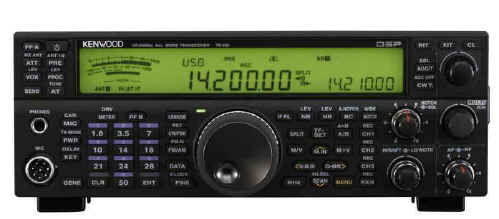
My May 2011 QST magazine arrived last week, and I was pleasantly surprised to see an excellent review of the new Kenwood TS-590S 160 through 6 meter transceiver. This radio is of special interest to us at Handihams because it uses the optional VGS-1 voice chip that gives excellent access to the menu system and the frequency display for blind users. Some listed features are:
• 100 W heavy-duty design
• Built-in automatic antenna tuner ( 6 ~ 160 meters )
• USB & Serial DB-9 ports for PC connectivity
• Kenwood ARCP-590 Control Software
• Kenwood ARHP-590 Radio Host Program for VOIP
• CW Auto Tune
• Beat Cancel
Although the QST article does not assess the TS-590S from the standpoint of a blind user, it is an excellent overview of the radio and is well worth the read. The article has been read for our blind members and is available in the members only section of Handiham.org.
Lyle, K0LR, and I have both taken a quick look at the ARCP-590 Control Software and we think it will be blind-accessible. Of course neither of us has that rig, so we are hoping a Handiham member who owns one will do some experimenting with the various accessibility features of the radio itself and the software, and then write up the results for us to share with our readers and podcast listeners.
For another take on the TS-590S, check out the eHam reviews. These reviews are all written by users, and if you find the post by K3UL from April 19, you will be able to read what a satisfied blind ham thinks. I’ll give you some useful links at the end of this story.
I’m going to just add a few words of my own to the discussion, because I’ve noticed that some potentially helpful information is not necessarily part of the usual review process. I know that my blind friends will be interested in what the front panel of the radio looks like. Anyone familiar with radios like the TS-440SAT and the TS-570SAT will feel right at home (almost) with the front panel of the new 590. Unlike the vastly different layouts of the TS-480SAT or TS-2000, this radio is the familiar rectangular shape with the big main tuning knob near the bottom center. Just to the left is the keypad for direct frequency entry or band selection. The keypad follows the expected 3 by 4 arrangement. Buttons for the antenna tuner, power, and attenuator (among others) are in a familiar location at the upper left of the front panel. Below them are the headphone and microphone jacks. I’m beginning to think at this point that I would have to look at the model number to make sure I wasn’t sitting in front of the venerable TS-570! On the lower right corner, easy to find, is the audio gain control. The outside concentric control is RF gain, as one would expect. The upper right corner is home to the XIT/CL control, another oft-used adjustment. Between these controls and to the right of the main tuning knob are the adjustments having to do with filtering, such as the notch control, noise blanker and IF filter. Immediately to the right of the main tuning knob are the split and M/V buttons. To the lower left of the main knob is the usual frequency lock button, which doubles as the fine tuning toggle. Other familiar buttons to the immediate left of the main tuning knob are the various mode selections. This doesn’t cover everything, but it should be enough to let you know that as a blind user, you will be in somewhat familiar territory if you have already familiarized yourself with the TS-570, or to a lesser extent with the TS-440.
In a sense, radios are like other technologies in that switching between models and brands can be a problem. Imagine, for example, what would happen if the main controls in cars were not standardized. If turning the steering wheel clockwise made the car turn right in one model, but left in another, or if the brake were a pedal in one but a button on the steering wheel in another, you can imagine the disastrous consequences for anyone trying to switch between cars! So one unspoken and really significant feature in the TS-590S is this familiar feel and standardization. I’m just putting it out there as one more reason Kenwood has hit a home run with this model!
For Handiham World, I’m…
Pat Tice
[email protected]
Now, here are the links I promised: (See Handiham.org.)

Pat Tice, WA0TDA, is the manager of HANDI-HAM and a regular contributor to AmateurRadio.com. Contact him at [email protected].
Handiham World for 20 April 2011
Welcome to Handiham World!
My May 2011 QST magazine arrived last week, and I was pleasantly surprised to see an excellent review of the new Kenwood TS-590S 160 through 6 meter transceiver. This radio is of special interest to us at Handihams because it uses the optional VGS-1 voice chip that gives excellent access to the menu system and the frequency display for blind users. Some listed features are:• 100 W heavy-duty design• Built-in automatic antenna tuner ( 6 ~ 160 meters )• USB & Serial DB-9 ports for PC connectivity• Kenwood ARCP-590 Control Software• Kenwood ARHP-590 Radio Host Program for VOIP• CW Auto Tune• Beat Cancel
Although the QST article does not assess the TS-590S from the standpoint of a blind user, it is an excellent overview of the radio and is well worth the read. The article has been read for our blind members and is available in the members only section of Handiham.org.
Lyle, K0LR, and I have both taken a quick look at the ARCP-590 Control Software and we think it will be blind-accessible. Of course neither of us has that rig, so we are hoping a Handiham member who owns one will do some experimenting with the various accessibility features of the radio itself and the software, and then write up the results for us to share with our readers and podcast listeners.
For another take on the TS-590S, check out the eHam reviews. These reviews are all written by users, and if you find the post by K3UL from April 19, you will be able to read what a satisfied blind ham thinks. I’ll give you some useful links at the end of this story.
I’m going to just add a few words of my own to the discussion, because I’ve noticed that some potentially helpful information is not necessarily part of the usual review process. I know that my blind friends will be interested in what the front panel of the radio looks like. Anyone familiar with radios like the TS-440SAT and the TS-570SAT will feel right at home (almost) with the front panel of the new 590. Unlike the vastly different layouts of the TS-480SAT or TS-2000, this radio is the familiar rectangular shape with the big main tuning knob near the bottom center. Just to the left is the keypad for direct frequency entry or band selection. The keypad follows the expected 3 by 4 arrangement. Buttons for the antenna tuner, power, and attenuator (among others) are in a familiar location at the upper left of the front panel. Below them are the headphone and microphone jacks. I’m beginning to think at this point that I would have to look at the model number to make sure I wasn’t sitting in front of the venerable TS-570! On the lower right corner, easy to find, is the audio gain control. The outside concentric control is RF gain, as one would expect. The upper right corner is home to the XIT/CL control, another oft-used adjustment. Between these controls and to the right of the main tuning knob are the adjustments having to do with filtering, such as the notch control, noise blanker and IF filter. Immediately to the right of the main tuning knob are the split and M/V buttons. To the lower left of the main knob is the usual frequency lock button, which doubles as the fine tuning toggle. Other familiar buttons to the immediate left of the main tuning knob are the various mode selections. This doesn’t cover everything, but it should be enough to let you know that as a blind user, you will be in somewhat familiar territory if you have already familiarized yourself with the TS-570, or to a lesser extent with the TS-440.
In a sense, radios are like other technologies in that switching between models and brands can be a problem. Imagine, for example, what would happen if the main controls in cars were not standardized. If turning the steering wheel clockwise made the car turn right in one model, but left in another, or if the brake were a pedal in one but a button on the steering wheel in another, you can imagine the disastrous consequences for anyone trying to switch between cars! So one unspoken and really significant feature in the TS-590S is this familiar feel and standardization. I’m just putting it out there as one more reason Kenwood has hit a home run with this model!
For Handiham World, I’m…
Pat Tice[email protected]
Now, here are the links I promised: (See Handiham.org.)
Pat Tice, WA0TDA, is the manager of HANDI-HAM and a regular contributor to AmateurRadio.com. Contact him at [email protected].
Prettiest Portable Site
We’re enjoying some wonderful weather here in the Lake District at the moment. Unfortunately I haven’t been able to get out on the hills for some radio activation. I’ve been plagued with back pain ever since I returned from Blackpool. But not only that, sometimes I have to go somewhere that is of interest to Olga.
Today we decided to take a drive down to visit Holehird Gardens, home of the Lakeland Horticultural Society. For Olga, who is if anything even more obsessed with gardening than I am with radio, this is like visiting a really big ham radio show would be for me. I have zero interest in gardening, but I do enjoy looking at a nice garden, and I enjoyed the day out as much as she did. In fact, we agreed we should visit Holehird more often.

I took along the little Jin Ma Tong JT-228 VHF radio because it is small, light and easily slips in a shirt pocket. The antenna was a short stubby helical. No sooner had we arrived than I heard Phil M0AYB/P calling CQ Wainwrights On The Air from the summit of Great Gable. Phil was rattling off the contacts, and soon heard my call. I was pleased to make a contact using 3W to such a small antenna especially as Phil was also using a stock rubber duck, though according to a panorama engraved on the slate behind me in the picture Great Gable was line of sight from where I was standing so it shouldn’t have been too difficult.
More was to come, as just after Olga had taken my picture I heard Derek 2E0MIX/P calling CQ WOTA from the summit of Hindscarth. I got in a quick call and Derek heard me first, so we had a quick chat. Hindscarth was not line of sight, I think, but Derek was using his SOTA Beam which made a big difference. I was well pleased to make two WOTA contacts using the tiny hand-held radio. I popped it back in my shirt pocket and carried it around for the rest of the afternoon but didn’t hear anyone else although several Wainwright summits were activated.

However I was too busy enjoying the wonderful warm weather and beautiful Holehird Gardens to worry too much about the contacts I missed.

What this proved to me is that you don’t need to be up on the fells to enjoy some WOTA fun. Come to the Lake District and bring a hand-held with you and you’ll be sure to make some contacts!

Julian Moss, G4ILO, is a regular contributor to AmateurRadio.com and writes from Cumbria, England. Contact him at [email protected].
 Ham Radio Deluxe |
 W5SWL Electronics |
 Ham Radio Prep |
 KB3IFH QSL Cards  Hip Ham Shirts  HamRadioAuctions HamRadioAuctions Reliance Antennas Reliance Antennas Enigma Shop Enigma Shop |  morseDX  Ni4L Antennas  R&L Electronics R&L Electronics antennas.us antennas.us QRV QRV |
- Matt W1MST, Managing Editor
