 |
 Another eBay dud
 11 May 2011 | by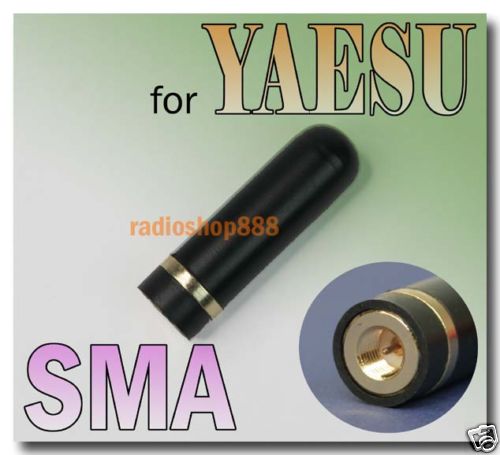

It’s the same on 433MHz as well.
In fact I couldn’t find any frequency at which this so-called antenna is resonant!

Julian Moss, G4ILO, is a regular contributor to AmateurRadio.com and writes from Cumbria, England. Contact him at [email protected].
Another eBay dud
It’s the same on 433MHz as well.
In fact I couldn’t find any frequency at which this so-called antenna is resonant!
Julian Moss, G4ILO, is a regular contributor to AmateurRadio.com and writes from Cumbria, England. Contact him at [email protected].
Winnie the war winner
The other day I noticed a very interesting photo on a fellow Australian ham blogger, Peter Mark’s site. The blog entry was titled a “Radio nerd’s tour of Canberra“. The first photo is described as ‘a transceiver with a nifty antenna tuner’. But the instant I saw it I sensed there was slightly more to it.

Winnie the war-winner seen in the Australian War Memorial in Canberra. It was named after British wartime Prime Minister, Winston Churchill.
The fact that it was built on a beaten up old kerosene can prompted me to google “Winnie the war winner” and the results confirmed Peter’s photo is of this most famous piece of Australian ham homebrew ingenuity. Max (Joe) Loveless’ skill to be precise. The photo prompted me to find out the story of this iconic wireless set that’s an inspiration to a generation of Australian radio hams proud of their traditions of ‘making-do’.
The wikipedia entry on the Battle of Timor gives detailed historical and military background to this little radio’s moment of fame in April 1942.
As a result of British intrigue Australian troops were sent to Portuguese East Timor to disrupt any Japanese invasion on Australia’s northern doorstep. By April the 2/2nd Independent Company had been fighting a guerilla campaign for four months. Many were ill and they were low on supplies, and had had no contact with Australia since February.
For weeks a team had been trying to build a transmitter from salvaged parts from damaged radio gear. Before the war Max Loveless was a radio amateur in Hobart with the call 7ML. He became a Signaller with “Sparrowforce” on the Dutch part of Timor with the Australian Infantry Forces (AIF).

Bill Marien reported the story in the Melbourne Argus of 1st January 1943:
“Force Intact. Still Fighting. Badly Need Boots, Money, Quinine, Tommygun, Ammunition.”
This was the first official message received in Australia from the lost AIF commandos of Portuguese Timor who, for 59 days after the Japanese landing on the island, had been written off as missing or dead.
The signal came to Darwin on the night of April 19. It was transmitted by “Winnie the War Winner,” a crazy contraption built from scraps of wire and tin, and pieces of long discarded radio sets.
When the commandos showed me the incredible Winnie recently, it was easy to recapture the scene of that night of April 19.
In the thin air of a Timor mountain hideout, 4 bearded, haggard Australians were working by the smoking, stinking light of a pig-fat flare. Three of them watched anxiously as the fourth thumbed a Morse key. Weak batteries sent the dots and dashes of the morse dimly across the Arafura Sea to the Northern Territory of Australia. The tension was something physical as the operator strained his ears for a reply. At last a reply came.”
The AIF commando force which had been in Portuguese Timor were joined by other Australians from Dutch Timor including two signalmen, Cpl John Sargeant, of Bonshaw, NSW, and Lance-Cpl John Donovan, of Lindfield, NSW. Under leadership of Capt George Parker, of Earlwood, NSW, they joined Sigs Max (Joe) Loveless, of Hobart, and K. Richards, of Victoria, both of the original commando force.
“On March 8 the 4 men got to work — Loveless just out of sick bed and Sargeant just recovered from malaria. Three days later a Dutch sergeant, exhausted, stumbled in. He had carried what he thought to be a transmitter-receiver 40 miles through some of the roughest country in the world. It was an ordinary commercial medium-wave receiving set – and out of order.
CORPORAL WENT SCROUNGING
Loveless, whose knowledge made him No 1 man of the team, thought he could build a one-valve transmitter from parts of this set and of another small and weak set. He planned a circuit, and all the commandos were asked to be on the lookout for anything that might serve as a radio part.
Cpl Donovan went scrounging at Attamboa, on the north coast, to see what he could salvage, while his companions recovered an abandoned army set. The parts of the 3 sets were unsoldered, and a bamboo used to catch all the melted solder for re-use. Loveless had carefully preserved 2 small batteries, but they needed recharging. A generator was taken from an abandoned 10-year old car and rigged to a series of wooden wheels, which a native was persuaded to turn. The set was complete on March 26.
It would not work!

Three of the team who helped Max Loveless build Winnie the war winner re-enact transmissions from a hill in East Timor - Signaller Keith Richards, Corporal John Donovan and Lieutenant Jack Sergeant. Photo by Damien Parer
The only tools available were a tomahawk, pliers, and screw-driver. They had no test equipment to determine the set’s frequency. The coils were wound on pieces of bamboo.
On March 28 Donovan returned from Attamboa – laden like a treasure ship. He had the power pack from a Dutch transmitter, 2 aerial tuning condensers, 60ft of aerial wire in short lengths, and a receiving set. Next day the men had to move all their precious gear, for the Japanese were getting too close.
Loveless got to work on a second transmitter twice as big as the first, and built it into a 4-gallon kerosene tin. A battery charger was recovered from enemy-held territory. To get it 14 commandos went through the Japanese lines to the old Australian headquarters at Villa Maria. There, within 100 yards of Japanese sentries, protected only by the dark, they dug up the charger which had been buried when the headquarters were evacuated.
HEARD DARWIN WAS SAFE
On April 10 the signallers heard Darwin on the receiver, and knew then that Darwin was still in Australian hands. But their second transmitter was also a failure.
Loveless had another idea, but he needed more batteries. Four were found. Then the petrol ran out and the charger could not be kept running. So they raided the Japanese lines and carried off tins of kerosene. Finally the charger was started oil kerosene and run on diesel oil.
With batteries at full strength they signalled Darwin on April 18, but got no reply. They did not know that their message had been picked up on the Australian mainland and passed on to Darwin, that all transmitting stations had been warned to keep off the air and listen to Timor the following night.
You can get a good sense of the story from this video of the documentary ‘The Men of Timor’ filmed in Timor by Damien Parer in late September 1943. You can see a reconstruction of the building of the radio about 3’16″ in from the start.
On the 19th April they heard Darwin but their batteries failed again.
On the night of April 20 they again got Darwin. But Darwin was suspicious; demanded proof of their identity. So questions and answers like these were rushed across the Arafura Sea:
“Do you know Bill Jones?”— “Yes, he’s with us.”
“What rank, and answer immediately?”— “Captain.”
“Is he there? Bring him to the transmitter. . . . What’s your wife’s name, Bill?”— “Joan.”
“What’s the street number of your home?”
Once they provided the correct answers, help was on its way.
I found the newspaper report on the National Library of Australia’s brilliant Trove, where digital versions of many Australian newspapers have been put online courtesy of crowd-sourced editors across the global internet. Truly astounding!
Stephen Rapley, VK2RH, is a regular contributor to AmateurRadio.com and writes from New South Wales, Australia. Contact him at [email protected].
Soaked through on Gowbarrow Fell
I’m finally eligible to claim one of my own WOTA certificates! This morning I made a contact with Phil G4OBK/P on Souther Fell and thereby completed working all of Wainwright’s Northern Fells.
Phil had preannounced his intention to visit Souther Fell on the WOTA website, which was the last one I needed. This fell is blocked by higher mountains so I can’t work it from home – I would have to get to a good vantage point. I could have driven to a suitable spot, parked and waited for Phil to appear but I decided to make the contact from a summit. The weather forecast was for rain, however, not the kind of conditions I normally choose for an activation. Out of the rucksack came the antenna mount (so I could use the waterproof rucksack cover) and the APRS radios (too expensive to risk getting wet.) The rig for the day was the Motorola GP300 with the base loaded Nagoya half wave telescopic.
The weather lived up to the forecast. By the time I reached the summit my boots had taken on water from the numerous puddles and long wet grass I had to traverse to reach it. My Goretex waterproof was letting in the rain, too. Only the inside of my rucksack remained dry. The views from this summit can be spectacular, but today was no day for a camera. So no photos. Instead, I’ll link to a page that has some pictures of what I could have seen on a better day.
I had to make several calls before I could raise anyone. Finally Malcolm M0XAT heard me. Next the Penrith duo, G0TDM and G4WHA, and then Colin G4UXH and Sue G1OHH from “down south” who were both at good signal strength. I then had a bit of a wait before Phil arrived on summit and began to call. I passed the time trying to wring the water out of my socks.
Mission accomplished I headed back down to the car, home and a hot bath. The radio and antenna are now in the hot water tank cupboard drying out. My boots will probably take a bit longer.

Julian Moss, G4ILO, is a regular contributor to AmateurRadio.com and writes from Cumbria, England. Contact him at [email protected].
Soaked through on Gowbarrow Fell
I’m finally eligible to claim one of my own WOTA certificates! This morning I made a contact with Phil G4OBK/P on Souther Fell and thereby completed working all of Wainwright’s Northern Fells.
Phil had preannounced his intention to visit Souther Fell on the WOTA website, which was the last one I needed. This fell is blocked by higher mountains so I can’t work it from home – I would have to get to a good vantage point. I could have driven to a suitable spot, parked and waited for Phil to appear but I decided to make the contact from a summit. The weather forecast was for rain, however, not the kind of conditions I normally choose for an activation. Out of the rucksack came the antenna mount (so I could use the waterproof rucksack cover) and the APRS radios (too expensive to risk getting wet.) The rig for the day was the Motorola GP300 with the base loaded Nagoya half wave telescopic.
The weather lived up to the forecast. By the time I reached the summit my boots had taken on water from the numerous puddles and long wet grass I had to traverse to reach it. My Goretex waterproof was letting in the rain, too. Only the inside of my rucksack remained dry. The views from this summit can be spectacular, but today was no day for a camera. So no photos. Instead, I’ll link to a page that has some pictures of what I could have seen on a better day.
I had to make several calls before I could raise anyone. Finally Malcolm M0XAT heard me. Next the Penrith duo, G0TDM and G4WHA, and then Colin G4UXH and Sue G1OHH from “down south” who were both at good signal strength. I then had a bit of a wait before Phil arrived on summit and began to call. I passed the time trying to wring the water out of my socks.
Mission accomplished I headed back down to the car, home and a hot bath. The radio and antenna are now in the hot water tank cupboard drying out. My boots will probably take a bit longer.
Julian Moss, G4ILO, is a regular contributor to AmateurRadio.com and writes from Cumbria, England. Contact him at [email protected].
Ridgeway Repeater Group (GB3WH/GB3TD) AGM on 11th May
It’s annual general meeting time again for the Ridgeway Repeater Group (http://www.rrg.org.uk). The group looks after the GB3WH and GB3TD as well MB7UR and GB3NW in the Swindon area.
If you are close by, do come along – it would be great to see you there.
The meeting will be held at 19:30 at Thring Townsend, 6 Drakes Meadow, Penny Lane, Swindon. SN3 3LL

Tim Kirby, G4VXE, is a regular contributor to AmateurRadio.com and writes from Oxfordshire, England. Contact him at [email protected].
Ridgeway Repeater Group (GB3WH/GB3TD) AGM on 11th May
It’s annual general meeting time again for the Ridgeway Repeater Group (http://www.rrg.org.uk). The group looks after the GB3WH and GB3TD as well MB7UR and GB3NW in the Swindon area.If you are close by, do come along – it would be great to see you there.The meeting will be held at 19:30 at Thring Townsend, 6 Drakes Meadow, Penny Lane, Swindon. SN3 3LL
View Larger Map
Tim Kirby, G4VXE, is a regular contributor to AmateurRadio.com and writes from Oxfordshire, England. Contact him at [email protected].
 Ham Radio Deluxe |
 W5SWL Electronics |
 Ham Radio Prep |
 KB3IFH QSL Cards  Hip Ham Shirts  HamRadioAuctions HamRadioAuctions Reliance Antennas Reliance Antennas Enigma Shop Enigma Shop |  morseDX  Ni4L Antennas  R&L Electronics R&L Electronics antennas.us antennas.us QRV QRV |
- Matt W1MST, Managing Editor
