 |
 Ridgeway Repeater Group (GB3WH/GB3TD) AGM on 11th May
 10 May 2011 | by
 It’s annual general meeting time again for the Ridgeway Repeater Group (http://www.rrg.org.uk). The group looks after the GB3WH and GB3TD as well MB7UR and GB3NW in the Swindon area.
If you are close by, do come along – it would be great to see you there.
The meeting will be held at 19:30 at Thring Townsend, 6 Drakes Meadow, Penny Lane, Swindon. SN3 3LL

Tim Kirby, G4VXE, is a regular contributor to AmateurRadio.com and writes from Oxfordshire, England. Contact him at [email protected].
Ridgeway Repeater Group (GB3WH/GB3TD) AGM on 11th May
It’s annual general meeting time again for the Ridgeway Repeater Group (http://www.rrg.org.uk). The group looks after the GB3WH and GB3TD as well MB7UR and GB3NW in the Swindon area.If you are close by, do come along – it would be great to see you there.The meeting will be held at 19:30 at Thring Townsend, 6 Drakes Meadow, Penny Lane, Swindon. SN3 3LL
View Larger Map
Tim Kirby, G4VXE, is a regular contributor to AmateurRadio.com and writes from Oxfordshire, England. Contact him at [email protected].
May 2011 QSL Card Giveaway Winner

We are very pleased to announce the winner of
1,000 Photo QSL Cards
from KB3IFH
Thanks to Randy for sponsoring this month’s drawing.
We had almost 500 entries!
We’re giving away more great prizes soon.
Stay tuned and get ready to enter.
OK, onto what you’ve all been waiting for!
The winner of our May 2011 prize giveaway is…
Matt Thomas, W1MST, is the managing editor of AmateurRadio.com. Contact him at [email protected].
ICQ Podcast S04 E10 – NVIS (8 May 2011)
Series Four Episode Ten of the ICQ Podcast has been released. News Stories include :-
- Amateur Radio suffers robot interference setback
- Disappointment when poorly designed equipment malfunctions
- 1000 FUNcube group members
- Radio Hams' Royal Wedding Tribute
- Practical Introduction to Amateur Radio
- World Amateur Radio Day on prime-time TV
- Your Callsign to Mars
- Easy Soldering Comic Book
- New 2m ham radio station on ISS
- Danny’s Digital Packet
- Bell System Technical Journals online
- One Millionth QSO mark for Summits on the Air
Your feedback and Martin (M1MRB) discusses NVIS.
Colin Butler, M6BOY, is the host of the ICQ Podcast, a weekly radio show about Amateur Radio. Contact him at [email protected].
ICQ Podcast S04 E10 – NVIS (8 May 2011)
Series Four Episode Ten of the ICQ Podcast has been released. News Stories include :-
- Amateur Radio suffers robot interference setback
- Disappointment when poorly designed equipment malfunctions
- 1000 FUNcube group members
- Radio Hams' Royal Wedding Tribute
- Practical Introduction to Amateur Radio
- World Amateur Radio Day on prime-time TV
- Your Callsign to Mars
- Easy Soldering Comic Book
- New 2m ham radio station on ISS
- Danny’s Digital Packet
- Bell System Technical Journals online
- One Millionth QSO mark for Summits on the Air
Your feedback and Martin (M1MRB) discusses NVIS.
Colin Butler, M6BOY, is the host of the ICQ Podcast, a weekly radio show about Amateur Radio. Contact him at [email protected].
More on IC-290A disappearing display
See original post here. Convinced that I had it working, I put the IC-290A aside and worked on some other projects. But, when I came back to it a few weeks later, the display was still disappearing. So, armed with the schematic and the block diagram, I began narrowing it down.
The display digits and tuning A/D converter are both driven off the same bus. But, since the disappearance of the display did not bring loss of receive, that gave me some confidence that it was not affecting the synthesizer. In order to simplify the analysis, I elected to assume that it was a single component (almost certainly a cold solder joint or an electrolytic capacitor) at fault.
Another clue was that the VFO dial ceased to operate once the display started acting up. Taking the single-point-of-failure assumption into account, this strongly implicated the microprocessor on the LOGIC board as a starting point. The only suspicious device that I could find on the schematic was C9, a 1000-uF, 6.3-volt electrolytic capacitor on the Vcc line of the microprocessor. So, I replaced it with a similar value unit from my junk box.
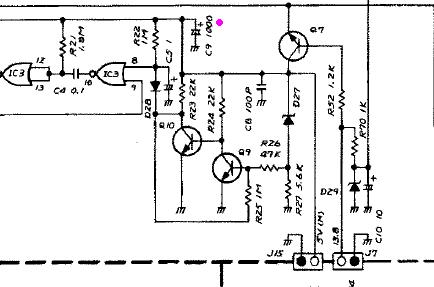
And, the radio seems to be working…for now. I did park it on WA1ZMS/B overnight and it is still running.
Ethan Miller, K8GU, is a regular contributor to AmateurRadio.com and writes from Maryland, USA. Contact him at [email protected].
Iowa High Altitude Balloon Launch #4
The iHAB-4 launch last Saturday was oddly enough close enough to my QTH (51 miles away– in Oxford, IA just east of Iowa City, IA) to justify taking the kids to. It also happened to be sponsored by the Marion Home School Assistance program (Marion, IA) that my children happened to be open enrolled in. Yes, on top of everything else (having four, young, non-genetically related South Korean adoptees) we homeschool our children.
This was a great way of trying to interest kids in Amateur Radio. I’ve been taking my oldest two boys (9 and 10) to a Technician Class with the hopes that eventually between that class and me teaching them the material that at least one of them would get a Technician license. Yes, they are a little young, but I think they could do it. (After all, they are homeschooled.) Unfortunately, they have been very antsy.. I think I will get at least one to pass.. but maybe that will take months more.. maybe years more?
They like hamfests… but they LOVED this launch…
It is difficult to keep kids interested in DXing, Contesting, building antennas, etc. But launching a balloon is a different story.
This should remind us all that Amateur Radio is a very diverse hobby with many aspects. Marshall Dias, W0OTM of Ottumwa, IA I believe became a ham to fly the types of communications payloads that he does fly on the iHAB missions.
You can see what this leads to:

Serious hardware for the balloon experiments
And, you can see a “Serious ham’s” equipment inside of the trailer:

Inside of the iHAB Communications Trailer
Of course, the payload boxes are even more interesting than the trailer. Again, this shows how serious even this unusual aspect of the hobby can be technically!

iHAB-4 Top most payload - APRS 2m Beacon and 20m CW Beacon
As you can tell, Marshall W0OTM is an extremely positive guy and one could genuinely tell he enjoyed the involvement of the children. My kids, with the important task of keeping the payload boxes from blowing away in the 25 MPH (with gusts over 30) Iowa nasty spring winds we thrilled to have the task.
The picture above showed my 9 year old son helping steady the top payload from blowing away.. the picture below shows my 10 year old (yes he’s shorter and smaller) doing the same with the bottom payload. One of the experiments on this launch were separating the two payloads and running the antennas vertical between the two payloads. It was probably a success on 20m, but it proved to be a bad idea on the parrot repeater (and maybe the APRS?) because when the balloon was above about 10,000 ft. the stations on the ground in Iowa were in the antennas deep null!

The payloads are a clever version of simple technology: Here is an example:

iHAB-4 20m CW Beacon inside the payload box
The equipment inside the payload is decidedly low-tech. I actually decided to show the 20m beacon as it is probably the most custom piece of hardware in the whole balloon. The repeaters and APRS transmitters are literally Alinco small Handi-Talkies.
Marshall is not an electrical engineer. He’s willing to fly payloads that the ham community provides. (So build something for him!) Personally, if I had time (which I don’t) I’d like to do a SDR ARISSat-1 style linear transponder with the APRS beacon as the transponder beacon. Marshall also said that he has most or all of the equipment to do a crossband FM repeater. But he believes the “parrot” repeater is more accessible to hams. I think it’s rather awkward to operate through. Maybe the community can convince him not to fear 70cm. I worked the parrot repeater with a $99 TYT dual band HT. Dual band FM rigs are cheap now!
The main point, though is the science and the “WOW!” factor of the event for the kids. Actually the iHAB-4 launch was probably the least technically successful launches that he did– really.. almost nothing on it worked fully correctly! But the specific involvement of the children on this launch made the event really special. Marshall, W0OTM should be lauded for his willingness to cooperate with the homeschool assistance program and his utter excitement and positive energy was an inspiration to my kids– and all of the kids at the event.
He also reminded me, now 25 years into the hobby and — even though I am only 42 years old– I am definitely a curmudgeon and a OF… the excitement I had early in my ham radio experience. I suppose I need to try to recapture some of that.
The event was covered by the local newspaper (the Cedar Rapids Gazette) and their associated TV station KCRG-TV (Channel 9) in Cedar Rapids. So there was very good positive advertising for the hobby with this event.
KCRG-TV 9 report on iHAB-4 launch — video on You Tube
Yes, my children and I seriously get our 15 seconds of fame here.
There are a lot of primary source info about this event on the http://www.ihabproject.com website at the following link: http://www.ihabproject.com/iHAB-4/
Of course who are these goofy people posed by the fully inflated and ready to go:

The Motley Balloon Observation crewe
4/6 of the Spinner clan. My youngest son and my wife stayed home to be the remote “mission control” for us!
Fred Spinner, WØFMS, is a regular contributor to AmateurRadio.com and writes from Iowa, USA. Contact him at [email protected].
 Ham Radio Deluxe |
 W5SWL Electronics |
 Ham Radio Prep |
 KB3IFH QSL Cards  Hip Ham Shirts  HamRadioAuctions HamRadioAuctions Reliance Antennas Reliance Antennas Enigma Shop Enigma Shop |  morseDX  Ni4L Antennas  R&L Electronics R&L Electronics antennas.us antennas.us QRV QRV |
- Matt W1MST, Managing Editor
