 |
 No charge
 22 May 2011 | by
 The object on the left of the picture is a 9600mAh external back-up battery for MP3 players, mobile phones and other 5V devices. I bought it on eBay (where else?) for $55.99 including shipping with the intention of using it to power my HTC Touch Pro smartphone so that it could run all day using GPS and internet connected apps like the APRS client APRSISCE. Previously I hadn’t been able to make much use of such applications when out and about on foot because if I was away from a power supply for more than a couple of hours the end result was a dead battery and a phone that could not be used to make phone calls.

The product arrived after a couple of weeks wait rather poorly packed in a jiffy bag containing the battery back-up unit, a 5V USB charger with the usual two-prong fold-out mains plug, and a USB cable with coiled lead and interchangeable power connectors. There was no box, nor any instructions so I had to figure things out for myself. Clearly the DC IN port was meant for the charger, the USB socket marked DC OUT was the output and the slide switch next to it turned the output on and off. The four LEDs showed the battery state for a few seconds after the POWER button to the left of it was pressed, and the charging state whilst charging.
There was no cable for charging, so I presumed I had to use the USB lead supplied for output and one of the interchangeable connectors. One of them did fit, though not very well, poorly enough in fact that it pulled out of the socket if there was the slightest tension on the coiled cable.
I started charging the power pack. Two lights lit up on the charger and the charge status showed two of the four LEDs lit. Next time I looked at it all the LEDs were off. Surely the batteries could not have charged so quickly? Eventually I measured the output from the charger and found it was about 0.25V. Clearly the charger had failed.
I sent an email to the eBay seller who was anxious enough about the possibility of receiving negative feedback to immediately promise to send a replacement. Meanwhile I found that the charger which came with my HTC phone had a USB output so I charged the battery pack with that. With hindsight that was rather foolhardy and I ought to have attempted to measure the current drawn first, but I got away with it. Though rated at 1.0 Amp output the HTC charger got fairly warm, but eventually the charge level reached full and the charger got cold again so I assume that it finished charging and the pack was fully charged.
The charger that came with the battery pack is labelled as an “MP3 Power Supply” and the output is rated at: DC 200mA +/- 30mA. Even the 1500mAh battery in the little Baofeng radio takes more than 400mA on charge. I managed to find a cable that would enable me to charge the battery pack from my workbench variable metered power supply and even when the battery pack is only half discharged it is drawing a current of almost 800mA. So I think the charger supplied simply blew up! I’m just hoping the eBay seller will provide a more adequate charger as a replacement. Sure, I can use my existing HTC phone charger. It may even be more convenient than having separate chargers for the two devices. But it would be nice to receive what one paid for.
By the way, if you ever wondered what is inside those Chinese wall-wart power supplies, how come they are so light, here are some pictures of the innards of the one that failed.
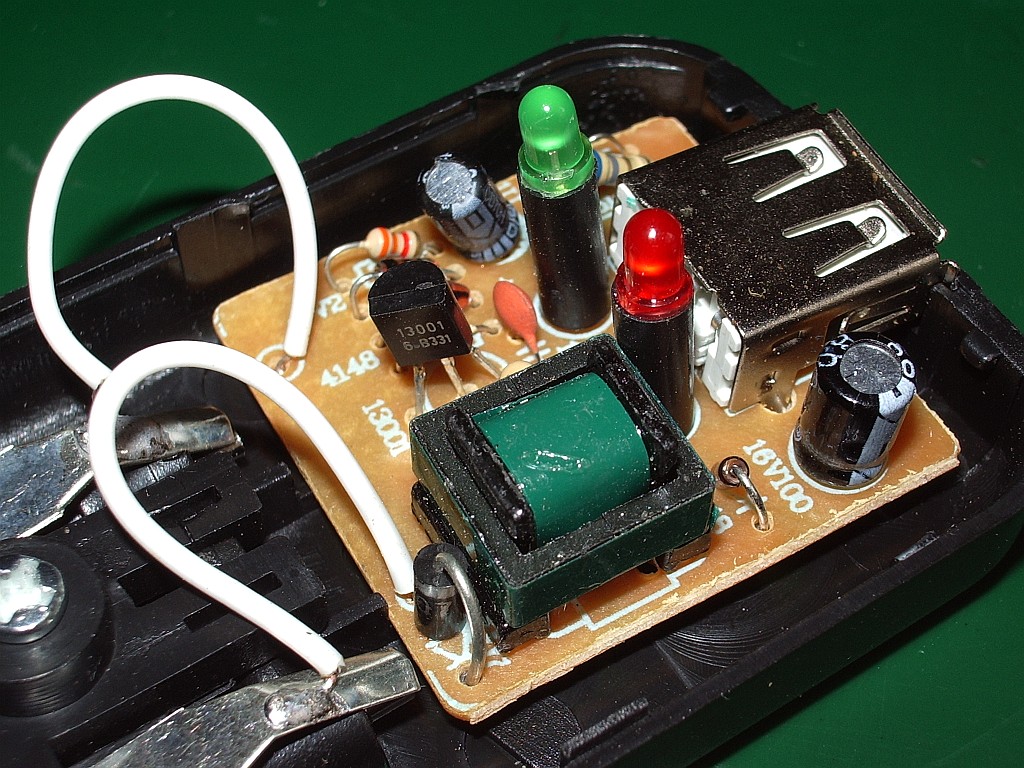
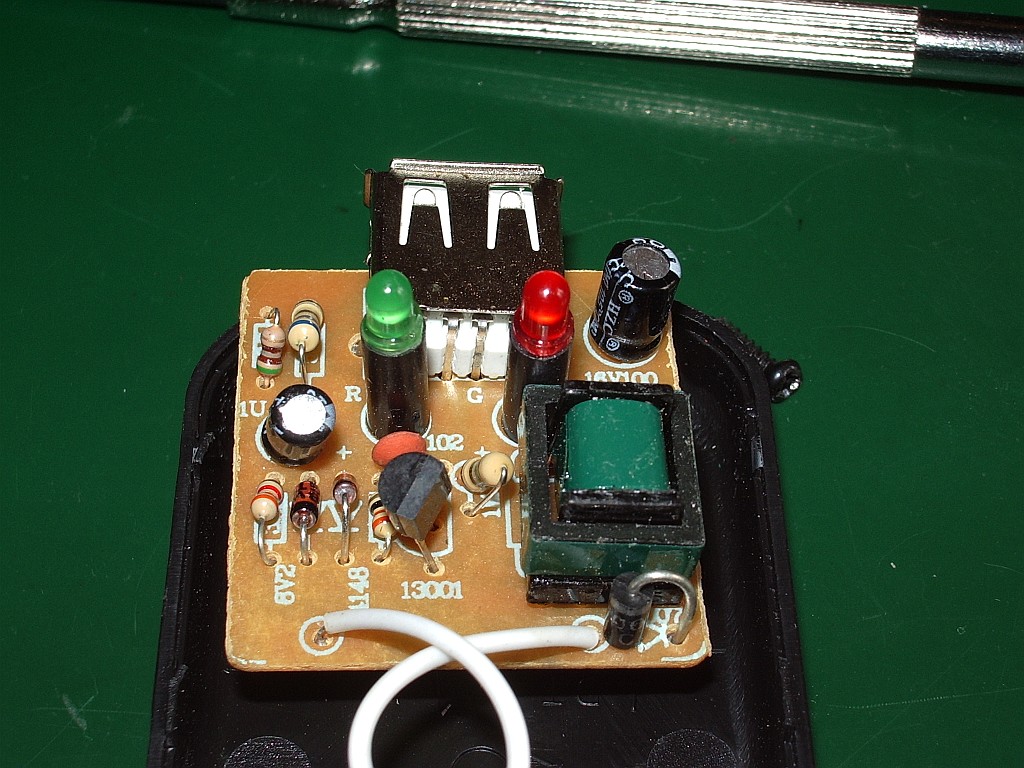

The answer, it seems, is not much. Call me old fashioned, but I’m just a bit apprehensive about having just a handful of components between my equipment and the 230V mains!
It’s a pity that this problem has occurred because I would have liked to have been able to recommend this battery pack to other users of APRSISCE on Windows Mobile. My initial test on the workbench suggest that this battery pack is more than capable of powering the phone with GPS and mobile data connection active during a day’s outing. The battery pack itself seems well made and I would guess that it is probably supplied by its Chinese manufacturer in a nice box with instructions and an adequately rated charger. The trouble in this case would seem to be caused by a cheapskate eBay seller.

Julian Moss, G4ILO, is a regular contributor to AmateurRadio.com and writes from Cumbria, England. Contact him at [email protected].
No charge
The object on the left of the picture is a 9600mAh external back-up battery for MP3 players, mobile phones and other 5V devices. I bought it on eBay (where else?) for $55.99 including shipping with the intention of using it to power my HTC Touch Pro smartphone so that it could run all day using GPS and internet connected apps like the APRS client APRSISCE. Previously I hadn’t been able to make much use of such applications when out and about on foot because if I was away from a power supply for more than a couple of hours the end result was a dead battery and a phone that could not be used to make phone calls.
The product arrived after a couple of weeks wait rather poorly packed in a jiffy bag containing the battery back-up unit, a 5V USB charger with the usual two-prong fold-out mains plug, and a USB cable with coiled lead and interchangeable power connectors. There was no box, nor any instructions so I had to figure things out for myself. Clearly the DC IN port was meant for the charger, the USB socket marked DC OUT was the output and the slide switch next to it turned the output on and off. The four LEDs showed the battery state for a few seconds after the POWER button to the left of it was pressed, and the charging state whilst charging.
There was no cable for charging, so I presumed I had to use the USB lead supplied for output and one of the interchangeable connectors. One of them did fit, though not very well, poorly enough in fact that it pulled out of the socket if there was the slightest tension on the coiled cable.
I started charging the power pack. Two lights lit up on the charger and the charge status showed two of the four LEDs lit. Next time I looked at it all the LEDs were off. Surely the batteries could not have charged so quickly? Eventually I measured the output from the charger and found it was about 0.25V. Clearly the charger had failed.
I sent an email to the eBay seller who was anxious enough about the possibility of receiving negative feedback to immediately promise to send a replacement. Meanwhile I found that the charger which came with my HTC phone had a USB output so I charged the battery pack with that. With hindsight that was rather foolhardy and I ought to have attempted to measure the current drawn first, but I got away with it. Though rated at 1.0 Amp output the HTC charger got fairly warm, but eventually the charge level reached full and the charger got cold again so I assume that it finished charging and the pack was fully charged.
The charger that came with the battery pack is labelled as an “MP3 Power Supply” and the output is rated at: DC 200mA +/- 30mA. Even the 1500mAh battery in the little Baofeng radio takes more than 400mA on charge. I managed to find a cable that would enable me to charge the battery pack from my workbench variable metered power supply and even when the battery pack is only half discharged it is drawing a current of almost 800mA. So I think the charger supplied simply blew up! I’m just hoping the eBay seller will provide a more adequate charger as a replacement. Sure, I can use my existing HTC phone charger. It may even be more convenient than having separate chargers for the two devices. But it would be nice to receive what one paid for.
By the way, if you ever wondered what is inside those Chinese wall-wart power supplies, how come they are so light, here are some pictures of the innards of the one that failed.
The answer, it seems, is not much. Call me old fashioned, but I’m just a bit apprehensive about having just a handful of components between my equipment and the 230V mains!
It’s a pity that this problem has occurred because I would have liked to have been able to recommend this battery pack to other users of APRSISCE on Windows Mobile. My initial test on the workbench suggest that this battery pack is more than capable of powering the phone with GPS and mobile data connection active during a day’s outing. The battery pack itself seems well made and I would guess that it is probably supplied by its Chinese manufacturer in a nice box with instructions and an adequately rated charger. The trouble in this case would seem to be caused by a cheapskate eBay seller.
Julian Moss, G4ILO, is a regular contributor to AmateurRadio.com and writes from Cumbria, England. Contact him at [email protected].
ICQ Podcast S04 E11 – Worldwide Contributors News (22 May 2011)
Series Four Episode Eleven of the ICQ Podcast has been released. News Stories include :-
- Apply to the National Amateur Radio Emergency Database
- International Lighthouse and Lightship Weekend Coming Soon
- CASHOTA Ireland and UK Activity Weekend
- Education Through Amateur Satellites
- New US 4-metre Band Beacon
- PSAs for Amateur Radio
- Thousands of Ham Radio Equipment Stolen
- Walton Fire Rescue Gets Ham Radios
- Enigma Exhibition
- New Radio Listening Guides for Asia-Pacific
- New 40m beacon tests NAVIS conditions
- Decline in UK Amateur Exam Passes
- Saluting Those That Serve
Your feedback, Steve Nichols (G0KYA) Propogation Report, Down Under Report from Ed Durrant (VK2ARE) and a North American HamBrief from Chris Mathieu (N7ICE)
Colin Butler, M6BOY, is the host of the ICQ Podcast, a weekly radio show about Amateur Radio. Contact him at [email protected].
ICQ Podcast S04 E11 – Worldwide Contributors News (22 May 2011)
Series Four Episode Eleven of the ICQ Podcast has been released. News Stories include :-
- Apply to the National Amateur Radio Emergency Database
- International Lighthouse and Lightship Weekend Coming Soon
- CASHOTA Ireland and UK Activity Weekend
- Education Through Amateur Satellites
- New US 4-metre Band Beacon
- PSAs for Amateur Radio
- Thousands of Ham Radio Equipment Stolen
- Walton Fire Rescue Gets Ham Radios
- Enigma Exhibition
- New Radio Listening Guides for Asia-Pacific
- New 40m beacon tests NAVIS conditions
- Decline in UK Amateur Exam Passes
- Saluting Those That Serve
Your feedback, Steve Nichols (G0KYA) Propogation Report, Down Under Report from Ed Durrant (VK2ARE) and a North American HamBrief from Chris Mathieu (N7ICE)
Colin Butler, M6BOY, is the host of the ICQ Podcast, a weekly radio show about Amateur Radio. Contact him at [email protected].
Just when you convinced your wife that your friends were normal…
Just when you convinced your wife that your friends were normal…
You take your wife to Dayton! 🙂 (Ok it’s been about 15 years since I did that and I can’t get my wife to come back even still!)
- Dayton 2011: Saturday– the BIG day!
Except for the toilets (sewer line) exploding in the afternoon in the flea market… it was a picture perfect Hamvention. Nothing like it ever before for me.
But it looks like driving back it will be “tornado alley”.. I’ll keep my fingers crossed…No Hail… No Hail…
Here’s the day in pictures:


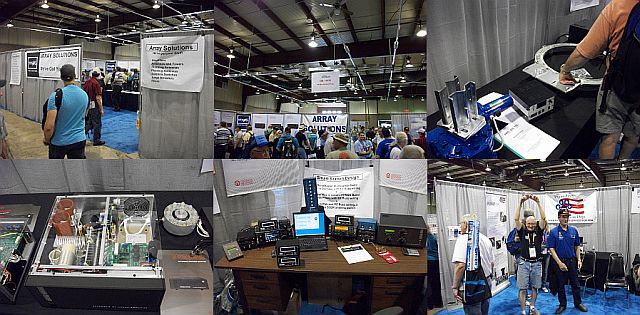


Who is that crazy looking dude with the Astronaut?!?
Well.. it was all fun and games this year.. it’s a wrap for me and the Eastern Iowa DX Association.. I’m praying that the weather isn’t as severe on the way back as predicted.
It was a blast meeting everyone I met at Dayton this year.. I had great fun.. the City of Dayton looks a lot better than it did in 2004, and the weather was beautiful. I had some of the best eyeball QSOs that I’ve had anywhere.
Hopefully it won’t be 7 years before I make the pilgrimage again… catch you all on the bands, eh?
Fred Spinner, WØFMS, is a regular contributor to AmateurRadio.com and writes from Iowa, USA. Contact him at [email protected].
Elecraft KX3 Preview
KX3 STANDARD FEATURES
- 160-6 meter ham bands; general coverage from 1.6-30 MHz (optional broadcast-band filter module covers 0.5-1.6 KHz)
- All modes: SSB, CW, Data (four sub-modes), AM FM
- Ultra-compact size: 3.4″H x 7.4″W x 1.7″D; 18 oz. (less options)
- Rear tilt feet fold up for transport
- Custom high-contrast LCD with alphanumeric text display
- Current drain as low as 150 mA in receive mode
- High-performance 32-bit floating-point DSP
- Built-in PSK/TTY decode/encode allows data mode operation without a PC; transmit in data modes using CW keyer paddle
- Low-noise synthesizer with 1-Hz tuning resolution
- Firmware updateable via provided application software
- Quadrature down-sampling mixer compatible with PC-based SDR (software-defined-radio) applications
- Receiver I/Q outputs for use with PC soundcard
- Narrow roofing filter option with four bandwidths (500Hz, 1500Hz, 2700Hz, 3800Hz) for excellent dynamic range
- Switchable preamp (2 levels) and attenuator (2 levels)
- 8-band receive audio equalizer
- Dual watch over ±10kHz range; uses applicable roofing filter
- Easy-to-use PassBand Tuning (PBT) for shift/width/hi-cut/lo-cut; roofing filters automatically track DSP filter settings
- Automatic and manual notch filtering; adjustable noise reduction and noise blanking; binaural audio effects for enhanced receive
- Center-tuning indicator for CW and data modes
- Built-in speaker; stereo jack for headphones/external speakers
TRANSMITTER
- Adjustable output, 0.1 to 10W+ (100W+ with KXPA100 amp)
- Rugged, SWR and temperature-protected final amplifier stage
- Optional MH3 microphone with PT and UP/DOWN functions
- Optional attached keyer paddle with spacing adjustment
- Switchable PA output impedance for efficient 5-W or 10-W use
- Fast, silent, PIN-diode T-R switching – no relays
- DSP speech processing for excellent “punch”
- 8 band equalizer tailors passband to your voice and microphone
OTHER FEATURES
- Built in digital voice recorder (DVR) with two message buffers
- Internal CW keyer with 8-50 WPM range
- Six CW/DATA message memories
- 100 general-purpose memories store VFO A/B, modes, etc.
- Accessory/RS-232 port for computer control using supplied cable
- Full remote-control command set works with most amateur radio software applications (emulates Elecraft K3)
- One-click firmware upgrades via the web (with free PC software)
- Optional mobile bracket compatible with RAM-mounts
- Tutorial-style manual ideal for new hams
OPTIONS and ACCESSORIES
- KXFLE Roofing Filter Module (500/1500/2700/3800 Hz)
- KXAT3 Internal, Wide-Range 20-W Automatic Antenna Tuner
- KXAM3 Broadcast Band Filter Module (0.5-1.6 MHz)
- KXBT3 Internal 8-AA Cell Battery Pack with NiMH Charger (Batteries not supplied; nonrechanrgeable batteries can also be used)
- KXPD3 Precision Keyer Paddle
- KXMM3 Mobile Mount Bracket
- MH3 Hand Microphone with UP/DN Controls
- KUSB RS232 to USB Adapter
- KXPA100 High-Performance 160-6 meter, 100-W Amplifier; usable with most 5 to 10 W transceivers KXAT100 Wide-Range 100-W ATU with Dual Anenna Jacks (attaches to KXPA100 module)
All kidding aside
I recently re-posted a link to my satirical “My first annual pre-post-Dayton writeup” that I wrote a few years ago. The intent of that was the poke fun at all the write-ups that showed up after the annual Dayton Hamvention, which, to me, seemed to all say the same thing. However, I noticed a couple of interesting things this year. First, unsurprisingly, technology has advanced enough so that there are many folks blogging and even tweeting from on-site while attending. Second, I noticed that several of the on-site bloggers have been posting really good writeups, not just the usual “big, smelly crowds” and “Hara Arena stinks” comments. (Well, apparently Hara Arena is still badly in need of repair).
I suspect that many of my readers already follow these blogs, but David, K2DSL has been posting on-site updates from his first time to Dayton on his blog, and Steve, K9ZW has been posting a series of “Random Notes” on his blog, With Varying Frequency – Amateur Radio Ponderings. I’ve found those postings to be informative and can recommend them. There are also a number of other bloggers posting about Hamvention that are syndicated at amateurradio.com (as is this blog).
Most of the tweets on twitter, while occasionally amusing, haven’t been particularly informative, but Jeff, KE9V has been doing a great job of tweeting about some of the new gear that’s showing up, particularly the new portable Elecraft KX3.
 Ham Radio Deluxe |
 W5SWL Electronics |
 Ham Radio Prep |
 KB3IFH QSL Cards  Hip Ham Shirts  HamRadioAuctions HamRadioAuctions Reliance Antennas Reliance Antennas Enigma Shop Enigma Shop |  morseDX  Ni4L Antennas  R&L Electronics R&L Electronics antennas.us antennas.us QRV QRV |
- Matt W1MST, Managing Editor
