 |
 A bit of a headache
 15 June 2011 | by
 A couple of people have commented on the lack of new postings on this blog. I’m grateful that you noticed. Here are a few words of explanation.
Three weeks ago I was doing some work on the computer when I had what I thought was a bad migraine attack. My vision became blurred and I felt nauseous. I switched off the PC and lay down in a darkened room to recover.
Normally a migraine leaves you feeling a bit shaky and after a couple of days you are right as rain again. but the feeling of shakiness never really went away.
After the attack I noticed a few symptoms that were a bit scary because they were really odd. For example I had trouble telling the time. I could see the hands of the watch but couldn’t seem to make sense of it. I also had trouble finding the pointer on the computer screen, even when I knew where it should be. These symptoms did start to wear off, but I still felt that something wasn’t quite right.
For example, if I was trying to pick something (like a Wainwright summit name) from an alphabetically sorted list on a web page I couldn’t find it. If my radio was on 145.450 and someone said they were QSYing to 145.525 I had trouble finding the channel.
I also had – indeed if you could watch me typing this you would find I still have – a lot of trouble using the keyboard. It became so frustrating that I lost most of the desire to post to the blog.
I was in denial that anything was wrong. Plus, to be honest, I didn’t have much faith that the system here would do much to help me. I hoped that if I just carried on trying to do normal things one day I would find that everything was back to normal again.
Last weekend I went for a walk to the top of Binsey, one of the local Wainwright summits. I made it to the top OK but after I finished making contacts and went to leave I felt strangely disorientated and had to search for the way down. On the drive home I almost went off the edge of the road because I had trouble judging the distance on the left hand side.
Walking around town several times I knocked into lamp posts and other obstructions on the left hand side, as if I didn’t notice them.
Eventually, yesterday, I decided finally that I should see my GP. He listened carefully as I described all the symptoms I have mentioned and did a few tests on my reflexes and co-ordination. Unfortunately it seems my pessimism about the system was not misplaced. The doctor told me that the specialist he would like to refer me to, a neurologist, is not available here.
He said – these are more or less his exact words – that the NHS is very good in an emergency, such as if you have a heart attack, but in the case of ongoing problems it doesn’t work very well. His role is just to help me get the best out of it. So he has arranged for me to have an appointment at the hospital in Whitehaven for a CT scan. which given the speed things normally move here could be several days. In the meantime I have been advised not to drive, which is obviously understandable but a major hassle in an place where public transport is very limited and it is a couple of hours by bus just to reach the hospital.
So I don’t know exactly what is the matter with me. I just have to wait for the results of the scan and hope for the best. In the meantime I can still talk to people on the radio but it is unlikely that I shall be posting to the blog or answering emails very much.

Julian Moss, G4ILO, is a regular contributor to AmateurRadio.com and writes from Cumbria, England. Contact him at [email protected].
My Collins Radio Equipment Is For Sale
I’ve finally decided to sell my Collins S-line station. Trust me, it’s not a decision I’ve made lightly!
I absolutely love this equipment. In fact, it’s my dream rig. I just don’t have the time to devote to working HF and I don’t see that situation improving anytime soon. I know that someone will be able to make very good use of it.
If you are interested, or know of someone who is, please pass this along!

Collins 32S-3A Ham Radio Transmitter
http://cgi.ebay.com/ws/eBayISAPI.dll?ViewItem&item=120737000467

Collins 75S-3C Ham Radio Receiver
http://cgi.ebay.com/ws/eBayISAPI.dll?ViewItem&item=120737004368

Collins 30L-1 Ham Radio Linear Amplifier
http://cgi.ebay.com/ws/eBayISAPI.dll?ViewItem&item=120737009082

Collins DL-1 Ham Radio Dummy Load
http://cgi.ebay.com/ws/eBayISAPI.dll?ViewItem&item=120737012242

Collins 312B-4 Ham Radio Station Control
http://cgi.ebay.com/ws/eBayISAPI.dll?ViewItem&item=120737015978

Collins 516F-2 Ham Radio AC Power Supply
http://cgi.ebay.com/ws/eBayISAPI.dll?ViewItem&item=120737020097
(Update: I’m sorry to report that all the equipment has now sold. Thanks for your interest!)
Matt Thomas, W1MST, is the managing editor of AmateurRadio.com. Contact him at [email protected].
6m digital DX
Conditions were again great on 6 metres yesterday afternoon and evening, with the Sporadic E favouring Scandinavia and the Baltic countries. After making a few contacts on SSB – it’s always gratifying when using an attic dipole to have stations come right back to your call and give you a 59 report – I was tuning up the band and heard the unmistakable sound of PSK31 activity.
I worked LA8OKA and OH2NAF using PSK31 and SM7OYP using PSK63. I thought these may have been my first PSK contacts on 6m but my log tells me I worked Spain using the digimode during June last year.
Signals were strong and steady and most people were using their regular macros and brag files and exchanging greetings rather than sending quick report and locator overs as you might expect for sporadic propagation.
Some bloggers have been advocating using the weak signal digital modes like WSPR or JT65A on 6m but when propagation is this strong I’d rather use a digital mode that allows me to have a proper QSO and exchange names and other details with the stations I’m working.

Julian Moss, G4ILO, is a regular contributor to AmateurRadio.com and writes from Cumbria, England. Contact him at [email protected].
Cheap boom for a mic with this Ikea hack
 I’ve modded a lot of Ikea stuff in the past (I mean really, if you receive something and decide not to use it, do you think you’ll actually get that thing back in the packaging????). Here is a rather simple, inexpensive mod you can do to create a rather decent boom for your mic. I did something similar with a drafting lamp years ago and it really does work well.
Grab yourself a Tertial desk lamp. Last I knew, it was around ten bucks at my local Ikea. All you really need to do is lop off the lamp and cord. Grab the hardware for your mic (you may need a few pieces of assorted hardware or epoxy, but it really isn’t difficult).
I have a few pages with links to help you out if you get stuck.
The following link:
has a decent write up. However, I really have NO clue as to what that mic is in this tutorial. The process is similar for any of our XLR or similar type mics and cages.
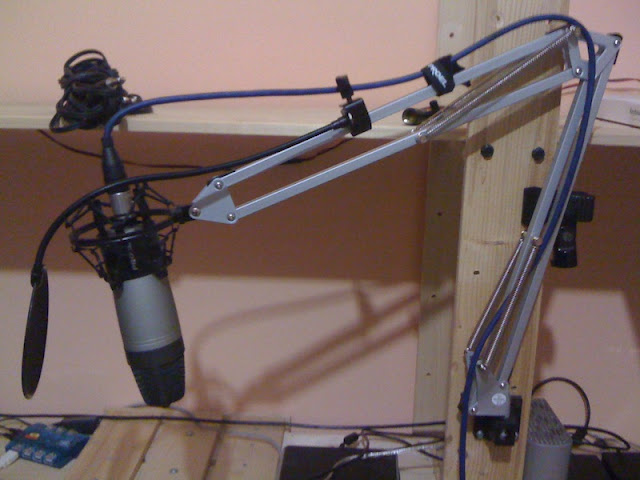 I think this is a little more for what we are looking at with this project.
I hope this works out for you and if you know of any similar boom hacks, let me know. We can save a ton of money on buying something similar specific for our mics.
And if you find any neat Ikea ham radio hacks, let me know and I’ll make a post. I like these rather inexpensive hacks!
Jonathan Hardy, KB1KIX, is a regular contributor to AmateurRadio.com and writes from Connecticut, USA. Contact him at [email protected].
Mirage Active Bias mod, Part 1
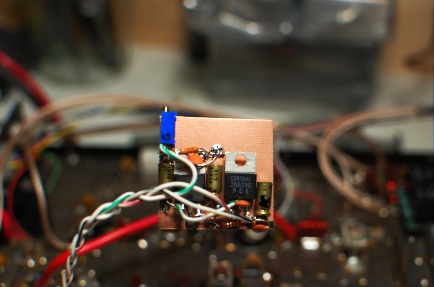
After chatting with Terry, W8ZN, about whether to keep or sell the AM-6155s (which I did sell to finance a tower), he suggested that I apply the N1DPM “Active Bias” modification to my elderly “160-watt” Mirage 2-meter amplifier. I contacted Fred, N1DPM, and he sent me a copy of his paper Linearization of Solid State “Brick” Amplifiers from the 21st Eastern VHF/UHF Conference (1995), along with some additional notes from his notebook. It’s pretty eye-opening how non-linear the amp is without the modification! I finally gathered the parts and hacked it together last night. Hope to test it soon with a “dummy” transistor and then live on the amp. The braided wires go to the thermal compensation transistor which is thermally bonded to one of the RF power transistors.
It probably won’t be ready for the ARRL June VHF this weekend, though. So, I’ll only be using the amp on CW. That’s no matter since I haven’t hung the low-loss cable (LMR and Heliax), nor have I received a D1010 432-MHz amp that will be on its way to me soon. Everything seems to take longer than it ought to!
Ethan Miller, K8GU, is a regular contributor to AmateurRadio.com and writes from Maryland, USA. Contact him at [email protected].
Lost treasure
Earlier in the year I was hunting through some folders on my hard drive and discovered an unreleased version of my Morse training program MorseGen. I had no memory at all of having updated it so I had no idea whether I had finished or tested the update. The main changes from the last released version 1.4 appeared to be that there was now a batch mode for creating recordings to play on an MP3 player and a “Common words” mode. This jogged my memory as to the reason for updating the program. A couple of years ago in QST there was an article which suggested that in order to be able to copy Morse at high speed you should learn to recognize the sounds of complete words not just individual letters. So I had added the ability to play random selections from a list of some of the most common words and CW abbreviations.
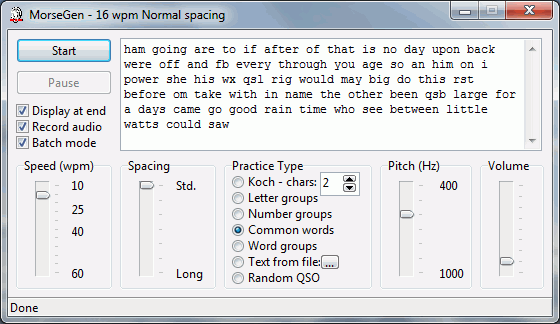
Today I placed this new version of MorseGen on the G4ILO’s Shack website. The previous version is still available to be downloaded in case the new one has problems. My interest in programming has now fallen to absolute zero and I no longer even have the development tools used to compile MorseGen so this is definitely, without argument the last ever version.
This is actually a bit of a nuisance as the new version seems to have a small bug. Occasionally, in Random QSO mode the program will halt with an error message “List index out of bounds.” You have to close the error message and continue. I’m guessing that I added some QSO templates and the random number generator sometimes generates a number that is more than the number of templates. If so, this would be easy to fix if I still had the development tools. But I don’t, so I can’t, so tough luck! But no-one has any grounds for complaint because MorseGen is free!
Despite the bug, I still think MorseGen is a useful program. I often use it whenever I get the urge to try to improve my Morse reading skills. Admittedly it hasn’t done me any good, but I think that is more due to something peculiar to my brain that is just incapable of mastering the code. Over the years since I wrote the first version of MorseGen I’ve had many emails thanking me for it so it appears that it does work for people less Morse-resistant than me!

Julian Moss, G4ILO, is a regular contributor to AmateurRadio.com and writes from Cumbria, England. Contact him at [email protected].
A success for my new FM monitoring capability…
I posted a few weeks ago that I’d got a V2000 antenna up for 50/144/432MHz. When I’ve not been using it on 50MHz, I have had an FM mobile rig scanning about 35 channels. Some of those channels have repeaters close by and others are generally quiet, but liven up if there is a hint of improved propagation.The variation in propagation on a daily basis is fascinating, particularly in the morning and evenings.Last Sunday was a particularly interesting day though. I was working in the shack off and on and left the rig monitoring 145.500 and tried to answer when anyone came up. There were a couple of local QSOs and a couple of not so local ones. I was pleased to work Roger, G4OCO/M near Ely in Cambridgeshire which seemed a decent distance from me. It seemed that conditions were perhaps slightly improved to the east and north east.Later on in the afternoon I worked ON8DM on 144MHz SSB. Just afterwards I noticed a signal on 145.675, weaker than GB3RD that I normally hear on that channel but stronger than the other signals I normally hear there. I wondered what it was and stopped the scan to listen. Over the next few minutes a conversation started up in a language I didn’t immediately recognise. In fact, I suspected it was perhaps an ON repeater, as I’d just worked Belgium on SSB. Signals came up a bit more and then I heard the repeater send a CW ID – LA9MR! LA9MR is located in southern Norway in JO38 around 920km from Longworth.There was absolutely no hint that the band was open in that direction – no beacons on SSB – I listened! It must have been a very localised opening. The signals from LA9MR were audible for about 45 minutes before fading back into the noise.Really fascinating!

Tim Kirby, G4VXE, is a regular contributor to AmateurRadio.com and writes from Oxfordshire, England. Contact him at [email protected].
 Ham Radio Deluxe |
 W5SWL Electronics |
 Ham Radio Prep |
 KB3IFH QSL Cards  Hip Ham Shirts  HamRadioAuctions HamRadioAuctions Reliance Antennas Reliance Antennas Enigma Shop Enigma Shop |  morseDX  Ni4L Antennas  R&L Electronics R&L Electronics antennas.us antennas.us QRV QRV |
- Matt W1MST, Managing Editor
