 |
 Cheap boom for a mic with this Ikea hack
 10 June 2011 | by
  I’ve modded a lot of Ikea stuff in the past (I mean really, if you receive something and decide not to use it, do you think you’ll actually get that thing back in the packaging????). Here is a rather simple, inexpensive mod you can do to create a rather decent boom for your mic. I did something similar with a drafting lamp years ago and it really does work well.
Grab yourself a Tertial desk lamp. Last I knew, it was around ten bucks at my local Ikea. All you really need to do is lop off the lamp and cord. Grab the hardware for your mic (you may need a few pieces of assorted hardware or epoxy, but it really isn’t difficult).
I have a few pages with links to help you out if you get stuck.
The following link:
has a decent write up. However, I really have NO clue as to what that mic is in this tutorial. The process is similar for any of our XLR or similar type mics and cages.
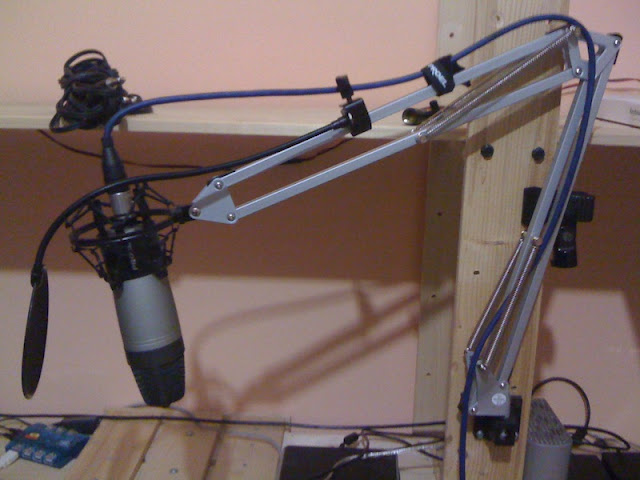 I think this is a little more for what we are looking at with this project.
I hope this works out for you and if you know of any similar boom hacks, let me know. We can save a ton of money on buying something similar specific for our mics.
And if you find any neat Ikea ham radio hacks, let me know and I’ll make a post. I like these rather inexpensive hacks!
Jonathan Hardy, KB1KIX, is a regular contributor to AmateurRadio.com and writes from Connecticut, USA. Contact him at [email protected].
Mirage Active Bias mod, Part 1
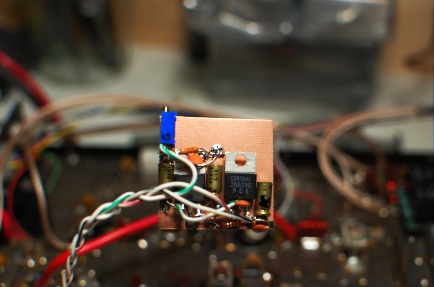
After chatting with Terry, W8ZN, about whether to keep or sell the AM-6155s (which I did sell to finance a tower), he suggested that I apply the N1DPM “Active Bias” modification to my elderly “160-watt” Mirage 2-meter amplifier. I contacted Fred, N1DPM, and he sent me a copy of his paper Linearization of Solid State “Brick” Amplifiers from the 21st Eastern VHF/UHF Conference (1995), along with some additional notes from his notebook. It’s pretty eye-opening how non-linear the amp is without the modification! I finally gathered the parts and hacked it together last night. Hope to test it soon with a “dummy” transistor and then live on the amp. The braided wires go to the thermal compensation transistor which is thermally bonded to one of the RF power transistors.
It probably won’t be ready for the ARRL June VHF this weekend, though. So, I’ll only be using the amp on CW. That’s no matter since I haven’t hung the low-loss cable (LMR and Heliax), nor have I received a D1010 432-MHz amp that will be on its way to me soon. Everything seems to take longer than it ought to!
Ethan Miller, K8GU, is a regular contributor to AmateurRadio.com and writes from Maryland, USA. Contact him at [email protected].
Lost treasure
Earlier in the year I was hunting through some folders on my hard drive and discovered an unreleased version of my Morse training program MorseGen. I had no memory at all of having updated it so I had no idea whether I had finished or tested the update. The main changes from the last released version 1.4 appeared to be that there was now a batch mode for creating recordings to play on an MP3 player and a “Common words” mode. This jogged my memory as to the reason for updating the program. A couple of years ago in QST there was an article which suggested that in order to be able to copy Morse at high speed you should learn to recognize the sounds of complete words not just individual letters. So I had added the ability to play random selections from a list of some of the most common words and CW abbreviations.
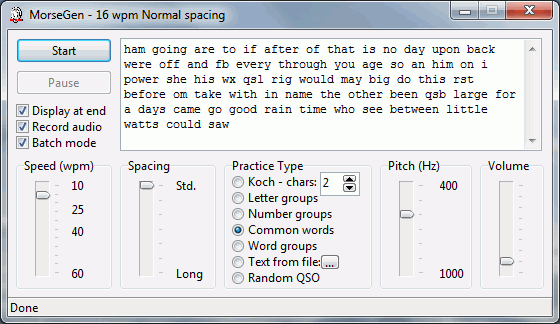
Today I placed this new version of MorseGen on the G4ILO’s Shack website. The previous version is still available to be downloaded in case the new one has problems. My interest in programming has now fallen to absolute zero and I no longer even have the development tools used to compile MorseGen so this is definitely, without argument the last ever version.
This is actually a bit of a nuisance as the new version seems to have a small bug. Occasionally, in Random QSO mode the program will halt with an error message “List index out of bounds.” You have to close the error message and continue. I’m guessing that I added some QSO templates and the random number generator sometimes generates a number that is more than the number of templates. If so, this would be easy to fix if I still had the development tools. But I don’t, so I can’t, so tough luck! But no-one has any grounds for complaint because MorseGen is free!
Despite the bug, I still think MorseGen is a useful program. I often use it whenever I get the urge to try to improve my Morse reading skills. Admittedly it hasn’t done me any good, but I think that is more due to something peculiar to my brain that is just incapable of mastering the code. Over the years since I wrote the first version of MorseGen I’ve had many emails thanking me for it so it appears that it does work for people less Morse-resistant than me!

Julian Moss, G4ILO, is a regular contributor to AmateurRadio.com and writes from Cumbria, England. Contact him at [email protected].
A success for my new FM monitoring capability…
I posted a few weeks ago that I’d got a V2000 antenna up for 50/144/432MHz. When I’ve not been using it on 50MHz, I have had an FM mobile rig scanning about 35 channels. Some of those channels have repeaters close by and others are generally quiet, but liven up if there is a hint of improved propagation.The variation in propagation on a daily basis is fascinating, particularly in the morning and evenings.Last Sunday was a particularly interesting day though. I was working in the shack off and on and left the rig monitoring 145.500 and tried to answer when anyone came up. There were a couple of local QSOs and a couple of not so local ones. I was pleased to work Roger, G4OCO/M near Ely in Cambridgeshire which seemed a decent distance from me. It seemed that conditions were perhaps slightly improved to the east and north east.Later on in the afternoon I worked ON8DM on 144MHz SSB. Just afterwards I noticed a signal on 145.675, weaker than GB3RD that I normally hear on that channel but stronger than the other signals I normally hear there. I wondered what it was and stopped the scan to listen. Over the next few minutes a conversation started up in a language I didn’t immediately recognise. In fact, I suspected it was perhaps an ON repeater, as I’d just worked Belgium on SSB. Signals came up a bit more and then I heard the repeater send a CW ID – LA9MR! LA9MR is located in southern Norway in JO38 around 920km from Longworth.There was absolutely no hint that the band was open in that direction – no beacons on SSB – I listened! It must have been a very localised opening. The signals from LA9MR were audible for about 45 minutes before fading back into the noise.Really fascinating!

Tim Kirby, G4VXE, is a regular contributor to AmateurRadio.com and writes from Oxfordshire, England. Contact him at [email protected].
Simplex D-STAR
Things have been busy here so not much chance to update the blog, but just a few moments now, so….It’s good to hear that some people are having a go at using D-STAR for simplex contacts rather than just repeater/network based work. Des, G0RBD in Chippenham has just got started on the mode and has been making some interesting simplex QSOs.What I hadn’t realised was that 144.6125 appears to be being used for simplex contacts on 144MHz. So if you’re out and about mobile or portable with D-STAR kit, it could well be worth a call on there!

Tim Kirby, G4VXE, is a regular contributor to AmateurRadio.com and writes from Oxfordshire, England. Contact him at [email protected].
More Travelling

"Radio was born here" sign in an old CBC building
Once again, I am travelling because of work. This time it is the other side of North America, I am currently in St John’s Newfoundland.
While Ontario has had a heat wave the weather in St John’s has been cool and foggy. The fog has been almost continuous since I arrived on Sunday and it even caused one aborted attempt at landing when flying in from Ottawa. The conference has been good and in the evening we have visited Kelly’s Bar which has great fish and chips as well as live music. For vegetarian food I recommend the Sprout too, great curry! (Just realized, showing my British origins with my eating habits – fish n’ chips and curry).
The fog lifted a little today and gave an opportunity to see more of the painted ‘jelly bean’ houses that St John’s is famous for.

One of the 'jelly bean' houses in St John's NF
The conference is now over and I fly back tomorrow afternoon. However, in the morning I plan on visiting Signal Hill the receiver site of Marconi’s first trans-Atlantic radio transmission. I will report on the visit in a later post.


Alan Steele, VA3STL, is a regular contributor to AmateurRadio.com and writes from Ottawa, Ontario. Contact him at [email protected].
An Honest Report
Some may just jump to the conclusion that I’m recycling articles from QST, but I’m not — I promise! Having said that, on with the show…
A few months ago there was a nice two-month series in QST about signal reports. The author concentrated on what the numbers actually mean and how to use the reports. The first installment was about voice signals, the second about digital signals along with a suggestion of a tweaked system for digital signal reports.
I enjoy a nice cross section of our hobby: rag chewing, traffic handling, EmComm, some contesting, DX’ing, nets, and digital work. Of all those aspects there is one thing that stands out that seems pointless. Every signal report is a 5 by 9. Now I understand that during the peak or activity in a contest, it may be easiest to give the same report to everyone, especially if you can have your logging program pre-fill the signal report. But is this helpful? Is it ‘honest’? The signal report system was designed to give a signal report. An honest evaluation of how you can copy the other station. It wasn’t conceived to be an autopilot tool to speed along a contest or QSO.
If someone is stuck in autopilot with 5 by 9 reports, what’s the point of even giving them? There are times where it’s beyond obvious that I was hard to pull out, yet I’m told I’m 5 by 9. If they we’re honest about my report, I could tweak my antenna or processor or if I have an amp, turn up my power a little to improve my signal. If I’m only giving out a 5 by 9 report, the same holds true, it’s of no help whatsoever to the other station.
I refuse to just give 5 by 9 reports. I don’t care if it’s a contest or a rare DX station. If they are not an honest 5 by 9, I will not give them a 5 by 9 report. I’ve made a few contesters mad. One even chewed me out about it. One even tried to ‘teach me’ to only give 5 by 9 reports. But I refuse. I want to use the system properly!
I challenge others to join me, give an honest signal, even when it catches the other station off guard. Maybe if enough of us do that we’ll start getting honest reports back and be able to actually use the reports as they were intended!
 Ham Radio Deluxe |
 W5SWL Electronics |
 Ham Radio Prep |
 KB3IFH QSL Cards  Hip Ham Shirts  HamRadioAuctions HamRadioAuctions Reliance Antennas Reliance Antennas Enigma Shop Enigma Shop |  morseDX  Ni4L Antennas  R&L Electronics R&L Electronics antennas.us antennas.us QRV QRV |
- Matt W1MST, Managing Editor
