 |
 Ham Nation 10
 28 July 2011 | by
 Special guest Nate Brightman talks about working in the wireless room aboard the Queen Mary, George builds a crystal radio kit, Bob answers your questions, and more.
Guests: Nate Brightman, K6OSC, David Akins, N6HHR, and George Thomas, W5JDX
Download or subscribe to this show at http://twit.tv/hn.
We invite you to read, add to, and amend our show notes at wiki.twit.tv.
Thanks to Joe Walsh who wrote and plays the Ham Nation theme.
Thanks to Cachefly for the bandwidth for this show.
http://dts.podtrac.com/redirect.mp4/twit.cachefly.net/video/hn/hn0010/hn0010_h264b_864x480_500.mp4
http://dts.podtrac.com/redirect.mp4/twit.cachefly.net/video/hn/hn0010/hn0010_h264b_640x368_256.mp4
http://www.podtrac.com/pts/redirect.mp3/twit.cachefly.net/hn0010.mp3
Dr. Bob Heil, K9EID, is the founder of Heil Sound and host of TWiT.tv's Ham Nation which streams live each Tuesday at 6:00pm PT (9:00pm ET) at http://live.twit.tv. Contact him at [email protected].
Handiham World for 27 July 2011
Welcome to Handiham World!
It is less than two weeks to Handiham Radio Camp, which begins on Monday, 8 August. As you might imagine, Nancy and I have been busy with last minute paperwork and communications from everyone who is planning to be at camp. We have made considerable progress, but lots of work still needs to be done as we get the equipment ready and answer questions while still trying to provide services to our Handiham members who will not be at camp. Last week I got my son Will, KC0LJL, sent off to Japan, where he will be teaching English for a year. Needless to say, I have not been bored for lack of things to keep me busy!
 | Wouldn’t it be nice to get QST in digital format? That just could be an option in the future. A plan for the next steps in providing QST digitally (in addition to the print edition) was approved at the recent ARRL Board meeting. The change in accessibility brought about by the personal computer and digital reading devices is simply enormous. Worldradio Magazine has led the way with an entirely digital version, which allows blind computer users to access the articles with screenreading software at virtually the same time they are available to everyone else. |
| Curious about Morse code? Coming to Radio Camp? Keep reading for news about learning code. |
[email protected]
Handiham Manager
But first – Help us win the Dr. Dave Challenge!
Money is tight these days and we desperately need your support. Now, thanks to a generous challenge grant by Dr. Dave Justis, KN0S, we have a chance to help fill the budget gap. Dr. Dave will donate $5,000 to the Handiham System if we can raise a matching amount. That means we need to really put the fund-raising into high gear! If you can help, designate a donation to Handihams, stating that it is for the “Dr. Dave Challenge”. We will keep you posted in our weekly e-letter as to the progress of the fund.
Nancy can take credit card donations via the toll-free number, 1-866-426-3442, or accept checks sent to our Courage Center Handiham address:
Courage Handiham System
3915 Golden Valley Road
Golden Valley, MN 55422
Be sure to put a note saying “Dr. Dave Challenge” somewhere in the envelope or on the note line of the check. If you donate online as detailed toward the end of your weekly e-letter, be sure to designate to Handihams and then send me an email letting me know you donated to the Dr. Dave fund: [email protected].
Thank you so much for your support!

Pat Tice, WA0TDA, is the manager of HANDI-HAM and a regular contributor to AmateurRadio.com. Contact him at [email protected].
Meet Leo Laporte – KJ6QGP
I have been a fan of Leo Laporte for many, many, years. I even had the pleasure to interview him for NewsTek, about his Tricaster and just new media in general. And now, after many years of saying he could be an amazing ambassador for Amateur Radio, it has come to pass, as I had speculated a few months back, Leo is now KJ6QGP.

Photo Courtesy of Leo Laporte
There really isn’t much I can say about Leo that isn’t already widely known about him already. He’s a syndicated radio show host, with The Tech Guy, and he is now starting a new chapter in the TWiT history books with a new studio built on the popularity of the shows he has created and produced, which are all online. New Media’s finest example.
Now that he has him Ham Radio ticket, from what I have heard in Ham Nation Episode 8, is that Leo is planning on making Ham Radio a main fixture at the new studio for his shows. And that local Hams will be helping to get it all started. From setting up the station to helping erect antennas. According to Bob, K9EID, the station will be able to transmit HF as well as VHF/UHF. And it has also been said, that Leo is applying for the vanity call W6TWT.
If anything, I now have a goal of getting my HF back on the air, so I can try and work the new TWiT Brickhouse and get a cool QSL card. And then, there is always getting out there to actually use the station.
73.
Rich also writes a Tech blog and posts stories every Tuesday and Thursday on Q103, The Rock of Albany’s website, as well as Amateur Radio stories every Monday thru Friday here on AmiZed Studios.
Rich Gattie, KB2MOB, is a regular contributor to AmateurRadio.com and writes from New York, USA. Contact him at [email protected].
The meaning of >F
I have been playing with using the Kenwood TH-D72 as a standalone digipeater and fired up the FoxTrak APRS tracker I built last year. The FoxTrak is a TinyTrak clone using DK7IN firmware. I had not noticed a problem before when using a TNC connected to PC software, but now I found that the D72 will not display the FoxTrak’s packets. Instead, it interrupts the frequency display and puts >F G4ILO-12 on the first line of the display. The packets are digipeated but they don’t appear in the radio’s list of received stations.
I’m guessing that >F is some sort of error status but it is not listed on page APRS-3 of the user manual where the other status indicators are listed. Does anyone know what it means, or how to configure the FoxTrak so that the Kenwood will display the beacons?

Julian Moss, G4ILO, is a regular contributor to AmateurRadio.com and writes from Cumbria, England. Contact him at [email protected].
A Dozen Radios in One Car. [VIDEO]
So I guess this video is as viral as you can get in the Ham Radio Community. But the name of the video lives up to what you see in it. I guess you could almost say it’s something you would see on HamSexy. But everyone has their own way. So here it is. The video that has been making it’s way around Twitter. Some questions I have about this video is, how does he know which mic to use, and how does he keep track of conversations? And what’s up with the business cards on the dash? And with all those speakers, does he get surround sound now if he tunes all the radios to the same frequency? Just askin’.
73.
Rich also writes a Tech blog and posts stories every Tuesday and Thursday on Q103, The Rock of Albany’s website, as well as Amateur Radio stories every Monday thru Friday here on AmiZed Studios.
Rich Gattie, KB2MOB, is a regular contributor to AmateurRadio.com and writes from New York, USA. Contact him at [email protected].
UV-3R programming cable
Today I made a programming cable for the Baofeng UV-3R. Until now I couldn’t be bothered, as the radio is easy to program manually and neither the cost of sending off for a programming cable nor the complexity of building one of the programming interfaces published on the web seemed worthwhile. But it turned out to be very easy.
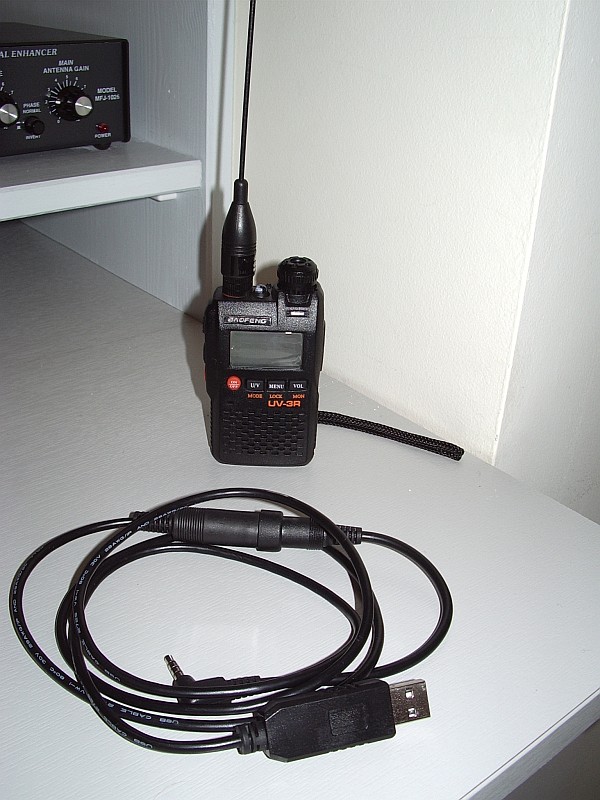
A few months ago, with other purposes in mind, I ordered on eBay two USB/TTL/RS232 cables. If you search eBay for “PL2303” you should find a couple of sellers: one from Hong Kong is currently selling a single cable with free shipping for £3.99. These are USB plugs with the serial converter built in to the plug. At the other end there are four wires: GND, TXD, RXD and +5V. The logic level is 3.3V (at least mine are) so it can be used directly with the UV-3R. Just solder the appropriate wires to a 4-way 3.5mm jack plug.
The connections (and the wire colours for my cables) are:
- GND (black) – base of the plug
- TXD (green) – first ring
- no connection – second ring
- RXD (white) tip
Cut off the red +5V wire and make sure it doesn’t short out against anything.
In the photo you’ll see that there is something else in the middle of my cable. That’s because I used a 4-way 3.5mm to mini-DIN adapter sold for use with various Yaesu radios such as the VX-1R, VX-3R, VX-5R, FT-60R and VX-150 instead of a simple plug. I bought that at the same time I bought the radio as I thought it might be useful if I wanted to try connecting other things such as a TNC. Plus the simple 4-way 3.5mm jack plugs are a bit hard to find.
Mini-DIN plugs can be a bugger to solder, especially with my hands shaking as they do now. But the inline socket I used today had terminals that would hold the tinned end of a thin wire pushed into it even without soldering, which made the job easy for me.
I tested the new cable with the UV-3R programming software and it worked, so that was a good result.
By the way, I saw on the UV-3R Yahoo group that the free cross-platform cross-radio programming tool CHIRP will soon be supporting the UV-3R. I can claim a little bit of credit for that as I was instrumental in persuading a UV-3R user who had been investigating the programming protocol to share his findings with CHIRP’s author. So soon you’ll be able to upload memories from other radios into your UV-3R.

Julian Moss, G4ILO, is a regular contributor to AmateurRadio.com and writes from Cumbria, England. Contact him at [email protected].
I am thinking Flight of the Bumblebees in STYLE this year !

K4UPG demonstrates how to get to FOBB in STYLE!
While everyone is thinking about antennas, staying cool and planning for the upcoming FOBB, I been checkin out a new ride! What do you think? Buzz- Buzz! Does this shout FOBB or what?
Now I can settle down and get ready for FOBB action with my untested top secret antenna. It will be all out for me again this year! Lookin’ for my friends out there on the ether and praying we don’t get lightning again like we did in 2009.
The last few years 20 meters has been the go to band, but it sure has not sounded very good here in Central Florida during the contest hours, so it will require being ready to shift bands to take advantage of the conditions.
BumbleBee #010 is gonna be listening for you all and lookin’ for the promised post of last year’s results too. CUL and 72– K4UPG
Kelly McClelland, K4UPG, is a regular contributor to AmateurRadio.com and writes from Florida, USA. Contact him at [email protected].
 Ham Radio Deluxe |
 W5SWL Electronics |
 Ham Radio Prep |
 KB3IFH QSL Cards  Hip Ham Shirts  HamRadioAuctions HamRadioAuctions Reliance Antennas Reliance Antennas Enigma Shop Enigma Shop |  morseDX  Ni4L Antennas  R&L Electronics R&L Electronics antennas.us antennas.us QRV QRV |
- Matt W1MST, Managing Editor
