 |
 ICQ Podcast S04 E16 – Cyprus Ham Radio Uncovered (31 July 2011)
 31 July 2011 | by
 Series Four Episode Sixteen of the ICQ Podcast has been released. News Stories include :-
- New Zealand's first radio station ZLW 100 years old
- RSGB Amateur Radio survey results
- Ofcom licensing error
- Codar radar on 24 MHz
- Amateur Radio exams falling
- 2 metre simplex frequencies loss imminent in Texas
- Radio ham killed in tower accident
- Ham radio saves man’s life
- SJ22S World Scout Jamboree
- The Republic of South Sudan now a DXCC Entity
- 5 MHz in Slovakia
- 500 kHz and 70 MHz in the Netherlands
- Brazil's first Amateur Radio satellite
Your feedback and Martin (M1MRB) and Colin (M6BOY) interview Richard (5B4AJG / M1EAR) and Baz (5B4AHO / M5BAZ) about being Amateur / Ham Radio operators in Cyprus.
Colin Butler, M6BOY, is the host of the ICQ Podcast, a weekly radio show about Amateur Radio. Contact him at [email protected].
Riverside portable with KX1

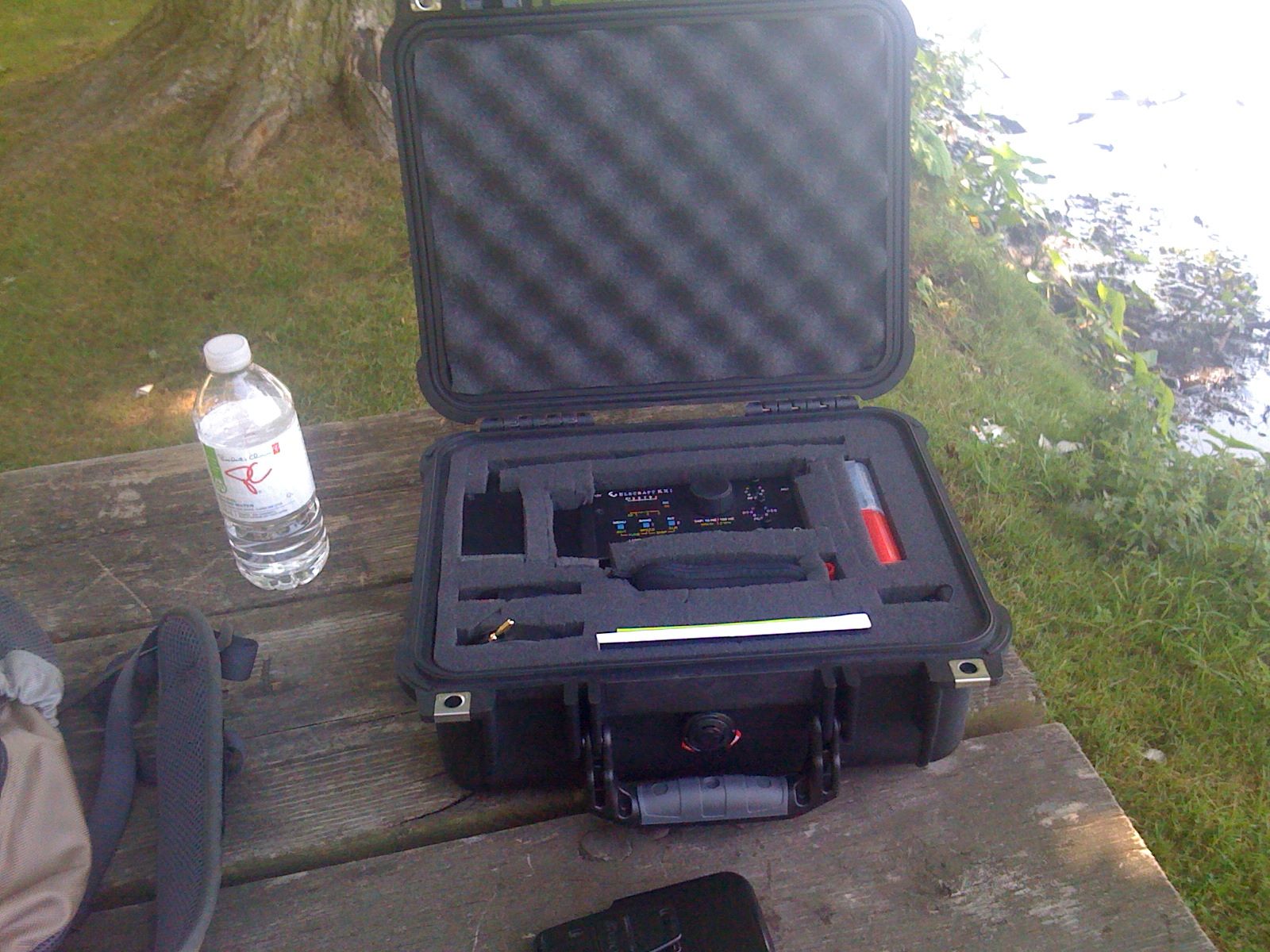
sure all was packed (Murphy decided to participate in those plans). It was off to Starbuck to have a coffee and get the laptop out (Starbucks has free wifi) and look up the contests that are on and get the exchange's they are using. I was going to be a "point giver" in as many contests as I could. So once at Starbucks Murphy kicked in.....I had all I needed for my portable operation but forgot my laptop!!!! Well the Iphone came to the rescue and I was able to get the contest info from there. So it was off to the park and I did find the perfect spot to setup at around 10 am. It was still cool but just to make sure this spot was under a large tree with
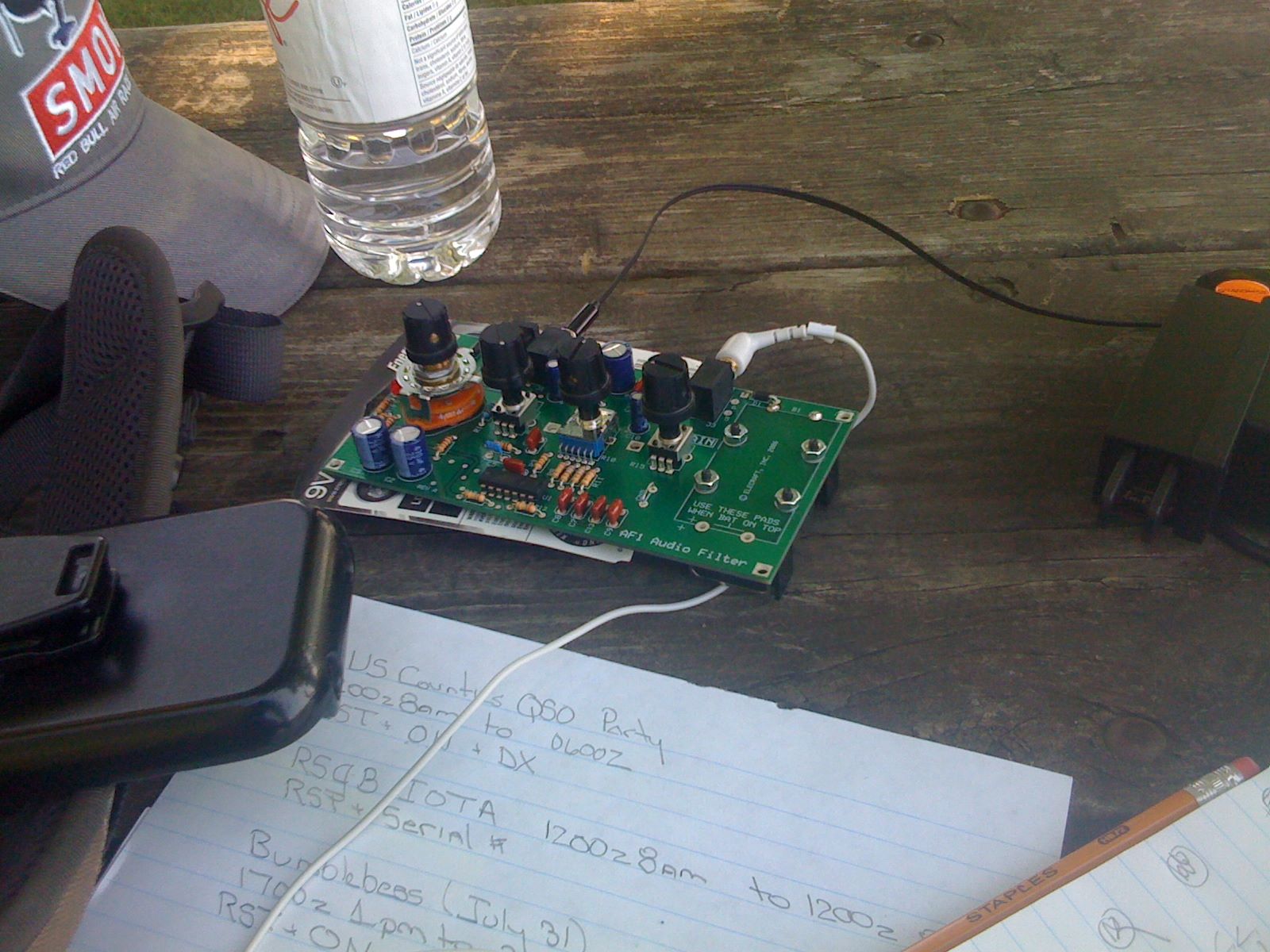 |
| Elecraft AF1 |
lots of shade right beside the river. It was time to take a picture of the setup. Got the camera out and it just would not take a picture...I charged the battery last night....hmmm...upon further investigation I forgot to put a memory card for the camera.....another Murphy moment....Well the Iphone came to the rescue once again so the pic's in this post are done with my Iphone. I camped out on 20 meters and it seemed to be more alive with the IOTA contest than the QSO party contest. The noise level was amazing at almost "0" . So how did the AF1 work out...I found the connecting cable between the KX1 and AF1 being not shielded was picking up the RF from the
 |
| The park patrol |
 N4LN 14.082mhz 400 miles with 1 watt.
Mike Weir, VE9KK, is a regular contributor to AmateurRadio.com and writes from New Brunswick, Canada. Contact him at [email protected].
HamAuction.com Up For Grabs

A little birdie let me know that an interesting web address is up for auction today. The Internet domain name, hamauction.com, is at a little over $300 at the moment. For those looking to set up a ham radio-related site, not a bad name!
For those who are interested, it’s being offered up for auction by the domain registrar. Apparently the former owner didn’t pay the renewal fee, so now it goes to auction to the highest bidder. There’s a good lesson here — if you own your own web address, don’t forget to keep your e-mail address current so that you get the renewal notices. Even better, pay a few years ahead so that you don’t wake up one morning and your domain name is gone!
Anyway, here’s the link.
Matt Thomas, W1MST, is the managing editor of AmateurRadio.com. Contact him at [email protected].
Meet Herman Munster – W6XLR-4 [VIDEO]
For no apparent reason, I woke up this morning, took a shower and ate my oatmeal for breakfast. Sat down a started looking through the emails I got over night and it struck me. Why don’t I look up videos on YouTube of the Munsters. Then I remembered that Herman Munster was a Ham!So I started my search knowing full well that I may never find a clip of what I was looking for. I wanted to share the entire episode, but part 1 was missing. So I would like to share this with you. Herman Munster, W6XLR-4, super Ham Radio operator.
73.
Rich also writes a Tech blog and posts stories every Tuesday and Thursday on Q103, The Rock of Albany’s website, as well as Amateur Radio stories every Monday thru Friday here on AmiZed Studios.
Rich Gattie, KB2MOB, is a regular contributor to AmateurRadio.com and writes from New York, USA. Contact him at [email protected].
Improving 50-MHz Transmit Capability
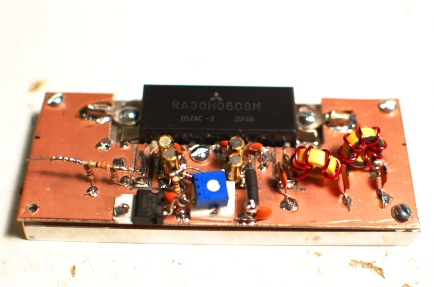
Over the past week in the evenings, I’ve managed to cobble a little PA together for the 50-MHz transverter. It’s a near-clone of the PA in the Elecraft XV50 using the Mitsubishi RA30H0608M. Last night, I got it all hooked up and installed in the cabinet. It broke into oscillation when keyed on CW.
The oscillation was about 50.040 MHz. I reasoned that it might be the PA output coupling into the nearby TX RF bandpass filters which are followed by 12 dB of gain before returning to the PA. So, tonight, I added a litle shield between the BPF and the PA board. That seemed to clear things up and I got about 10 watts out. There is a 6-dB pad between the last driver stage and the PA, so I should be able to get it up to about 18-20 watts. But, the first goal will be to check the linearity on SSB.
In other transmit capability news, some boxes and heatsinks arrived for the W6PQL PAs for 903 and 1296 this afternoon.
Ethan Miller, K8GU, is a regular contributor to AmateurRadio.com and writes from Maryland, USA. Contact him at [email protected].
LHS Show Notes #062
Introduction:
- Introductions, chit chat, a bit about the Dayton Hamvention, Texas Linuxfest, and the Belton hamfest.
- LHS will be at several events this summer:
- SouthEast LinuxFest (SELF), June 10-12 in Spartanburg, SC. (Yes, I know, by the time you hear this episode, it’s come and gone.)
- Huntsville Hamfest August 20-21 in Huntsville, AL.
- Ohio Linuxfest September 9-11 in Columbus, OH.
- Stop by and say hello to Russ and Cheryl!
- Richard may be attending the Texoma Hamarama October 21-22 in Ardmore, OK.
- Russ tells us about the sewer failure at Dayton. Only two restrooms in Hara were working Saturday afternoon. Apparently it was fixed by Saturday evening.
Topic: PulseAudio
- Richard’s son is trying to start his own computer repair business and recently he received a call from Misha who wanted him to fix a sound issue on her Sony Vaio, which dual-boots Windows 7 and Ubuntu 11.04. Sound worked fine in Windows, but not in Ubuntu, and she preferred using Ubuntu. After working with the machine for a while, he figured out that PulseAudio was the problem, and replacing it with ALSA fixed it.
- While researching the problem, Richard discovered PulseAudio problems exist on more than just the Sony Vaio. He also found PulseAudio problems with Ubuntu, Fedora, Open Suse 11 or higher, Arch Linux, Zen, and Sabayon, and with both Gnome and KDE desktops.
- Two sites in particular were helpful:
- Russ and Richard discuss Linux audio problems, and the current state of PulseAudio, particularly with WINE. Russ notes that he’s had no sound problems under Linux Mint.
- Russ describes various ways to troubleshoot PulseAudio issues on Linux.
- In Gnome, right-click on the speaker icon and select sound preferences. From here you can examine the hardware, choose a sound profile, configure your inputs and outputs, and see which applications are using PulseAudio.
- There are a variety of utilities useful for debugging PulseAudio problems:
- paman (PulseAudio Manager Utility). Install it with the command “apt-get install paman”. It tells you a lot of information about PulseAudio, including “sinks” and “sources”. You can also use it to set volume levels with greater control than with the desktop audio manager.
- paprefs (PulseAudio Preferences Panel) Install it with the command “apt-get install paprefs”. Allows you to perform advanced functions such as connecting PulseAudio servers together, send sound from one server to another, create virtual sound devices, etc.
- pavucontrol (PulseAudio Volume Control) Install it with the command “apt-get install pavucontrol”. Allows you to see every application that accesses PulseAudio, set volume levels per channel, and other configuration settings.
- pavumeter (PulseAudio VU Meter) Install it with the command “apt-get install pavumeter”. Creates a VU Meter window that displays your audio levels.
- padsp, pamon Install with the command “apt-get install pulseaudio-utils”. pamon will allow you to capture the bytes of audio data. padsp allows you to pipe the audio from an application that does not normally support PulseAudio, into PulseAudio.
- Remember, you can use the “man” command for help on any of these commands. For example, in a terminal type “man padsp” for help on the padsp utility.
- Check out Ted’s sound card programs for ham radio. They are all now PulseAudio compatible.
Contact Info:
- Contact Richard at [email protected], Russ at [email protected], or both at the same time at [email protected].
- Listen to the live stream every other Tuesday at 8:00pm Central time. Check the LHS web site for dates.
- Leave us a voice mail at 417-200-4811, or record an introduction to the podcast.
- Sign up for the LHS mailing list.
- Sign up for the MAGNetcon mailing list.
- LHS merchandise is available at the SHOP! link on Web site. Check out the Badgerwear or buy one of the other LHS-branded items at PrintFection.com/lhs or Cafe Press. Thanks!
- Thanks to Dave from Gamma Leonis for the theme music.
Russ Woodman, K5TUX, co-hosts the Linux in the Ham Shack podcast which is available for download in both MP3 and OGG audio format. Contact him at [email protected].
ARRL Forums are Open for Business
I haven’t seen anything on this on Twitter, but every now and again, I like to make sure to check the ARRL’s website for info on what’s going on. It seems that a lot of it seems to not make it to Twitter. Either no one’s retweeting it or I keep missing it on the ARRL’s Twitter.

Screen Shot of the ARRL's New Web Forums
The ARRL has opened up a forum on their website back on July 26th. I have only taken a glance at some of the forums that are open, like DXCC and VUCC. There is also a couple of RFI forums as well. I could use that with my mobile radio. But at first look alone, this looks to be a good resource for new as well as veteran hams.
Forums rules are also posted for all to read, and I encourage those of you planning on using the forums to read them. I don’t know about anyone else, but I’m not a fan of coming in to a forum and reading a question from a new ham and seeing a sideways comment aimed at them. I’m reasonably sure no one likes that.
As the forum is brand new, there really isn’t much in there, but I think a few good posts could help that and get more people in there to post. Plus if more people talk about it, that would help greatly. So if you can, retweet the link, or better yet, retweet this story! Yeah, That’s the ticket!
73.
Rich also writes a Tech blog and posts stories every Tuesday and Thursday on Q103, The Rock of Albany’s website, as well as Amateur Radio stories every Monday thru Friday here on AmiZed Studios.
Rich Gattie, KB2MOB, is a regular contributor to AmateurRadio.com and writes from New York, USA. Contact him at [email protected].
 Ham Radio Deluxe |
 W5SWL Electronics |
 Ham Radio Prep |
 KB3IFH QSL Cards  Hip Ham Shirts  HamRadioAuctions HamRadioAuctions Reliance Antennas Reliance Antennas Enigma Shop Enigma Shop |  morseDX  Ni4L Antennas  R&L Electronics R&L Electronics antennas.us antennas.us QRV QRV |
- Matt W1MST, Managing Editor
