 |
 Fascinating signals: AA1TJ/QRPp
 18 August 2011 | by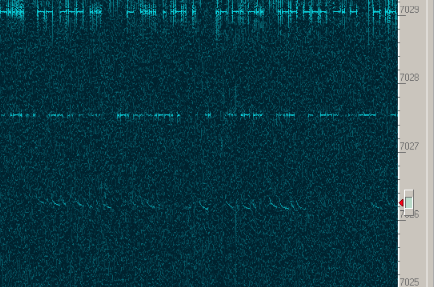
Last night, as I have been doing lately in both the evenings and mornings, I was trawling the bands with a SoftRock (a dual-band v6.0 built for 40 and 80 meters—my first SoftRock) and Rocky. Without fail, the waterfall enables me to see something interesting, which brings me to the point that I really need to integrate these receivers into my station. But, I digress. The really tantalizing, fascinating signals are the weak ones, especially when they are weak and unusual.
The subject weak and unusual signal is shown in the figure headlining this post. Rocky’s cursor shows the approximate bandwidth of the CW filter (250 Hz, if I recall correctly) and the center frequency (7026.25 MHz). I tuned it in and caught a CQ from “AA1T…” Recalling that I head read about Mike, AA1TJ‘s, Das DereLicht transmitter built mostly from parts scavenged from a dead CFL, I suspected it was him. After a moment the QSB came up and I caught the ‘J.’ Thanks to the fact that the SDR is not fully integrated into the station, I scrambled to plug my 15-year-old Small Wonder SW-40 in and get it online. Mid-scramble, Sarah handed Evan off to me for a diaper change, but I did manage to snap the screenshot above. By the time I returned to the shack awhile later to close things down, AA1TJ had disappeared.
Through the (ubiquitous) magic of the Internet, I sent Mike an apologetic e-mail QSL, which yielded a nice response. It turns out that he was trying a 40-meter version of the first transistor transmitter described in the amateur literature. The design for 146 MHz by K2AH appears in March 1953 QST. If you are an ARRL member, pull up those old QSTs in the archives and read about it. K2AH is on the cover of February 1953 QST with the same transmitter. Mike figures he was making 20 mW, or 20650 miles/Watt on the path from his station to mine. The more remarkable thing is that he was using a 1956-era point-contact transistor (the same type as in the K2AH article). Fascinating stuff! Hopefully, we’ll connect for a real over-the-air QSO sometime soon.
Thanks, Mike, for making my day by doing something interesting and sharing it on the air!
Ethan Miller, K8GU, is a regular contributor to AmateurRadio.com and writes from Maryland, USA. Contact him at [email protected].
Ham Nation 13
W6TWT unveils his new setup and makes his first QSO, Shorty explains WIN System, George shows one of the most valuable things in ham radio, and more.
Guests: Ray Novak, N9JA, Bill Hillendahl, KH6GJV, Bill Smith, AB6MT, Shorty Stouffer, K6JSI, and George Thomas, W5JDX
Download or subscribe to this show at http://twit.tv/hn.
We invite you to read, add to, and amend our show notes at wiki.twit.tv.
Thanks to Joe Walsh who wrote and plays the Ham Nation theme.
Thanks to Cachefly for the bandwidth for this show.
http://dts.podtrac.com/redirect.mp4/twit.cachefly.net/video/hn/hn0013/hn0013_h264b_864x480_500.mp4
http://dts.podtrac.com/redirect.mp4/twit.cachefly.net/video/hn/hn0013/hn0013_h264b_640x368_256.mp4
http://www.podtrac.com/pts/redirect.mp3/twit.cachefly.net/hn0013.mp3
Dr. Bob Heil, K9EID, is the founder of Heil Sound and host of TWiT.tv's Ham Nation which streams live each Tuesday at 6:00pm PT (9:00pm ET) at http://live.twit.tv. Contact him at [email protected].
Low power portable on HF
If you’ve been reading this blog recently, you may have got the impression that I’ve rather lost interest in HF operation. That’s not entirely true. But I do think that DXing in general has lost its appeal on HF for me. There’s the antisocial behaviour which dogs a lot of DX operations these days. And also, once you’ve played with WSPR and JT65 on HF, there’s the nagging doubt that using CW or SSB at 100w or more is somewhat akin to fishing by lobbing a hand grenade into the water and seeing what floats to the surface. Of course, that’s completely unfair, but it’s a fun analogy! Nevertheless, it’s clear that efficiency of an ‘average’ HF DX contact is suboptimal compared to a few mW and a ‘decent’ mode.
All that having been said, I still love being able to connect up a simple HF transceiver such as my FT817 and a simple antenna like my MP1 vertical and make CW contacts over hundreds or thousands of miles. It’s particularly satisfying to do that from a portable location.
And so it was yesterday that I thoroughly enjoyed some 17 and 20m CW QSOs around Europe. It was good, too, to hear Mongolia coming in loud and clear on 30m. But I wasn’t remotely tempted to get involved with the pileup!

Tim Kirby, G4VXE, is a regular contributor to AmateurRadio.com and writes from Oxfordshire, England. Contact him at [email protected].
Adventures in programming the Anytone AT5555
As the Anytone 10m rig arrived, the different band segments were fine, but I thought it might be fun to reprogram it a little. One thing I was keen to do was to be able to listen (only listen, mind you) lower down on 27MHz ssb. I guessed that activity would be higher there than on 28MHz and that it might provide some useful propagation indicators.
I ordered the programming disk and lead which arrived quickly. However, I had an enormous amount of frustration getting the lead to install on my PC (and actually I tried pretty much every PC in the house). Sometimes the PC would detect it as a COM port and sometimes it wouldn’t. I thought it must be me doing something wrong. However in the end, I talked with Paul in the sales/service department at Nevada and we agreed that I would send it back. I completely expected him to say that it worked fine for him, but happily he declared it a faulty lead. Unfortunately, though they were out of stock so I had to wait for a replacement.
The replacement duly arrived last week and the PC immediately picked up the COM port. I still had to fiddle and faff somewhat as I didn’t realise that my Anytone had v4 software in it rather than v3. Once I ot that sorted out, I was able to retask one of the band segments so that I could listen around 27.555. This works well (on receive!).
And as I hoped, it has already shown that the band is open more often than activity on 28MHz would have us believe. Sadly, I have already heard music and mildly abusive language on there! Not much difference, in case anyone’s feeling smug, to your average DX pileup on the amateur bands.
Positively though, the Anytone has been a real favourite through the summer, listening for Es on 28MHz. With the reprogrammed segment, I’m certain that it will be a great indication of when to put a CQ out on 10m.

Tim Kirby, G4VXE, is a regular contributor to AmateurRadio.com and writes from Oxfordshire, England. Contact him at [email protected].
LHS Show Notes #063
Promo:
- Ohio LinuxFest will be held September 9-11, 2011 at the Greater Columbus Convention Center in Columbus, OH.
- Linux in the Ham Shack promo from the Low SWR guys. Thanks!
Announcements:
- Our best wishes for a speedy recovery to MadamMoo!
- Our regular hosts are joined by Torsten, XE2/K5TOR.
Topics:
- Firefox 4 has been out a while, and version 5 beta is available at the time of recording. Our hosts discuss. The first thing Russ noted, was the increase in speed! Look for versions 6 and 7 before the end of the year. (As I write this, version 6 has been released. -Ed.)
- Kudos to The Linux Link Tech Show (TLLTS) and their interest in amateur radio. One of the hosts, Joel, aka “gorkon”, W3RAZ, has recorded a couple podcasts for Hacker Public Radio: Episode #738 is an introduction to amateur radio, and Episode #756 explains the basics of radio. Another TLLTS host, Allan, is N3MAW.
- Leo LaPorte of This Week in Tech has started a podcast about amateur radio. (It’s Ham Nation with Bob Heil, K9EID, and Gordon West, WB6NOA, under the TWiT banner and with Leo’s support and occasional participation. By the time you read this, Leo has his license and is now W6TWT. -Ed.)
- Russ describes the Linux from Scratch project that provides instructions for building your own custom Linux system, entirely from source code. Russ plans on providing more details of his experience with Linux from Scratch on a future episode of the QSK Netcast.
- Our hosts tried Ubuntu 11.04, Natty Narwhal, and discuss it, good and bad.
- Russ also tried Fedora 15, and liked the default desktop environment.
- Richard likes PCLinuxOS, and SUSE Linux.
- Linux Mint gets a mention, too.
- In future LHS episodes, look for information about svxlink, an EchoLink client for Linux, and codec2, an Open Source and patent-free audio codec.
- Torsten has had problems installing CQRLog on a 64-bit machine. Russ recommends installing the ia32-libs package to provide the needed 32-bit libraries. In Debian-based distributions, you can install that package with the command “apt-get install ia32-libs”. More information about running 32-bit programs on a 64-bit machine with Debian-based Linux is here.
Contact Info:
- Contact Richard at [email protected], Russ at [email protected], or both at the same time at [email protected].
- Listen to the live stream every other Tuesday at 8:00pm Central time. Check the LHS web site for dates.
- Leave us a voice mail at 1-909-LHS-SHOW (1-909-547-7469), or record an introduction to the podcast.
- Sign up for the LHS mailing list.
- Sign up for the MAGNetcon mailing list.
- LHS merchandise is available at the Merch link on Web site. Check out the Badgerwear or buy one of the other LHS-branded items at PrintFection.com/lhs or Cafe Press. Thanks!
- Thanks to Dave from Gamma Leonis for the theme music.
Music:
- “Vacancy” by Assembly Line Gods, from their album Control (Volume 1).
- The music in Episode #063 is provided with kind permission by Assembly Line Gods from their recent EP release, Control (Volume 1). The track is called “Vacancy.” Follow ALG on Twitter and Facebook and buy their new tracks at iTunes. Thanks, guys!
Russ Woodman, K5TUX, co-hosts the Linux in the Ham Shack podcast which is available for download in both MP3 and OGG audio format. Contact him at [email protected].
PARP Episode 45 Now Available

The Practical Amateur Radio Podcast (PARP) is an amateur radio or ham radio podcast I created in 2008. Like many, I discovered podcasts when I purchased my first iPod and was introduced to the world of iTunes. I subscribed to many podcasts in those early days but it wasn’t until after I got my ham ticket in 2007 that I discovered amateur radio related podcasts. I decided to launch PARP as a mechanism for giving back to the hobby I love so much. The Practical Amateur Radio Podcast is a podcast about all things ham radio. While geared towards the brand new ham or someone interested in getting into the hobby, I do cover a wide range of topics which have even inspired individuals who have been in the hobby for many years, to try out and find they truly enjoy some of the newer modes.
If I remember correctly, I created this blog several months before the podcast was born. While both have suffered over the years due to my sometimes hectic work and life schedule, I’ve tried to keep both going and never allow either to duplicate each other. I really think of this blog as more of an extension of my radio hobby and the podcast more of the educational mechanism for Elmering new and prospective hams alike.
In any event, I just released my 45th episode and you can download it via iTunes (just search for the practical amateur radio podcast) or you can stream it direct from my podcast website. A site designed for smart phone users is also available. The topic for episode 45 of the Practical Amateur Radio Podcast is, So you have your technician class license, now what? I encourage the newly licensed ham to join a local club in his/her area and get involved. In addition, I’m a strong supporter of the American Radio Relay League (ARRL) and encourage all to join and support this organization. I also share many of the exciting things a new tech class license holder can get involved with.
As it is with every episode, I encourage all listeners to share the knowledge learned through my podcast episodes with others. The Practical Amateur Radio Podcast, creating Elmers one podcast at a time.
73,
Jerry
KD0BIK
Jerry Taylor, KD0BIK, is a regular contributor to AmateurRadio.com and writes from Colorado, USA. He is the host of the Practical Amateur Radio Podcast. Contact him at [email protected].
Heathkit Staging a Comeback Too?
I’ve been seeing on the googles and the twitters, that HeathKit is going to start selling kits again, but not for Ham Radio. They are going to start selling “Do It Yourself Kits” for around the house. While this is great, It’s kind of useless for me.

Photo Courtesy of Wikipedia/Louis F. Sander
The first two kits they are offering is a garage parking assistant and a wireless swimming pool monitor. I’m sure these will be great kits and lots of fun to build for many people out there, but not for me. You see, I live in an apartment. Curses, foiled again! But in seriousness, with Heathkit’s come back, it kind of makes me wonder why now? I’m guessing the economy is not what it used to be and money is getting a little tighter. So they are just firing up an old revenue stream that has been dormant a long time and getting back to what worked?
I have never built from a kit, but I have owned kit made electronics before, buying them after the person who made them, then got tired of them. I used to own a nice Heathkit AM/SSB HF transceiver back in the early days of my license. I think it was around the time I upgraded to General Class. While they haven’t started offering anything Ham Radio related yet, they are looking for suggestions for new projects. A couple that come to mind for me would be, an APRS kit and maybe a small CW or SSB transceiver for backpacking or mobile use. That would have to be pretty rugged though, so not sure how that would play out.
But with Radio Shack also getting back into the DIY arena too, things are starting to come full circle and we’ll have a new generation of kids able to build some pretty cool things on the weekends, keeping them off the interwebs thingy and the facebook doo-dads. Maybe even a return to the catalogs we would get every now and again, and would eagerly await in the mail, like I used to wait for the Sears and Montgomery Wards catalogs for Christmas to see all the toys. But being the 21st century, the catalogs would be in PDF format, and delivered by email.
73.
Rich also writes a Tech blog and posts stories every Tuesday and Thursday on Q103, The Rock of Albany’s website, as well as Amateur Radio stories every Monday thru Friday here on AmiZed Studios.
Rich Gattie, KB2MOB, is a regular contributor to AmateurRadio.com and writes from New York, USA. Contact him at [email protected].
 Ham Radio Deluxe |
 W5SWL Electronics |
 Ham Radio Prep |
 KB3IFH QSL Cards  Hip Ham Shirts  HamRadioAuctions HamRadioAuctions Reliance Antennas Reliance Antennas Enigma Shop Enigma Shop |  morseDX  Ni4L Antennas  R&L Electronics R&L Electronics antennas.us antennas.us QRV QRV |
- Matt W1MST, Managing Editor
