 |
 Support Your Local Radio Shack
 5 September 2011 | by
 For five months now my friend Keith (ACØVW) and I have been planning to get together and build Ham-Can kits together. Finally the day arrived when we could fit it in! Last Thursday Keith made the 2 1/2 hour drive from the Twin Cities to my house in Granite Falls for a kit-building session.
The first thing we did was to inventory the parts in each of our kits. All were present and accounted for except one — a 1000 pF capacitor was missing from Keith’s kit. So naturally I picked up the phone and called Radio Shack in Montevideo, MN. Where else are you going to find a part like this at a moment’s notice out in the sticks?
What I didn’t know when I called was that the store had already been closed for a half hour! But still the owner answered the phone, and without saying anything about being closed he went to see if he had the capacitor we needed. When he came back he said that he couldn’t find one, but that it was a bit hard for him to search all of his stock because he had to use a flashlight — that’s when he explained that the store was closed. After thanking him for going to the trouble I started lamenting our state, explaining how my friend had driven all the way out here only to find that he didn’t have all of his parts.
The fellow at Radio Shack told me to hold on while he went to search for the capacitor again. Next time he got back on the phone he told me he had found one! And not only that, he told me that he would deliver it to me since he and his wife happened to be heading our way in a few minutes. By now I’m really thanking him! But it gets better. He told me, “The only catch is that you can’t pay for it. We get paid by the smile.”
We met this gentleman and his charming wife at Subway, where he gave us the capacitor we needed along with a handful of others just for fun. All of this added up to way more than mere marketing. This was heart-warming small-town kindness, and yes, it did instantly make me a loyal customer.
Of course Keith and I insisted on purchasing their dinner. They showed us what had brought them our way. In the back of their pickup-truck was an antique mill they had just purchased. They were planning on grinding up a whole bunch of wheat that they had at home so they could make their own bread with flour they’d ground themselves. I gave them my card and told them to call me when they had a loaf of that bread, and we’d have them over for supper.
Whatever you think of Radio Shack, it’s still the only game in town for most of us when we need electronic components at a moment’s notice. Maybe we should think twice before going to Wal-Mart or ordering stuff online that we could otherwise get at the local Radio Shack. It may cost a few dollars more, but it might be worth it. If we don’t support our local Radio Shack, it may not be around for long (see here).
I for one am sure glad this Radio Shack is still around, and that the owner is such a fine fellow. I’d like to keep him in business so that the next time I come up short when building something, he’s still there to sell it to me.


Todd Mitchell, NØIP, is a regular contributor to AmateurRadio.com and writes from Minnesota, USA. He can be contacted at [email protected].
For Sale: Tune-A-Tenna
I was perusing eBay a few weeks ago and stumbled upon an interesting listing:
 What is it? According to the listing, it’s a remote adjustable half-wave dipole antenna with an SWR of less than 1.5:1 from 1.8 MHz to 55 MHz. How does it work? From the listing:
By Extending or retracting the 2 Antenna elements until you have reached the point of Resonance for the desired operating frequency. There by providing maximum forward power and little if any reflected RF power.
You have effectively built a custom cut to frequency dipole antenna each and every time you change frequency with out leaving the equipment operating position.
The Antenna is controlled by the flip of a switch, or could possibly be controlled by the micro processor in most modern day transceivers and could possibly track the VFO as you move up and down in frequency so it would always be at its resonant point.

A little intrigued, I e-mailed the creator, Frank McGinley, WB4NWV, to inquire about it. I asked how he developed it and told him that I’d be interested in doing a little post on his antenna design.
THE TITLE OF THE THE STORY IS HOW FAR HAVE WE COME.
LOCATION FORT BRAGG NORTH CAROLINA, UNIT OF ASSIGNMENT, 50TH SIGNAL BATTALION ( AIRBORNE ), FIELD TRAINING EXERCISE.
IT WAS DARK EXCEPT FOR THE LIGHT FROM THE STARS, THAT SHOWN THROUGH THE CLOUDS , IT WAS BITTER COLD AND THE WIND WAS HOWLING , THE RAIN AND SLEET WAS INTENSE, AS I STUMBLED THROUGH THE BUSHES TRYING NOT TO GET THE DIPOLE ANTENNA ELEMENTS TANGLED UP IN THE SAME BUSHES, UNSUCCESSFULLY I MIGHT ADD,THE TIME 23:45 HOURS I HAD TO CHANGE THE LENGTH OF THE DIPOLE FROM THE DAY FREQUENCY TO THE NIGHT FREQUENCY, AFTER A HECK OF A FIGHT TO LOWER THE ELEMENTS TO THE GROUND AND SPENDING 3 OR 4 MINUTES TRYING TO UNTANGLE THE HALYARDS, THE FLASH LIGHT WITH THE RED LENS HELD IN MY MOUTH AND MY GLOVES REMOVED, MY FINGERS SO COLD THAT THEY DID NOT WANT TO COOPERATE I WAS SHAKING SO BAD FROM THE COLD THAT THE LIGHT WAS HAVING A HARD TIME STAYING ON THE SPOT WHERE I NEEDED IT, MAKING IT EVEN MORE DIFFICULT TO UNTIE THE TANGLED MESS ALL THE TIME TRYING TO HURRY TO BE BACK UP ON THE AIR BY 24:00 HOURS
WELL AFTER WHAT SEEMED LIKE FOREVER I GOT IT BACK UP,AND RETURNED TO THE WARMTH OF THE RADIO TELETYPE SHELTER, AND BEGAN THE PROCESS OF CHECKING THE SWR, ONLY TO FIND THAT IT WAS TOO HIGH, WELL BACK OUT INTO THE COLD AND RAIN I WENT, THE ANTENNA WAS TO SHORT, ROUND 2 WENT ABOUT LIKE ROUND 1 NOT VERY SMOOTH, AS THE WIND HAD BLOWN THE ANTENNA ELEMENTS INTO THE BUSHES, IT TOOK ME QUITE A WHILE TO UNTANGLE THEM, LENGTHEN THEM AND PULL THEM BACK UP, BACK TO THE RADIO VAN, CHECK THE SWR AGAIN, NOT FLAT BUT GOOD ENOUGH, I WAS SOAKED AND FROZEN AND WAS NOT GOING TO TRY IT A THIRD TIME, NOT TO MENTION THAT IT WAS 00:24 HOURS,AND TIME FOR ME TO CHECK IN WITH THE NET CONTROL STATION, I HAD NO TRAFFIC AND THE RADIO CHECK WENT WELL, IT WAS NOW TIME FOR ME TO GET OUT OF MY COLD WET UNIFORM AND INTO A DRY WARM ONE, WELL AS YOU CAN IMAGINE I WAS NOT A VERY HAPPY CAMPER, AND TO THIS DAY I DO NOT ENJOY CAMPING OUT, THERE WERE MANY DAYS AND NIGHTS LIKE THESE THAT FOLLOWED , EXTREME HEAT,EXTREME COLD, WET AND SOGGY, BITING FLY’S, MOSQUITOES, YOU NAME IT AND ALWAYS THE SAME PROBLEM, TO LONG OR TO SHORT, KNEE DEEP IN MUD, UP AND DOWN BACK TO THE VAN, UP AND DOWN AND BACK TO THE VAN,AND NEVER COULD I GET THE SWR FLAT, CLOSE BUT NEVER FLAT.
TIME FLY’S WHEN YOU ARE HAVING FUN, SOON 20 YEARS OF FUN TRAVEL AND ADVENTURE HAD COME TO AND END, AND IT WAS TIME TO ENJOY H. F. RADIO AS A SERVICE, WELL THE MORE THINGS CHANGE THE MORE THEY STAY THE SAME, MY DIPOLE ANTENNA CUT FOR THE HIGH END OF THE BAND WITH A CLIP LEAD EXTENSION TO MAKE IT RESONANT AT THE LOW END OF THE BAND, WELL YOU GUESSED IT, BACK OUT INTO THE NIGHT IN THE SNOW IN MY BEDROOM SLIPPERS P.J.’S AND HOUSECOAT, NOT A GOOD THING, I KNOW I COULD HAVE USED AN ANTENNA TUNER OR COUPLER AS IT IS CALLED, BUT ALAS I AM A PURIST, AND DO NOT LIKE THEM, EVERY TIME I HAD TO DO THIS, I KEPT HAVING FLASH BACKS OF MY MANY FIELD TRAINING EXERCISES , THAT WAS WHEN IT STRUCK ME THERE, HAS GOT TO BE A BETTER WAY.
WELL I TRIED EVERY THING, G5RV’S, OFF CENTER FED DIPOLES, YOU NAME IT I TRIED IT, WAS I HAPPY, TO PUT IT MILDLY, HECK NO, SO IT WAS TIME TO PUT ON MY THINKING CAP, MY MIND WANDERED BACK TO WHEN I WAS THE NONCOMMISSIONED OFFICER IN CHARGE OF THE MARS RADIO STATION AT FORT BRAGG, WE HAD A DIPOLE MADE FOR COLLINS BY HYGAIN THE TD-1 IT WAS MADE OUT OF TAPE MEASURE TAPES, IT WAS A POOR DESIGN, IF YOU USED MORE THEN 100 WATTS IT WOULD ARC INTERNALLY , BUT THE CONCEPT WAS THERE, CHANGE THE DESIGN SOME ADD A 13.8 VOLT D.C. MOTOR, SOME LIMIT SWITCHES AND A CONTROL BOX AND , YOU HAVE A MOTORIZED ONE HALF WAVELENGTH DIPOLE THAT CAN BE REMOTELY ADJUSTED FROM INSIDE THE RADIO OPERATOR’S LOCATION, WITH NO NEED TO SEE IT OR GO OUTSIDE TO ADJUST THE ANTENNA.
YES 1.8 MEGAHERTZ TO 55 MEGAHERTZ AND EVERYTHING IN BETWEEN WITHOUT COMPROMISING, PERFECTLY FLAT SWR 1 TO 1, AND NO NEED FOR THE INFAMOUS ANTENNA TUNER, IN THIS AGE OF ALL MODE ALL FREQUENCY H.F. TRANSCEIVERS, THERE WAS A NEED FOR AN ANTENNA THAT WOULD COVER THE ENTIRE H,F, SPECTRUM WITHOUT COMPROMISE, MANY THOUGHT THAT DAY WOULD NEVER COME, ARE YOU SICK OF DUMMY LOAD ANTENNAS AND ANTENNA TUNERS, GENERAL COVERAGE TRANSCEIVER MEET GENERAL COVERAGE ANTENNA, I GIVE YOU THE AMAZING TUNE-A-TENNA.
Frank has a fascinating story and I salute his service to our country.
Pretty neat. But… well, $25,000 is a lot of money for an antenna. What do you get? A patent (7,286,100B1), trademark (3,336,489), domain names, and a few prototypes. According to the eBay listing, Mr. McGinley believes that the right buyer could base a business around this antenna design and manufacture them for about $300 each:
Our best estimate, the cost to produce the final product for sale should be around $300, Possibly lower.
Our best Estimate of the retail price of the semi-auto version would be $825, which equates to $525 per unit. If you advertise wisely on Ebay, Qrz.com and QST Magazine you should have no problem netting $500 per unit profit, possible more?
Our best estimate of the retail price of the auto version would be $1,225 which equates to $700 net per unit possibly more?
What do you think? Is there a market for such an antenna? If you think so, check out the eBay listing or contact Frank. I’m sure he’d like to hear from you.
Matt Thomas, W1MST, is the managing editor of AmateurRadio.com. Contact him at [email protected].
QSO Party Colorado Style

I’ve worked contests before. Typically if I hear a contest taking place on the bands I’ll tune around and answer a few CQ’s to give points away. However, I’ve never been serious enough about it to spend several hours working a specific contest and do most of it while running a specific frequency. Most contests (excluding Field Day) I generally use the search and pounce method of scanning up and down the bands listening for contest stations calling CQ, then pounce and answer their CQ.
I’ve had the Colorado QSO Party on my calendar for a few weeks now and coordinated the time with my wife so I could work the contest. From the beginning I decided I wanted to try my hand at contest operations and I would log my contacts in a suitable logging software and submit my log. I really had no expectations of just what the outcome would be. My goal was to have fun and represent my state of Colorado as proudly as possible on the amateur bands.
The Colorado QSO party was scheduled to start at 6 AM (local) and run for 16 hours until 10 PM (local). The work week prior had been difficult and I decided I wouldn’t get started too early of a start. I had my priorities in the right order and made sure to switch on the coffee pot before the HF rig. With coffee in hand, I turned on the computer and the HF rig just a little after 8:30 and positioned myself on 14.280 and began calling CQ contest.
The Q’s began flying into the log book and I probably had logged 30 or so within what seemed like no time at all. I quickly recharged my coffee cup and logged another 30 or so before lunch. I took a short break for lunch and then things slowed down. 20m had been hot in the mid-morning hours, but all that changed after lunch.
The best laid plans, well…are not always exactly what you want them to be. We’re trying to get new windows installed on the ground level portion of our house this year. The salesman was dropping by for the contract signing and this took a little longer than planned. After about 90 minutes the changes were incorporated (gotta keep the wife happy) and I was back on the air. But I would have another 2.5 hours off the air as we agreed to attend a neighborhood BBQ (gotta keep the wife and neighbors happy). I got back home and got back on the air for the last 90 minutes of the QSO Party.
The final 90 minutes was slow and I switched between the 40 and 20m band and managed to work an additional 10 QSO’s. All-in-all it was a lot of fun. I worked a total of 138 QSO’s for a total of 8004 points.
Band | QSOs | Pts | Mlt |
3.5 | 1 | 2 | 0 |
7 | 7 | 14 | 2 |
14 | 130 | 260 | 26 |
Total | 138 | 276 | 28 |
Score | 8004 |
My setup for the Colorado QSO party consisted of my Yaesu FT-950 (I really love this rig), a Heil Pro-Set headset with the HC-4 mic and for true hands free operation, I dusted off my Heil footswitch. I also logged using N1MM software for the first time. I had searched for logging software which would work for the Colorado QSO party. This did the job and I look forward to using it again for other contest logging.
In closing, I’m not sure where my numbers will rank in the totals. I know others who participated scored much higher. I didn’t begin it to win it, I did it to have fun and mission accomplished. I do look forward to the next contest and of course next year for the Colorado QSO party. Radio Sport is fun, exciting and ham radio.
Until next time…
73 de KD0BIK/AE
Jerry Taylor, KD0BIK, is a regular contributor to AmateurRadio.com and writes from Colorado, USA. He is the host of the Practical Amateur Radio Podcast. Contact him at [email protected].
WB9LPU’s Marconi Centenary Key

A Marconi style straight key homebrewed by Rich, WB9LPU (copyright Richard Meiss, used with permission)
After my last post on my visit to Signal Hill I have been contacted Richard Meiss, WB9LPU, who constructed a straight key in the tradition of the keys made by the Marconi company, to celebrate the centenary in 2001 of Marconi’s reception of the first transatlantic signal. Rich has a written an account of the construction of the key, which is mounted on a piece of Newfoundland soapstone and it can be accessed below by clicking on ‘WB9LPU Marconi Style Key’; it is well worth reading.
Rich manufactures many keys, paddles and bugs and his craftsmanship is outstanding. There will be more posted on Rich’s work on the blog in the near future, but to whet your appetite here is a video of one of his homebrew bugs.
Please note Rich’s materials (photograph and PDF document) are included here with permission and do not fall under the Creative Commons license that I use on this blog.


Alan Steele, VA3STL, is a regular contributor to AmateurRadio.com and writes from Ottawa, Ontario. Contact him at [email protected].
New wallpaper just arrived
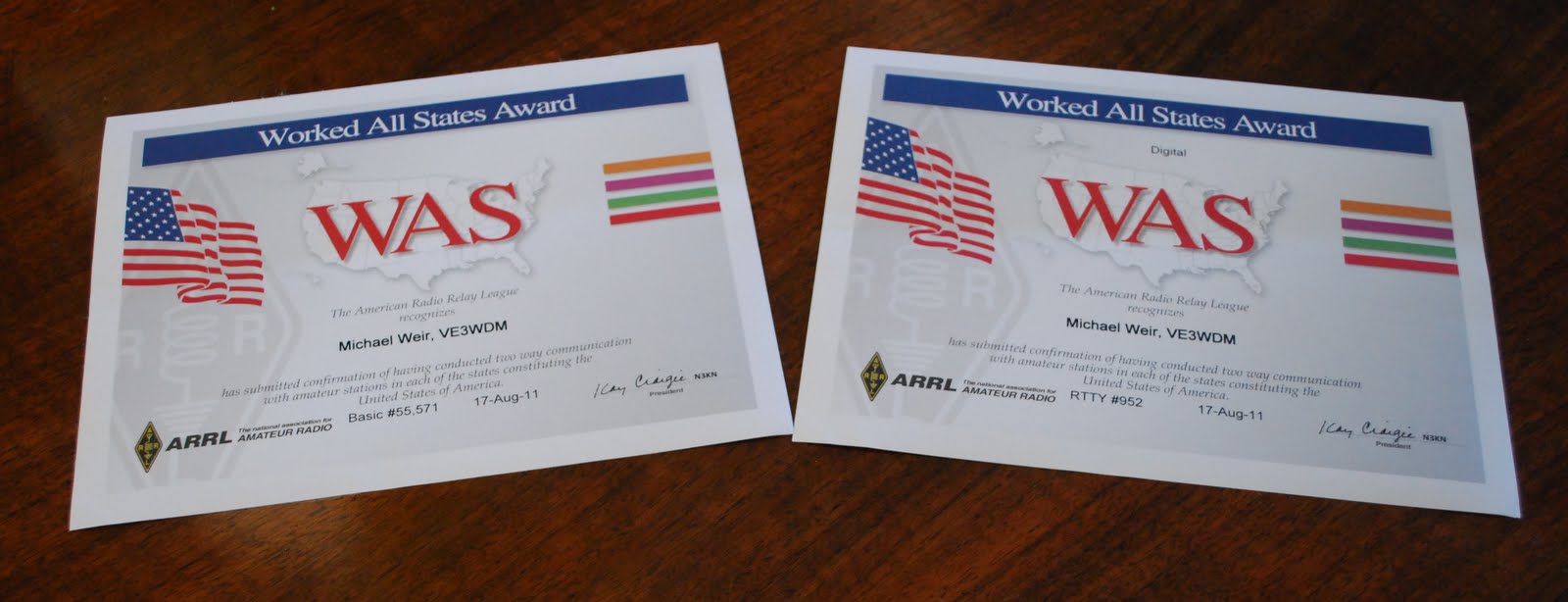

Mike Weir, VE9KK, is a regular contributor to AmateurRadio.com and writes from New Brunswick, Canada. Contact him at [email protected].
Visit to Signal Hill

Welcome to Signal Hill
Back in June I attended a conference at Memorial University at St John’s Newfoundland. The morning of my last day in the city a colleague and myself went to visit the historic site of Signal Hill, where Marconi received the first transatlantic radio signal after they were transmitted from Poldhu Cornwall, England, in December 1901.
The day we visited the Hill was thick with fog, which had enveloped St John’s for the five days I had been there. Still it was good to visit such an important site for radio even if you could not even see the sea which was at the foot of the hill. The Cabot Tower at the top of the hill is not the actual building where Marconi received the signals, that was then adjacent Fever Hospital which was destroyed by fire in 1920, however the Cabot Tower is the focus of the commemoration of the event and it has an exhibit, a shop and a radio station, VO1AA, run by the Society of Newfoundland Radio Amateurs. The shop is at the entrance level and then there is a floor for the exhibit, you can also gain access to the roof – which probably has fine views in good weather but the fog was thick the day we visited. Unfortunately, there was nobody manning the station so I did not get chance to operate from there. Still, there was plenty on display although the modern equipment looked like it was locked away. The photographs below show some of what was on display.
The name ‘Signal Hill’ does not come from Marconi’s work, but due to the fact it was a viewing post for incoming ships. Once the merchant line was identified a flag associated with that company was raised so the stevedores and other dockworkers for the respective company could get ready for the ship’s arrival in the port of St John’s. There is a photograph of rolled up and neatly stored set of flags, which I presume were the company identifier flags, in the gallery below.
In the shop I bought a copy of “Marconi’s Miracle” by D. R Tarrant. This is a short (101 pages) but concise account of the reception of the first transatlantic signals, including the build up and subsequent controversy of Marconi’s work. The controversy being that Marconi was effectively and quickly forced to cease his work in Newfoundland as the Anglo-American Telegraph Company enforced their exclusive rights to telegraphy systems in Newfoundland. They obviously felt concerned the new wireless system would take business from their cable system.
Just further down the Hill from Cabot Tower is a visitors centre that has more information about not only Marconi but the military significance of the Hill and the trading in the region. That is worth a visit too.
So, if you find yourself in or near St John’s I strongly recommend you visit Cabot Tower and if you are an amateur radio operator it is a ‘do not miss’ just for its important significance.


Alan Steele, VA3STL, is a regular contributor to AmateurRadio.com and writes from Ottawa, Ontario. Contact him at [email protected].
Baofeng UV-3R Review
Following the success of the Wouxun radios, we have a new Chinese handheld transceiver that has many hams excited – the Baofeng UV-3R. The UV-3R is a dual band (UHF/VHF) 2W “micro” transceiver manufactured by Vero Global Telecom and sold by Baofeng. While the Baofeng brand is the most popular, the radio is also sold as the Comtex UV-3R, the Magiksu UV-3R, and the Zastone ZT-UV3R. (Baofeng also sells the UV-100 and UV-200 models that share common internals with the UV-3R, but have some cosmetic differences. Also, on ebay.com you can find speaker mics for these models that are unavailable for the UV-3R.) One reason the UV-3R is so popular is its relatively low price – less than $50 via ebay and slightly more from the US suppliers. At this price and small form factor, it makes a great back-up radio to keep in a truck glove box or a laptop bag.
Cosmetically, the UV-3R is very similar to the Yaesu VX-3R.
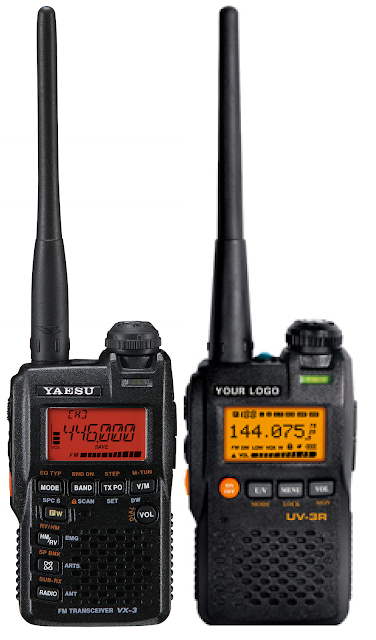
The dimensions are the same, but the UV-3R is missing a few buttons on the front panel and the functions of the duplicate buttons are not the same as the VX-3R. The UV-3R, in the fine tradition of Chinese radios, adds an LED flashlight. The radio also is available in red, yellow, blue, and camouflage in addition to the standard black. When holding both the Yaesu and Baofeng in my hand, it is easy to see and feel the superior quality of the Japanese radio.
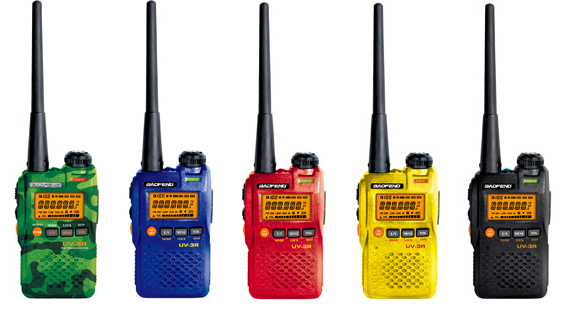
A quick review of the technical specifications reveals that this radio is dramatically different from the VX-3R. The UV-3R is a 2M/440 MHz transceiver and FM broadcast receiver. An abbreviated list of its features/functions/specs is below. (A full list can be found here.) The radio is built by levering the power of the RDA1846 by RDA Microelectronics. This single transceiver chip provides most of the radio functionality – essentially making it a SDR.
Functions and Features
– 50 CTCSS, 104 CDCSS
– Time-out Timer (Off/30/60/90/120/150/180 secs)
– Shift Frequency
– VOX (Off/1-9 Levels)
– Call Tone (1750 KHz)
– Squelch Set (1-9 Levels)
– Electronic Volume Adjusting (8 Levels)
– Keypad Lock
– Backlight (On/Off/Key)
– Tail Tone Elimination
– Battery Save
– Restore to Factory Default
– PC Programming
– FM Radio Channel Storage
Technical Specification – General
Frequency Range | 136-174/400-470 MHz
Channel Capacity | 99
Channel Spacing | 5/6.25/12.5/25 KHz
Operated Voltage | 3.8V
Standard Battery | 1500 mAh
Battery Life | 10 hours
Dimensions | 1.9″ x 3.2″ X .9″ (Approximate)
Weight | 140g
Technical Specification – Transmitter
RF Power Output | 2W
Early adopters were “treated” to a version that appeared to be rushed to market – the units only had twelve menu options, the s-meter was worthless, and it came in a rather plain box. The subsequent version added six more menu options, improved the signal meter, and now comes in a more polished box.
The menu options are:
| Menu # | Name | Description | Options |
| 1 | RXCODE | Receive Tone | Off, CTCSS, DCS |
| 2 | TXCODE | Transmit Tone | Off, CTCSS, DCS |
| 3 | SQL | Squelch | 0-9 |
| 4 | LIGHT | LCD Illumination | Off, On, Key |
| 5 | K TONE | Keypad Beep | Off, On |
| 6 | VOX | VOX/Handsfree | Off, 1-9 |
| 7 | POWER | RF Output Power | High, Low |
| 8 | DW | Dual Watch/UHF & VHF | Off, On |
| 9 | STEP | Freq Size Step | 12.5/25KHz |
| 10 | OFFSET | Repeater Offset | 0-37.995, 0-69.995M |
| 11 | SHIFT | Repeater Shift | 0,+,- |
| 12 | STE | Squelch Tone Elimination | Off, On |
| 13 | W/N | Wide/Narrow Receive | Wide/Narrow |
| 14 | SAVE | Battery Save | Off, On |
| 15 | TOT | Timeout Timer | Off, 30, 60, etc. |
| 16 | SCANM | Scan Memory | TO Time based – time out/ CO Carrier (present) based – carrier out |
| 17 | RELAYM | Relay Message | |
| 18 | BCLO | Busy Channel Lock | Off/On (No Tx when receiving) |
In addition to the cost and size, hams give the UV-3R favorable reports for both transmitted and received audio. On July 20, 2011, the UV-3R became Type 90 accepted by the FCC. The FCC documents can be found here.
The UV-3R is easy to use in spite of a somewhat confusing manual. ZL2GVA mitigated that short-coming by releasing an easy to use cheat-sheet. While most folks find it easy to program the memories from the radio itself, the UV-3R can be programmed from a computer using a USB cable and software from Baofeng. In addition to the factory software, the UV-3R is also supported by the CHIRP cross radio programming application. (CHRIP may not program all features for all radios; it is intended to allow hams to transfer memories from one device to another with little effort.)
In addition to the USB programming cable, the radio has several accessories. It comes with the manual, charger, a charger adaptor (if needed), a charging stand, wrist strap, an UHF antenna, a VHF antenna, an ear bud/mic combo, and a belt clip. The shorter antenna (with a red ring) is for UHF. The longer antenna is for VHF. The UV-3R requires an antenna with a SMA-M connector. The antennas perform well, but many folks have wished for a dual band antenna. The Nagoya NA-701 and Nagoya NA-666 both seem to be popular choices. The antenna connector is fairly close to the LED, so some trimming may have to be done to get a good fit.
Car chargers, cases, and the USB programming cable are available as options or sometimes included as a bundle with the radio. The battery is a common NP-60 (FUJI compatible), so picking up an extra one is easy to do. Also, with a slight modification to account for the belt clip mount, the AA battery pack (FBA-37) for the Yaesu VX-3R can be used to run the UV-3R. For me, the car charger and the AA battery pack are the must have accessories for the UV-3R in its role as a backup radio.
The radio is not without some minor problems and quirks. For example, one oddity is that it uses the less common negative tip for the power plug. As for the problems, hams have reported issues with fit and finish – specifically plugs/sockets that result in loose connections. If pushing the plug with all your might doesn’t work, then try backing it out a little. Also, hams have found spurious emissions on harmonic frequencies. There was a lot of debate about the severity of this issue on the UV-3R Yahoo group – bench vs. real world, letter vs. spirit of the FCC regulations, Type 90 Acceptance impact, etc. Whatever the severity of the emissions, it did not prevent the UV-3R from meeting the requirements of the FCC. Another common complaint was with the loud receive volume. Even at the lowest setting, the radio is quite loud. For that reason, I don’t like using it where it will bother others.
One of the advantages of an inexpensive radio is that you don’t risk much when trying to modify it. Disassembly mostly involves removing screws, but you will have to unsolder the antenna connector. Two mods seem to be the most common as they address some of the issues mentioned above. The first adds a capacitor to reduce spurious emissions on the harmonics. The second also involves adding a capacitor to reduce the loud receive volume issue. More frivolous mods include turning the LCD blue – but then you can have a blue radio with a blue screen.
For me, this little radio has provided a great learning experience as well as a good value for my money. It may not be the best radio ever, but the price, size, and overall good performance make it a good choice for backup radio or even one for a new ham to get on the air. It also has been interesting to see:
- the debates that sprung up around the severity of the spurious emissions,
- the wisdom (or not) of using a dual band antenna,
- the variety of applications from simple transceiver to APRS and tracking satellites
Credit goes to a lot of the guys on the UV-3R Yahoo group – I don’t have the knowledge, tools, or time to do a lot of the research/testing/playing that they have done. I highly recommend the Yahoo group – although it has now reached a point where a lot of the same questions are being asked.
Editor’s note: I personally follow Brick’s blog and find it very worthwhile. While not all content is Amateur Radio related, I encourage you to check it out. -Matt W1MST
Brick O’Lore wrote this guest post and blogs regularly about a variety of topics at http://www.brickolore.com. Contact him at [email protected].
 Ham Radio Deluxe |
 W5SWL Electronics |
 Ham Radio Prep |
 KB3IFH QSL Cards  Hip Ham Shirts  HamRadioAuctions HamRadioAuctions Reliance Antennas Reliance Antennas Enigma Shop Enigma Shop |  morseDX  Ni4L Antennas  R&L Electronics R&L Electronics antennas.us antennas.us QRV QRV |
- Matt W1MST, Managing Editor
