 |
 Handiham World for 05 October 2011
 5 October 2011 | by
 Welcome to Handiham World.


Pat Tice, WA0TDA, is the manager of HANDI-HAM and a regular contributor to AmateurRadio.com. Contact him at [email protected].
Meeting old and new radioamateurs
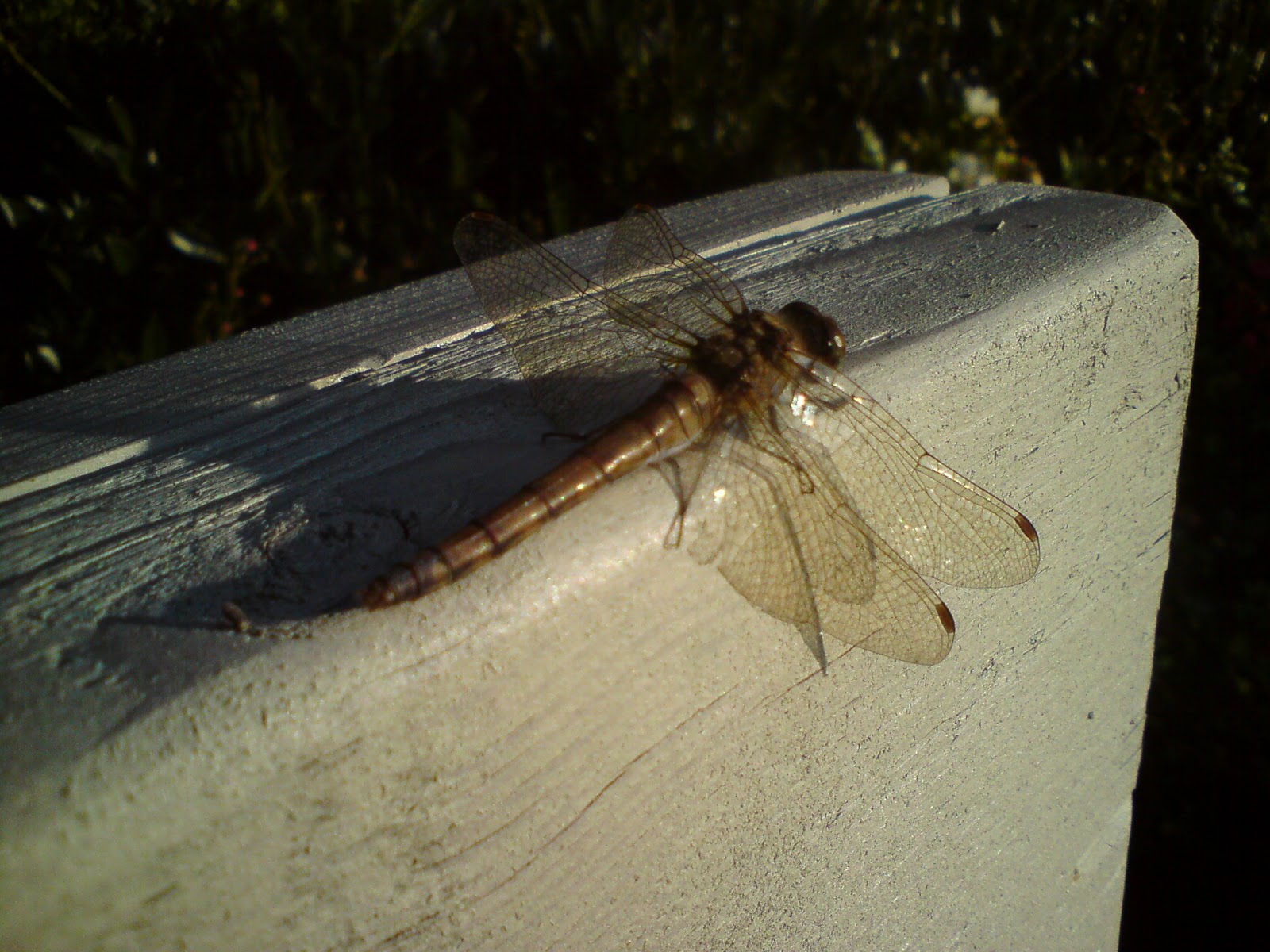 |
| Dragonfly photographed in our garden in the evening sun |
The weather was beautifull the last 2 weeks. Temperatures around 20-24 C without that much wind, a real nice autumn. Unfortenately work had to be done both at the job and at home. Not much time for radio, although… at monday I heard a few locals on 10m. They seem to have a kind of net there on 28.400 USB. I heard some known voices and decided to jump in. After a short hello I discovered a couple of them were old friends from the CB years. I did a lot of 11 Mtr DX about 20 years ago with one of them and now he got his license as PD1BM. I remember Bert very well as we did a lot of DX together, I even visited him now and then after school back then just to do some DX. Bert has a ear for special DX and also has a exceptional location between 2 large canals which apparently gives him a advantage. I welcome him on the amateurbands and hope he enjoys it a lot. Bert already made some very nice DX with his 4 element LFA yagi for 10 Mtr. Last friday we had a meeting from our radioclub VERON dep. Hunsingo, there was a pile of QSL cards waiting for me. Another pile was for a neigbour HAM PC5F which I had to deliver to another local HAM. Very complicated….end of the story he made a telephone call to me and met me at my job to get his cards. Never spoke this guy although he is living in the same street that was my QTH for 12 years. So, I decided to e-mail him for a sked. We did meet at 80m PSK31 at Tuesday evening and had a chat for a while. PC5F Ferdinand has all his antennas inside the house on the attic, and makes some very nice DX for instance to North America on 10m! And with Hawaii on 20m! That is really nice, why do we need all those big antennas??
Bas, PE4BAS, is a regular contributor to AmateurRadio.com and writes from Groningen, Netherlands. Contact him at [email protected].
iHAB-7 Was a Sucsess!
Southgate Amatuer Radio has a great article about iHAB-7, which is a high altitude balloon that carried Amateur Radio as well as record HD video of the flight. It went up to a little over 85,000 feet and took some stunning images.

YouTube Screen Shot
It all carried a 40 Meter beacon and a 70cm simplex repeater up with it. The video was posted on YouTube and I am re-posting it here for you as well. Here’s the description from the YouTube video giving a little more detail on the flight:
First, we are thankful for everyone who participated in the iHAB-7 launch. What a GREAT way to spend a beautiful Iowa fall day! iHAB-7 was a picture perfect flight! The propulsion team did a fantastic job getting the balloon filled to specifications, which gave iHAB-7 a perfect 5.5m/sec ascent rate.
The balloon stayed aloft for 1 Hour – 51min, reaching a burst altitude of 85,290ft and traveling 33 miles down range. COLD temperature at altitude, lowest temperature recorded inside the payload reached -8 °C or 17.6 °F. The recovery team had the rare opportunity to get a visual on the payload at 8,000 feet on its decent, and witnessed it land in a freshly harvested cornfield SE of Morning Sun, Iowa.
Signal reports are still coming in on the 40 Meter beacon. UHF Simplex repeater worked as well as it could. Being a “Parrot” it is a little more challenging to work, but some folks were able to make QSOs.
A special thank you to the Washington Area Amateur Radio Club for their sponsorship of the iHAB-7 Launch! Also, thank you to Mark Joseph (KC9DUU) – Jesse Risley (K9JLR) – Jeremy Lamb (KC9KGJ) – and Pete Lilja (KC0GPB) for chasing with us!
Looking at a still image from the video, the view reminds me of Courasant from Star Wars. There I go being geek again. Anyways, here is your Amateur Radio moment of “Zen”.
73.
Rich also writes a Tech blog and posts stories every Tuesday and Thursday on Q103, Albany’s #1 Rock Station website, as well as Amateur Radio stories every Monday thru Friday on AmiZed Studios and hosts a podcast called The Kim & Rich Show with his fiance’ Kim Dunne.
Rich Gattie, KB2MOB, is a regular contributor to AmateurRadio.com and writes from New York, USA. Contact him at [email protected].
Seeing the big picture with PowerSDR
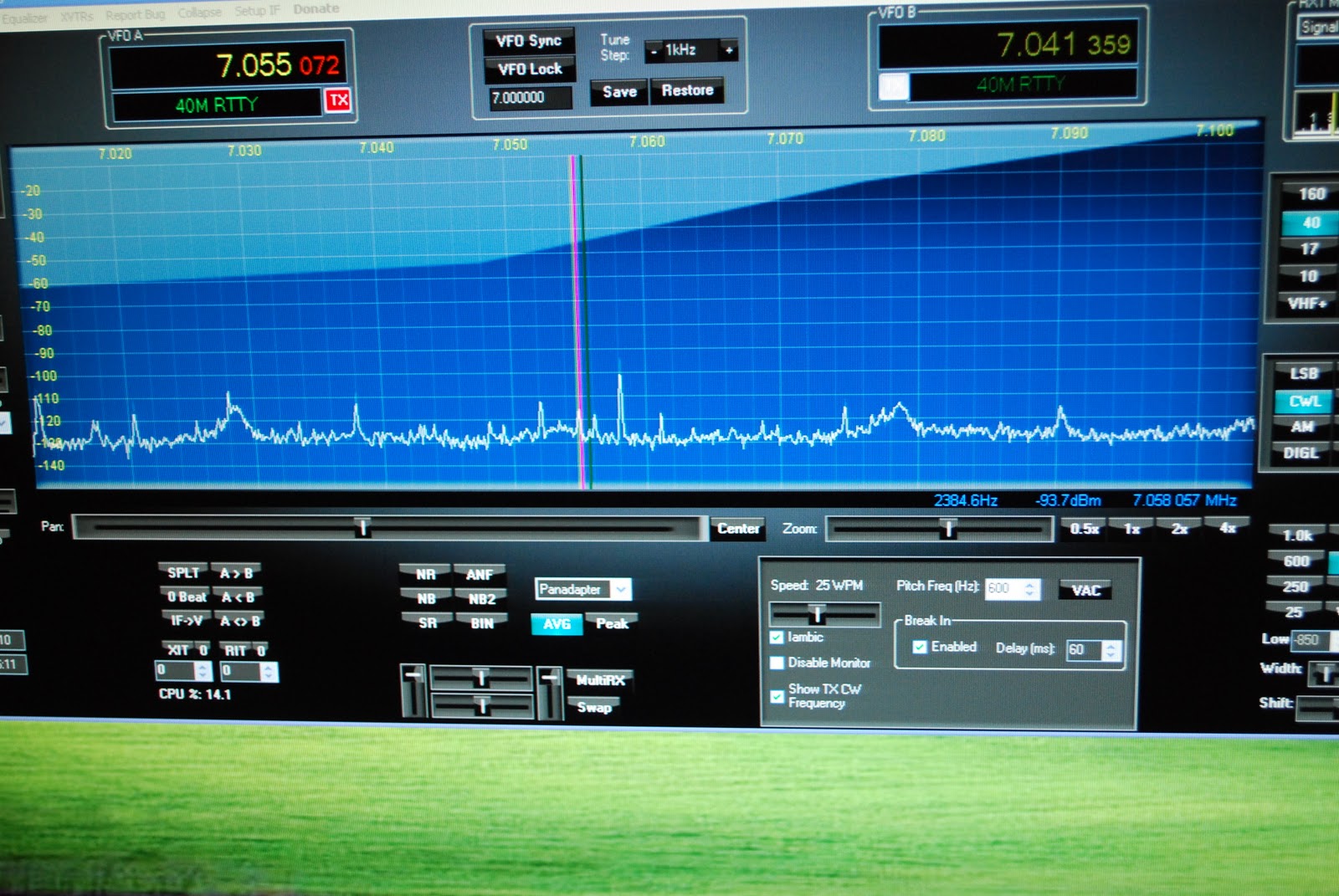 |
| PowerSDR screen |
the band that your radio is on. My setup is made up of the LP Pan, EMU 0202 Creative labs external sound card and the PowerSDR software. The pan-adapter gives my QRP station some nice advantages the main one is the ability to see the entire CW segment at one time. I can see a strong station or week station then point and click and I'm there. Before I would be spinning the VFO from on end of the band to the other. I may just miss a station calling CQ and is now waiting for a response but to me its static with no one there and I move on missing this station for his
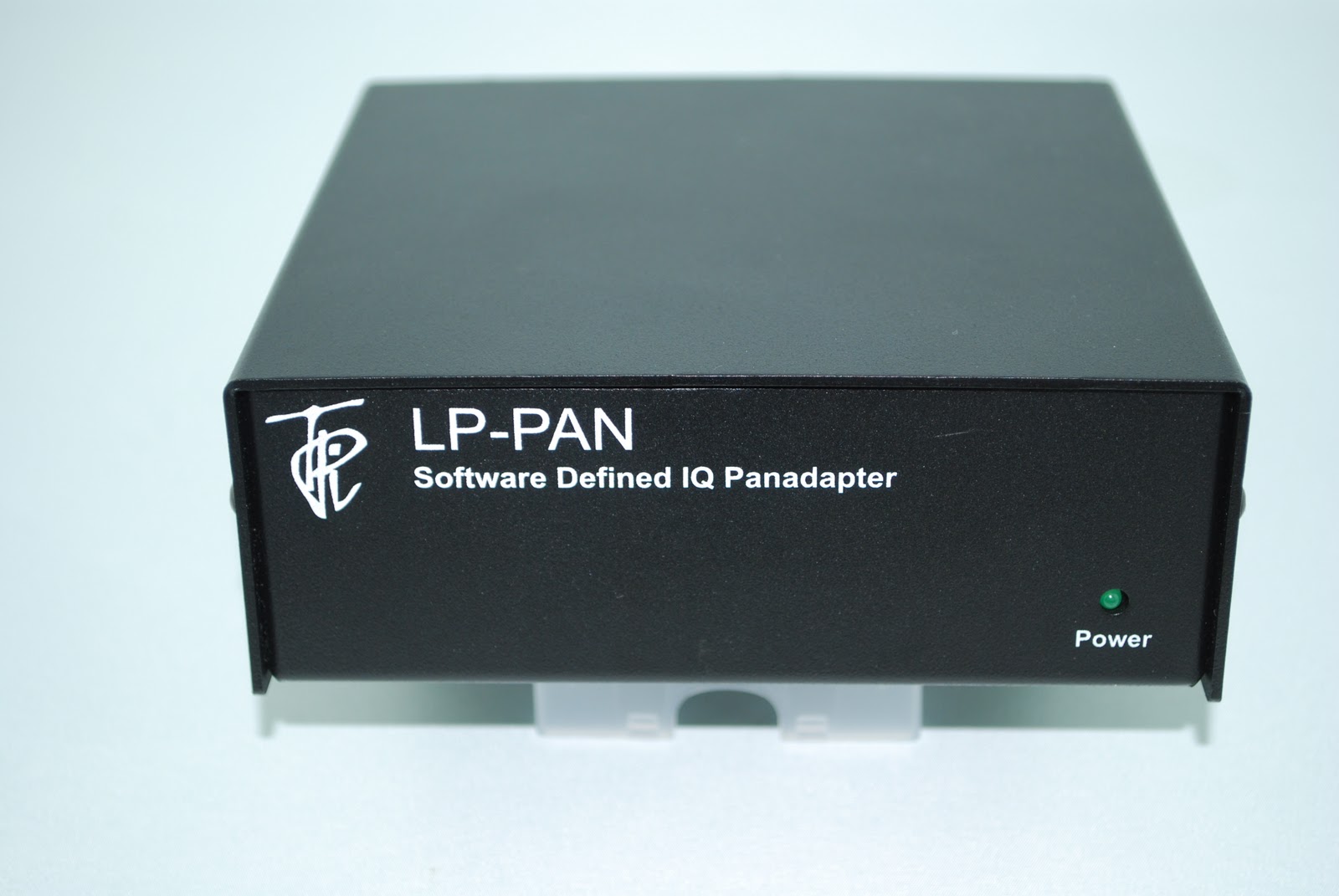 |
| My LP-Pan unit below, new TS-990s |
 next CQ call. Also I can flip to 10 meters and look at the pan-adapter to see if there is any action on the band or not....seeing if the band is open in a shorter time as opposed to spinning the VFO over the entire band. If you want to go down the Pan-adapter road at this time there are about 3 ways to do it. You can go all out and purchase a Flex radio system this is by far the most expensive way of going about it. Having said that it comes complete with all that is needed including a rig, processor for software and software all in one package. Or as I did you can order a pan-adapter, sound card and download the free software. Finally there is the stand alone Pan-adapter the only one at this time on the market I know of is the Elecraft P3. This unit is plug and play there is not need for software or a
computer...the only catch is you need an Elecraft K3. To be fair some
of Icom's rigs come with a band scope. I am not sure how interactive
they are. Also Yaesu has their DMU-2000 option that gives you more than just a band scope.
There is also some rumors of Kenwood coming out with a new rig.
I have seen some pictures and along side is an
next CQ call. Also I can flip to 10 meters and look at the pan-adapter to see if there is any action on the band or not....seeing if the band is open in a shorter time as opposed to spinning the VFO over the entire band. If you want to go down the Pan-adapter road at this time there are about 3 ways to do it. You can go all out and purchase a Flex radio system this is by far the most expensive way of going about it. Having said that it comes complete with all that is needed including a rig, processor for software and software all in one package. Or as I did you can order a pan-adapter, sound card and download the free software. Finally there is the stand alone Pan-adapter the only one at this time on the market I know of is the Elecraft P3. This unit is plug and play there is not need for software or a
computer...the only catch is you need an Elecraft K3. To be fair some
of Icom's rigs come with a band scope. I am not sure how interactive
they are. Also Yaesu has their DMU-2000 option that gives you more than just a band scope.
There is also some rumors of Kenwood coming out with a new rig.
I have seen some pictures and along side is an Elecraft type stand along plug and play Pan-adapter. Next question that most ham's ask is "how much for this toy" The option I chose I believe is the cheapest...the LP-Pan comes either as a kit or factory built unit. I chose the kit at 200.00. The EMU-0202 ran me 125.00 and the software is well what all hams want to hear....FREE!!! So for about 325.00 you can be in the Pan-adapter world. Oh and one last consideration is the speed of your PC. It is recommended on the LP Pan site the following be used for your PC:
2.8 GHz processor (the more the merrier), preferably Core Duo or Quad.
1 GB RAM (the more the merrier, limited to 3GB on 32-bit systems, which are recommended)
16-bit sound card, preferably not integrated into motherboard. 24-bit preferred (lower noise floor)
48 kHz sound card... 96 or 192 KHz preferred (display width is roughly equal to sampling rate)
Separate video card, or integrated video with sufficient dedicated memory. Most of the SDR applications are video intensive.
So there you have it a pan-adapter setup...Christmas is coming and maybe it might be something you would like under the tree??
JUST WANTED TO ADD A NEW ADDITION TO THE POST I WAS EMAILED BY JOHN AE5X. HE REMINDED ME OF ANOTHER OPTION I NEGLECTED TO INCLUDE IN THE POSTING. THE SOFTROCK AND IT'S A 20.00 KIT!!!! HERE IS A LINK TO GM0ELP'S BLOG DETAILING THE SOFTROCK.

Mike Weir, VE9KK, is a regular contributor to AmateurRadio.com and writes from New Brunswick, Canada. Contact him at [email protected].
Central Florida QRP Meetup 8 October 2011
This coming Saturday at the Melbourne Hamfest and ARRL FL State Convention QRP ops from around the state will gather for a time of eyeball QSO’s, bragging, show ‘n tell and maybe even some operating from the picnic tables in the park next door!

Looking for Something?
Get there early and do your tailgating and swapping so you can gather at noon near the front entrance. Look for K4UPG’s gawdy yellow hat and come up and say HI! Some of us want to go to lunch together and depending on the number we have a couple places in mind that are nearby the event site.
So come one and all (even the curious) and join the fun.
GATHERING: Front entrance to Auditorium
DATE: Saturday, 8 October 2011
TIME: 12:00-12:15 EDT
Bring some gear if you want to play radio in the park or on the beach later in the day!
Kelly McClelland, K4UPG, is a regular contributor to AmateurRadio.com and writes from Florida, USA. Contact him at [email protected].
Pumpkin Patrol is Coming!
I haven’t heard about this too much in the last few years, but back when I first got my license, I helped out with this. So I figured I would mention the Pumpkin Patrol since it’s now October and Halloween will be here before we know it!

Screen Shot of YNN Video
When I was helping out, I was stationed on one of 2 bridges near where I lived. One was in the village of Fultonville, just off Exit 28 on the NY Thruway, and the other was in Amsterdam off of Exit 27 of the Thruway. Both bridges, went over the Thruway and were accessible because they were State routes that went over the bridges. Now I had heard on the news about kids throwing stuff off of the bridges down on to roads and cars. And after a particularity bad incident, the NY State Police decided to stop the problem right off. That’s where volunteer Ham Radio operators like myself came in.
I had heard on the local repeater they were looking for a few people to help cover bridges and that they needed someone to cover one of those 2 bridges by me. So I called the man in charge at the time, Jack, WA2YBM, and ask if I could help. Long story short, I got all the info and a plaque for the car so the police knew who I was, and went out and sat on the bridge till midnight and did my check ins. I did it a few more times. Then I didn’t hear anything about it for a while, so I never really did it again.
Although, given the chance, I might be willing to still do it, if the need arose. It was fun, but to be honest, it was also a little boring. But I kept myself occupied and still enjoyed the experience overall. If there is a Pumpkin Patrol in your area, I would encourage you to sign up and be a part of it. Especially if you’re looking for something for the first time out. This would be a good way to break the ice.
Here’s a link to a quick story from a couple years ago. Just a blurb on the news…
73.
Rich Gattie, KB2MOB, is a regular contributor to AmateurRadio.com and writes from New York, USA. Contact him at [email protected].
EBG

Sad picture, isn’t it? For those of you that know the Kenwood TS-440S well it is a familiar picture: VFO#5 covered in “Evil Brown Glue“, or EBG as it is mostly referred to. As I wrote in my last post, I counted my unfinished projects and fixing my TS-440S was highest on my list, so I took it apart yesterday. Mine is actually not covered in much EBG at all, but that is because I already removed a lot of the stuff some time ago. But now that the shroud is off you can clearly see that the EBG has crept under most components. No wonder the VFO was unstable or not working at all.
I prepared everything well, so the actual disassembly of the rig and the VFO was a piece of cake. I put some more photo’s on my website for you to enjoy. I already discovered that I don’t have one of the transistors which needs to be replaced. Will have to get them next weekend when we go up to Taipei. In the mean time I’ll keep myself busy with removing the components and cleaning the PCB, which is a little more work than I anticipated. I’ll keep you posted. 73 de Hans
P.S. lots of rain and wind the last couple of days, which we haven’t had for a while. Apparently it cleaned the power lines of dust and grime…..and the arcing. The bands are nice and clean again.
Hans "Fong" van den Boogert, BX2ABT, is a regular contributor to AmateurRadio.com and writes from Taiwan. Contact him at [email protected].
 Ham Radio Deluxe |
 W5SWL Electronics |
 Ham Radio Prep |
 KB3IFH QSL Cards  Hip Ham Shirts  HamRadioAuctions HamRadioAuctions Reliance Antennas Reliance Antennas Enigma Shop Enigma Shop |  morseDX  Ni4L Antennas  R&L Electronics R&L Electronics antennas.us antennas.us QRV QRV |
- Matt W1MST, Managing Editor
