 |
 When did 28 MHz get good?
 25 September 2011 | by
 I noticed a few tweets this afternoon about 28MHz being good. It wasn’t until just now that I listened on the little Anytone rig. Sure enough there was some SSB coming through and some good signals on CW too. Now, so far I haven’t connected up a keyed to the Anytone. Somehow it didn’t seem right to hear conditions like that and not try to make a QSO or two. I quickly diverted the coax from the Anytone to the HF port on the FT847, my VHF rig which has a built in keyer. Despite being after 1930z there was still plenty coming in. Some quite big pileups as I suspect a lot of people, like me, wanted to get on and make some contacts. KG9N was first in the log. YV8AD next and then the band started to fade. But one last spin up the band and there was NE0X finishing off a QSO. Very happy to work Ron for the best DX of the day. Good to hear 28MHz in such great shape.

Tim Kirby, G4VXE, is a regular contributor to AmateurRadio.com and writes from Oxfordshire, England. Contact him at [email protected].
The Practical Wireless 70MHz contest
I almost forgot! But I popped upstairs to have a quick listen just after lunch and decided to call CQ on 70MHz FM. I was pleased to be called and then a little surprised when a serial number was sent! I worked about 3 stations on FM and then decided to QSY onto the SSB end. As you know by now, the FT847 with the poor receiver and a vertical antenna is not an ideal tropo system. I was pleased to work G5RS/P in JO00 for a new square. One entrant who I suspect will feature in the leading stations made rather hard work of things by gabbling a report and locator and not sending a serial number! It took ages to get it out of them – long enough to make a quick QSO with a local in the meantime!Back on FM later, it was interesting to listen to Walt G3NYY/P operating from Broadway Tower. He was a great signal and it was good to be able to hear stations such as 2E0UAC in Coventry and even something from a station further north in Tamworth. Not bad for FM. I could also hear some fragments of a GW portable near Merthyr but sadly not enough for a QSO. A good afternoon on 70 MHz though.

Tim Kirby, G4VXE, is a regular contributor to AmateurRadio.com and writes from Oxfordshire, England. Contact him at [email protected].
1000 miles per watting
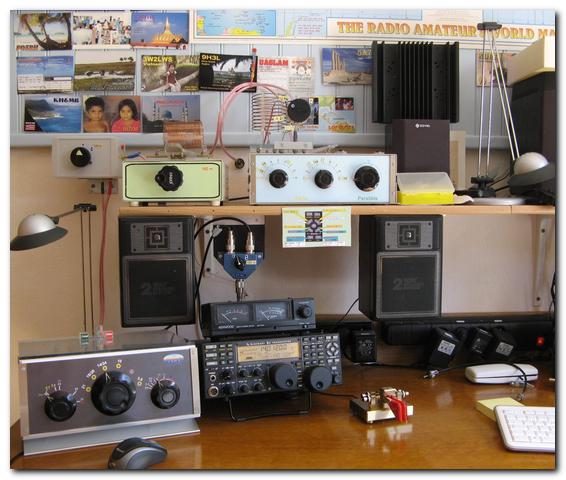 |
| F5HY station |
I then heard OZ3NP calling CQ on 20 meters and 3 watts just did not seem to cut it so I eventually cranked it up to 10 watts. Ben now heard me in Denmark and I was not sure if he was copying me at times but I'm in his log and I did get an email from him thanking me for the contact. That surprised me as this contact was plagued with propagation gremlins. AT QRZ.COM Ben has a great setup and with his son now a ham radio history goes back three generations in his family. It was time to shut things down as there was other things that had to be down around the house plus Julie and I were going to have Chinese takeout yummy.
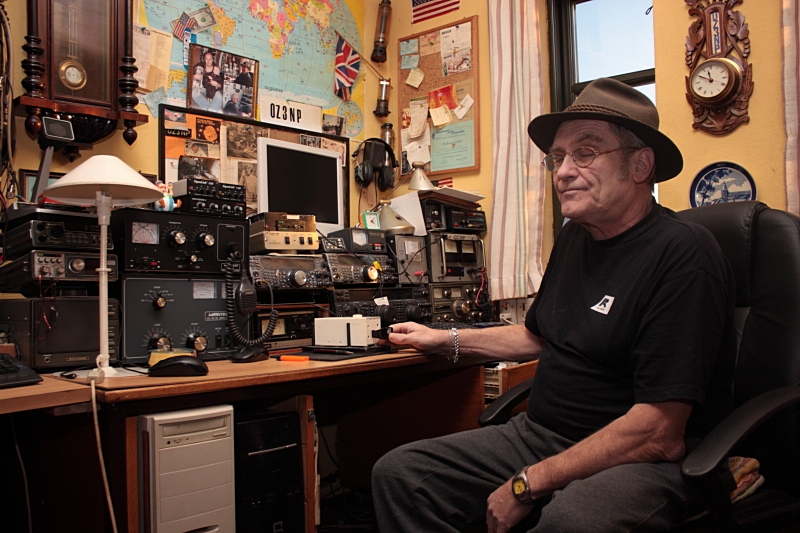 |
| OZ3NP |
I was able to get back on the radio again Saturday afternoon. I checked out 10 meters but it was dead there was some action on 15 so I thought I would give it a go. Rudy IK4VFD was calling CQ so I pumped my 3 watts into my attic dipole. Rudy came back to me and gave me a 529 this was strictly giving out RST, name and QTH as Rudy had a pileup waiting for him. There was a couple of repeats on my behalf as the 3 watts was struggling at times. With this contact my distance into Parma Italy was 1,412 miles per watt.
It was back to 20 meters as 15 seemed to be shutting down here I ran across UR4UC calling CQ Val came back to me on my first call. I received a 449 RST for some reason my keyer was acting up.....well at the time that was what I blamed it on. In fact it was my nerves getting the better of me during the contact. Not sure why but I can copy most QSO's when they are not a contact. As soon as I engage in a contact for some reason the code copying in my brain goes all funky. I also get all jumbled up with the sending at times as well. I could not understand why Val kept sending me "UC UC UC"....it was not until almost the final 73's that I realized I was sending UR4NC!!! If you read the blog Val sorry about that. This contact netted me my best miles per watt contact of 1,620 miles per watt.
It's now Sunday and I hope to get some radio time in this afternoon.

Mike Weir, VE9KK, is a regular contributor to AmateurRadio.com and writes from New Brunswick, Canada. Contact him at [email protected].
Zero Bias: The Benefits of “Geekdom”

The Aurora Borealis as seen from Maine in early August. (Rachel Moseson photo)
Standing with my family, watching the sunset on top of Cadillac Mountain in Maine’s Acadia National Park, my Blackberry buzzed to tell me I had a new e-mail. It was an alert from spaceweather.com about an impending geomagnetic storm, including a notice that the aurora was likely to be visible later that night in upper latitudes. Viewing, it said, would be best starting around local midnight.
We didn’t know if our location at around 44 degrees north latitude was “upper” enough, but we figured that a dark mountaintop with a 360-degree sky view might give us an edge. We returned around 11:30–the only people up there – and saw what looked like a thin white cloud to the north in an otherwise cloudless sky. And it was lit up, as though reflecting lights from a city or a stadium beneath it. Only thing was, the ground beneath the “cloud” was dark. We figured out the best settings on our cameras to photograph this cloud in the middle of the night and were amazed to see that what looked white to us looked green to the cameras!
I quickly shot a picture with my phone of the image on the camera’s monitor and sent it to Chip, K7JA, whom I knew had seen auroras in Alaska and asked him if that was what we were seeing. By the time he texted back a “Yes!”, the answer had become obvious to us as parts of the cloud began to brighten and shoot out rays of light above and below the main area. Then the cloud began to expand vertically and the whole thing started drifting to the west. Directly overhead, the “carpet” of the Milky Way was clearly visible, and–this being a week before the peak of the Perseids–every few minutes, a meteor flashed by. It was truly a magical evening … that the four of us enjoyed in total solitude. No one else, it seemed, knew about the celestial show going on over their heads.
“The benefits of geekdom,” I joked to my daughter. “If I wasn’t on spaceweather.com’s e-mail alert list, we wouldn’t have known about it either.” She responded, “Not too many people even know there’s such a thing as ‘space weather.’ ”
So… is there a ham radio connection here? Did I turn on my 2-meter FM rig and work Alberta off the aurora? No. First of all, Au doesn’t “work” effectively on FM, and secondly, I was too entranced by the visual aurora to even think about radio.
But this aurora resulted from a coronal mass ejection from the sun, an event which affected radio communications here on Earth as well as touching off visible aurora overhead. Such solar events are common in a rising sunspot cycle and have touched off speculation in the popular press about “killer flares” that could fry electronics here on Earth and cause billions– maybe trillions–of dollars of damage to our telecommunications infrastructure.
These “killer flares,” along with speculation at the other end of the solar spectrum that we are heading toward a period of decades with no sunspots, were the subjects of Dr. David Hathaway’s talk, “The Sky is NOT Falling,” at the Huntsville Hamfest a few weeks later. Hathaway is a solar physicist at NASA’s Marshall Space Flight Center in Huntsville and one of the nation’s leading authorities on the sun, sunspots and solar-earth interactions. The crux of what he talked about–in terms of “killer flares,” the “death of sunspots” and his newest predictions about Cycle 24–are reported on this issue’s news page, so I won’t repeat them here. But the audience was another demonstration of the benefits of geekdom.
“I like coming here to talk,” said Hathaway. “Hams actually understand and appreciate what I’m talking about.” Fortunately for those of us who are not solar physicists ourselves, Hathaway is a lively and engaging speaker, and able to explain exceedingly complex matters of solar dynamics in terms that a well-educated ham can understand. The flip-side, of course, is that we hams like to hear what Dr. Hathaway has to say. And it is a testament to our collective interest in the science behind the art of radio communication that arguably the nation’s leading expert on the sun and sunspots is willing to give up part of his weekend once a year to come talk, unpaid, to an audience of hams. The appreciation and respect are mutual.
Young Hams…

The Clark family at the Huntsville Hamfest, including dad Mark, W4CK; mom Laura, KJ4HCU, son Will, WB4SCK; and daughter Sara. Will and Sara built working code oscillators at the hamfest's youth lounge.
The Huntsville Hamfest was home once again to the annual presentation of the Newsline Young Ham of the Year award, of which CQ is a co-sponsor. This year’s winner is 11-year old Kaitlyn Cole, KS3P, of Harvest, Alabama (see profile on page 69). In addition to coming to the hamfest to receive her award, Kaitlyn was also there to work, running the youth lounge for other young hams and children of hams. Activities included a scavenger hunt, a foxhunt and a learn-to-build table, where kids (with adult supervision) learned to solder by building code oscillators. We were visited by one family (see photo) with two children who successfully completed this project. Activities like these are incubators of the next generation of young hams, especially when run by other young hams themselves. Speaking of which, we saw a very healthy number of younger adult hams at Huntsville, many of whom were accompanied by their own young children. It is clear that such efforts as the Young Ham of the Year award and hamfest youth lounges are having an impact and are helping to attract more young people into our hobby. I continue to be confident that ham radio’s future is in good hands. (PS to young hams: it’s OK if people think you’re a geek. Geekdom is cool. It opens doors to meeting top scientists and being the only one to know when to go look for an aurora!)
73, W2VU
Rich Moseson, W2VU, is Editor of CQ magazine and Editorial Director of all CQ publications, including CQ VHF, Popular Communications and WorldRadio Online. Contact him at [email protected].
ICQ Podcast S04 E20 – 21st Century PMR (25 September 2011)
Series Four Episode Twenty of the ICQ Podcast has been released. News Stories include :-
- Ham Radio Deluxe purchased
- Android Smartphone CubeSat
- SO67 safe but problematic
- Body as Antennas
- UK record for 434.650 MHz balloon
- Region 1 recommends Band Plan changes
- New JOTA info and badge
- National Hamfest Special callsign
- Canadian Amateur Radio Hall of Fame
- ATV world first - Hams wedding
Your feedback, Steve Nicholls (G0KYA) propogation report and Martin (M1MRB) reports on 21st Century PMR.
Colin Butler, M6BOY, is the host of the ICQ Podcast, a weekly radio show about Amateur Radio. Contact him at [email protected].
TI7/K2DBK officially approved, Part 1
It was a lot more difficult than I’d expected, but I finally received official approval from the ARRL’s DXCC desk for my TI7/K2DBK operation earlier this year. I’ve been holding off writing about it until I had resolution, one way or another, hence the delay in writing this.The issue had to do with the licensing authority in Costa Rica. Here’s the story as I understand it.
A couple of years ago, the organization responsible for issuing all radio licenses in Costa Rica was reorganized. That organization, SUTEL, apparently revised the laws regarding all radio services in Costa Rica, but somehow they neglected to revise the rules pertaining to amateur radio. In fact, they didn’t include rules about amateur radio at all after the rules revision. As a result, they had no way to issue or renew any amateur licenses, regardless of whether those licenses were for residents of Costa Rica or for visitors. As I understand it, this was an oversight, not an intentional removal of the amateur service from Costa Rica. Previously, for a US amateur to operate from Costa Rica, you’d have to fill out some forms and pay a nominal fee at the SUTEL offices in the capital city of San José and you’d walk out with your license. Unfortunately, after the laws were revised, there simply wasn’t a way to get a license.
I didn’t know any of this earlier this year when I decided to operate from Costa Rica. My concern was that you had to physically go to the SUTEL office in San Jose to get your license.
The location where we stay in Costa Rica is in the northwest portion of the country near the city of Liberia, and it’s a pretty significant drive to San Jose. (The green marker is where I was staying, the blue is San Jose.) Although Costa Rica isn’t a very large country, a multi-hour drive through a country where I didn’t speak the language (and where were weren’t planning to rent a car) just didn’t seem very appealing. What I thought I would do is to post to a couple of the DX lists to ask if perhaps there was a way to get a license online, or perhaps to see if there was someone in Costa Rica who could do the paperwork for me in advance, and mail it to me either at home or where we were staying. I got back multiple responses, both from US hams who’d recently operated from there as well as a couple of hams who live in Costa Rica, all of whom told me about the situation with SUTEL.
Among those responses were a couple that said that based on conversations between the ARRL and the Radio Club de Costa Rica there was a working agreement in place so that for amateurs from countries that had reciprocal operating agreements in place with Costa Rica (the US does), that as long as the visiting amateur is in the country legally (a copy of a passport stamp can be used to prove this) and they held an appropriate US license (I hold an Amateur Extra class license). they can operate legally from Costa Rica. The only other requirement is to use the appropriate regional prefix, which for my operation was TI7, indicating the Guanacaste region. Based on that, I operated as I’ve previously described, and assumed that I’d have no trouble having my operation officially approved for DXCC credit (for others, of course) and getting a Logbook of The World certificate, necessary to upload my QSOs to that system. As I said, it turned out to be a bit more of a challenge than I’d expected.
To be continued…

David Kozinn, K2DBK, is a regular contributor to AmateurRadio.com and writes from New Jersey, USA. Contact him at [email protected].
What’s Ahead for Arduino
The Arduino project announced some news at MakerFaire 2011. Here’s a video of a talk from Massimo Banzi:
In a nutshell, they are working on a new release of Arduino called “1.0″ or the “1.0 Core” which is going to break some things, but also set the stage for a more consistent and stable platform going forward. There are new hardware revisions for the Uno and Mega boards. The most notable change with these boards is the addition of several pins to support a two wire interface (I2C) bus which will enable much easier and standardized interfacing to shields. There is also a new Arduino that has an Ethernet interface built in, rather than having to use a separate Ethernet shield. (Shields are optional boards you can stack on Arduinos for additional capabilities.) I’m very interested in this board as it also has an SD slot for memory storage. I’ve been toying with the idea of writing a logger module for the keyer project. Why? Because I can and it’s never been done :-)
The project is also releasing a WiFi shield which opens up a lot of possibilities. Another dream geek project I’ve had has been to place Arduinos in various places throughout the house and the yard for doing various things like reporting the temperature or sensing intruders. The Arduinos could network via WiFi and report to each other or back to the mothership.
All and all it’s an exciting time in Arduino land. If you haven’t tried using one of these little boards, you’re missing out on some fun. The applications in amateur radio are endless and with the power and functionality steadily increasing, I expect in a few years we’ll be doing things like DSP or perhaps have a rig-on-a-shield.


 Ham Radio Deluxe |
 W5SWL Electronics |
 Ham Radio Prep |
 KB3IFH QSL Cards  Hip Ham Shirts  HamRadioAuctions HamRadioAuctions Reliance Antennas Reliance Antennas Enigma Shop Enigma Shop |  morseDX  Ni4L Antennas  R&L Electronics R&L Electronics antennas.us antennas.us QRV QRV |
- Matt W1MST, Managing Editor
