 |
 Long wave goodbye
 10 October 2011 | by
 I never did get the Spectrum Communications Off-Air Frequency Standard kit working. Now it is looking as though it would be a waste of time anyway as the BBC will be closing down the Radio 4 long wave transmitter that is used as a frequency standard.
An article published yesterday in the Guardian Online explains that the Radio 4 long wave transmitter uses valves (tubes) that are no longer obtainable. The BBC has the only ones still in existence. The transmitter uses a pair and they can last as little as one year. When the last valve blows, Radio 4 on long wave will become a thing of the past.
Building a new long wave transmitter using up to date technology would cost millions which the BBC can no longer afford due to the need to cut costs as a result of the government’s decision to freeze the licence fee.
There are many other ways to receive the Radio 4 programming if the long wave transmitter closes down. But none of them involve a powerful 500kW transmitter whose frequency is maintained accurately enough to be used as a frequency standard.

Julian Moss, G4ILO, is a regular contributor to AmateurRadio.com and writes from Cumbria, England. Contact him at [email protected].
Confidence
 |
| Combined result RTX Saturday |
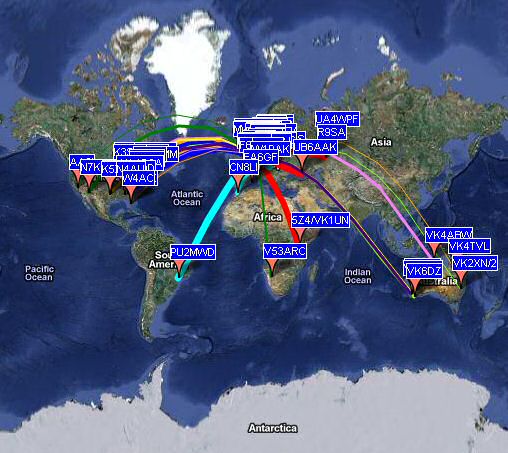
I left WSPR running at 10m this weekend. Although there was a huge difference between propagation at Saturday and Sunday. Since my computer chrashed a couple of months ago this was the first time that I installed WSPR again and Saturday around 10:00 UTC I was finally on air with my usual 1W. A little late as I already heard several Japanese stations with big signals on both 10m and 12m. Anyway, my WSPR signal was heard from Australia to Africa and North and South America. I could note several new DXCC and I count 18 till now on 10m WSPR that received met 1W signal. As always I received a lot more, and there was something that was conspicuous. There were stations that transmit with 50W and stations that transmit with only 0,1W. I did remember what Paul PC4T wrote about the QRO stations that appear on JT65A as well. Then I thought why? Why is someone using that much power on QRP modes like WSPR and JT65 or even PSK? I think it is a matter of confidence. Confidence in your station and in your antenna system or even the propagation. Probabely someone that has no confidence in it will use more power so he is certain to be heard. It could also be something else, like a wall of QRM/QRN in very populated or industrial areas. Imagine you always have to struggle with S7-9 QRM on all bands and you occasionally spot something on WSPR or JT65? Using QRO could be a scream for others to do the same so it’s finally possible to QSO or spot a WSPR signal. I don’t know, I hope someone that use more then 5W on WSPR or JT65 can tell his story why? Most confident station this weekend on 10m was N4AU with 0,1W over 7337km (4559mls) my report -6dB. No confidence at all had DF4PV who was transmitting 50W and had a signal of +2dB. Later he switched to 10-1 and 5W, probabely gained some confidence after all.
Bas, PE4BAS, is a regular contributor to AmateurRadio.com and writes from Groningen, Netherlands. Contact him at [email protected].
W3NQN filter wrap-up
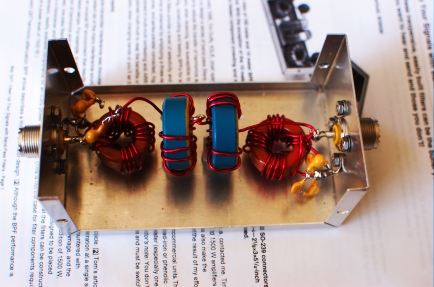
After about six years of sporadic effort, I finally finished the W3NQN filter set by building the 10- and 15-meter filters over the past two weekends. Now I can operate SO2R with impunity on all bands. Several band combinations are still problematic, but those are problems that filters can’t solve.
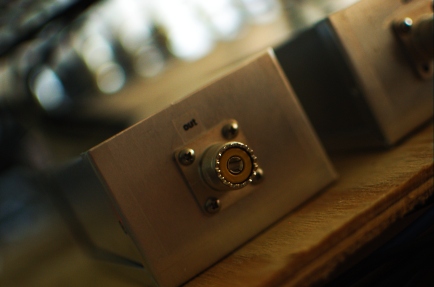
Because the geometry of our home does not permit me to have a walk-behind station desk, I had to attach the filters to the mounting board by laying on my back with a right-angle drill. That sort of thing is always a bit exciting!
Ethan Miller, K8GU, is a regular contributor to AmateurRadio.com and writes from Maryland, USA. Contact him at [email protected].
Eliminating CRTs
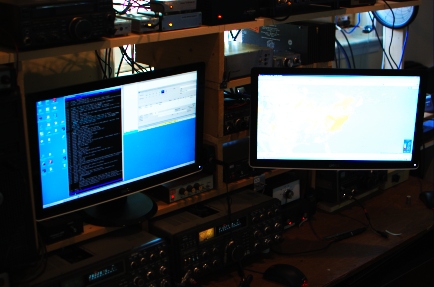
Ever since I replaced my primary station computer (a decision that may be reversed soon—details in a later post), I desired to replace the remaining 19-inch Dell Trinitron CRT monitor with something lighter and smaller. Mom and Dad were in town a few weeks ago on a much-needed vacation and we went to the National Air and Space Museum’s Udvar-Hazy facility near Dulles Airport. This is only a few miles from one of the best used computer shops in the DC area—CedarPC.
CedarPC is nice because they’ll sell you “damaged” stuff at a discount if you don’t care about the damage. I inquired about a 24-inch flat panel I had seen on the web site, but they could not find it. They did find me a nice 20-inch flat panel that was just missing the stand and the price was right. The missing stand was no big deal because I wanted to mount the monitor on an arm so I could bring it closer to the HF end of the station desk, tuck it in at the VHF end, or even swivel it out over the couch to watch a DVD. Sold.
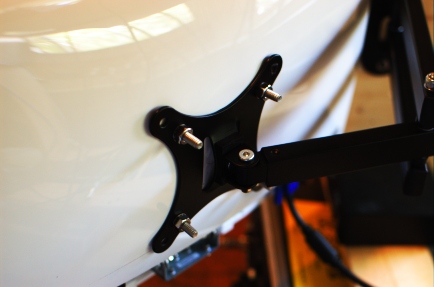
Monitor arms are generally expensive…at least 2-3 times what I paid for the monitor itself, often more. So, I went to trusty eBay and found something designed for mounting televisions for $15 including shipping. This did require some modification of the monitor housing and liberal application of wide washers to reinforce the plastic in the housing. But, it was done with all junkbox screws and washers.
Ethan Miller, K8GU, is a regular contributor to AmateurRadio.com and writes from Maryland, USA. Contact him at [email protected].
Lucky 10
I understand the reason for split operation when you run a DXpedition. Without split operation you probably wouldn’t be able to hear a thing apart from the big guns shouting for attention. Unfortunately for a little fish like me the split is too wide, most of the time. My classic TS-130V has a RIT of only 2 kHz. Nowadays many operations choose splits of 5 or even 10 kHz, even for CW! Never mind, I’m already glad to be able to hear them.
Today, however, 10 meters was open again and after tuning around I found a 53 signal from T32C. Nice, but I heard them before, so no big deal. But it became nicer when I noted he was working a split of 0 kHz and he was calling out CQ because there were few takers. Out came my mike and with the 12 Watts I am putting out on 10 meters he gave me a 59 report. Yeah, right! I gave him the honest 53, but I don’t think he noticed.
Of course, when my TS-440S is fixed I have a 1oo Watts and wide RIT/XIT again, but unfortunately that hasn’t happened yet. I got the missing parts yesterday and spent tonight putting the VFO#5 back together again. No luck, still lots of dots on the display saying that the PLL won’t lock and I’m measuring 8 Volts where I should be measuring 5 Volts. The search for the fault continues……unfortunately.
Hans "Fong" van den Boogert, BX2ABT, is a regular contributor to AmateurRadio.com and writes from Taiwan. Contact him at [email protected].
ICQ Podcast S04 E21 – Soldering and Leadfree (9 October 2011)
Series Four Episode Twenty-One of the ICQ Podcast has been released. News Stories include :-
- Solar CME and flares kill upper HF bands
- ARISSat used as teaching tool
- Simulated Emergency Test
- VI6CHOGM
- GB400KJB
- AO-51 to support 54th Jamboree On The Air
- WWII HRO receiver donated to museum
- Limited Greek 5 MHz permission
- Sputnik transmitters on-air
- XYL radio ham to stay in touch with husband
Your feedback and Martin (M1MRB) discusses Soldering and Leadfree.
Colin Butler, M6BOY, is the host of the ICQ Podcast, a weekly radio show about Amateur Radio. Contact him at [email protected].
Enough Planning! It’s Time to Put This Antenna Up!
Hopefully Monday will be an antenna-building day. I don’t know that it will all come together in one shot, but if I don’t get this project going it’s never going to get done.
I spent some time in the hardware store yesterday, picking out the many different bits and pieces that I’ll need for the job. Hard to believe how much it all added up to. Gulp! At least I had a coupon for $10 off of my purchase. As it is there are still a couple more little things I need, but I’ll have to drive up to Willmar for those on Monday.
Here’s a rough sketch that I made last March, dusted off and updated slightly. There are still a couple of unknowns — those are the figures in red. I’m not certain that I’ll need to attach anything to the adjacent church-building, since I may get away with just draping the wire in a nearby tree. But I’ll figure that out as I go. I’ve planned enough! It’s time to put this antenna up!


Todd Mitchell, NØIP, is a regular contributor to AmateurRadio.com and writes from Minnesota, USA. He can be contacted at [email protected].
 Ham Radio Deluxe |
 W5SWL Electronics |
 Ham Radio Prep |
 KB3IFH QSL Cards  Hip Ham Shirts  HamRadioAuctions HamRadioAuctions Reliance Antennas Reliance Antennas Enigma Shop Enigma Shop |  morseDX  Ni4L Antennas  R&L Electronics R&L Electronics antennas.us antennas.us QRV QRV |
- Matt W1MST, Managing Editor
