 |
 DXpedition QSLing
 2 November 2011 | by
 This post might better be titled “supporting things that you value.” A recent large-scale DXpedition to a “new one” just started sending out QSL cards in the past few weeks. I have seen a bit of traffic leaking onto the regional contest club’s e-mail reflector about QSLing this operation and today someone complained that QSL requests that included donations were being processed rapidly and that he had not yet seen his. He was thoroughly chastised by a number of people on the reflector (including one of the DXpedition operators who went on at some length about the cost of the DXpedition) before the thread was (wisely) quashed by the moderator.
I composed a short reply very early in the melee, but decided (also wisely) not to contribute it because it really had little to do with contesting. So, I’m writing here in hopes that someone finds it interesting.
When I was a new ham, I won a copy of the ARRL Operating Manual at a hamfest. It sounds inane now, but I read the thing cover to cover. In the chapter on DXpeditions, the author writes, “A donation should never be a condition for receiving a QSL card.” That has stuck with me through the years. The fundamental question is: why spend tens of thousands of dollars on the effort only to hold the operators who worked you hostage for a donation that might cover your QSLing costs if you’re lucky?
But, life is rarely black and white and most DXpeditions understand the futility of that question, so the situation outlined above rarely happens. In the present scenario, the DXpedition stepped into the gray by prioritizing donors ahead of non-donors. I have no problem with this. In fact, as I began to write in my reply, it is a matter of supporting things that are important to you. If having a card for the “new one” is important so you get on the Honor Roll for this year’s DXCC Yearbook, how much is that worth?
This falls into the same category as people who used to complain about the results of contests sponsored by CQ magazine being unavailable for free online. Well, if you want the results, buy the magazine!
Enough ranting…did somebody mention that CW Sweepstakes is this weekend? SWEEPSTAKES!
Ethan Miller, K8GU, is a regular contributor to AmateurRadio.com and writes from Maryland, USA. Contact him at [email protected].
Lessons Learned During Antenna Construction
I learned a few lessons — the hard way — while building this New Carolina Windom. At risk of making myself look like an idiot I’ll share some of them with you here so that you can learn from my mistakes.
You might wonder how a guy who has been a ham for 33 years could be so ignorant about some of these things, but understand that up until this project I had never even put up an outdoor antenna on my own. My dad was the one who did all this when I was a kid. When I became a homeowner, all my antennas were indoor, stealthy antennas located in my attic — a whole different ballgame. That doesn’t work in my current house, so for the first time I’ve had to build up an outdoor antenna-system.
Anyhow, here they are (in no particular order):
- Drilling holes in masts: Use a titanium bit. It’s worth the money! I used lesser bits at first, to my frustration. Titanium bits cut through aluminum like a hot knife through soft butter, and they make short work of steel, too. If you’re drilling anywhere but in a workshop, make sure you put down newspaper or something to catch the metal shavings; metal shavings do not contribute to a “barefoot lawn!” Also, build a good jig if you’re drilling all the way through the mast. The jig I built did a good job of holding the mast in place but next time I’ll improve it with a guide that ensures top-dead-center and (in lieu of a drill-press) perfectly perpendicular drilling.
- Cutting & handling antenna wire: Be generous when cutting the legs of your antenna. I thought I was generous, but when it came time to make my final adjustment (after SWR testing) I could have used just a few more inches than the extra 15″ I had allowed myself on the long leg of my New Carolina Windom. And when handling 14 AWG copperweld, watch out for kinks! As hard as I tried, I came mighty close more than once to putting a bad kink in that unwieldy stuff.
- Erecting masts: Use a level to make sure the mast is vertical. I know, DUH! I did use a level when I put the tripods up, but when it came time to put the masts in I had forgotten to bring it up on the roof with me. It was just too tempting to pop them in without checking to see that they were perfectly vertical. I found out the hard way that a mast can be tilted quite a bit and still look perfect when peering up its length!
- Working safely on the roof: Use a safety-line. The first time I went up on my roof I was surprised at how much steeper it was than the one I used to scramble around as a kid. Frankly I was scared stiff up there, especially with this bum leg of mine. I’ve heard there are safety harnesses out there, but I couldn’t find one. So what I did was to throw a safety-line over the roof and tie it off to something stout. That at least gave me some added security on the side of the roof opposite the attach-point. Just make sure your rope is strong and your knots are good!
- Soldering wire on the roof: Buy or borrow a butane soldering iron. I found out the hard way that even a 100 watt soldering gun is useless at the end of a long extension cord. It worked fine for soldering lugs onto the end of my 14 AWG copperweld, but not for soldering the same wire twisted onto itself. And a regular propane torch is definitely not the right tool for the job (I know, I tried!). Also, you might want a drop-cloth up there. By the time I was done with the job using a propane torch (you should have seen it — it was pretty comical), I had more than one solder-drip on the shingles.
- Waterproofing coaxial connectors: Use coax-seal or self-amalgamating tape. As I mentioned in my earlier post on this subject, I at first just used electrical tape to wrap my coaxial connectors. After being persuaded by several kind hams who posted comments on that post, I ordered some coax-seal. It’s a good thing I did; I am grateful to those hams for their good advice. When the shipment arrived, I went up on the roof to discover one of my nice pretty tape-jobs already coming apart at the seams after less than two weeks! By the way I found out that five feet of 1/2″ coax-seal is good for only three connections, at least the way I wrapped them.
- Using pulleys: Use big enough rope. The first time I hoisted my antenna the rope was too small; it quickly jumped off the pulley and got jammed between the pulley and the housing. Fortunately I got it free. I swapped out the thin rope for something much stouter, and now it will never get stuck. (By the way, I’ve read one ham’s advice not to use pulleys at all but ceramic egg-insulators instead; there’s nothing for the rope to get stuck on and they’re durable enough that he’s been using one as a pulley for 20 years.)
- Allowing for radials: Build in an attach-point for radials at the base of your RF choke if you’re building a New Carolina Windom. Only after my antenna was complete did I read about the benefits of adding radials to this antenna. There is no good way that I can think of for me to connect radials directly to the coaxial connection. Next time I build an RF choke I’ll provide some lugs (or a plate or something) on one end for this purpose.
- Testing SWR: Make sure you hoist your antenna all the way up before testing its performance. I tried testing my antenna before climbing up on the roof — my son held the mast upright and I tied the legs of the antenna off as high as I could to nearby trees, but the SWR was just too high on 40 meters due to the proximity of the antenna to the ground.
- Throwing lines: If you have trouble throwing a line, try a heavier weight at the end. I now know that throwing lines is an art. At various points in this project I experimented with a sling-shot, potato-gun, and throwing by hand. Each of these techniques has its place. At one point the best way for us to get a line where we wanted it to go was by simply whirling a weight and letting it fly — but only after we figured out that we needed a good heavy weight at the end. At first I used just a few ounces of metal, but it kept getting hung up in the branches we were penetrating. Once we switched to a pop bottle full of water, it worked on the first try.
- Pounding ground rods: Put your connectors on the ground rod before pounding it all the way in, if they’re the kind of connectors you have to slip on over the top of the ground rod. By the time I was done pounding in my 8-foot ground rod, the top was so flattened out I couldn’t get the one-piece connector over the top. (An angle-grinder solved the problem; I cut off the top and slipped the connector on.)
No doubt some of these lessons I’ve only partially learned (and maybe some of them I haven’t learned well at all). If you have any better suggestions, or if you have some of your own hard-won lessons you’d like to add, fire away. If we can learn from each other here, maybe we won’t have to learn quite as many lessons the hard way!


Todd Mitchell, NØIP, is a regular contributor to AmateurRadio.com and writes from Minnesota, USA. He can be contacted at [email protected].
CQWW SSB 2011 wishlist
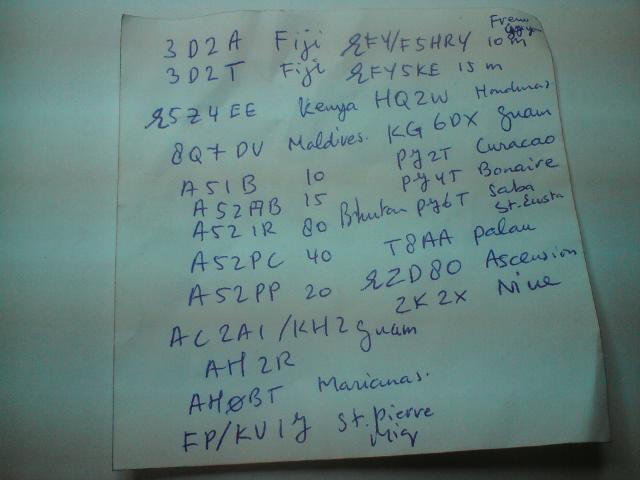
Incredible! Worked 20 !!! new band DXCC on 10m in the CQWW contest last weekend. That’s a lot. Propagation was very good especially on the 10m band. I actually made a wishlist before the contest with the help of the announced DX operations list of NG3K. Did not work everything fom the list as for example the PJ and A52 stations were constantly in a pile-up and I didn’t want to waste time with so many nice DXCC to work. But at last I did QSO with a few of the list. I even made a incredible QSO over the northpole to Alaska on 10m another first on that band. And no, I don’t work with a large beam but with a simple vertical made partially from Aluminium foil! I don’t have a lineair amplifier as well and did make all QSOs with 100W. I was not on the radio the whole weekend, so I missed opening to Oceania. I was simply not able to be on the radio on the right time as family duty calls. But after all I cannot complain I made 450 QSO’s, 200 of them were made on the 10m band. And I was almost jumping in the air….I made my first QSO with XE zone 6 after years of trying on various bands.
Some highlights on 10m, of course I made some QSOs on other bands too:
10m: JH4UTP (Japan), ST2UOK (Sudan), JT5DX (Mongolia), A92GR (Bahrain), BX100 (Taiwan), BD3NCK (China), VU2PAI (India), JY4NE (Jordan), C5A (Gambia), PZ5MM (Surinam), HI3TEJ (Dominican Rep.), P40W (Aruba), 8R1EA (Guyana), A73A (Quatar), A61BM (UAE), AA4V/VP9 (Bermuda), XE1CQ (Mexico), YV5NEA (Venezuela), HR2DX (Honduras), VP2MDG (Montserrat), WL7E (Alaska), 5H3EE (Tanzania), 7Z1SJ (Saudi Arabia), FY/F5HRY (Fr.Guyana)
I didn’t mention the countless northern American stations I worked on 10m. Imagine what would have happen if I used a beam, I think I would have doubled this list !!!
Bas, PE4BAS, is a regular contributor to AmateurRadio.com and writes from Groningen, Netherlands. Contact him at [email protected].
Waiting list update
On Halloween Steve Weber KD1JV has announced to the AT-Sprint Yahoogroup he’s considering planning to take orders online for the ATS-4B at 11:11:11 AM, EDT on the 11th November, 2011. Clearly a time and date not to be forgotten. Shipping would follow close behind then. One exciting aspect of this latest ATS-4B version is the planned integrated CW/PSK decoder on a daughter board, planned for a January release.
And the other hotly awaited item for the QRP and HFpack crew, the new Elecraft KX3 is now likely not to start shipping until the new year, 2012 I presume. An apparently hastily written update indicates “KX3 estimated ordering date (Winter 2001) and shipping date (January)”.
UPDATE: We’re getting closer. On 2 November this has been updated to “KX3 estimated ordering date (Nov/Dec 2011) and shipping date (Late January)” [my emphasis].
I’m dreaming of an expensive Christmas.
Stephen Rapley, VK2RH, is a regular contributor to AmateurRadio.com and writes from New South Wales, Australia. Contact him at [email protected].
Each DXpedition QSO makes someone happy…
I remember a conversation way back when I was on the D68C expedition to the Comoros islands in the Indian Ocean. John G3WGV and Mark M0DXR were talking about the pleasure that people get from making contacts with DXpeditions. Mark summarised it in a way that I’ve always remembered, “for each QSO we make, we’re making someone happy”. It’s a magical way of looking at it and it would be nice to think that it is true.
I was reminded of this reading Dave Richards’ AA7EE’s blog about his QSO with T32C on 80m with a homebrew QRP and a 40m dipole! It’s a great story but what makes it even better is that the operator from T32C, Franky, ON7RU read the blog and commented on it! What really makes it is Dave’s clear surprise and pleasure at making the QSO.
Having operated a few DXpeditions over the years, I can safely say that it’s stories like these that make it all the more enjoyable. I remember back at 3B9C, I randomly strolled over to a spare station which was free and put out a call on 10m FM on 29.600MHz. A fair few came back and I worked my way through. Soon, I heard a familiar voice calling me, MW0TTU.
Mo, MW0TTU is the aunt of my friend Kelvin, GW4TTU and we had worked many a time on VHF from the South Wales hills. Simply, I replied without callsigns, “Hello Mo, what a lovely surprise, you’re five and nine in Rodrigues”.
It was lovely to hear Mo’s surprised voice as she said “Who’s that? Who’s that!”. Of course I explained quickly and did the more formal exchange of reports and then got back to the pileup, but it was a magical exchange.
It’s the QSOs like that that really surprise people and make them happy.

Tim Kirby, G4VXE, is a regular contributor to AmateurRadio.com and writes from Oxfordshire, England. Contact him at [email protected].
Nationwide EAS Test on November 9th
The FCC, FEMA and NOAA are going to be conducting a nationwide test of the EAS system, November 9th, 2011. Mainly to be sure, that it works, as a national test has never never been done. While states have done local tests on a weekly and monthly basis, no one is sure if an alert on a national scale was to go out, that it would 100% work.

Photo Courtesy of Wikipedia
So on November 9th, at around 2pm, someone, somewhere at the FCC or FEMA or NOAA, will push the activate button, and TVs and radio stations across the US will play the familiar tones we all know, when we hear an alert for a storm warning or some other event. Some of the differences will be that on TVs, you may see a background image on the screen as the scrolling text goes by, telling you this is all just a test. Some may not see the background image. Also the test will last for 3 minutes, as compared to 2 minutes for all others. The main reason is to make sure the code is getting to everyone to activate. So you could see a few systems slow on the catch up. Think of it like dominoes.
Now from my experience with the EAS system, working in broadcasting, sometimes the recording length on the Endec device that radio stations use, are only set for 2 minutes to record the audio. I don’t know if this will override all that and go live as soon as it hears the codes come across, or if the units will record the audio allowing manned studios to replay the alert in a break of the programming. I think there was only 1 or 2 times that we broking into programming to play an alert. Most of the time, it was at a scheduled pause in the programming.
But either way, this should be an event to see. The whole system tested at once. I wish the guys conducting the test good luck that this system works, and I hope we’ll never have to use it either.
73.
Rich also writes a Tech blog and posts stories every Tuesday and Thursday on Q103, Albany’s #1 Rock Station website, as well as Amateur Radio stories every Monday thru Friday on AmiZed Studios and hosts a podcast called The Kim & Rich Show with his fiance’ Kim Dunne
Rich Gattie, KB2MOB, is a regular contributor to AmateurRadio.com and writes from New York, USA. Contact him at [email protected].
Web Site Outage
Sorry for the recent Web site downtime. It was a stupid error on my (K5TUX’s) part. Also, it drives home the need for me to separate the production Web server from the development one. Hopefully that will be accomplished in the near future and downtime like was experienced over the last few days will not happen again. Thank you for hanging in there and welcome back to the site.
73 de K5TUX
Russ Woodman, K5TUX, co-hosts the Linux in the Ham Shack podcast which is available for download in both MP3 and OGG audio format. Contact him at [email protected].
 Ham Radio Deluxe |
 W5SWL Electronics |
 Ham Radio Prep |
 KB3IFH QSL Cards  Hip Ham Shirts  HamRadioAuctions HamRadioAuctions Reliance Antennas Reliance Antennas Enigma Shop Enigma Shop |  morseDX  Ni4L Antennas  R&L Electronics R&L Electronics antennas.us antennas.us QRV QRV |
- Matt W1MST, Managing Editor
