 |
 Ham Nation 25
 10 November 2011 | by
Hosts: Bob Heil (K9EID), Gordon West (WB6NOA), and George Thomas (W5JDX)
98 new hams from Cal Poly, Dave Kalter and Don Dubon talk about their Youth DX Adventure, rub-on transfers for PC boards, and more.
Guests: Dave Kalter (KB8OCP), Don Dubon (N6JRL), Dave Kalter (KB8OCP), Mitchell (KD8JRS), Rachel (KD8FOB), and Arthur (KD8NUB)
Download or subscribe to this show at http://twit.tv/hn.
We invite you to read, add to, and amend our show notes at wiki.twit.tv.
Thanks to Joe Walsh who wrote and plays the Ham Nation theme.
Thanks to Cachefly for the bandwidth for this show.
http://dts.podtrac.com/redirect.mp4/twit.cachefly.net/video/hn/hn0025/hn0025_h264b_864x480_500.mp4
http://dts.podtrac.com/redirect.mp4/twit.cachefly.net/video/hn/hn0025/hn0025_h264b_640x368_256.mp4
http://www.podtrac.com/pts/redirect.mp3/twit.cachefly.net/hn0025.mp3
Dr. Bob Heil, K9EID, is the founder of Heil Sound and host of TWiT.tv's Ham Nation which streams live each Tuesday at 6:00pm PT (9:00pm ET) at http://live.twit.tv. Contact him at [email protected].
Handiham World for 09 November 2011
Welcome to Handiham World.

Photo: Pat, WA0TDA, poses in front of the Honda Driving Simulator at the Mazda car rental agency in Chitose, Japan. Note the Handiham baseball cap! In Japan one drives on the left side of the road.
[email protected]
Handiham Manager

Pat Tice, WA0TDA, is the manager of HANDI-HAM and a regular contributor to AmateurRadio.com. Contact him at [email protected].
My first QSOs on JT65a
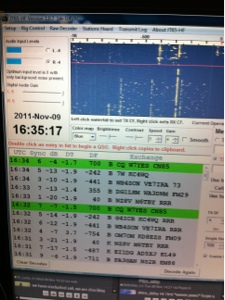
I’ve mentioned before that I wanted to try out JT65A on HF but had hit some problems with the laptop’s sound card and the software. Having got things going on WSPR yesterday; my 1W 20m signal got as far as VE6PDQ/1 in Edmonton. Having had an insight as to what I thought the sound card issue was with the JT65A-HF software was, this afternoon I connected it all up and started the software.
It worked!
First of all I tried it out on 20m and got a decode, having sorted out the levels to the sound card. It seemed that the JT65A software needed a slightly higher input level than WSPR. Having done that I was delighted to work DL1AAH on 20m running about 1W.
I wondered what 10m would be like and sure enough it was busy! I answered a few CQ calls, but a particularly nice QSO was with W7YES – I was running about 10W to the vertical.
By about 1830z the band seemed to have faded but I left the software running whilst we had supper. To my surprise, when I popped up later, the band had opened again and the software had logged some further US stations including WY7LL.
I’m pleased to have this working and suspect I shall have a lot of fun with it.

Tim Kirby, G4VXE, is a regular contributor to AmateurRadio.com and writes from Oxfordshire, England. Contact him at [email protected].
The Basement Project
While I’ve mentioned it several times on my podcast, I don’t recall blogging much about it. I did blog once about moving my ham shack from a 6 foot area to a larger area here. But for what feels like a decade, I’ve been planning for and slowly working on my new basement ham shack, office and just general man-cave. It all began sometime in early 2008 when I got the idea to turn the un-finished portion of my basement into a new ham shack.
We had half of our basement finished soon after purchasing our house in 2004. It’s been in this finished area where I’ve setup my ham shack, podcast recording studio and home office. Because this basement area was finished prior to me getting my ham ticket, I have to run my coax feed line either across the ceiling or across the carpet to get it to an outside wall. Of course we do what we have to do to get on the air. But I’ve always thought it would be nice to have a space that didn’t have coax and power cords everywhere.
The first step was to move everything from the unfinished area of the basement (primarily used for storage) to the finished area so I could begin construction. The unfinished portion of the basement is concrete floor and concrete walls. While I would have no problem working in a concrete space like this, the object was to create something that was nice and comfortable. So up went the 2×4 stud walls.
The framing portion of the overall project went fairly quickly. The main room of my ham shack/home office/man cave is a room approx. 20’x20’ with a hallway measuring about 8’x16’ opening up into the area that is the laundry room which when framed in was about another 12’ or so of wall space.
While I started the framing project in 2008, if memory serves me correctly all the framing was complete in about 3-4 months. So what have I been doing the past three years? Well obviously not a lot in relation to the basement project.
Part of the delay has been due to life schedule conflicts. You know work, travel, good DX conditions etc. In recent weeks, it has been hard to pry myself away from the radio to go work on the basement. But I really want to get this done and the wife really wants to claim the rest of the basement for other uses.
A few weeks ago I started working on the basement area again. I’ve been running electrical, CATV, telephone and network cables in the new area. With the help of my wonderful wife, we have mapped out where my desk and such will be. I’ll admit I’m not the most tidy person on the planet. My current shack area looks like a bomb went off. I blame this primarily on the fact that I have no cabinet space. Everything is either on the desk, under the desk or stacked beside the desk. The new space will have cabinets under the desk surface and cabinets from the ceiling down with just enough space in between for the work area.
Speaking of work areas. I’ll have my primary operating position in one corner. I’ve worked in a corner type setup for the past couple of years and like having the LCD in the corner with my FT-950 on the right and my FT-897 (used for digi modes) to my left. There will be plenty of space for my VHF/UHF rigs, packet and just about anything else I want to do. I have also factored in a large workbench area where I can build projects and restore those old AM radios which I enjoy.
For the wall material I’m going with sheetrock. While we had investigated other options, we kept coming back to drywall. This will be one area which we’ll contract out and for a couple of reasons. One, it will be difficult for just my wife and I to handle the sheetrock (especially the ceiling) the time to complete the job would take us a few weekends. The sheetrock process is a dirty and nasty one. I can hire a contractor and crew to come in and they’ll hang, plaster, sand and texture the walls in just a few days. My wife and I then will paint and do all the rest.
Back to the cable planning. I’ve factored in both what my present need is as well as looking ahead. Because the exterior wall where I run the coax feed line for my Hustler 6BTV (ground mounted in my back yard) will be covered in sheetrock as well as the ceiling above it, I’ll need a way to access this in the future. I installed a 1 1/2” PVC pipe across the ceiling for my coax needs. Some may argue and say I should have installed a larger pipe, but living in “HOA Hell” I’ll never have a need (nor permission) to install anything other than a vertical antenna in my back yard. I’ll still have access from the utility closet where I’ve pulled the feed line for my 20m hamstick dipole, rotator and VHF/UHF antenna.
The final decision to make is on the floor covering. Everything from just the bare concrete floor to tile has come into our heads. I do know that carpet (any style is out). I want to be able to zoom from one side of my desk to the other in my chair without issue and carpet just doesn’t allow it. Plus carpet in a basement is a bad idea any way you look at it.
I have just another weekend or two of work to do before we can bring in the sheetrock guys. I need to run speaker wire for a surround sound setup and make one more plumbing modification near where the laundry area will be. If all goes as planned, we would like to have the sheetrock installed just prior to Christmas and use some of the time-off to do the painting.
I’ll update everyone in a few weeks on our progress and hopefully with pictures. I don’t see much need in adding photos to this blog article. I think everyone knows what concrete walls with 2×4 studs in front look like.
Until next time….
73 de KD0BIK (Jerry)
Jerry Taylor, KD0BIK, is a regular contributor to AmateurRadio.com and writes from Colorado, USA. He is the host of the Practical Amateur Radio Podcast. Contact him at [email protected].
Feeling chirpy
Not without some difficulty due to my shaking hands, I managed to modify my copy of Roger G3XBM’s XBM-10-2 two transistor transceiver for 10m to his latest version. It is now named the “Chirpy” for reasons that will become obvious when you hear one on the air.
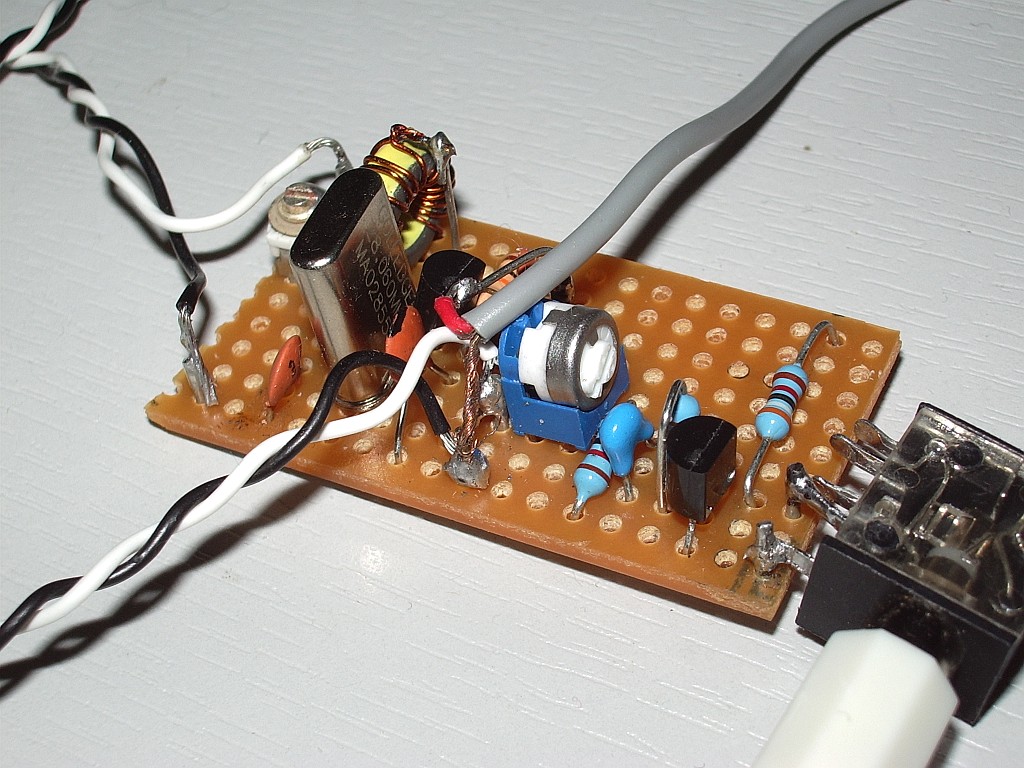
My version is exactly the same as Roger’s except that R3 is a trimpot not a fixed resistor. This allows me to adjust the power output to what I want. I am getting 150mW output on a 13.8V supply, this drops to 50mW with a 9V power source.
So far I have yet to make a contact with the little rig. I have called CQ on 28.060 many times but my signal is yet to be spotted on the Reverse Beacon Network. I don’t know if that is because my signal is too weak or too chirpy for decoding by the skimmer stations. Or perhaps the skimmers don’t receive that far up the 10m band. I will probably have to arrange a sked with a local station who is near enough to hear me.

Julian Moss, G4ILO, is a regular contributor to AmateurRadio.com and writes from Cumbria, England. Contact him at [email protected].
What’s that signal on 433.075? "Beep Beep – 500 feet!"
I was passing through the shack quickly on Sunday and popped the FT7900 FM rig on to see what was going on in both the 145 and 433MHz bands. To my surprise, the receiver stopped on 433.075 – the output of the local Swindon repeater, GB3TD. However, what I heard was not GB3TD.
At strengths between S2 and about S4, fading up and down, was an FM transmission, consisting of a series of tones followed by an occasional announcement of “500 feet”. I’d never heard this before and wasn’t entirely sure what it might be. To start with, I thought perhaps it was a data from a balloon flight, but as the heights were increasing and decreasing quite rapidly, I suspected that was unlikely.
However, GB3TD sprang into life and Andy, G0BEQ popped up, testing his new Baofeng UV-3R (which sounded great!). I told Andy what I was hearing – and interestingly, about 15 miles away from me, he wasn’t hearing the interference. He was able to tell me what it was though; equipment for model aircraft that reports the altitude of the model plane back to a receiver on the ground.
Oddly, after Andy and I had been speaking for a few minutes, I noticed that the transmission stopped. A coincidence perhaps, or perhaps the signal from the repeater being rather stronger than the few milliwatts from the plane had caused the altimeter to stop working whilst the repeater was active.
Not sure about the legality of these devices – although my suspicion is that they come under the heading of the low power devices and can thus be operated legally. However, if you are a model aircraft enthusiast reading this and you have one of these devices, may I ask you respectfully (genuinely) to try and use a channel that amateurs do not use. If you are in doubt – then your local amateur radio club can probably advise you which frequencies are likely to be in use local to you.
It’s surprising how far a milliwatt or two of FM on 433MHz will travel!

Tim Kirby, G4VXE, is a regular contributor to AmateurRadio.com and writes from Oxfordshire, England. Contact him at [email protected].
CW Sweepstakes 2011
So, K3KU, who won last year’s Maryland-DC certificate in A-power (150-watts, no DX cluster) for Sweepstakes CW posted to the contest club e-mail reflector a few weeks ago noting that although he had won that I had nipped at his heels with 7 additional hours of operating left on the table. I responded to the reflector that he had operated long and made more contacts and therefore deserved the win…but, that I was highly motivated by that fact this year.
I tried not to let Sweepstakes consume my home life before the contest since contesting is a major disruption for a married couple, let alone a couple with a four-month baby. So, I did not start setting up and testing the logging software, etc, until Saturday morning of the contest. As long-time readers know, I replaced TR Log for DOS in the Spring with TR4W on Windows XP. I also replaced the real-time keying interfaces (basically an NPN transistor and a resistor attached to a serial or parallel port) with a K1EL WKUSB. This combination worked flawlessly for the most part, although there were a few glitches I need to fix.
Last year, 80 meters was excellent. And, for a city lot station, I have a pretty good setup on 80 (full-size vertical and a K9AY RX antenna). So, even when I had a slow start on 40 meters with the second radio on 20 meters, I had high hopes for a bottomless pit on 80…that never happened. And, something—perhaps related to the lawn mower incident— is wrong with the K9AY. So, I had a solid S9 buzz on 80. When I worked K3AU (op K2YWE), he sent ‘A’ as his precedence and a serial number that was 20% higher than mine. In fact, every time I heard him, that geometric relationship in our scores held. I was worried but plowed forward. The high bands were clearly in good shape because there was always a clear run frequency on 40 and 80.
I operated from the start at 2100 UT on Saturday pretty much straight through until 0700 (3 am local, actually 2 am after the Standard/Daylight time change) on Sunday morning. Slept for about 4.5 hours (an even multiple of 90 minutes, I might point out) and was back at it again. Having not spent much time on 20 the night before, I was keen to get there and was well-rewarded for doing so after scraping up what I could on 80 and 40.
I never really worry about multipliers in SS. Like the “Soviet Russia” jokes go, “In Sweepstakes, multipliers work you.” But, the fact that K3AU was kicking my butt and the fact that I had only 70 sections (out of the possible 80) on Sunday morning was a bit of a motivator to set score aside and make an effort to get “the Sweep” of all 80. My normal (low-sunspot) strategy is to call CQ all day Sunday on 40 meters with the second radio S&Ping on 20 and vice versa. With two more bands definitely in play, this was a different experience. Since I finished the W3NQN filters, I now felt confident that I wasn’t going to destroy my receivers operating SO2R on 15 and 10. However, I soon noticed that there was quite a bit of RF getting into the computer. When I was CQing on 20, keyboard entry to the computer was choppy. It’s very difficult to line-up a second-radio contact when you can’t enter the call! Some ferrite will fix this.
So, I ended up using the second radio mostly as a multiplier monitor. First, I found KE0A (North Dakota) on 10 meters with a roaring pileup. I kept CQing on 40 and 20 with 10 in my right ear until the pileup died. I dumped my call in and worked him on the first try while running off a dozen or so guys on the left radio. SO2R WIN #1! The same thing happened with the elusive VY1EI (who deserves a massive medal—Northwest Territories). However, VY1EI’s pile-up management technique involved moving around in frequency. So, I just waited for him to move and I had the good fortune of being able to study his habits for a half hour without losing rate on the other radio. SO2R WIN #2!
With VY1EI in the log, I only needed Nebraska for the Sweep. And, I was rewarded when W0PQ answered my CQ on 20 at 2242 UT. So, with the Sweep out of the way, I pressed on trying my best to stay motivated and keep the rate up.
Although running (calling CQ) is mentally easier, I found search & pounce much more effective from a rate standpoint for a lot of the contest. I probably should have done even more. TR4W guessed that I made 441 QSOs by running and 294 by S&P. It also says that I called CQ 3870 times. That’s a pretty bad return on investment. Anyhow, here are the numbers from 3830 for the interested:
                    ARRL Sweepstakes Contest, CW

Call: K8GU
Operator(s): K8GU
Station: K8GU

Class: Single Op LP
QTH: MDC
Operating Time (hrs): 21
Radios: SO2R

Summary:
 Band  QSOs
------------
  160:    0
   80:  182
   40:  330
   20:  170
   15:   31
   10:   22
------------
Total:  735  Sections = 80  Total Score = 116,000

Club: Potomac Valley Radio Club
Those numbers include 10 dupes (at least two of which duped me several times). But, the score is calculated as 725 x 80 (x 2). Last year, I lost 12 QSOs with two additional penalty QSOs. I’m not optimistic about this year. Last year’s #3 finisher in Maryland-DC is claiming 738 x 80 in 24 hours (and an effort to improve his accuracy). And, K3KU is claiming 716 x 79 also in 24 hours. So, I may have to settle for a spot down in the rankings again this year. After the contest, K2YWE fessed up that his K3AU effort was actually a last-minute switch to Unlimited…so, at least I have a chance despite some mediocre performance on my part this year! It all comes down to the log-checking.
Ethan Miller, K8GU, is a regular contributor to AmateurRadio.com and writes from Maryland, USA. Contact him at [email protected].
 Ham Radio Deluxe |
 W5SWL Electronics |
 Ham Radio Prep |
 KB3IFH QSL Cards  Hip Ham Shirts  HamRadioAuctions HamRadioAuctions Reliance Antennas Reliance Antennas Enigma Shop Enigma Shop |  morseDX  Ni4L Antennas  R&L Electronics R&L Electronics antennas.us antennas.us QRV QRV |
- Matt W1MST, Managing Editor
