 |
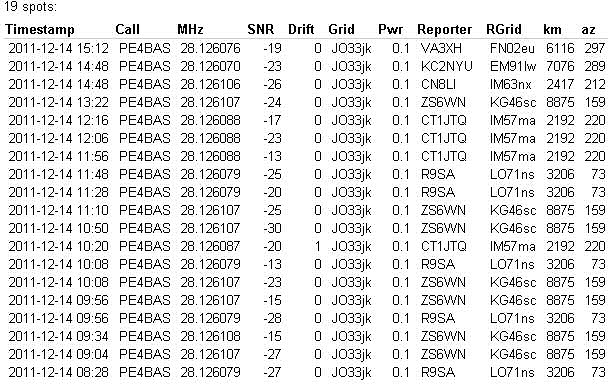
 WSPR 100mW 10m results today
 14 December 2011 | by
A picture says more then 1000 words. I finally found a way to import the WSPR data from the database output on the WSPRnet.org website. It is rather complicated but will try to get back to that later. Interesting is that I can now finally do what I want with the data. I mean the things I like. Like a worldmap, a earthglobe and DXCC counting.

The globe is made through HRD V4 with google earth. The results were not shocking today. But for 100mW in my Alu-tape antenna not that bad.
I will try to reproduce everything tomorrow and write kind of a manual how to get the WSPR data converted to ADIF and then import it in your favorite logger.
Below all the spots that were made of my 100mW transmission today.
Bas, PE4BAS, is a regular contributor to AmateurRadio.com and writes from Groningen, Netherlands. Contact him at [email protected].
SDR Radio
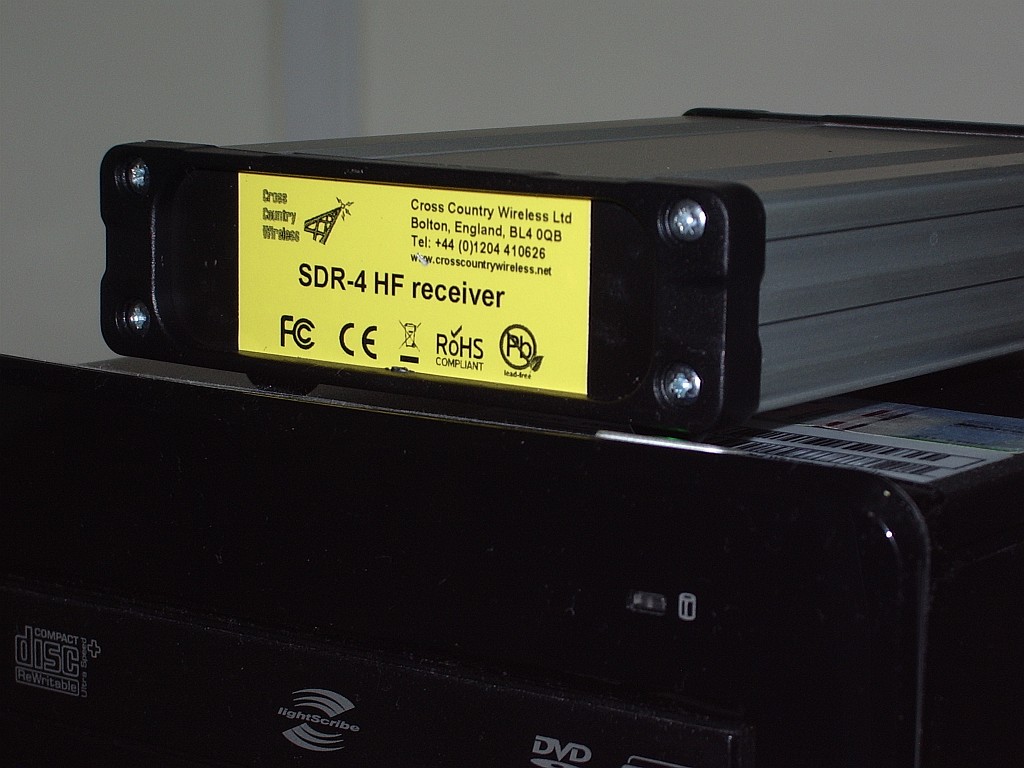
An early Christmas present to myself is this SDR-4 HF receiver from Cross Country Wireless. Actually, it wasn’t intended to be a Christmas present. I decided to get one a couple of months ago when I first found out about it.
I think the SDR-4 is the lowest cost ready built HF bands software defined radio on the market (£150 or about $250 US). Unless you know different, of course. However it seems that a lot of other people thought so too, as there is a waiting list – people are ordering them faster than the designer Chris G4HYG can make them!
The SDR-4 works with the usual free SDR applications. But it also works with the free version of Simon Brown HB9DRV’s SDR-Radio.com application. This is the best SDR software by a mile, though due to all the treatment and medication I am receiving for my brain tumour my mind is a bit slow at the moment and I find figuring out how to do what I want with it a bit challenging.
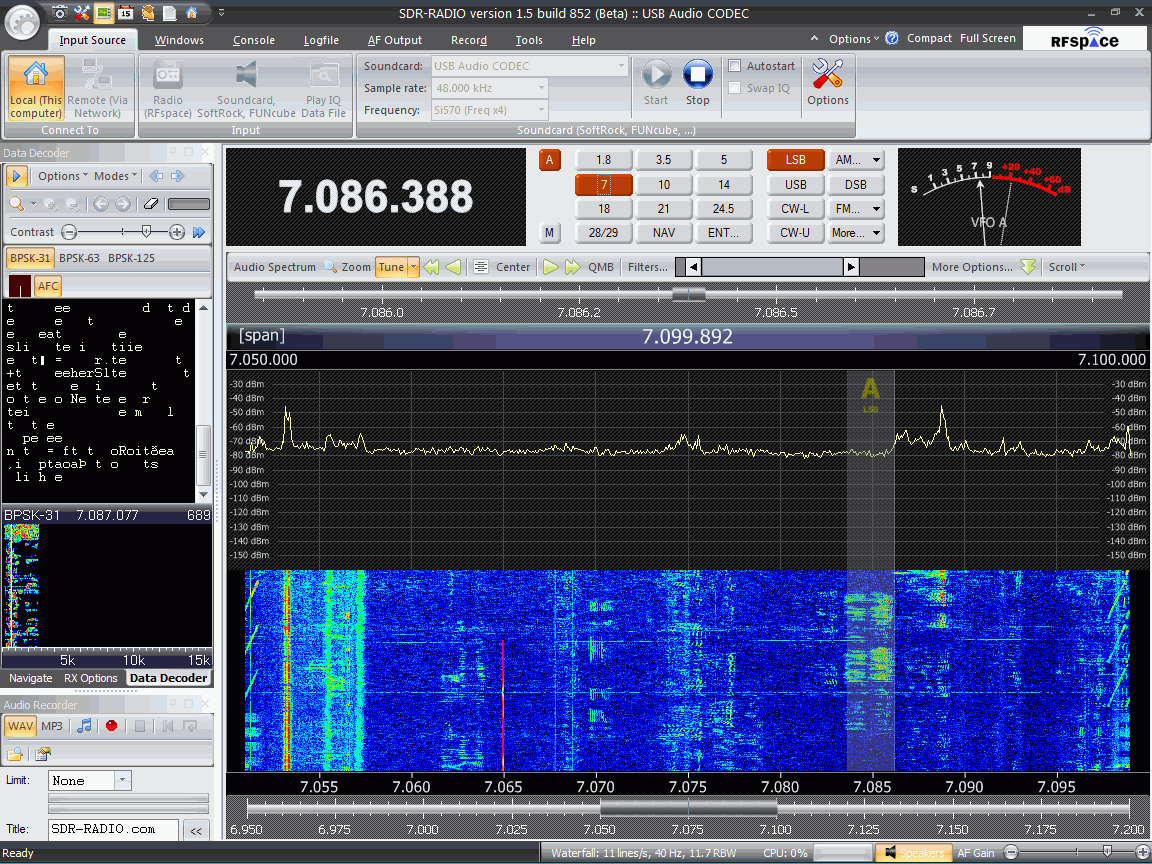
As you might expect from the author of Ham Radio Deluxe, SDR-Radio.com has built-in support for decoding digital modes. Unfortunately I haven’t managed to work out yet how to get the digital decoder waterfall to be a reasonable size: At the moment it’s a small window on the left hand side which is trying to display 15kHz worth of spectrum and although I’m hearing PSK31 I can’t find a trace to click on! I’m also still trying to discover if there is a PSK Browser in the program that sends reports to the PSK Reporter reverse beacon site. Hopefully someone will enlighten me.
I’m sure I’ll be writing more about the SDR-4 receiver and SDR-Radio.com in due course, but in the meantime if you want more information or to ask questions about the receiver there is a Cross Country Wireless Yahoo! group. You can even try an SDR-4 out over the Internet if you follow the instructions posted by Chris. I did and it worked perfectly – and it was so nice to hear the amateur bands without the awful frying noise I have to endure here.
Yahoo! is also the place to go for information and support of SDR-Radio.com (the software.) I look forward to seeing some comments and experiences of any of my readers who are tempted into trying this software defined radio.

Julian Moss, G4ILO, is a regular contributor to AmateurRadio.com and writes from Cumbria, England. Contact him at [email protected].
I’m no contest(er)
So with my PSU fixed I thought I would try my luck in the ARRL 10-meter contest. I have never participated in a contest before, but with 10 meters so hot nowadays I’d thought I’d give it a try. Murphy reared its head, so with the wife and kids all sick there was lots of housework to do and too little time behind the set. But I did sneak in an hour or four over two days. My goal: to practise my CW skills. My thought was that doing many short exchanges would give me enough practice to get a little more fluent with the key. So I started out on Saturday morning answering CQs, but nobody came back to me. Fiddled with my side tone, checked my signal with another receiver, no problems found. After four tries I gave up and went up to the SSB portion. Great fun: one Brazilian after another and my first Argentinian on 10 meters. Great to have the comfort of 100 Watts – makes life a lot easier.
Sunday morning the sunspots were lower, but I did manage a couple of State side stations. But it irked me that I hadn’t logged one CW QSO, so I tried again in the afternoon. Found a strong enough signal from Japan and after the second try it worked. Europe was okay and I did log one Dutch station: PI4TUE, the station of the University of Eindhoven, very close to my place of birth.
I had to stop there, but when I came back I switched to SSB again. Worked some Europeans and then, all of a sudden, CX2DDP. via long path. These kind of QSOs are fun though short and I guess Hector Rubens was as surprised as I was. After 75 QSOs I called it a day, which that was right when the band was closing. I’m not in for the numbers, so I am already happy with so many QSOs. I worked 32 different entities in SSB and six in CW, so a grant total of 38 multiplier points. Indeed, no contest for die-hard contesting hams and I doubt that I will often enter other contests.
But the best thing about this contest was that I got my private language student to do a QSO. He is a 16 year old, very shy boy, whom I teach English on Saturday afternoons. He just graduated from high school and he now goes to polytech, which give us a common interest: electronics. Every week I show him some radio related stuff, so this week it was how a QSO is being done. After showing him the ropes and teaching him the NATO alphabet I let him answer CQs with my call sign. He soon found out that you have to open your mouth and speak slowly, clearly and – when using SSB – loudly. Unfortunately these are traits that most Asians don’t possess. But he found it very “cool” that you could call all the way to Europe so he made an effort and in the end he managed a QSO on his own with JA7BEW. He will soon know more about electronics than I, so the exam for a radio licence will be a piece of cake then. Another ham in the making. Who says contests have no use?
Hans "Fong" van den Boogert, BX2ABT, is a regular contributor to AmateurRadio.com and writes from Taiwan. Contact him at [email protected].
Christmas Gifts for The Ham Radio Operator
One year, the YL asked me what I wanted for Christmas. I told her, anything Ham Radio related would be a great gift for me. After about 30 seconds of awkward staring at each other, she asked where she could find those kinds of things, as she isn’t a Ham Radio op. I promptly pointed her to the ARRL website, but I also found another option for this year!

Photo Courtesy of TechNote Time
So I did a fast Google search and sure enough, the search algorithm, came through again with the website TechNote Time. They do have some unique gifts for Ham Radio operators and the prices do seem reasonable. The one that stood out to me was the On Air sign in neon blue. When I do get my “man cave” and have my shack all setup, this sign will have a nice place in it.
The Christmas ornaments are a nice touch for the Ham Radio family tree. They are made of porcelain and come in a few different designs. There’s also decals, novelty signs warning you of electrical shock or RF radiation, and more. So some nice gifts to be had. The trick is, dropping the subtle hints to the shopper who is looking.
They also have gifts not related to Ham Radio, but some could still fit the bill. They even offer gift certificates, if you’re not sure what to get. So there are a bunch of options available. If you’ve already completed your shopping, they well done! If not, you still have a little time to left to get something unique and nice for the Ham Radio op on your list.
73.
Rich Gattie, KB2MOB, is a regular contributor to AmateurRadio.com and writes from New York, USA. Contact him at [email protected].
Link between radio use and brain tumours?
A news item in the December 2011 CQ magazine caught my attention yesterday. It reported that a Danish study of more than 350,000 people found no evidence of a link between cellphone use and cancer. Cancer rates have not increased during the time that cellphone use has become widespread. “That’s good news” I thought.
However, some websites that reported the story carried the additional information that the Danish researchers found a hint of a link between heavy phone use and the rare but usually fatal glioma brain tumours – exactly the bugger I have. Not such good news after all, then.
Another study by Swedish researchers found an increase in cancer in areas of the brain exposed to microwave energy during a mobile phone call. Most of this data was from users of older analogue phones which run higher power and cause three times the exposure of newer digital systems. However that would still apply to use of VHF and UHF FM hand-helds which are typically operated at a power of 5 watts.
I think you would have to be an extremely active ham radio operator to expose yourself to as much RF as a heavy mobile phone user. But most hams are using much lower frequencies – though potentially higher power levels. Are the frequencies commonly used by hams more or less likely to cause cancer? I don’t think anyone definitively knows the answer to that.
But it is certainly food for thought. I’d be more inclined now to use my HTs on low power or with a speaker mic so as to get the antenna further from the head. And if you must use indoor or stealth antennas that can only be sited a few feet from the operating position, life’s too short for QRO!

Julian Moss, G4ILO, is a regular contributor to AmateurRadio.com and writes from Cumbria, England. Contact him at [email protected].
ARES in a Small Town
I’m afraid I haven’t spend much time on the air lately, because what time I have for ham radio has been devoted to a project that began as an idea for a blog post and has grown . . . and grown . . . and grown! I hope to write it all up when everything comes together, but I don’t want to give it away just yet. For now I’ll just give you a few clues: I’ve been assembling some test equipment, including an inductance-capacitance meter kit and a signal generator kit, and I received a tantalizing shipment in the mail today from a fellow who wrote a stellar article in QST 31 years ago. Stay tuned!
 On another front, I finally got to meet a local ham who is the IT manager at the hospital in our small town (population ~3K) — Mr. Andrew Rosenau, KCØYFY. I’ve been meaning to introduce myself to him ever since moving out here, but when I found out a few days ago that he is our county’s ARES (Amateur Radio Emergency Services) Emergency Coordinator, I sent him an email right away. He replied immediately, and today, after wrapping up a meeting in another part of the hospital, I ambled over and chatted with him for a few minutes in his office.
Behind him on his desk sat an HF rig, a 2M rig, and a TNC. Andy explained that he was a ham before moving here, and he got involved with ARES when the hospital became interested in EmComm. But with so few hams in our area (only 14 in the whole county), there hasn’t been much in the way of ARES activity. I volunteered to do what I could, and he said that for starters I could act as a back-up operator there at his station if he were unavailable in time of need.
It turns out that Minnesota has a huge packet network, and a radio club in a nearby town has even installed an antenna right in our city to extend this network. That was news to me! I’m going to have to dig up my old TNC and see if I can get it running. As much as I prefer CW, I have to admit that it does seem like an excellent way to handle traffic in an emergency.
ARES has always interested me. I’ve never been involved in it before, back when I lived in the Twin Cities, but now I think I owe it to my community. It appears that while there is less opportunity to do much ARES work out here in the sticks, there is also more opportunity for one ham to make a difference. So far Andy has been all alone in his effort — if even one ham chips in, that would double the number of ARES operators in our county.
Andy’s wife is a ham, too! I hope to have them over for dinner one of these days and get to know them better.


Todd Mitchell, NØIP, is a regular contributor to AmateurRadio.com and writes from Minnesota, USA. He can be contacted at [email protected].
Post-post Thanksgiving Leftover Leftovers
 Ham Radio Deluxe |
 W5SWL Electronics |
 Ham Radio Prep |
 KB3IFH QSL Cards  Hip Ham Shirts  HamRadioAuctions HamRadioAuctions Reliance Antennas Reliance Antennas Enigma Shop Enigma Shop |  morseDX  Ni4L Antennas  R&L Electronics R&L Electronics antennas.us antennas.us QRV QRV |
- Matt W1MST, Managing Editor
