 |
 Rothamel’s Antenna Book: An Authoritative Source
 23 November 2022 | by
 As an academic researcher, the term “authoritative source” is reserved for works deemed to be the standard by which other scholarship in an area is judged. As a U.S. ham, I’ve purchased the ARRL Antenna Book (both new and used) since I’ve been licensed. Good reading and reference. It’s been a go-to document not only for me but for many State-side hams. There is a new Sheriff in town.

I’ve read about Rothammel’s Antenna Handbook in other publications—Practical Wireless and RadCom, for instance—but it was in German. Alas…Ich spreche kein deutsch! Since 2019, there is an English translation.
On eHam, there is but a single review. James AD0YO says, “This book is amazing! It should be on the desk of any ham interested in antennas. And, that should be all of us. The first 270 pages cover theory. The rest cover all types of antennas.” OK. James loves it. What about others?
A website I often read, the Reeve Observatory near Anchorage AK, has a review: “The information in Rothammel’s Antenna Book appears to be taken from both amateur and professional literature and patents from around the world. Having this book generally will save readers considerable time when looking for details on a particular antenna type or for ideas on what antenna to build for a certain
application. Each chapter has an extensive list of references, so it may be possible to get to the original source document.”

The popular commercial vendor in the U.S., DX Engineering, carries this volume (although out of stock as I write this). It also has only a single review. Two years ago, Juan (no call) wrote, “This is a 1,600 (page) treatise on Antennas! It is more theoretical than the ARRL Antenna Book, but quite less than John Kraus classical textbook. It has a ton of data and practical information. It is a very good comprehensive reference book on antennas.” Another onesy but rave review. No gotchas yet.
Another source I enjoy, Radio User magazine, had this announcement. “The famous Rothammel’s Antenna Book is now, at last, available in English. At the 2019 Hamvention, DARC announced the availability of the wonderful Rothammel’s Antenna Book into English. This translation is of the 13th edition of Rothammels Antennenbuch.” Now I recall my friend, Scott K0MD, telling me that he picked up a copy of this impressive book at Hamvention. Great international reviews. A close friend who bought it and is impressed. Wow! This is getting close to my wallet.
The standard ham radio antenna reference.
James AD0YO, eHam Review
Rothammel. Who is (was) this guy? Wikipedia advises “was” is unfortunately the correct tense as he is now a Silent Key (1914–1987). After reading a short biography on Rothammel, it strikes me that he would be in league with Lawrence Cebik W4RNL, a professor of philosophy at the University of Tennessee in Knoxville, long revered for his antenna work and writing. From the German Wiki, translated to English by Google Translate:
“Rothammel had been a radio amateur since 1932 with his call sign “DE3040/L”. During World War II he served as an Air Force radio operator. Little is currently known about his stay after the war, except that he settled in the Soviet occupation zone – the later GDR.

After the war, he initially worked as a guest and farmer before moving to the postal service of the GDR for ten years. At the post office, he looked after the radio and television transmission systems. After ten years, Rothammel moved to the information and documentation center at the radio equipment factory Stern-Radio in Sonneberg, which later became VEB Stern-Radio Sonneberg . He did this job for 25 years until he retired. Since 1954 Rothammel was active as a radio amateur under the call sign “DM2ABK”, since 1980 under the call sign “Y21BK” or “Y30ABK”.
In addition to his professional activities at the post office and at VEB Stern-Radio, Rothammel was a long-time club station manager in Sonneberg, a member of the examination committee in the Suhl district and an authorized person for the radio performance badge in gold. For five years he wrote articles on VHF topics for the magazine Funkamateur. In addition, he contributed as an author to various publications on the subject of radio, for example the books “Ultra Short Waves”, “Practice of TV Antennas Part 1 and 2” and the “Handbook for Short Wave Amateurs”, etc.”
I ordered a copy of the 1st Edition English translation, copyrighted in 2019, directly from the DARC. Easy order. It took several weeks to arrive via DHL and final delivery by the US Postal Service. I was researching HF loop antennas for an article. I was thrilled at the depth of coverage and the detailed citations and patents included. It greatly helped me organize my thinking on how to improve the design and deployment of an HF horizontal loop antenna. More on that article in the near future as it nears publication in Practical Wireless magazine.
Here’s an illuminating example on a relatively unknown niche type of antenna. Here in the States, due mostly to posts on QRZ.com, the reader would conclude that fractal antennas were wholly invented by Nathan W1YW. As the sportscaster Lee Corso is fond of saying, “not so fast!”. Look at what I read on pp. 948-9:

In the same year (1995), two researchers filed patent applications for something they called, fractal antennas. In May, Dr. Carlos Puente in Spain filed his application which was approved in 1998. Later, in August, Dr. Nathan Cohen filed his patent application in the United States but it was not granted until 2000. As Rothammel states, the priority goes to the first filing. This small point may only matter on legal issues but it’s both enlightening and historically correct for the amateur radio community to know that there were indeed two “inventors” of the fractal antenna line. Lots of good stuff like this in the Rothammel Antenna Book.
So does this book replace the need for the very popular Antenna Handbook by the ARRL? Not at all, as the ARRL book is geared more toward pedagogy and far less on being an authoritative reference. Rothammel’s book, for instance, does not include supplementary software, data files (antenna models, propagation projections, etc.), and such. Editions of the ARRL book do overlap greatly across adjacent editions so that’s caveat emptor for the buying ham. Me? I have quite a number of the ARRL Antenna Handbooks, as well as most things written by Joe Carr and other antenna scholars. Now, the Rothammel’s Antenna Book is on my bookshelf right beside them. I won’t have a problem finding it at 1,600 pages in length!
I can add my own superlative review to those quoted above. It’s not been fully read thus far but the spine and pages are certainly creased quite a bit! I’ve read deeply on loop antennas and through the theory section. It’s now my authoritative resource for amateur radio antennas.
Frank Howell, K4FMH, is a regular contributor to AmateurRadio.com and writes from Mississippi, USA. Contact him at [email protected].
ICQ Podcast Episode 390 – Restarting HamFests
In this episode, we join Martin Butler M1MRB, Martin Rothwell (M0SGL), Frank Howell (K4FMH) and Leslie Butterfields (G0CIB) to discuss the latest Amateur / Ham Radio news. Colin Butler (M6BOY) rounds up the news in brief and in the episode's, feature is Restarting Hamfests.
We would like to thank our monthly and annual subscription donors for keeping the podcast advert free. To donate, please visit - http://www.icqpodcast.com/donate
- Reaching Youth Through Amateur Radio in the Classroom
- Beware of Counterfeit Icom Products
- Germany's Proposed New "N" Class Entry-Level Licence
- RSGB Construction Competition
- QSO Today Virtual Ham Expo Heads to YouTube
- RSGB ESC Publishes Annual Report
Colin Butler, M6BOY, is the host of the ICQ Podcast, a weekly radio show about Amateur Radio. Contact him at [email protected].
Amateur Radio Weekly – Issue 262

Ever heard of the Heathkit SS-8000 Digital Transceiver?
The reason that very few Hams have heard of it is that it was never released.
VE7SL
CW Hotline
Think The Bat Phone for CW.
Ham Radio Solutions
DATV Trans-Atlantic experiments
Successful Digital Amateur TV tests on the 29 MHz band across the North Atlantic.
EI7GL
FediHams Digital Voice Network
This digital voice network is intended as a place to hang out for all the Fediverse Hams.
QRZ.is
Pride Radio Group
Pride Radio Group is a virtual radio club set up to demonstrate and promote acceptance within the hobby.
Pride Radio Group
Solar powered Meshtastic network
Austin Mesh is a community group working to build a mesh network of solar-powered Meshtastic radios.
Austin Mesh
Why do I want to buy so many Ham Radios?
What is it with this obsession of collecting radio gear?
WK4DS
The enduring Yaesu FT-817 and FT-818 series transceivers
Why choose a legacy design like the 817/818 when newer QRP transceivers have better overall field specs and features?
QRPer
Book: War Diaries – A Radio Amateur
What it’s been like for a radio listener and Ham Radio Operator living day-to-day in Kyiv since Russia invaded Ukraine earlier this year.
SWLing Post
Video
When secret government numbers stations go wrong
Automated stations are prone to errors.
Ringway Manchester
A.I. and Amateur Radio
Artificial Intelligence and Machine Learning and the future of Amateur Radio.
Open Research Institute
W6MRR balloon launch
High altitude balloon launch, Pasadena California. W6MRR, KN6KZF, and K6EAU.
SF HAB
RX888 MK2 16BIT Software Defined Radio
64 MHz real time bandwidth on HF.
Tech Minds
Get Amateur Radio Weekly in your inbox.
Sign-up here
Amateur Radio Weekly is curated by Cale Mooth K4HCK. Sign up free to receive ham radio's most relevant news, projects, technology and events by e-mail each week at http://www.hamweekly.com.
LHS Episode #489: 2CW or not 2CW
Hello and welcome to Episode #489 of Linux in the Ham Shack. In this short-topics episode, the hosts cover the future of morse code in amateur radio, more grants from the ARDC, pipewire, Xanmod, Nitrus and much more. Thank you for listening and we hope you have a great week.
73 de The LHS Crew
Russ Woodman, K5TUX, co-hosts the Linux in the Ham Shack podcast which is available for download in both MP3 and OGG audio format. Contact him at [email protected].
Ever Heard Of Heathkit’s SS-8000 Digital Transceiver? …. Me Neither!
 |
| courtesy N8RS |
The Heathkit SS-8000 was a unique synthesized HF transceiver (160-10m) originally designed as a kit in 1978. The reason that very few hams have heard of it is that it was never released … and only three were ever prototyped!
Steve McDonald, VE7SL, is a regular contributor to AmateurRadio.com and writes from British Columbia, Canada. Contact him at [email protected].
Ever Heard Of Heathkit’s SS-8000 Digital Transceiver? …. Me Neither!
|
| courtesy N8RS |
The Heathkit SS-8000 was a unique synthesized HF transceiver (160-10m) originally designed as a kit in 1978. The reason that very few hams have heard of it is that it was never released … and only three were ever prototyped!
Steve McDonald, VE7SL, is a regular contributor to AmateurRadio.com and writes from British Columbia, Canada. Contact him at [email protected].
For those Icom 7610 owners a different way to work split.
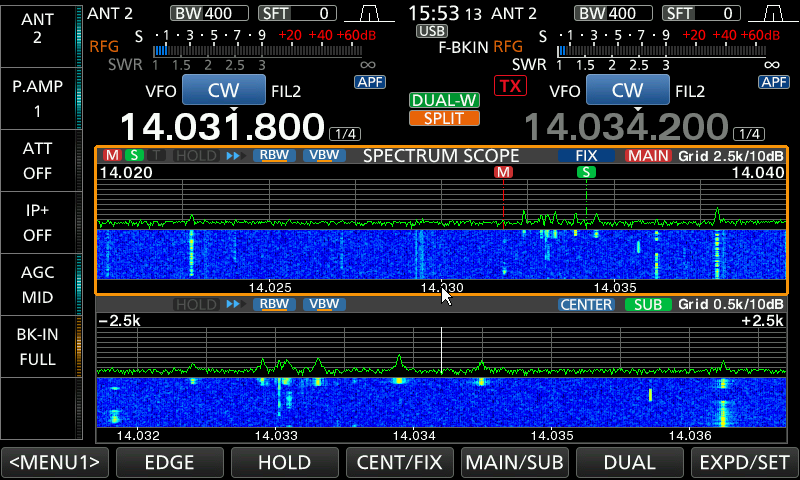 |
| Fixed mode with 20kHz span |
I have had my Icom 7610 for several years now and am still very much enjoying it. From time to time I enjoy working DXpeditions and having Dual receivers and dual spectrum scopes with the Icom 7610 is very handy. The spectrum scope has 2 tuning options which are fixed and center modes. It could just be me but I find center mode hard to follow were as fixed mode seems very easy to follow. When you come across a station that is working split more often than not it’s because there is a large pileup and it’s more efficient to work split. For those readers who are not certain what split operation is this LINK explains it better than I can.
During split operation especially with a very rare DX station, there are LOTS of operators trying to contact the prized DX station. For this reason on the DX’s listening frequency, there are many ops trying to make contact. When you as an operator want to get involved and try to contact the DX station you have to drop yourself in the pool of stations calling the DX station.
The trick is where to set your VFO dial to have a chance to be heard by the DX station. In most cases, the DX station has a routine to move up or down his listening frequency which is your transmit frequency. One must listen and watch the waterfall to see who the DX station is answering call after call. You can then get the idea if he is moving up or down his listening frequency and by how much.
As I said there could be lots of callers and this translates to a very crowded waterfall display. To find out where to drop your call one must have a closer look at the waterfall. When this is done you can get some separation between the calling stations. Thus allowing you to better see who the DX station is answering. Then you have a good idea when and where to drop your call and hopefully be heard.
As I said the center mode I find very confusing and when I use it in split mode and spin the VFO I am just lost as to who is where and for this reason I use fixed mode.
As a side note: In center mode when you spin the VFO the signals on the waterfall move and the VFO marker remains stationary. In center mode when the VFO is changed the waterfall signals remain stationary and the VFO marker moves to the next signal.
As was said earlier it is best to have a closer look at the waterfall to see the action. In fixed mode, the smallest slice of the band you can have is 20khz. When operating CW as I do this for me is not enough for a very crowded calling group. In center mode, you can get a slice all the way down to +/- 2.5kHz or +/- 5kHz. For me, these are great options and with CW I generally would choose +/-2.5kHz but the rig has to be in center mode and that just does not work for me.
I have found a workaround so I can use the center mode, select +/-2.5kHz and still have the moving VFO B marker and not a moving waterfall! Below are the setup steps I take to make this happen.
In fixed mode, I find the DX station with VFO A
I then press the Dual-W button
Then press and hold Dual-W button to get the settings for VFO B the same as VFO A
I then press the split button
I press the Dual soft key my scope becomes over-under as this is how it is setup. You can see the dual scope view in the post pictures.
I change both scopes to center mode if not there already.
I now set the span to the same on each lower and upper scope in my case it is +/-2.5kHz I then touch VFO B frequency readout on the upper band scope (to activate VFO B)
Now in the upper band scope, VFO A remains stationary on the DX station. VFO B (in the upper band scope) now moves when the VFO dial is turned. The VFO marker moves (like fixed mode) and the band signals remain stationary.
The lower scope is still there but I don’t pay any attention to it. I found if I did not stay in dual scope mode I would lose the CENTER mode for VFO A and FIXED mode for VFO B.
 |
| 5+/-kHz in center mode but VFO acts like fixed mode |
Now with all this said I just know there is going to be a comment that informs me I can press 2 simple buttons on the rig and get the same results. I seem to always take the long way around with things. I have added some screen pics of how the waterfall looks when in 20kHz, +/-5kHz and +/-2.5kHz span during a DXpedition. As you can see when in +/-2.5kHz mode the calling station are easy to see compared to fix 20kHz and +/-5kHz selections. But best of all I have fixed mode operation of VFO B with these small spans.
 |
| +/-2.5kHz span view of pile up calling DX station |
Mike Weir, VE9KK, is a regular contributor to AmateurRadio.com and writes from New Brunswick, Canada. Contact him at [email protected].
 Ham Radio Deluxe |
 W5SWL Electronics |
 Ham Radio Prep |
 KB3IFH QSL Cards  Hip Ham Shirts  HamRadioAuctions HamRadioAuctions Reliance Antennas Reliance Antennas Enigma Shop Enigma Shop |  morseDX  Ni4L Antennas  R&L Electronics R&L Electronics antennas.us antennas.us QRV QRV |
- Matt W1MST, Managing Editor
