 |
 QRP ARCI Pet rock contest over…….
 7 January 2012 | by
  |
10m, 15m gave forth some contacts but the best band was 20m. In this contest it was nice leisurely CW not like the world wide contests were CW sounds more like machine gun fire! Also during the occasional contact more was given than the required exchange info.....SAY IT AIN'T SO........we tossed around our names, rig and at times a hearty 72. ( that was not a typo 72 is the 73 of QRPers) This was the first time the Elecraft P3 was used in a contest and it was a great aid. It would show you what looked like just the noise floor but in the water fall below on the display a signal is made very apparent. Then along with the K3's APF (audio peak filtering) the signal just jumped out and a contact was made. This really was the first time I was able to see how great the APF was on the K3 I had tried it in the past and to be honest was not impressed but that has changed.
Power output 5 watts ( I can say I operated QRO compared to others)
Total contacts 9
Total points 2352
It's no record breaking contact count but this short contest was a blast there were some contacts I just could not put in the log as I did not get the full exchange due to fading. Also at times I got so excited about making a contact it wasn't until the contact was complete and it was ready to be entered into N1MM that I realized it was a Dupe!!! But not once did I get the CW sent to me B4...sorry for not paying closer attention gents and ladies regarding this but thanks for your understand.

Mike Weir, VE9KK, is a regular contributor to AmateurRadio.com and writes from New Brunswick, Canada. Contact him at [email protected].
Listening to the International Space Station
It’s always exciting to hear an astronaut from the International Space Station active on 145MHz. Over the last few days I’ve heard activity a couple of times and the second time, I had my iPhone handy and I shot a quick video, which I hope you might find interesting.

Tim Kirby, G4VXE, is a regular contributor to AmateurRadio.com and writes from Oxfordshire, England. Contact him at [email protected].
Operatic debut
Nothing to do with Verdi or Rossini, nor the web browser of the same name. OPERA is a new weak signal digital mode that has been developed for use on the amateur LF (500kHz) and VLF (136kHz) bands.
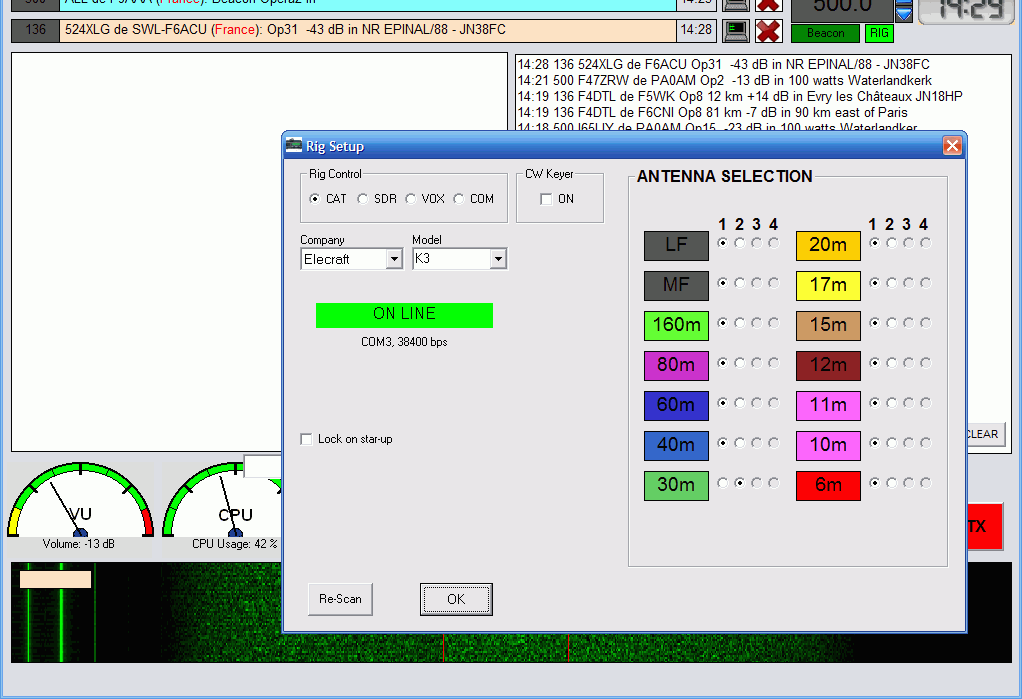
Information about it seems to be a bit hard to come by, but there is an OPERA Yahoo group from where I presume you can download the latest version of the software. I managed to find a copy and was surprised at the sophistication of the program. It already has working CAT support for many transceivers including my Elecraft K2 and K3. It also has a built-in chat system showing reported signals from other users.
Although the new mode is apparently the invention of Graham, G0NBD, the program has been written by Jose Alberto Ros, EA5HVK, author of the ROS digital mode, and there are clear similarities in the user interface. The program supports all amateur bands from VLF to 6m but currently you can only select the frequencies 136kHz and 500kHz.
There are actually two OPERA modes, one of which is claimed to be even better (i.e. work with even weaker signals) than the WSPR mode. What is particularly interesting about OPERA though is that it does not need to use a sound card to send a transmission. Although the sound card is an option – and a convenient one for users already set up for data modes – OPERA actually (if I understand correctly) uses on/off keying, in other words CW (though not Morse code.) This offers the potential for long distance contacts to be made using ultra-simple QRPP (very low power) transmitters designed for QRP CW use – though I imagine that success depends on use of a very narrow bandwidth so you might need to pay more attention to transmitter stability than you would need for Morse code.) If the digital encoding scheme is published then it would also be simple to build microcontroller based beacon transmitters.
As I am not equipped to operate on the 500kHz or 136kHz bands I have been unable to try OPERA out on the air myself. But it certainly looks an interesting mode, especially if it is opened up to allow use on the HF bands where it could be used as an alternative to WSPR and QRSS CW modes.

Julian Moss, G4ILO, is a regular contributor to AmateurRadio.com and writes from Cumbria, England. Contact him at [email protected].
Anniversary of Vail’s First Demonstration of the Telegraph
Over at “This Day in History,” the lead story today is “Morse demonstrates telegraph.” It leads off, “On this day in 1838, Samuel Morse’s telegraph system is demonstrated for the first time at the Speedwell Iron Works in Morristown, New Jersey.” Well, I thought, surely this is worthy of a blog post, so I poked around on the web to learn more.
 It turns out that this first demonstration was put on by Morse’s partner, Alfred Vail. Vail had first become involved three months earlier when visiting his alma mater, the University of the City of New York. He stumbled upon Samuel Morse demonstrating his “electro-magnetic telegraph” with over one-third of a mile of wire coiled around a room. Vail was hooked. He convinced his brother George and father Stephen to support further development of the telegraph at the Speedwell Iron Works, and he signed an agreement with Morse to turn Morse’s crude prototype into a market-ready model — at his own expense — by January 1, 1838, in return for a minor share.
The challenge was to get the thing to work with a length of wire much longer than Morse had managed to use. Alfred Vail recruited an apprentice at Speedwell, William Baxter, and got to work. After many frustrations, they finally succeeded in getting their model to work:
At last on January 6, 1838, the machine was ready to be demonstrated. The cotton-covered hat wire was coiled around the room on nails to equal a distance of two miles. Alfred sent Baxter to “invite Father to come down and see the ‘Telegraph’ machine work,” which sent the eager lad plunging into the cold afternoon without stopping to throw a coat over his shop clothes.
The machine that sent Stephen’s message, “A patient waiter is no loser,” was still far from perfect. A few days later [January 11] several hundred men and women crowded into Speedwell to witness the first public demonstration. The message this time had a practical cast: “Railroad cars just arrived, 345 passengers.”
I’m not sure how these messages were formatted, but most likely they were not sent letter-by-letter. In those early days messages were laboriously sent using numbers that were assigned to commonly-used words. Eventually the “Morse Code” alphabet would replace this system, though great debate rages over who invented it.
Vail himself gives credit to Morse for the alphabetical system on p. 30 of his book, The American electro magnetic telegraph: with the reports of Congress, and a description of all telegraphs known, employing electricity or galvanism (available online for free), though some doubt the truth of this statement. Many years after his death, someone even sneaked in and engraved on Vail’s tombstone, “INVENTOR OF THE TELEGRAPHIC DOT AND DASH ALPHABET.”
Whoever invented the alphabet, what does seem clear is that Vail was the one who invented the straight key, an elegant improvement upon the cumbersome machines first used to encode messages. Today, you can even purchase a replica of Vail’s “spring key” from Kent Morse Keys!
Alfred Vail became increasingly frustrated by Samuel Morse’s lack of involvement in the development of the telegraph while publicly taking all the credit. Vail stuck with it for ten years before finally leaving the telegraph behind.


Todd Mitchell, NØIP, is a regular contributor to AmateurRadio.com and writes from Minnesota, USA. He can be contacted at [email protected].
What I love about PSK Reporter and the RBN Network
This morning, because I had to pop into the garage on the way to the station, I left the house a little later than normal on a work day. To fill the time (!), I popped onto 3.5MHz JT65 at greyline – just as the sun was rising. To my slight disappointment, although I heard several stations, I didn’t make any contacts.
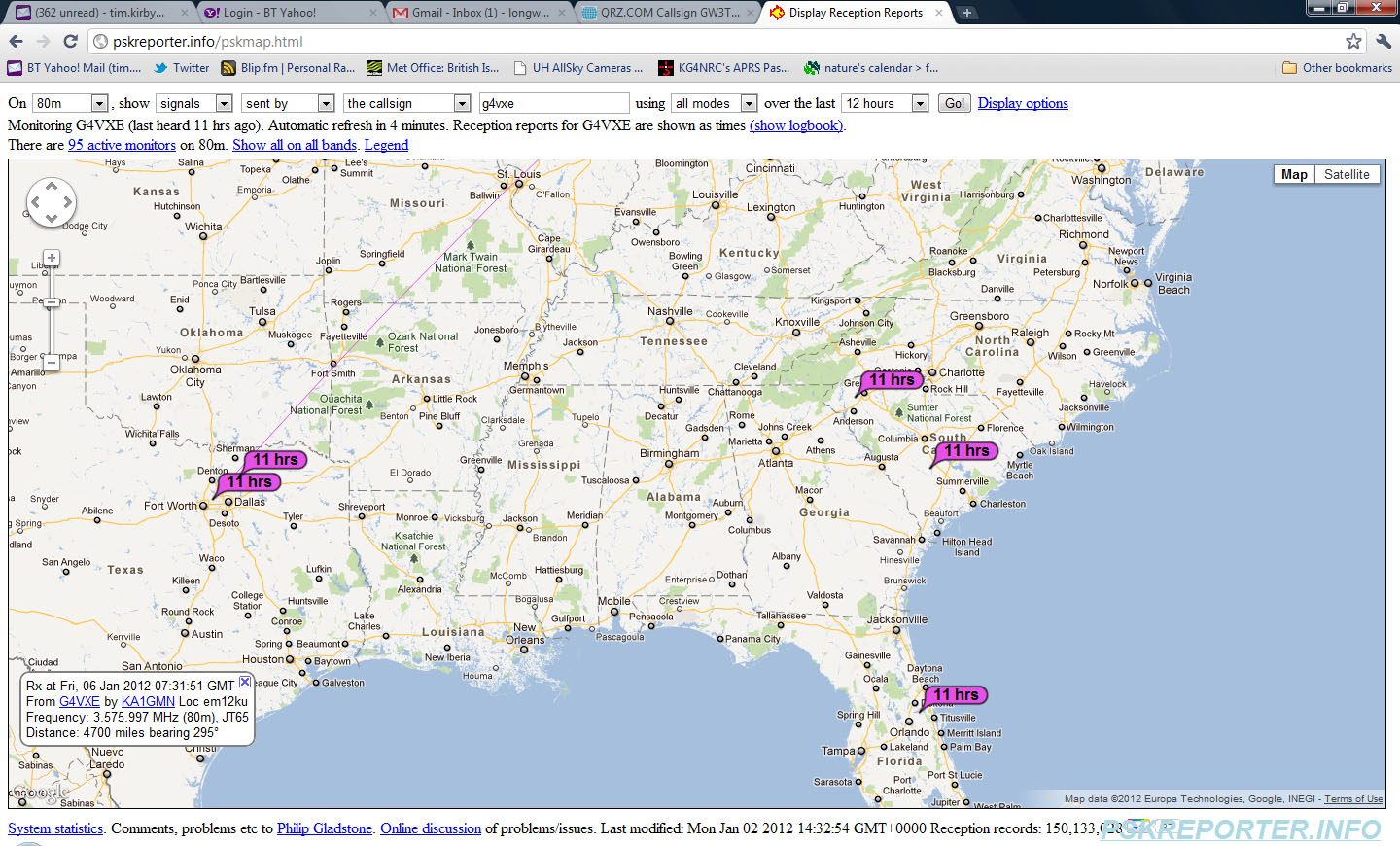
However, this evening, I checked the PSK Reporter website to see where I was heard. I was delighted that although I didn’t make any contacts, my 25W JT65A signal was getting quite a long way into the USA

Tim Kirby, G4VXE, is a regular contributor to AmateurRadio.com and writes from Oxfordshire, England. Contact him at [email protected].
My amateur radio aims for 2012
1. VHF JT65
As you know by now, I have become a great fan of JT65 on HF. I want to start using the mode on VHF. In particular the JT6M mode for 50MHz looks interesting. Would it be viable with 100W and a vertical? Maybe! I have to try it. If not, no doubt a simple low dipole would work for meteor scatter.
The challenge is the interface with the FT847 which I have struggled with in the past. Looks like I have various options which I hope to pursue soon.
2. 70MHz
Need to improve the performance of the 70MHz receiver and probably up the power a bit. I have a plan …. Not too worried about tropo on the band but would like to be more competitive for Es and meteor scatter.
3. 1.8MHz JT65
I wonder what could be done on 160m from a ‘small garden’ using JT65?
4. 144MHz EME
I would love to try and work some EME. Probably my old 13el on a stepladder in the back garden then. Need that interface for the FT847!
5. 28MHz mobile
I’m planning to install the Anytone AT-5555 in the car now I have the more efficient 10m antenna.
Hope I can do at least some of these.

Tim Kirby, G4VXE, is a regular contributor to AmateurRadio.com and writes from Oxfordshire, England. Contact him at [email protected].
Interference
Undoubtedly some of you radio artisans have been following the LightSquared spectrum fiasco. For those of you who haven’t been, in a nutshell LightSquared is a US company that is attempting to deploy a 4G mobile wireless network on 59 Mhz of real estate that’s right next to the GPS band. Their plans have been halted due to concerns about interference to GPS services, used by consumers, industry, and the military. Technically the problem is due not to LightSquared’s technology directly, but rather deficiencies or design limitations of millions of GPS receivers in use.
For a solution to this difficult interference issue, perhaps the FCC should look to a past interference situation, that of Broadband over Powerline, or BPL. Here are some ideas, some that came directly from BPL vendors and advocates or the FCC, and others just in the “spirit” of BPL:
Regulate it under Part 15. Part 15 states that a Part 15 service can’t interfere with licensed services. So, everyone should be happy, right? If someone experiences interference, like with BPL they can contact LightSquared and hopefully have the issue resolved in 6 to 36 months.
Declare no protection for mobile operations. Like mobile amateur radio operations and BPL interference, GPS users can just walk or drive away from LightSquared towers or cell phone users. Interference problem solved. Only stationary users of GPS should be able to file interference complaints. This would include people using GPS in their living rooms.
Create an online database of LightSquared towers and cell phone users. As with the BPL database, GPS users could query it to determine if they are experiencing interference from a LightSquared tower or device and determine where in the US they can relocate to avoid the interference.
Claim that interference to military GPS users really isn’t an issue. The military really only needs GPS when there’s a war going on. Most people in war zones aren’t making phone calls and LightSquared probably won’t be deploying towers in Iran, where our next war is likely to occur.
Point out that 4G wireless services are new technology and GPS is old. GPS development began in 1973, 39 years ago. Why are we still using this old, antiquated technology? 4G wireless is new, it creates jobs, and people can use maps instead of that old GPS.
There is always a simple solution to a complex problem. BPL was the no-brainer solution to the broadband crisis. The FCC just needs to dust off its BPL files and apply the same technical expertise and creativity that solved the BPL interference problem and made it the success it is today.


 Ham Radio Deluxe |
 W5SWL Electronics |
 Ham Radio Prep |
 KB3IFH QSL Cards  Hip Ham Shirts  HamRadioAuctions HamRadioAuctions Reliance Antennas Reliance Antennas Enigma Shop Enigma Shop |  morseDX  Ni4L Antennas  R&L Electronics R&L Electronics antennas.us antennas.us QRV QRV |
- Matt W1MST, Managing Editor
