 |
 Handiham World for 25 January 2012
 25 January 2012 | by
The new handiham.org is up and running. I hope you like it, but I am sure open to suggestions if there is something you find that does not work. In the meantime, the old website is still alive, but it is at the URL handiham.net. The two sites are different, but many of our users have not yet registered with the new site, and will probably just find it easier to log in at handiham.net until they have time to get set up in the new handiham.org. So if you visit handiham.org and find that your log in credentials don’t work, the reason is that the new site uses an entirely new database and re-registration is necessary. I have done this in advance for some users, but have not had the time to devote to manually entering so much data. If you wish you can use the create an account link to enter your own data, but please remember that this is a Handiham member service, so I would appreciate it if you used the credentials you already registered with us for the old website. That way, I can check against our database and approve your account because I will know it is really you, not some spammer who wants access to the site. Most of our users registered with their callsigns, except for those studying for a first license. Please stick with your existing username from the old site and, unless you have a different email address, the same email you registered with us in the first place. Be sure you always keep your email address up to date. If you are not a Handiham member, you may still enjoy the public portion of our website without logging in. If you are a Handiham member and need access, please use the Create Account link and apply for access. I will review and approve as soon as possible.
Another change is that our QST audio digest for February 2012 is available to our blind members in DAISY format from the members section. DAISY is the same special format used by the Library of Congress and other organizations providing specialized adapted audio to blind users. It is a single zip file, the preferred method for download simplicity. It will play on DAISY players and the the new Library of Congress player. The complete issue of QST generally takes a month to a month and a half to be released from the Library of Congress, so our audio digest gives blind hams some of the time-sensitive information at around the same time print subscribers to QST are reading their copies.
VOLLI, our volunteer hours logging system, has stopped functioning. We ask that Handiham volunteers simply email Nancy their hours on a regular basis. The best way is to fire off an email as soon as you finish a project. For example, if you volunteer at a hamfest giving out our literature, when you get home just send Nancy a message letting her know the volunteer activity and the hours you spent at the fest. For recording a big project, such as an audio tutorial or a book for our blind members, you might want to keep a log of your hours and then inform Nancy of the total when you complete the recording project.
The Handiham Radio Club and Handiham Volunteer mailing lists have both gone into the bit bucket! I should have thought about that before changing the domain name, but I forgot that detail. We still have the ability to set up mailing lists, so I will see what we can do. That project will have to wait just a little while because I want the website project to be further along and secure before taking on another task.
So that’s my update for this week. I expect to release a new General Class audio lecture on Friday, but we will see what time is available. We are always looking for help from talented volunteers who can record audio, teaching into a microphone. Be on the lookout for an upcoming two part “With the Handihams” series in Worldradio online about how to record using the open-source software Audacity. It is cross-platform, running on Windows, Mac, or Linux!
Handiham Manager

Pat Tice, WA0TDA, is the manager of HANDI-HAM and a regular contributor to AmateurRadio.com. Contact him at [email protected].
The Best Ham Radio Books

If you had to clean out all but three amateur radio and electronics related books from your bookshelf, which three would you keep?
What makes each of these three so useful to you?
Can’t think of three? At least tell us about one or two favorites.
With well over 4,500 daily readers worldwide (thank you!), I’m always so impressed by the answers we get here.
Here are the top 10 answers so far…
- ARRL Handbook (7 votes)
- ARRL Antenna Book (5 votes)
- ARRL Operating Manual (2 votes)
- Simple Wire Antennas (2 votes)
- Experimental Methods in RF Design (1 vote)
- Rothammels Antennenbuch (1 vote)
- Grob Basic Electronics (1 vote)
- TTL Cookbook (1 vote)
- ON4UN’s Low-Band DXing (1 vote)
- Vertical Antenna Classics (1 vote)
Matt Thomas, W1MST, is the managing editor of AmateurRadio.com. Contact him at [email protected].
I Crossed Those Hurdles
I’ve been trying to master Morse code since 2009. I have known the basic characters since my teens, but never got the speed and I freaked out whenever I didn’t get a character, stopping cold in my tracks. I never got passed those two hurdles. So when I got my novice licence and decided to get serious about learning Morse code I read a lot about different methods, why Koch is the best, software to help you and most important, that you should be fluent in taking down the code before grabbing key.
But I always had a bit of a problem with the last one. My good friend Wouter (PG2W) was a R/O in the 1970s and his story about him going to maritime school always stuck with me. Back then would-be R/O’s started out from day one by tapping out Morse code signals on their desks, not listening to them. They weren’t stupid then, so why do I have to be fluent in taking code no before I can start sending code? “Well, simply because you can’t understand what the other is sending to you, sonny!”
True, but I am a firm believer of multi-sensory – or Auditory-Visual-Kinaesthetic (AVK) – learning. I am practising it daily in my job as ESL teacher, so I should apply it to my own learning, too. So for a while I have been sending code and checking it with help of the computer. Every now and then I would answer a CQ from a station and try my hand at a real CQ while keeping Fldigi running in the background for back-up. By constantly hearing, watching and doing I felt I was improving more than by only taking down code.
So on December 23 last year I sat down itching to have a QSO. Busy with work and family I hadn’t had a single one in 9 days. I had just put together a new keyer (the AA0ZZ one, it was on my To Do-list, remember?) and hooked up my Kent paddles to test it. The power was turned down to nil (or so I thought, later it turned out I was still putting out a Watt or two) and when I heard VK2IG calling CQ I answered him, just for fun, because I thought he would not hear me anyway. But he came back to me, went QRS to my speed of 10 wpm and we had a QSO. And all-of-a-sudden it worked! I could understand his code, take it down by hand and answer him. Whenever I didn’t catch a character I simply shrugged it off and kept on writing. I felt great, because I finally crossed those two hurdles.
So later that night I tried 80 meters for a change. In Taiwan we are allowed to operate on 3.500 to 3.5125 and 3.550 to 3.5625 MHz, so CW territory. I heard JO4CTB, answered him and it worked again. BA5HAM, no problem, although he was pretty fast and I had to use Fldigi for part of the QSO. Ever since I have been having a ball. It has been CW all the way and I am glad to say that most hams I called have been nice enough to go slow. Some QSOs have been simple RST exchanges, others short conversations. But every one helps to get me more fluent and gain speed and I enjoy every one of them.
And to set a goal for myself I decided to go for the Prefix Award, which is to celebrate the 25th Anniversary of FISTS CW Club. 250 CW QSOs of which 10 need to be with FISTS members. No small feat, but one I am very eager to achieve. I know I can cross that hurdle, too.
Hans "Fong" van den Boogert, BX2ABT, is a regular contributor to AmateurRadio.com and writes from Taiwan. Contact him at [email protected].
Pop’s Shed and the Kingsley Radio AR7
After my grandfather passed away I spent a lot of time recalling the good times I had spent scrounging around his CB shack and hanging out with Pop “down the shed”. If you’ve spent time around old motorbikes, retired lawn mower engines, vacuum tube electronics and inches of dust you know what the shed smelt like and probably have a pretty good idea what it looked like as well. I used to be able to send Mum into fits by embedding a combination of oil, grease, dust and grinding compound into the knees and sleeves of my good clothes after spending the day “over south” (South Geelong)
Even now I can still walk into any old auto mechanics and the smell brings back dozens of memories as clear as day … but one memory in particular had been bugging me for a while now. On several occasions I had used a magnificent rack mounted shortwave receiver that had been hooked to a long-wire antenna between the shed and the house. It had several plug in coils housed in bright metal boxes, one for each band as well as a unique tuning dial that had windows around the circumference with numbers that updated as the dial was turned.
 |
| National HRO right? … Nope, its an Australian clone! |
For the longest time I was thinking what you are probably thinking now, I had been using a National HRO receiver right? Well, you’d be wrong … just as I had been for years! When I eventually asked my uncle about the receiver (I waited a long time as I feared it had been thrown out & honestly didn’t want to know if it had) he said, “The AR7?” … “Yes, its here in the garage covered in dust”. He went on to say that I could have the receiver if I could figure out some way to ship it … not a slight problem given the receiver, power supply and speaker are over 120 lbs!
Knowing now that I had been using a completely different receiver I set to work and found out what I could about this National HRO clone …
From : http://www.vk2bv.org/
The AR7 was produced during WW2 by Kingsley Radio of Melbourne for the R.A.A.F. These receivers were used in ground stations for long range communication over fixed circuits as well as for receiving signals from aircraft.
The AR7 was based largely on the National (USA) HRO model, a fact that did not go unnoticed by National. This was the subject of litigation during the war years. Over 3000 of these receivers were produced and for their time, produced excellent performance.
These sets were very popular with radio amateurs after the war and unfortunately subject to many modifications. The Wireless Institute of Australia station, VK2WI at Dural New South Wales was equipped with modifed AR7’s for many years. I seem to remember that very local operators could block the receivers completely, resulting in hurried phone calls!
An unmodified AR7 is a rare beast. The Department of Civil Aviation used these sets for many years in a highly modified form, requiring a new front panel. Refinements included squelch and crystal locked coil boxes.
From : http://www.shlrc.mq.edu.au/~robinson/museum/AR7/
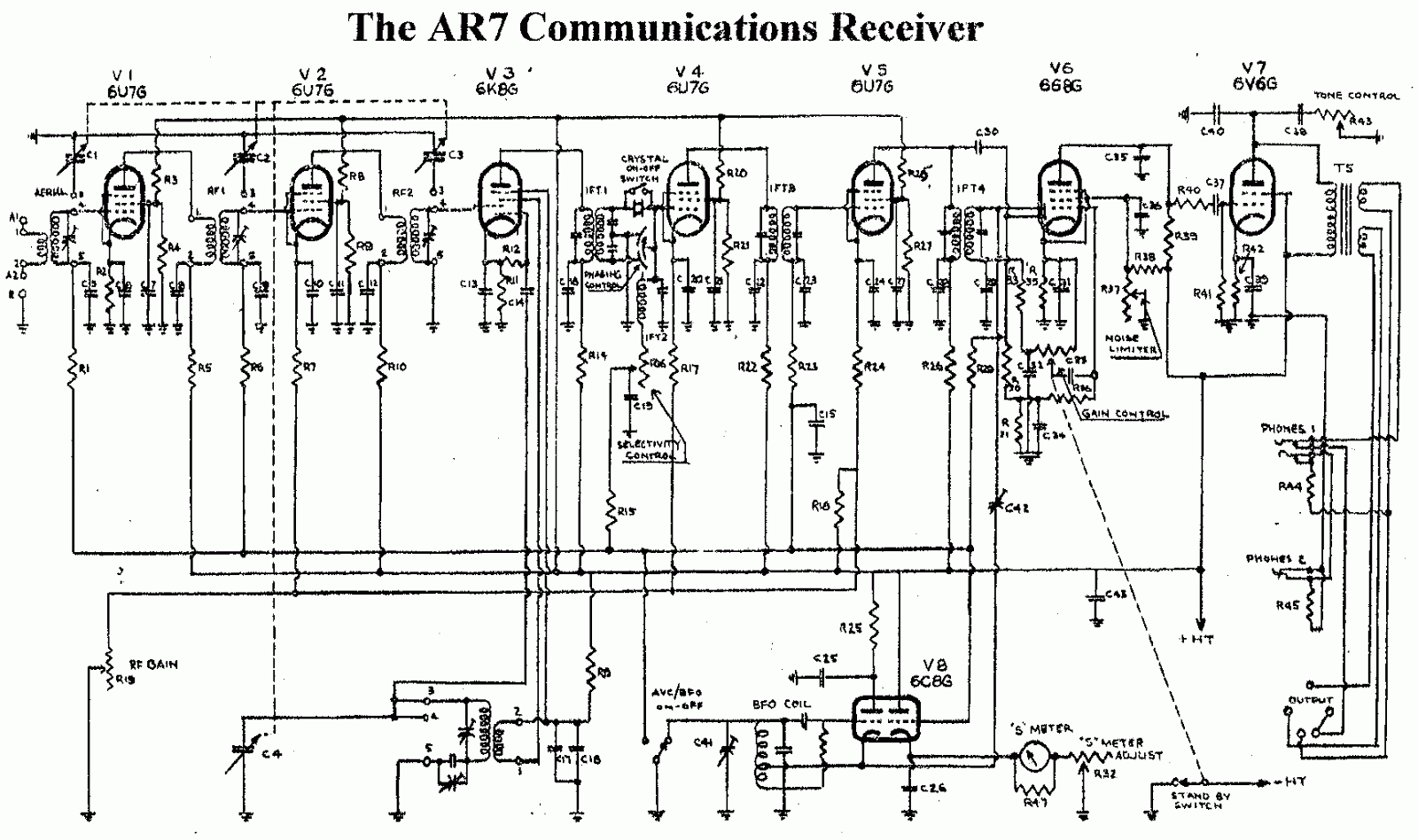
The AR7 is a communications receiver covering LF and HF bands. It was made in Australia during 1940 and bears an extremely close resemblance to the National HRO receiver. The receiver has a tuning range from 138 kcs to 25 mcs, with a gap of 45 kcs either side of the 455 kcs IF amplifier. The internal design is a single conversion superheterodyne receiver with 2 RF stages, 2 IF stages, a BFO and an “S” meter amplifier. The sensitivity is quoted as 1 microvolt. The front panel is stainless steel and it is a very distinctive looking receiver.
It is a good performer, sensitive, has a nice feel, is easy to tune, but hard to find the correct frequency, by reading the frequency from the dial number and coil box graph. It really needs a crystal calibrator. I use it for the weekly W.I.A. (Wireless Institute of Australia) broadcast, so it gets turned on once a week, and is so stable, than I don’t have to retune. It is very clear for AM but a bit fiddly for SSB.
The controls are: RF gain, BFO note, AVC/BFO switch, Adjust “S” meter, Tone, Tuning, Noise limiter, Selectivity, Crystal IN/OUT switch, Crystal Phasing, Audio gain. The Audio gain control has an OFF position which removes the HT so that the coil boxes can be changed.

It has two 6U7G RF stages, a 6K8G mixer, two 6U7G IF stages at 455 kcs, a 6G8G detector/AVC/audio preamplifier, and a 6V6G audio output amplifier. It has a 6C8G twin triode as a BFO and “S” meter amplifier. It also has a crystal filter. The IF alignment should be done very carefully, as any misalignment will reduce the effectiveness of the filter. It is best done with a sweep generator. The 6 volt valve heaters are connected in series, for 12 volt operation.
The external power supply and speaker, are usually mounted in a short 19″ rack, the AR7 at the bottom, the speaker in the middle, and the power supply at the top. The complete unit weighs about 118 pounds. The power supply was switchable between 12v and 240v.
The receiver was used as a ground monitoring receiver for aircraft. It was extremely stable. The model shown has an R.A.A.F. nameplate, and serial number 1786. The manual I have is a D.C.A. (Department of Civil Aviation) version and is a 1947 issue.
It has 5 plug in coil boxes. The coil boxes are: band A 140-405 kcs, band B 490-1430 kcs, band C 1.420-4.3 mcs, band D 4.25-12.5 mcs, band E 12.5-25 mcs. The Army version had an extra coil box covering 50-150 kcs. The large dial is a 20:1 reduction drive and has graduations from 0 to 500. It acts like a flywheel when tuning across the band, and has an effective scale length of 12 feet. The dial shaft goes into a right angle reduction gearbox and has 2 output shafts that drive 2 dual gang capacitors. The graph on the front of each coil box is used to covert the dial reading to frequency.

Owen Morgan, KF5CZO, is a regular contributor to AmateurRadio.com and writes from Texas, USA. Contact him at [email protected].
The runners up….
These are the QSL card designs that didn’t make the final cut:


… it was kind of tough not going with the Delorean.
Scott Hedberg, NØZB, is a regular contributor to AmateurRadio.com and writes from Kansas, USA. Contact him at [email protected].
InnovAntennas Now Available in US
I first noticed these antennas a few months ago. They look interesting. I’m looking forward to getting my hands on one and trying it out.
Here is the press release…
FOR IMMEDIATE RELEASE:
British Antenna Company InnovAntennas Appoints First American Dealer
Glade Park, Colorado – January 23, 2012 – The full line of high performance HF, VHF and UHF amateur radio antennas from fast-growing British company InnovAntennas are now available to customers across the United States via Hamilton, Ohio’s R&L Electronics.
“Our customers have been hearing about the outstanding performance of InnovAntennas’ designs from their amateur radio friends overseas, reading about them in European journals such as DUBUS and from a handful of ‘early adopter’ American hams who couldn’t wait and purchased InnovAntennas products direct from the UK,” said R&L Electronics’ Roger Smallwood. “We are proud to be the first American retailer to represent this exciting new brand.”
InnovAntennas was launched in 2011 by Justin Johnson, G0KSC, after his hobby of designing antennas for his personal use led to a flood of requests to “make one for me” from amateur radio operators who recognized that Johnson’s designs outperformed they could buy in a store. Today, InnovAntennas is building antennas at a former boat factory in Canvey Island, England and selling its products directly via InnovAntennas.com and via a network of dealers in Europe, Australia, and now, the United States.
InnovAntennas’ highly regarded designs include LFA (Loop Fed Array) and OP-DES (Opposing Phase –Driven Element System) Yagis. Performance of GOKSC designs routinely top the charts in their boom-length class on the survey of ‘moonbounce” antennas –“EME-ers” are among the ham world’s most demanding operators –compiled by VE7BQH and available online.
InnovAntennas America’s William Hein said “We selected R&L as our first American dealer due to their commitment to customer service, deep inventory, high order fill rate, great history, product knowledge and enthusiasm for InnovAntennas’ approach to design and construction. We look forward to a long, productive relationship with the gang from HAMilton OH!”
R&L’s Roger Smallwood added “We work hard to have all ham radio products in stock and ready for immediate shipment. From a 50 cent connector to the thousand dollar radio, our customers will receive the same fast service at a great price. No one likes to hear that an item is out of stock or it will be drop shipped from the manufacturer. We already know InnovAntennas are high quality products and will be very well known in the USA in a short period of time. Our goal is to have it in stock when you are ready for it!”
Matt Thomas, W1MST, is the managing editor of AmateurRadio.com. Contact him at [email protected].
Spam, spam, egg and spam
Oh joy, my email seems to have been hacked into.
Apologies to anyone who has received any helpful advice they didn’t really want from my account.
I’ve spent the best part of an hour changing passwords and resetting things and this site hold no ‘email-able’ information so there shouldn’t be any coming through but if you’ve been got then I apologise and I’d like to say it’ll never happen again but you know how it is.
It happened at 8.37am today and the password was changed by 9am so it was the best I could do.
Very annoyed about it!
Alex Hill, G7KSE, is a regular contributor to AmateurRadio.com and writes from Cumbria, UK. Contact him at [email protected].
 Ham Radio Deluxe |
 W5SWL Electronics |
 Ham Radio Prep |
 KB3IFH QSL Cards  Hip Ham Shirts  HamRadioAuctions HamRadioAuctions Reliance Antennas Reliance Antennas Enigma Shop Enigma Shop |  morseDX  Ni4L Antennas  R&L Electronics R&L Electronics antennas.us antennas.us QRV QRV |
- Matt W1MST, Managing Editor
