 |
 Ham Nation 34
 8 February 2012 | by
Hosts: Bob Heil (K9EID), Gordon West (WB6NOA), and George Thomas (W5JDX)
John Amodeo, producer of ABC’s new show, Last Man Standing, talks about the show, Tim Allen, and ham radio, Gordo reports from his annual CERT class, installing a mic connector, and more.
Guest: John Amodeo (NN6JA) and Cheryl Lasek (K9BIK)
Download or subscribe to this show at http://twit.tv/hn.
We invite you to read, add to, and amend our show notes at wiki.twit.tv.
Thanks to Joe Walsh who wrote and plays the Ham Nation theme.
Thanks to Cachefly for the bandwidth for this show.
http://dts.podtrac.com/redirect.mp4/twit.cachefly.net/video/hn/hn0034/hn0034_h264b_864x480_500.mp4
http://dts.podtrac.com/redirect.mp4/twit.cachefly.net/video/hn/hn0034/hn0034_h264b_640x368_256.mp4
http://www.podtrac.com/pts/redirect.mp3/twit.cachefly.net/hn0034.mp3
Dr. Bob Heil, K9EID, is the founder of Heil Sound and host of TWiT.tv's Ham Nation which streams live each Tuesday at 6:00pm PT (9:00pm ET) at http://live.twit.tv. Contact him at [email protected].
Handiham World for 08 February 2012

A few days ago I spotted a story in a small town newspaper that turned out to be a letter to the editor. It was written by an amateur radio operator who was admonishing his fellow amateur radio operators to please monitor their local repeaters in case there would be an emergency. He had an example of an actual emergency when a call was sent out via a repeater but there were no responses.
I have lost count of the number of times I have driven cross country myself, monitoring the various repeaters along the way and throwing my call sign out here and there, but getting nothing but silence in return. Others have mentioned this phenomenon as well. Amateur radio repeaters are very, very, VERY quiet these days. I often wonder if any of them get used more than a few times a week.
Conventional wisdom about repeaters used to be that you wanted them to be available during the “drive time” rush hour traffic in case they might be needed to report some kind of emergency. These days, it is a rare motorist indeed who does not travel with a cell phone. The cell phone is much more likely to be a more efficient way to reach emergency service personnel quickly than the local amateur radio repeater system. Yes, it is nice to have the repeater system as a backup because cellular service as not always available and is prone to overloading and failure during emergencies. But on a typical day cell phones work as expected and do absolutely everything they are needed to do. In fact, I suspect that most amateur radio operators use their cell phones more regularly than VHF mobile radios.
While there may be exceptions to the quiet repeater phenomenon in a few areas, I have heard nothing in the past few years to change my belief that most amateur radio repeater systems in large metropolitan areas are grossly underutilized. As I have said in the past, if a repeater system is to remain healthy (an actively used system) it requires a critical mass of regular users. One or two voices crying in the wilderness is not enough to save a repeater system from oblivion. Successful repeater systems host scheduled net activities, have a cadre of informal users who meet on the frequency regularly, and are maintained to high engineering standards so that the user base can enjoy reasonable reliability.
One thing that a repeater owner can do to make sure that the system is used often and doesn’t fade into obscurity is to connect it to a VoIP system like EchoLink, IRLP, WIRES, or Allstar Link Network. Unfortunately, there are amateur radio operators out there who don’t understand this technology and fear that it will somehow ruin the repeater system or dominate it to the point that the repeater will be unavailable for local users.
This, my friends, is nonsense. All you have to do is listen on a connected repeater system on a regular basis and you will find out that the repeater is used much more often than an unconnected repeater system but not to the point of overuse. I have virtually abandoned repeater systems that are not VoIP connected because they have no activity. They sound exactly the same whether the radio is turned on or turned off! If your club’s repeater system is one of these dead zones, I urge you to bring up the possibility of connecting it to the world via VoIP. There may be a few old fogies who will fulminate and fuss, but unless they are regulars on your local repeater all day long and are leaders in keeping the system maintained and active, I think you can safely call their bluff.
For Handiham World, I’m…
Patrick Tice, [email protected]
Handiham Manager

Pat Tice, WA0TDA, is the manager of HANDI-HAM and a regular contributor to AmateurRadio.com. Contact him at [email protected].
No output
I built the Kits and Parts RF Amplifier. Unfortunately it didn’t work.
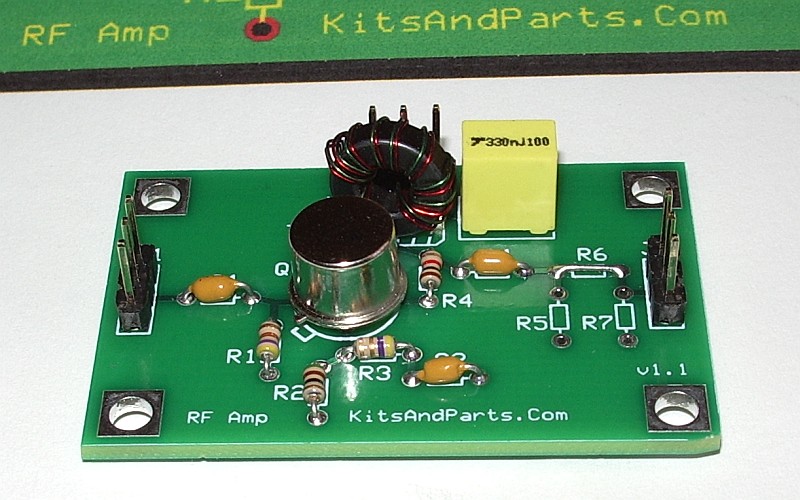
When power is applied the meter in my bench power supply reads 0.01A. As soon as the Propeller beacon starts the current draw increases to 0.03A (at 8V). But the needle on my QRP power meter, which shows more than 25mW from the barefoot Propeller, doesn’t budge.
I don’t understand it. It’s a simple enough circuit, there isn’t anything to go wrong. Unfortunately I find these kit construction failures too demoralizing. I struggle with my vision and shaky hands just to build the board. Desoldering and faultfinding are beyond me at the moment. If I do discover the cause of the problem it’s something really obvious that anyone with a normally functioning brain would spot. I think it is time for me to accept my limitations and stop attempting to do what I used to be able to do before my brain surgery. From now on if I can’t buy what I want ready to go out of the box I’ll just have to do without.

Julian Moss, G4ILO, is a regular contributor to AmateurRadio.com and writes from Cumbria, England. Contact him at [email protected].
Portable 50Mhz antenna
One of the enduring aspects of amateur radio is the emphasis on ‘experimentation’ and ‘homebrew’. To many people this means designing innovative circuits for their own transceivers, amps or whatever floats their boat. My area of interest is in collecting either bent wire, off cuts of cable and odd shaped plastic parts scavenged from just about any skip or rubbish bin I can find. Some people like to call this antenna experimentation. My XYL likes to call it ‘That junk in the garage’. I like to call it my continued education. Below is a teaser!

The latest in my armoury of ‘stuff I’ve done’ will never help anyone chase DX or bust a pile up for a little activated square or something else. But it will give me another band to work with when I’m away from home, either on top of a summit, at the mother in laws or operating portable in the summer Es season (I say summer because the top of St Bees head isn’t very welcoming in the winter as I found out whilst operating GB4LBC).
My take on the 5/8 wave 6m vertical originally published by the UKSMG by Mike, G3JVL took a little over a weekend and was made relatively cheaply from scrounged resources. I enjoyed the job so much I’ve added a little project page here which I hope you enjoy. Feel free to try it out yourself and improve on the design path I took, let me know how you got on with the manufacturing of what should be a nice project (that can also be cheap if you’re scrounging skills are up to scratch)
Alex Hill, G7KSE, is a regular contributor to AmateurRadio.com and writes from Cumbria, UK. Contact him at [email protected].
Weekend 50Mhz vertical antenna
One of the enduring aspects of amateur radio is the emphasis on ‘experimentation’ and ‘homebrew’. To many people this means designing innovative circuits for their own transceivers, amps or whatever floats their boat.
My area of interest is in collecting either bent wire, off cuts of cable and odd shaped plastic parts scavenged from just about any skip or rubbish bin I can find. Some people like to call this antenna experimentation. My XYL likes to call it ‘That junk in the garage’. I like to call it my continued education. Below is a teaser!
The latest in my armoury of ‘stuff I’ve done’ will never help anyone chase DX or bust a pile up for a little activated square or something else. But it will give me another band to work with when I’m away from home, either on top of a summit, at the mother in laws or operating portable in the summer Es season (I say summer because the top of St Bees head isn’t very welcoming in the winter as I found out whilst operating GB4LBC).
My take on the 5/8 wave 6m vertical originally published by the UKSMG by Mike, G3JVL took a little over a weekend and was made relatively cheaply from scrounged resources. I enjoyed the job so much I’ve added a little project page here which I hope you enjoy.
Feel free to try it out yourself and improve on the design path I took, let me know how you got on with the manufacturing of what should be a nice project (that can also be cheap if you’re scrounging skills are up to scratch)
Alex Hill, G7KSE, is a regular contributor to AmateurRadio.com and writes from Cumbria, UK. Contact him at [email protected].
Random thoughts.
The other night, I tried uploading some QSOs to Log of the World. I was unsuccessful as my certificate had expired. I filed for a new one, got everything working and uploaded my latest batch of QSOs without a problem. I try to do this once a month or once every couple of weeks.
Out of curiosity, I went back to the LOTW site tonight to do a little math. I have a LOTW QSL return rate of 19.8 percent. I have no idea as to whether that’s good, bad or average.
I went over to eQSL and did the same math – 19.27 percent – slightly lower. Frankly, that surprised me. I think we can all agree that eQSL has less “hoops” to jump through in order to get it working. I am not criticizing LOTW when I say that – I’m just pointing out what I think is fact. Although personally, I have not had any insurmountable LOTW problems, I have heard horror stories from other Hams who had, and gave up – running and screaming into the night. eQSL may not be as secure, I don’t know – but it does seem easier to use.
I would have thought (there goes that “conventional wisdom” again!) that being easier to use would also translate to ” greater participation and use”. I guess not.
Tonight is the 80 Meter QRP Fox hunt. Dave N0IT in Missouri is not feeling all that great, so he has swapped with John K4BAI. So the Foxes will be John in Georgia and Jim K9JWV in Utah. “Conventional wisdom” is telling me that from New Jersey on 80 Meters, I should be able to work John fairly easily and that Jim may be a stretch, if I hear him at all.
We’ll see.
72 de Larry W2LJ
QRP – When you care to send the very least!

Larry Makoski, W2LJ, is a regular contributor to AmateurRadio.com and writes from New Jersey, USA. Contact him at [email protected].
2012 Challenge–QSO a day update
I’m a few days late in getting this posted. I wanted to provide a quick update on the progress of my 2012 challenge. As I blogged about recently, I set my 2012 challenge to be a QSO a day throughout the year. I’m happy to report I successfully closed out the month of January with a QSO logged each day for a total of 205 logged QSO’s total for the month.
The breakdown is as follows:
| Mode | Number QSO’s |
| JT65 | 119 |
| RTTY | 79 |
| SSB | 7 |
I’m hoping as the year progresses to operate more SSB and also PSK. But with over 540 JT65 Q’s logged since I learned of this mode, I’m still having a lot of fun with JT65.
I’ve also recently given my main KDØBIK.com website a new look by using a WordPress theme install. While I’m keeping this blog site, as well as my SOTA blog and the Practical Amateur Radio Podcast websites all separate, the clean look of the WordPress theme just better ties everything together. Also, it allows me to essentially update the site from just about anywhere and even when on my iPad.
Finally, another plug for my podcast. I did release episode 51 back in late January. As I’ve done the past several years, the January episode is devoted to amateur radio related New Year’s resolutions. I provided several ideas in an attempt to help motivate and inspire. While we are almost to the half-way point in February, in my opinion it is never too late to set a goal. Especially if that goal allows you to have fun in the hobby of amateur radio.
Until next time,
73 de KDØBIK
Jerry Taylor, KD0BIK, is a regular contributor to AmateurRadio.com and writes from Colorado, USA. He is the host of the Practical Amateur Radio Podcast. Contact him at [email protected].
 Ham Radio Deluxe |
 W5SWL Electronics |
 Ham Radio Prep |
 KB3IFH QSL Cards  Hip Ham Shirts  HamRadioAuctions HamRadioAuctions Reliance Antennas Reliance Antennas Enigma Shop Enigma Shop |  morseDX  Ni4L Antennas  R&L Electronics R&L Electronics antennas.us antennas.us QRV QRV |
- Matt W1MST, Managing Editor
