 |
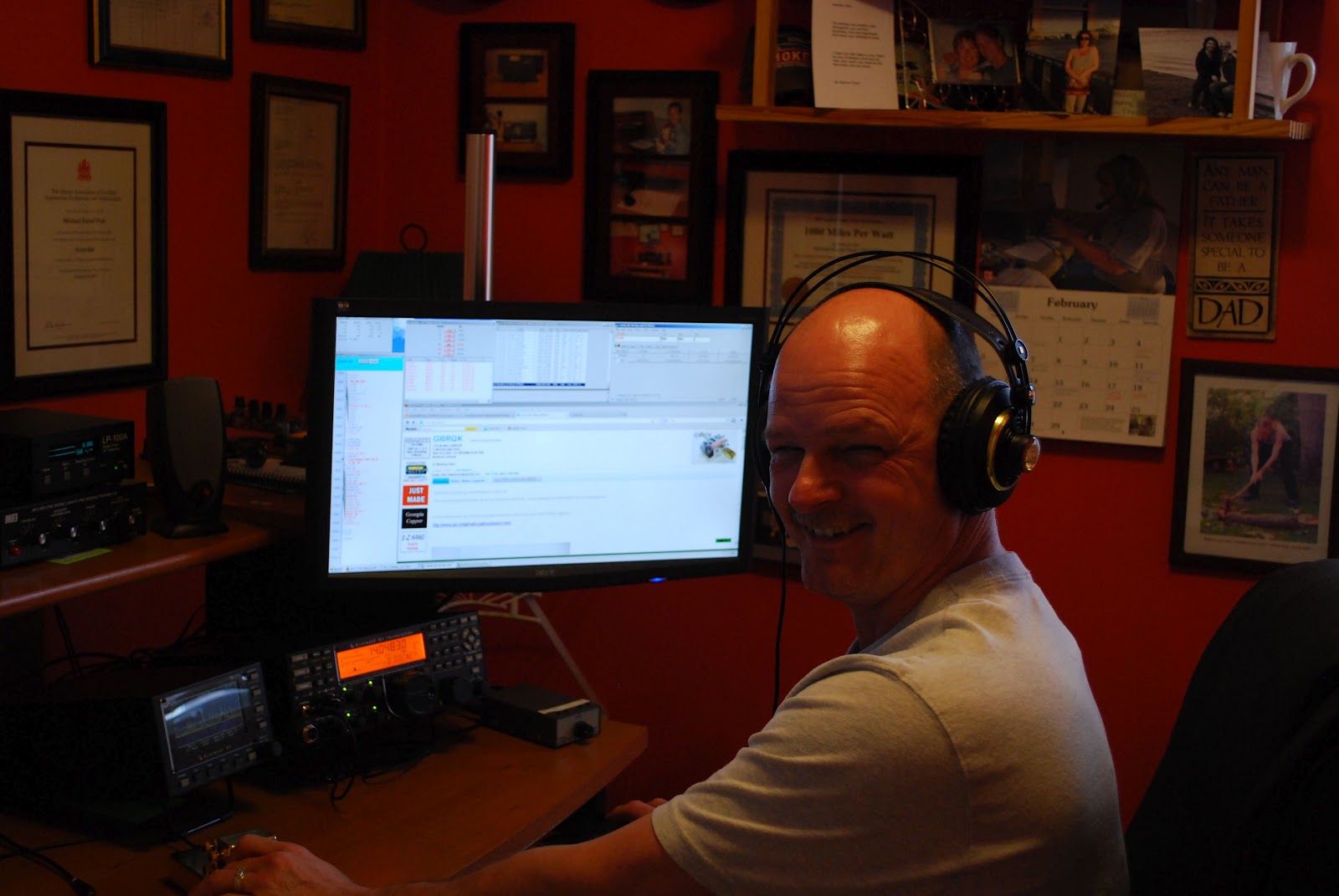
 Day one (for me) of the ARRL CW DX contest
 19 February 2012 | by
  |
| Relaxing and contesting |

Mike Weir, VE9KK, is a regular contributor to AmateurRadio.com and writes from New Brunswick, Canada. Contact him at [email protected].
New offering from Four State QRP Group
The following was announced today on the various QRP e-mail reflectors:
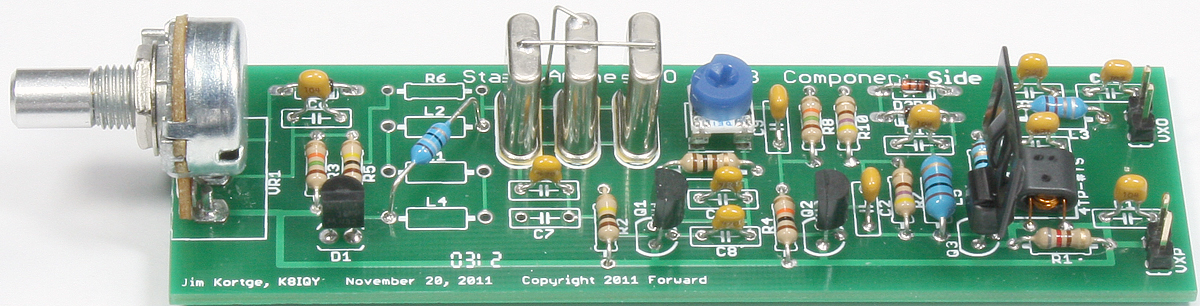
The Four State QRP Group is pleased to announce a new kit, the Stand Alone VXO (SAVXO) designed by Jim Kortge, K8IQY. The very complete manual, specifications, and ordering information can be found here http://www.wa0itp.com/savxo.html PayPal is accepted. It is shipped with 40M components but can easily be used on any HF band.
This is a Super VXO design which has it’s origins in the Super VXO of the SS-40 receiver. It is crystal controlled yet combines frequency agility with smooth stable tuning, and NO perceptible drift – even from a cold start. It is ideal for driving your NS-40 or other crystal controlled transmitter or receiver, and is also a great starting point for a transmitter strip of your own design. As kitted the SAVXO will put out over 250mW by itself, plenty of power to operate QRPp if desired.
All proceeds go to fund OzarkCon. As always thank you for supporting the Four State QRP Group. http://www.4sqrp.com/
I ordered mine! And once OzarkCon 2012 is over, I’ll be ordering a Magic Box kit, too.
72 de Larry W2LJ
QRP – When you care to send the very least!

Larry Makoski, W2LJ, is a regular contributor to AmateurRadio.com and writes from New Jersey, USA. Contact him at [email protected].
I need to follow my own advice
I went downstairs and flipped the K2 on and tuned around 40 Meters – WOW !!!!!!
After a long and full day of work, my brain is simply not ready to wrap around 40 WPM code. I worked HG3R who was cruising at about 35 WPM and called it a night. Tomorrow, after a good night’s sleep and after the opening hours pandemonium is over, I will be ready to jump into the fray. Also, during the daylight hours, stations will be spread out more as other bands open. Seems like right now, everyone is crammed into 40 and 80 Meters.
I’ve been at this Morse game for over 30 years now; and I really admire these guys who can while away at 40 – 50 WPM. I would love to be able to attain that kind of speed; but right now, it sounds more like a buzz saw than Morse Code. God bless them, you have to admire and respect that kind of ability.
72 de Larry W2LJ
QRP – When you care to send the very least!

Larry Makoski, W2LJ, is a regular contributor to AmateurRadio.com and writes from New Jersey, USA. Contact him at [email protected].
Opening thoughts about ARRL CW contest

Until then....contest on!!

Mike Weir, VE9KK, is a regular contributor to AmateurRadio.com and writes from New Brunswick, Canada. Contact him at [email protected].
DIY Magnetic Loop Antenna – Part 1
Do you live in a neighborhood with a restrictive antenna policy and despair of having a useful HF antenna?
Can you solder or know someone who can?
A magnetic loop antenna may be the answer and they are not as difficult to build as you might think. Like getting on the air for the first time or taking your license exam there is a certain amount of uncertainty when you first approach magnetic loop antennas, there are a few new ideas to grasp. However, thanks to other hams like Steve AA5TB there are tried and tested designs, calculators & building methods that are known to work and that you can follow.
 At the heart of every radio and MLA (Magnetic Loop Antenna) is the resonant circuit. The combination of an inductor (a wire has inductance, but a coil of wire has more) and a capacitor (two conductors separated by an insulator) in a circuit will resonate or ‘ring’ at a certain frequency. Sound vibrations at a certain frequency can cause a piano string to vibrate in sympathy and a vibration of the correct radio frequency will cause a resonant circuit to electrically vibrate in sympathy.
Since there is no such thing as a free lunch, the sacrifice you make with a MLA is that it needs to be re-tuned whenever you change frequency on your transceiver. The frequency range over which it is resonant is very small, typically only a few hundred kilohertz at the most.
The materials you can get your hands on is going to decide the capabilities of your MLA. Ideally you’ll have a loop made from a conductor with very low resistance (usually copper) and a capacitor that can handle high voltages. A variable capacitor is required if you want to use your antenna on multiple frequencies but you can use or make a fixed capacitor if you operate on one frequency, for Eg PSK31.
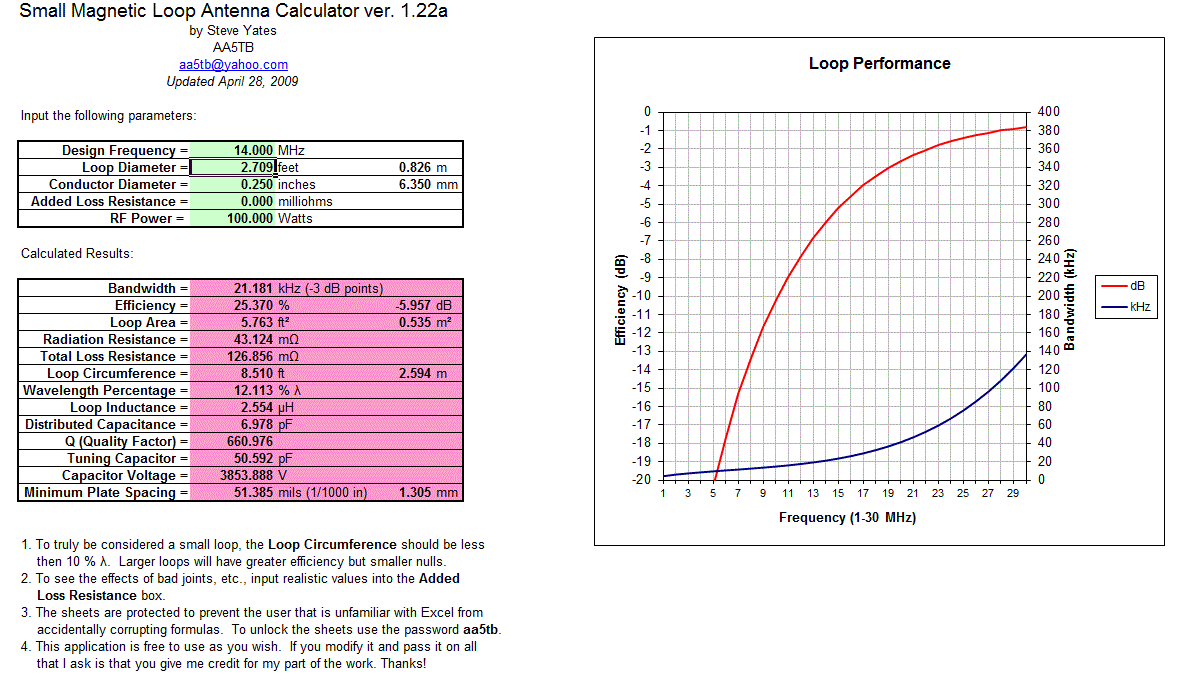
A MLA calculator like the Excel spreadsheet from Steve AA5TB or this web page from 66pacific.com will help you to decide what size components you’ll need to make your antenna.
The four pieces of information required are:
- What frequency or frequencies do you wish to transmit on?
- How large do you want the loop to be (It should have a circumference less than 10% of the design frequency wavelength, both calculators help you figure this out)
- The diameter of your conductor (Three quarter inch (0.75 inch) copper pipe is a good start)
- How much power you want to use (The voltage across the capacitor is proportional to the input power to the MLA)
 A MLA of a certain circumference will be more or less efficient based on the frequency you transmit at. It is worth changing the loop size in the calculator to get the best efficiency possible in your favorite band.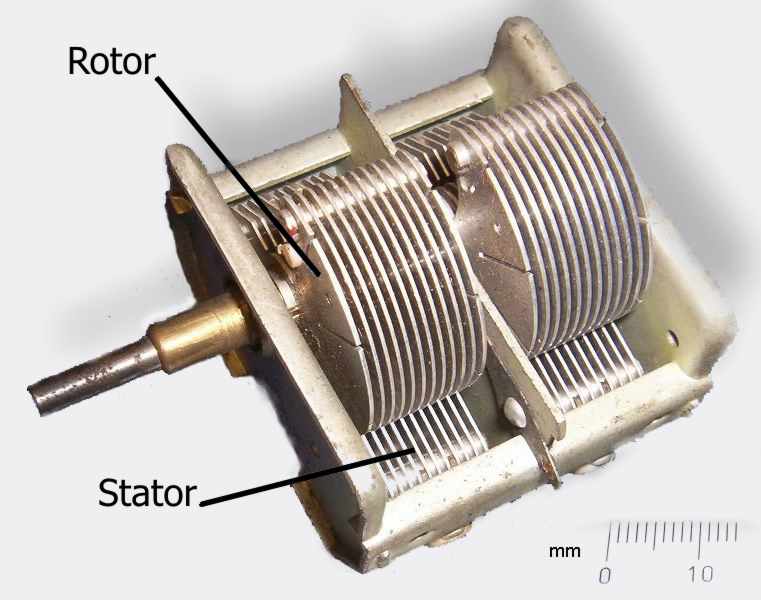
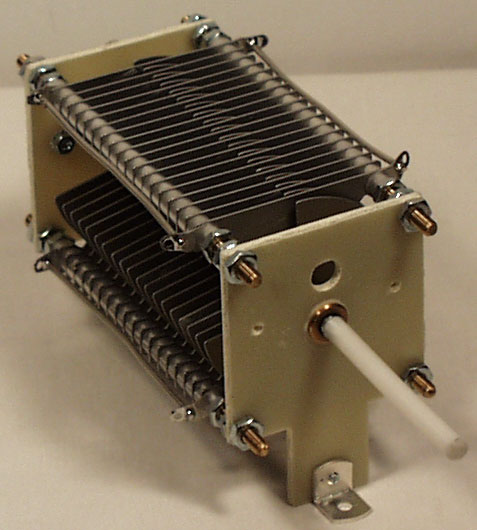

Owen Morgan, KF5CZO, is a regular contributor to AmateurRadio.com and writes from Texas, USA. Contact him at [email protected].
LHS Show Notes #075
Introduction:
- We’re a little light on content, but we’ll make up for it with enthusiasm!
Announcements:
- Ronny, K4RJJ, will be the LHS ambassador at the Dalton Hamfest, February 25, 2012, in Dalton, GA. Stop by and say hello.
Topics:
- Linux Mint 12 Review
- Richard has been using Ubuntu for some time, but he’s been unhappy with the latest version. He’s rediscovered Linux Mint! Version 12 is out, with Gnome 3, Gnome 2, MATE, and Cinnamon, and he gives a brief review.
- His primary needs: browser, email, Audacity, XChat, and a few others.
- Using the Gnome 3 desktop, as a desktop fills with icons, a new desktop is automatically created.
- By moving the mouse to a hot corner, you’ll see a high-level view of all your open applications.
- Russ has been using Linux Mint Debian Edition, so he’s missing out on the Gnome 3 goodies, at least for now.
- Our hosts then drift into a discussion of various desktop managers and visual effects.
- WINE: Wine Is Not an Emulator
- WINE is a collection of libraries for Linux that support Windows library calls from a Windows application.
- EchoLink, for example, is a Windows application works quite well under WINE on Linux.
- If you can’t find a native Linux application that does what you want, you may find that WINE will allow you to run the Windows program.
- There are a couple of different versions of WINE, all based on the core version of WINE.
- Cedega: a version of WINE that supports a variety of Windows games.
- CrossOver: a version of WINE that originally focused on supporting business applications such as Internet Explorer and MS Office, but has also expanded to include some games and running Windows applications on a Mac.
- Richard browses the list of ham radio applications in the WINE application database.
- Russ talks about installation and configuration:
- Red Hat/Fedora: yum install wine
- Debian-based: apt-get install wine
- Some repositories may not have the most recent version of WINE (1.4 at the time of recording).
- Under System Tools (in Linux Mint, or Debian) there is a WINE Configuration tool.
- To install a Windows program under WINE, download the Windows installer application. At the command line, type “wine [name of installer executable]“, and the setup program should proceed just as with Windows. A program icon should appear under the WINE program folder, and the program will, hopefully, run just like in Windows.
- Some Windows programs will run just fine under WINE; others won’t. Give your favorite a try and see!
- One of the most-wanted ham radio applications, Ham Radio Deluxe v. 5.0, does not run at all under WINE. If you can find a copy of HRD v. 4, it should work under WINE. Remember, too, the native Linux application fldigi does much of what HRD would do.
- Russ has also tried the N1MM Logger under WINE, and it worked fine.
- The Winetricks tool might help get a Windows application running under WINE.
- The WineHQ forum is a good resource for help.
Feedback:
- We had a donation from William A. Thank you!
- Leif, KC8RWR, continues a comment dialog about the origin of CUPS in Episode 67.
- G8FXM, mentioned LHS in his blog. Thanks, David.
- The Hoosier Hills Ham Club linked to the LHS site and we linked back. Thanks to W.W., KB9TMP.
Contact Info:
- Contact Richard at [email protected], Russ at [email protected], or both at the same time at [email protected].
- Listen to the live stream every other Tuesday at 8:00pm Central time. Check the LHS web site for dates.
- Leave us a voice mail at 1-909-LHS-SHOW (1-909-547-7469), or record an introduction to the podcast.
- Sign up for the LHS mailing list.
- Sign up for the MAGNetcon mailing list.
- LHS merchandise is available at the Merch link on Web site. Check out the Badgerwear or buy one of the other LHS-branded items at PrintFection.com/lhs or Cafe Press. Thanks!
- Thanks to Dave from Gamma Leonis for the theme music.
Music:
- To be added.
Russ Woodman, K5TUX, co-hosts the Linux in the Ham Shack podcast which is available for download in both MP3 and OGG audio format. Contact him at [email protected].
First summit of the year
Well I can call it a summit because it features in Wainwright’s book but it really something to write home about as far as height for me. But, there’s always a but, I decided to go with the XYL, kids, mother in law (not sure what the shorthand is for one of those) and two dogs. Abigail is my eldest at 5 years old and Sam is only 3 so to them this was a veritable Himalaya.
Progress as you can image was at their pace and eventually I had an extra 20Kg on my shoulders as we went back into the cloud near the summit of Dodd (LDW-174). The summit is low at only 502m but the propagation into both Southern Scotland and Northern Ireland was in effect and I managed a summit to summit before the kids / XYL got bored. Needless to say the dogs didn’t bat an eyelid.
So I’m off the mark for this year and hopefully I’ll be able to get a few SOTA and WOTA summits in this year although I think I’ll avoid carrying the kids. The lake district is an excellent place to live and visit and I’m glad to have made some new contacts for the log and I hope it will help WOTA to grow and grow
Alex Hill, G7KSE, is a regular contributor to AmateurRadio.com and writes from Cumbria, UK. Contact him at [email protected].
 Ham Radio Deluxe |
 W5SWL Electronics |
 Ham Radio Prep |
 KB3IFH QSL Cards  Hip Ham Shirts  HamRadioAuctions HamRadioAuctions Reliance Antennas Reliance Antennas Enigma Shop Enigma Shop |  morseDX  Ni4L Antennas  R&L Electronics R&L Electronics antennas.us antennas.us QRV QRV |
- Matt W1MST, Managing Editor
