 |
 Weekend Ham Shack Update
 27 February 2012 | by
 Last week I blogged about the progress made on the multi-year basement ham shack, podcast studio, home office and just general man-cave project. If you recall the sheetrock material was scheduled to be delivered and I had planned to start hanging the material just as soon as I was able to get the 4 foot by 8 foot sheets into the house (from the garage) and down into basement.
Just like clockwork, the truck from the big box store pulled up on Friday afternoon and unloaded 46 sheets of 4×8 (1/2 inch think) sheetrock in the garage. By the way, each 4×8 sheet weighs in at approx. 57 lbs. These are bundled two per so total weight for two sheets is approx. 114 lbs. Friday evening the task of moving this material into the basement was completed.
I eased into my Saturday morning much like any other Saturday. I’ll admit….I’m an addict and have been since my college days. I can’t function with out my coffee and you don’t want to be around me when I don’t have my morning fix. Anyway, I also applied a couple of Advil and a hot shower to get my joints moving again after the hard labor on Friday evening. While giving all this time to work, I managed to work some DX. I worked ON4CHD in Belgium on 15m JT65.
Anyway, one other thing to note. My house is a multi-family design. Meaning I share one interior wall with one neighbor. It just so happens the portion of the basement I’m working in is that joining wall. So while some would want to get an early start on a project like this, I want happy neighbors (I need happy neighbors) and never start anything before 9 AM.
Now what possibly can an IT Guy know about home remodeling? This is a good question and I wanted to spend a little time sharing my background. While none of this work is rocket science, at some point in my life I’ve either been trained how to do most of the needed tasks or have previously done them.
Most of the experience started by having a Dad who taught me how to do these sort of things as a teen. Also, while I never intended to be a farmer, I did take 4 years of FFA in high school. This taught me many skills which I’ve needed for this project including electrical, plumbing and general construction. Finally, while I’ve been working in the IT field for almost 20 years, this didn’t start until late in my working life. I spent about 4 years working for the State of Texas in a local public school system doing building maintenance. It just so happened during this time both my Dad and I worked for the same school. While we spent many hot Texas summers mowing and running a weed eater, we also did a lot of building maintenance tasks. It’s the experience of these tasks which has allowed me to do all of my own work.
So with all that experience, we began the process of hanging the drywall. My wife is a real trooper as well in all this. Not only is she supportive in my amateur radio hobby, but she is instrumental in the help and guidance in the project from this point forward. While I did all the framing, electrical and plumbing…she’s signed on to help me the rest of the way. This help is making the drywall installation go much easier and will speed the painting process and all the other bits and pieces required before I move into this new space.
How about some photographs.

As Norm Abram’s would say “Measure Twice, Cut Once”. I’m measuring and marking the sheetrock material.

Carefully cutting a sheet for length. No straight edge cut required for this piece. Just free handing.
Now as I’ve mentioned a few times in my blog updates. I’ve tried to think of everything I could/would need not only today but in the future. I’ve pulled extra coax for CATV as well as plenty of data cable. In addition, I added many electrical outlets to this space. All these added outlets require extra attention when hanging drywall.
Back in my younger years, we would have to carefully measure where each electrical box was located and then mark the drywall sheets, then cut the openings before hanging the material. You kept fingers crossed your measurements were accurate. Today we have simple technology that speeds all this up. I’m using a kit from Blind Mark. Blind Mark uses strong magnets in a two piece device to easily locate your outlet boxes after you hang your drywall or plywood material.

Just place a Blind Mark target in each electrical box. In the above picture one 4 foot piece of drywall was going to cover all three boxes.

A close-up of a single box.

Once you’ve secured the sheet of drywall to the wall, take the Blind Mark locator and slide it in the vicinity of where the outlet should be and it will find it. Just trace with a pencil around the Blind Mark locator.

Then with your knife start cutting. I also used a small cordless Dremel tool with a cutting bit to speed this process up. Just be careful as the Dremel tool can easily cut into things you don’t want to be cut. Once cut, just remove the Blind Mark locator and finishing securing the drywall to the studs.
How about a before and after shot? Unfortunately, I can’t find the photos I took 5 years ago showing just the concrete walls (before framing) so you’ll just need to use your imagination. These photos were in the blog posting from last week.

Before Sheetrock. This is the corner where my main operating position will be located. This room is roughly 16×16.

Before Sheetrock.

After Sheetrock. The corner unfinished portion is framing I had to do around a support post. On the other side is a utility closet and where I’ll run antenna feed line, grounding etc. for the amateur radio station. The wall on the right and left of the corner will be fitted with cabinets above and some below with an “L” shaped counter surface.

Another after sheetrock.
All-in-all, the weekend was very much a successful weekend. Together, my wife and I hung 17 sheets of drywall. We are a little over half way getting the walls done. Pending all goes as planned, we should be able to finish the walls next weekend. Of course, once the walls are finished all that will be left is the ceiling. While I can say I’m not looking forward to this part of the project, we will rent a sheetrock lift which will aid in the installation.
Tentatively we are planning to do the ceiling on the weekend of 10 March if we can keep up the pace. This would be three weekends in a row, but it would also be the completion of the sheetrock installation. This would bring us to the dirty phase of taping, mudding, sanding and texturing. But of course this phase must be done to bring us to the paint phase.
In the mean time, I will begin wiring in the electrical outlets, network jacks, telephone jacks and CATV outlets in the areas where we’ve installed drywall. I will work on a few every other evening or so as I have time. While we’ve made significant progress on the first weekend, this is not a race to the finish. However, I believe the progress we made did open our eyes to the fact that YES we can do this and we can complete the work in the next few months.
Until next time…
73 de KDØBIK (Jerry)
Jerry Taylor, KD0BIK, is a regular contributor to AmateurRadio.com and writes from Colorado, USA. He is the host of the Practical Amateur Radio Podcast. Contact him at [email protected].
6 and 10 pages shuffle
The amount of 6 and 10 reports that I was hosting was begining to cause me a headache with space so I’ve shifted them onto a Dropbox public folder which can be accessed here. There is limited demand for these older reports but I hope they are useful to someone. Let me know if there are any problems.
Alex Hill, G7KSE, is a regular contributor to AmateurRadio.com and writes from Cumbria, UK. Contact him at [email protected].
Decisions
Yesterday while I was continuing my research into new rigs, my TS-850 stopped working with a dead silent receiver. I pretty much wrote off the rig thinking it wasn’t worth the repair and I would be getting out the credit card and picking up the phone to place an order for its replacement. But my good friend K3PH happened to see my rig death announcement on Facebook and posted a link to a Kenwood service bulletin about a known issue with Kenwood 850 receivers going dead. For giggles I opened up the rig and checked the “RXB” voltage point, and sure enough it had the symptoms of the issue. I replaced one culprit SMT diode with two run-of-the-mill 1N914 diodes and the rig came back to life. As if that wasn’t enough, the CW QSK is now much better, with full break actually much quieter and smoother than before. It’s like the rig has a second lease on life.
So for now the decision that seemed eminent is postponed while I enjoy my reborn Kenwood 850. I’m still mulling over the choices for a new rig, but I think I have it down to the Kenwood TS-590 and the Yaesu FT-950. Despite my initial thoughts of abandoning Kenwood altogether, the 590 seems to have some of the old Kenwood flair I liked years ago. I’ve ruled out the K3, KX3, and Ten Tec Jupiter. The Ten Tec Eagle is getting pushed out of the race. I haven’t seriously considered Icom, but perhaps I should take the extra time to look at them.
So far the Kenwood and Yaesu offerings are neck-and-neck in the race, though from review comments, going through the manuals, and my experiences with other Yaesu products, I get the feeling the Kenwood interface may be more user friendly than the Yaesu menus. I do like the front CW key jack, the separate RCA REC and PTT jacks, and the rotator integration feature in the Yaesu. I wish I had an amateur radio store nearby I could touch each of these rigs.
Last night I operated during the CQ 160 phone contest with the 850. I ran 100 watts to an inverted L with a meager seven or eight short radials on my acre lot, and I worked all but perhaps four or five stations in the midwest who couldn’t hear me. It was like shooting fish in a barrel and quite fun, and really speaks to what you can do with a modest antenna on 160.


Just for fun
It’s been over two months since I last posted, and I realized that part of the reason for that is that I’ve been waiting for something “important enough” to write about. Along the same lines, I’ve skipped operating in a couple of contests recently where I’d done so in the past because I didn’t have enough time to put in more than a couple of hours in the chair. I decided to fix both of those things recently.
Last weekend was one of the “big” contests, the CW version of the ARRL DX contest. In this contest, DX stations work US & Canadian stations, and vice-versa. (As opposed to contests where anybody works anybody, or are primarily US/Canada only.) This is a 48 hour contest, and while I’ve never operated for that entire period, I do usually try to spend time operating both during the day and in the evening to take advantage of different types of propagation at the different times of day. Last weekend, I didn’t have time to do that, but I did have a few hours on Sunday afternoon. I decided to spend the afternoon working whatever stations I could. When I operate in a contest, I like to have some kind of goal for myself. For this contest, I knew that I wasn’t going to beat my own personal best, so I decided that I’d do nothing but work multipliers for my first 100 QSOs.
Generally, this is kind of silly thing to do, especially for person who works in “Search & Pounce” mode, where you’re trying to just make contacts. Multipliers have additional value, and there are all kinds of strategies on working multipliers versus just working stations, but most of those apply to bigger stations who know they’ll be competitive. In any case, I decided that it would be fun to do, and that’s exactly what I did. Once I hit 100 QSOs I started working any other station that I found, but I still managed to work 141 multipliers out of 169 contacts.
My final score was only a bit over 71,000 points, which in this contest, is very low, but I did have a good time doing it, and that’s the point. Hopefully, this will get me “back in the saddle” for both contesting and working on my blog.
For anyone interested, here’s my claimed score:
         Band    QSOs    Pts  Cty
           7      35     105   22
          14      66     198   58
          21      56     168   49
          28      12      36   12
       Total     169     507  141
       Score : 71,487
Opera on 6
I haven’t used the Opera digital mode on HF for a bit as it seemed that interest had dropped off and there is not much point in beaconing in no-one is receiving. It seems to be one of those modes where there is a resurgence of interest whenever there is something new to try. This weekend the new thing was some fast Opera modes for use on VHF so I fired up the K3 on 6m (50.700MHz) to see if I could receive anything.
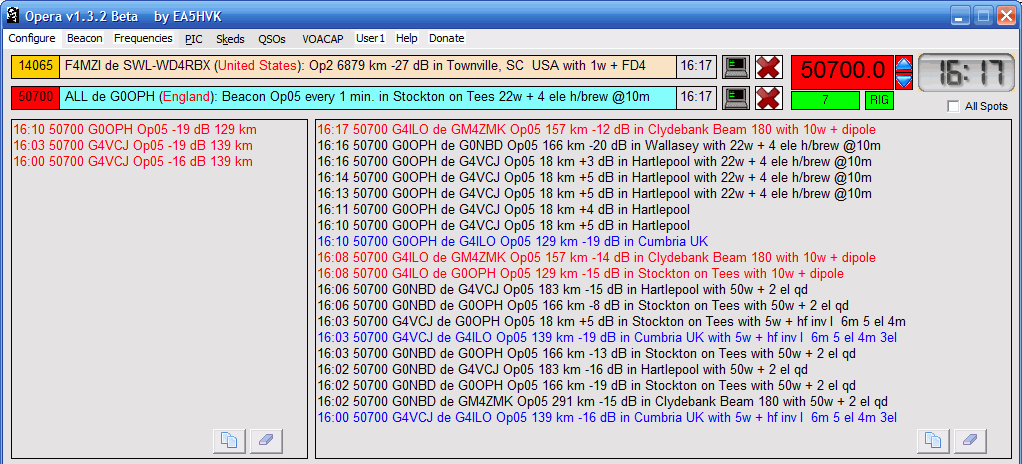
As you can see, not only did I receive some other stations but my own Opera signals were received around the UK. No great DX, but I was only using 20W to my attic dipole and would not expect to hear anything on 6m at this time.
If enough people were prepared to use it, this could be a good tool for discovering Sporadic-E openings on the VHF bands. The 30 second transmit cycle seems more appropriate for this type of propagation than WSPR’s two minute periods.

Julian Moss, G4ILO, is a regular contributor to AmateurRadio.com and writes from Cumbria, England. Contact him at [email protected].
Mistaken identity
A couple of weeks ago I came across FreeTrak, a PIC based APRS tracker developed by N0QBH. I have wanted to build a small ‘grab-and-go’ tracker for a while now. The FoxTrak works fine but is too big and bulky by the time it is paired with an HT. The TH-D72 is too much hassle as I need strong reading glasses to see the LCD screen and inevitably go out with some essential menu option disabled. Consequently these days I rarely bother taking APRS with me when Olga and I go for a walk around town.
I sent off for a couple of PIC 16F628A microcontrollers, thinking that I could program them in my EasyPIC5 development board. But when I tried, I immediately hit a snag.
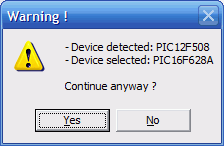
My PICFlash programmer detects a PIC 12F508 instead of a PIC 16F628A.
I don’t think I’ve been sold a fake MCU. If I remove the 16F628A so there is no micro plugged in at all I still receive the same warning. So I don’t know what to do. I’ve bricked too many PIC chips by programming them with the wrong settings to try crossing my fingers and clicking Yes. So it looks like my FreeTrak project is not going to get off the ground.

Julian Moss, G4ILO, is a regular contributor to AmateurRadio.com and writes from Cumbria, England. Contact him at [email protected].
ICQ Podcast S05 E05 – 100th Episode (26 February 2012)
Series Five Episode Five of the ICQ Podcast has been released. News Stories include :-
- 1st Interplanetary CubeSat Workshop
- New HF shortwave radio station callsign
- 13cm threat in Sweden
- Bahrain 70 MHz beacon A92C/B
- Open Mission Control software
- Craggy Island Dxpedition Group
- MIT offer free online electronics course
- G0KYA's February HF Propagation
- Android App for UK Band Plan 2012
- D-Star in Namibia V53W
- Radio Amateur to command ISS
- Field day BBQ cookbook published
Your feedback, Steve Nicholls, G0KYA Progation Report, and our 100th episode roundtable discussing the past and future of Amateur radio.
Colin Butler, M6BOY, is the host of the ICQ Podcast, a weekly radio show about Amateur Radio. Contact him at [email protected].
 Ham Radio Deluxe |
 W5SWL Electronics |
 Ham Radio Prep |
 KB3IFH QSL Cards  Hip Ham Shirts  HamRadioAuctions HamRadioAuctions Reliance Antennas Reliance Antennas Enigma Shop Enigma Shop |  morseDX  Ni4L Antennas  R&L Electronics R&L Electronics antennas.us antennas.us QRV QRV |
- Matt W1MST, Managing Editor
