 |
 PARP 52–QSL Bureau and more
 22 February 2012 | by
  The Practical Amateur Radio Podcast episode 52 is now available for download or stream. You can subscribe via iTunes, Zune or stream directly from MyAmateurRadio.com Want to stream on the go from your favorite smart phone device? You can do that as well via our mobile site.
In this new episode, I discuss the QSL Bureau Service as it relates to US Amateur’s. The bureau service is a great, inexpensive method of QSL’ing those DX contacts. Our featured website segment discusses the Ham Nation podcast/netcast as well as Mike Baxter, WA0XTT.
Please visit MyAmateurRadio.com to listen or download this new episode.
Thank you for listening and thank you for sharing your knowledge with others. The Practical Amateur Radio Podcast, creating Elmers one podcast at a time.
Until next time…
73 de KD0BIK
Jerry Taylor, KD0BIK, is a regular contributor to AmateurRadio.com and writes from Colorado, USA. He is the host of the Practical Amateur Radio Podcast. Contact him at [email protected].
Android Apps
I’ve long been a user of smartphone’s and always felt that in the past they were able to offer a lot in terms of being able to make and receive calls then the applications or apps that run on them we additional bonuses. Nowadays the primary selling point of a smartphone is not to do the basics like calls and text (SMS) messaging are the apps. My HTC desire S is like many other that run the Android OS in that it has access to the Android Market and its ever growing list of extras. A little run down on the ham radio one I have is as below. There’s no great explanation as to their functionality as its all on the Android Marketplace
APRSdroid – APRS on your phone. Well worth the money especially now that it supports messaging.
Echolink – Ro real need to introduce this application. Just does what you need to make use of the Echolink network
Electrodroid – A collection of electrical references
Hamsatdroid – Satellite prediction for your phone. Very effective with a simple interface.
Morse code reader – Like all readers its not as good as your ear and as such is limited but a simple application
Morse CT – The trainer that if it was a person would have given up on me learning the code a long time ago. A very patient trainer.
Repeater – Repeaters in you local area. Shows you the distance to your nearest repeater.
Satellite AR – A mixture of Google sky maps and hamsatdroid with a nice ‘point at the sky and see where the satellite is in real time’ interface. Does more than amateur radio satellites.
This is by no means an exhaustive list but these are the ones that have been installed and used. I’ve tinkered with the idea of a log book for when I’m portable but nothing so far has stood up to the old pencil and paper. If a developer makes one that can pick out call signs then that would be smart but I can imagine that’s not going to happen in the near future.
I know there are apps for digimodes like PSK-31 but nothing for things like WSPR or any of the exotic ones. As the next generation of phones come out and these become functional but obsolete the ability to repurpose them must be on someone else’s mind and not just mine.
Alex Hill, G7KSE, is a regular contributor to AmateurRadio.com and writes from Cumbria, UK. Contact him at [email protected].
DIY Magnetic Loop Antenna – Part 2
Part 1 of the DIY Magnetic Loop Antenna covered mostly theory and materials so now its time to move on to designing the magnetic loop antenna (MLA).
If you have priced a commercially made MLA you’ll see prices start at $400 and keep going up, and up. If they cost so much you would think they must be difficult to build or use expensive parts, right? Well, it is certainly possible to spend more and get a higher quality MLA but a low cost MLA will still work very well.
For the purposes of this article we’ll assume that you want to build a loop to cover the 20-10M bands. I’ll run through the calculations required to build the MLA.
The required information for the MLA calculator is:
- Length of the loop
- The conductor diameter
- Frequency/s of operation
- Input power to the antenna
- We don’t really know the best length of the loop at the moment so I’ll pick 9 feet circumference as a starting point (It’ll still fit in the trunk of my car)
- Since we seem to be having better luck with sunspots now I’d like to try 10M so we’ll start with 29 Mhz as the highest frequency we’ll use.
- I have some copper pipe left over from an ice-maker install, it is 1/4 (0.25) inch in diameter.
- Input power to the loop will be 100W.
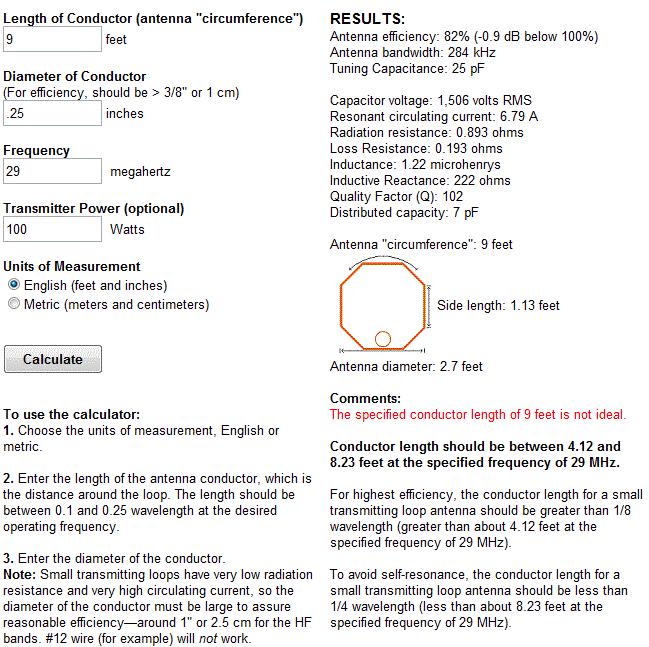
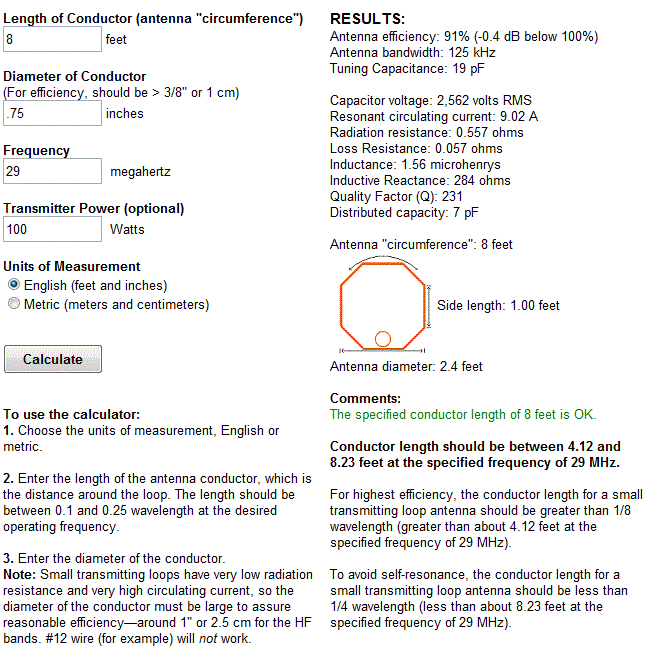
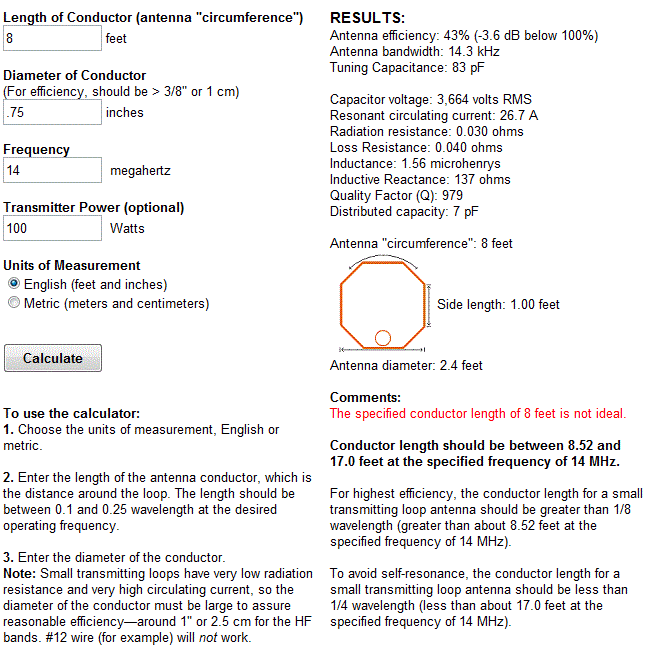
 A peak voltage of 5181V will require a minimum spacing of 1.7 mm (peak voltage / breakdown voltage per mm) between the closest conductors in the capacitor. That would rule out an old air spaced variable capacitor from a vacuum tube radio but you could still use a wide spaced variable capacitor from an antenna matching unit or transmitter. A vacuum variable capacitor would be great (watch the minimum capacitance) or a home-made capacitor would also be fine provided you checked the breakdown voltage of the insulating material.
Owen Morgan, KF5CZO, is a regular contributor to AmateurRadio.com and writes from Texas, USA. Contact him at [email protected].
Oh my!
Listening on 20 Meters, right now, there’s a DX station calling CQ, and all I can say is “Wow!”. He’s way loud and should be at the bottom of a pile up. Why not? Because he’s sending way too fast with no spacing whatsoever. I was finally able to make out the call; but he was getting very few takers. Once he switched over to the memory keyer (which had some spacing in there, which made it legible), I can see that he’s not only getting more takers, but that he has also been spotted on the DX cluster.
You know, if you want to be a speed demon, that’s one thing. But spacing is so important. There’s no point in sending so fast that you send gibberish. Even if there are no actual errors, no one is going to want to work you if they can’t understand you.
So any time advantage that you feel you’re gaining is probably lost by either A) repeats or B) lost opportunities due to no one wanting to work a fist like that.
You know, I’m not not an expert, by any means. But I do know bad Morse when I hear it; and that was bad. A shame really, because it could mean the difference between a lot of contacts and just a few.
72 de Larry W2LJ
QRP – When you care to send the very least!

Larry Makoski, W2LJ, is a regular contributor to AmateurRadio.com and writes from New Jersey, USA. Contact him at [email protected].
ARRL DX CW contest done for 2012
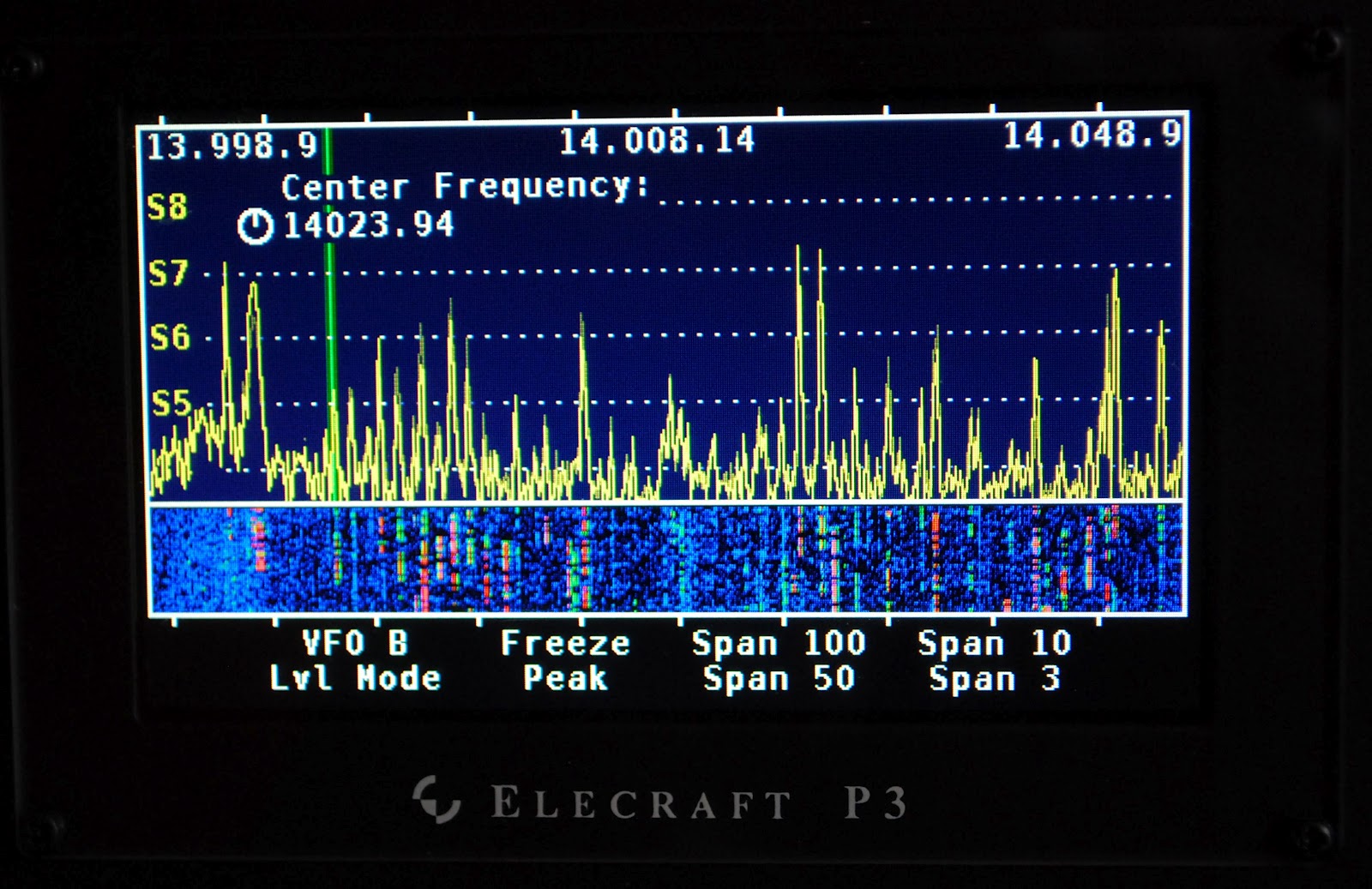 |
| Action on 20m |
- As always I operate the contest QRP at 5 watts but I also I was able at times to drop the power down to 5mW's. My longest miles per watts in this contest was 9339 miles per watt.
- I was able to collect 65 DXCC countries during the contest.
- I made it into Japan and Hawaii with 5 watts I tried lower power setting but it was not working.
- All bands (for me that's 10,15,20 and 40m) were open at one time or another and I had contacts on all these bands.
- This was the one and only downside I found for the whole contest.....at times when I came across rare DX and rightfully so there was a pileup. I found some stations would continue to send their call even over the DX station who was trying to answer a call. It's hard to find a hole to enter your call when (and they were very few) operators keep sending their call no matter what is going on in the pileup.

Mike Weir, VE9KK, is a regular contributor to AmateurRadio.com and writes from New Brunswick, Canada. Contact him at [email protected].
There are various ways to work a DX contest
You can meet up with a whole bunch of buds and combine to form one of those multi-multi teams. Or you can go solo and operate from your shack in a variety of categories. You can even go and BE the DX, like some friends that I know – Bob N4BP and John K4BAI come to mind.
OR, you can take a portable rig, a hunk o’ wire, a battery and a tuner and head out to the great outdoors to enjoy some sunshine and some plain ol’ fashioned fun.
Any ideas who that might be, showing us the way?
Sure enough – Jim W1PID – enjoying the DX Contest from the banks of the Winnipesaukee River.
72 de Larry W2LJ
QRP – When you care to send the very least!

Larry Makoski, W2LJ, is a regular contributor to AmateurRadio.com and writes from New Jersey, USA. Contact him at [email protected].
On the move
Due to the eventual closure of our website business the server on which my website g4ilo.com runs will be unavailable before long. I am now in the process of moving the site to a standard shared hosting account. It is possible that the site and even my blog may become unreachable or seem to be down during the transition. If this happens, don’t worry!
For information, my sites are hosted and g4ilo.com will continue to be hosted by HawkHost which I have found to be an absolutely first class hosting service with support staff who really know what they are doing. If you are looking for high quality hosting for your own website I can wholeheartedly recommend them.

Julian Moss, G4ILO, is a regular contributor to AmateurRadio.com and writes from Cumbria, England. Contact him at [email protected].
 Ham Radio Deluxe |
 W5SWL Electronics |
 Ham Radio Prep |
 KB3IFH QSL Cards  Hip Ham Shirts  HamRadioAuctions HamRadioAuctions Reliance Antennas Reliance Antennas Enigma Shop Enigma Shop |  morseDX  Ni4L Antennas  R&L Electronics R&L Electronics antennas.us antennas.us QRV QRV |
- Matt W1MST, Managing Editor
