 |
 Baofeng UV-5R spotted on Ed Griffin’s website
 8 March 2012 | by
Some exciting news! It looks like the new Baofeng UV-5R has arrived stateside. Browsing Ed Griffin’s Wouxun.us, I’ve found a page indicating that it’s coming soon and the scrolling banner lists the price at $65 shipped (USA). Brick O’Lore has a great post showing some of the exciting new features:
BAOFENG UV-5R 4W
136-174/400-480MhzBAOFENG UV-5R The transcevier is a micro-miniature multiband FM transceiver with extensive receive frequency coverage,providing local-area two-way amateur communications along with unmatched monitoring capability
VHF/ UHF DUAL-BAND TWO WAY RADIO
Frequency Range: 136-174 / 400-480MHz
Dual-Band Display, Dual Freq. Display, Dual-Standby
Output Power: 4 /1Watts
128 Channels
50 CTCSS and 104 CDCSS
Built-in VOX Function
1750Hz Brust Tone
FM Radio (65.0MHz-108.0MHz)
LED Flashlight
Large LCD Display
Hight /Low RF Power Switchable
25KHz/12.5KHz Switchable
Emergency Alert
Low Battery Alert
Battery Saver
Time-out Timer
Keypad Lock
Monitor Channel
Channel Step: 2.5/5/6.25/10/12.5/25KHz
Roger Set
Matt Thomas, W1MST, is the managing editor of AmateurRadio.com. Contact him at [email protected].
World Kidney Day
With all the news about giant solar flares that could black out communications I was surprised to hear activity on 10 metres. I made a few contacts on SSB with my attic dipole, including A65EE in Dubai and TC2012WKD from Turkey: a special event station for World Kidney Day to raise awareness of the importance of kidneys to our health.
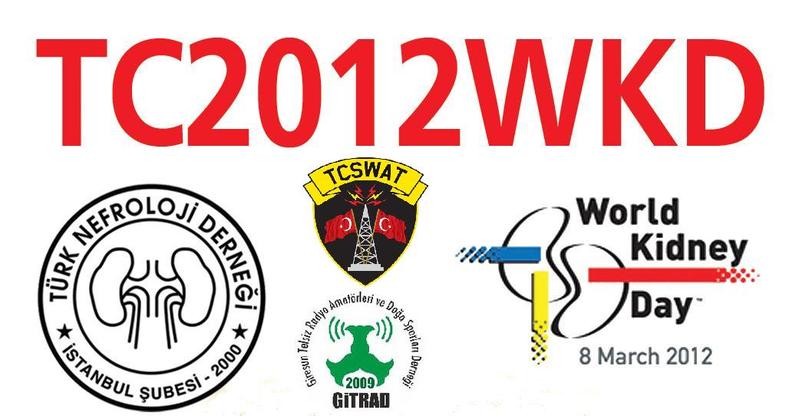
I like to operate on the highest frequencies I can. On the shortest wavelengths small antennas are at the least disadvantage.

Julian Moss, G4ILO, is a regular contributor to AmateurRadio.com and writes from Cumbria, England. Contact him at [email protected].
Ham Nation 38

http://dts.podtrac.com/redirect.mp4/twit.cachefly.net/video/hn/hn0038/hn0038_h264b_864x480_500.mp4
http://dts.podtrac.com/redirect.mp4/twit.cachefly.net/video/hn/hn0038/hn0038_h264b_640x368_256.mp4
http://www.podtrac.com/pts/redirect.mp3/twit.cachefly.net/hn0038.mp3
Hosts: Bob Heil (K9EID), Gordon West (WB6NOA), and George Thomas (W5JDX)
Dayton Hamvention 2012 plans, the history of qrz.com, building a Dremel table saw, and more.
Guests: Michael Kalter (W8CI), Fred Lloyd (AA7BQ), Amanda Alden (K1DDN), and Cheryl Lasek (K9BIK)
Download or subscribe to this show at http://twit.tv/hn.
We invite you to read, add to, and amend our show notes at wiki.twit.tv.
Thanks to Joe Walsh who wrote and plays the Ham Nation theme.
Thanks to Cachefly for the bandwidth for this show.
Dr. Bob Heil, K9EID, is the founder of Heil Sound and host of TWiT.tv's Ham Nation which streams live each Tuesday at 6:00pm PT (9:00pm ET) at http://live.twit.tv. Contact him at [email protected].
Ham Radio Deluxe

You may remember back in September, I blogged about the news of the developer (Simon) of Ham Radio Deluxe selling to several US hams. I followed one of the threads over on the QRZ forums until I basically grew bored of the hate and non-sense being discussed. At that time (Sept. timeframe) no one really knew what was going to happen or when we would learn the fate and future of the HRD software. While many had conjured up ideas of users receiving cease and desist letters, as I stated then (and what has been proven since) I didn’t think anyone had anything to worry about.
As the old year (2011) turned into the new year (2012) news began to surface about the plans for Ham Radio Deluxe. The new owners (Rick Ruhl, W4PC Mike Carper, WA9PIE and Randy Gawtry K0CBH have since released two free updates (version 5.1 and 5.11) and offered users a $59.95 support plan which covers version 5.11 and version 6 at no cost. Ham Radio Deluxe version 6 is scheduled to be available around the Dayton Hamvention timeframe of this year.
I learned about HRD before I even earned my license and was using it with my Yaesu FT-897 as I tuned around the bands listening. Once I got my ticket I used it to log my first HF QSO’s on 10 meters and have used it since. The value of what Ham Radio Deluxe brings to me in the enjoyment of the hobby is certainly more than I can associate a cost to. I’ve looked into alternatives for casual QSO logging, rig control and the digital modes and have found nothing that even comes close to beating HRD in its present form.
After watching the video below, I’m actually excited about the opportunity for HRD version 6 and beyond. Some of the new features discussed will be an integration between N1MM logger and DM780. This to me will be worth the investment to upgrade to version 6. I do love N1MM logger for contest operations, but I rarely use anything other than DM780 for digital modes. When I try to use other applications for PSK or RTTY, I’m like a fish out of water. For that reason I don’t do a lot of true digital contest operations.
If you haven’t already, please take about 52 minutes of your time and watch the video below which is made available by Gary Pearce, KN4AQ and his Amateur Radio Video News (ARVN) service.
I’ve had no contact with any of the three mentioned owners and simply blog about this particular subject because I want to. The opinions expressed are simply my own. I fully understand and appreciate that not everyone will share my thoughts and opinions on this subject.
Until next time…
73 de KDØBIK
Jerry Taylor, KD0BIK, is a regular contributor to AmateurRadio.com and writes from Colorado, USA. He is the host of the Practical Amateur Radio Podcast. Contact him at [email protected].
Handiham World for 07 March 2012
Welcome to Handiham World.

On March 5, 2012 the latest version of the United States Amateur Radio Bands chart from ARRL became effective. If you will recall, last November the FCC made some changes to the 60 meter band, and this new chart brings us up to date. Of course that will mean that you will want the latest version on your computer or in your ham shack for reference. Prior to this week, only upper sideband operation was allowed on the channelized 60 meter band. Few of us had actually made the move to 60 meters and made contacts, partly because of the odd restrictions in frequencies and modes, but also because many antenna systems just didn’t tune on 60 meters. Even so, those who were adventuresome took the plunge and were delighted to find that propagation on 60 meters made it quite a useful alternative to 75 and 40 meters since it has characteristics of both of those popular bands. This morning I was surprised to be listening on 5.330.5 MHz and hear a station in the southeastern United States calling CQ using CW at around 30 words per minute. He called off and on for perhaps 15 minutes, obviously using a programmed keyer before he was finally answered by a station somewhere on the East Coast. I have to admit that 30 words per minute is too fast for me to copy comfortably, so I had to listen up to make sure I was hearing correctly. After all, only upper sideband operation was allowed on the 60 m band. When I was sure I was copying the call sign correctly, I decided to check the frequency chart on my wall just to confirm that only upper sideband operation was allowed. The chart confirmed this, but then I recalled the changes that the FCC had made and decided to check the ARRL website for a new frequency chart. Sure enough, a new version was available and had been released just two days ago!
The difference is pretty significant, because the effective radiated power, the modes of operation, and even one of the channelized frequencies have been changed. Let’s go over the “new” 60 meter band as shown in the ARRL Frequency Chart. Here is the new information for our blind members in an easy to listen format:
The 60 meter band is also known as the 5.3 MHz band. Only General, Advanced, and Extra Class licensees may use 60 meters. All of these license classes have full band privileges.
The five channels available on a secondary basis with a maximum effective radiated power of 100 W PEP relative to a half wave dipole are:
5.330.5 MHz
5.346.5 MHz
5.357.0 MHz
5.371.5 MHz
5.403.5 MHz
Some readers and listeners may find it odd that we have listed two decimal points in each frequency. I decided to do it that way because this preserves the concept of the “5.3 MHz band”. The ARRL chart lists kilohertz, so that the frequency would read 5330.5 kHz, for example. On my ICOM IC-7200 transceiver the readout follows our listing in megahertz and has two decimal points.
Only USB suppressed carrier voice, CW, RTTY, and data such as Packtor 3 transmissions are allowed on the 60 m band.
There is a bandwidth restriction on 60 m. Bandwidth is limited to 2.8 kHz centered on 5.332, 5.348, 5.358.5, 5373, and 5.405 MHz respectively. (For example, you will be on the right frequency if you use upper sideband and tune to 5.330.5 MHz, which is the carrier frequency.)
All things considered, the 60 m band has been improved by these changes. It is still quite unique in its channelized nature, but the addition of new modes of operation do increase its versatility and will make it more attractive to a wider variety of users. Although there is no restriction on which mode of operation may or should be used on which channel, I did hear the CW station on 5.330.5 MHz, perhaps because that is the traditional lowest frequency spot on the band where CW operators might decide to congregate. Perhaps at some time in the future there will be at least an informal band plan beyond the more or less agreed upon use of 5.403.5 MHz as a DX frequency. The increase in power from 50 W to 100 W makes the band more useful still, especially during summertime band conditions when more power is likely to be needed to be heard above thunderstorm static.
I hope you will consider giving the 60 m band a test drive if you have a General Class license or above and an antenna that can be tuned to 5.3 MHz. I think you will be surprised and delighted with the propagation characteristics on 60, and will likely add it to your regular list of useful frequency bands.
For Handiham World, I’m…
Patrick Tice, [email protected]
Handiham Manager

Pat Tice, WA0TDA, is the manager of HANDI-HAM and a regular contributor to AmateurRadio.com. Contact him at [email protected].
Solar news
Under the title “Earth braces for biggest space storm in five years” ABC Australia’s online news reports on the last 24 hours of solar activity.
A NOAA space scientist is quoted “Space weather has gotten very interesting over the past 24 hours”.
Further detail as usual from http://www.spaceweather.com and http://www.swpc.noaa.gov/today.html.
UPDATE: 24 hours later – “Space storm fizzle“!
Stephen Rapley, VK2RH, is a regular contributor to AmateurRadio.com and writes from New South Wales, Australia. Contact him at [email protected].
ARES Center Stage at 2012 MNVOAD Training Conference
 I’m off and running with the online ARRL course on Emergency Communications! Already I’m learning new things. Take VOAD’s, for instance — I’d never heard of them in my life, but now, thanks to this course, I’m signed up to attend the 2012 MNVOAD Training Conference.
What is a VOAD? VOAD stands for “Voluntary Organizations Active in Disaster.” The first VOAD (and still the main VOAD) was NVOAD (National VOAD), born in 1970:
Hurricane Camille led to the formation of NVOAD. After Hurricane Camille, it became clear that voluntary agencies were responding to the needs of disaster victims in a fragmented, uncoordinated manner. Representatives from several voluntary agencies began to meet on a regular basis to share their respective activities, concerns, and frustrations in disaster response. On July 15, 1970, representatives from seven voluntary agencies came together in Washington, D.C. to form NVOAD. (FEMA course IS-288, “The Role of Voluntary Agencies in Emergency Management,” 2-11)
Those first seven agencies were the American Red Cross, Christian Reformed World Relief Committee, Mennonite Disaster Service, National Catholic Disaster Relief Committee, Seventh Day Adventists, Society of St. Vincent De Paul and Southern Baptist Disaster Relief. Now there are nearly 50 agencies involved, including the ARRL:
The mission of NVOAD is to foster more effective service to people affected by disasters. NVOAD, itself, does not deliver disaster response and recovery services. NVOAD coordinates planning efforts by many voluntary organizations responding to disaster. Member organizations provide more effective service and less duplication by getting together before disasters strike. Once disasters occur, NVOAD or an affiliated state VOAD encourages members and other voluntary agencies to convene on site. This cooperative effort has proven to be the most effective way for a wide variety of volunteers and organizations to work together in a crisis. (4-9)
The state VOAD movement began five years after NVOAD was born:
Not long after the development of NVOAD, State and regional VOAD organizations were created to ensure an effective response to disasters at the State and local levels. The first State VOAD was formed in 1975. The VOAD movement initially grew without much order and without official sanction or direction from NVOAD. However, in 1988 NVOAD developed formal procedures for chartering State and local VOAD members. At this time, there are chartered State VOAD organizations in almost all the U.S. states and territories, and there are a growing number of local VOADs. (4-13)
The Minnesota VOAD has 37 member organizations, including the ARRL — and this year, RACES/ARES is taking center stage at the 2012 MNVOAD Training Conference on Saturday, March 24. The keynote speaker is Peter Angelos, KCØKRI:
9:00-10:00 Keystone Session – Pagami Creek Fire Response – Peter Angelos
The Lake County Emergency Management response to the Pagami Creek Fire (September 2011) and the role Lake County RACES/ARES played is a good example to illustrate effective and successful use of affiliated volunteer organizations in incident management. This presentation will outline a brief description of the incident, the specific support that RACES/ARES provided for logistical and situational communication, and most importantly–the organizational practices and principles that lead to success.
I’m looking forward to hearing what Mr. Angelos has to say about how RACES/ARES helped fight the Pagami Creek Fire.
But perhaps even more valuable for me will be the rest of the training day, which has nothing to do with Amateur Radio. After all, the whole point of VOAD is to learn how to work with one another efficiently and effectively when the time comes!


Todd Mitchell, NØIP, is a regular contributor to AmateurRadio.com and writes from Minnesota, USA. He can be contacted at [email protected].
 Ham Radio Deluxe |
 W5SWL Electronics |
 Ham Radio Prep |
 KB3IFH QSL Cards  Hip Ham Shirts  HamRadioAuctions HamRadioAuctions Reliance Antennas Reliance Antennas Enigma Shop Enigma Shop |  morseDX  Ni4L Antennas  R&L Electronics R&L Electronics antennas.us antennas.us QRV QRV |
- Matt W1MST, Managing Editor
