 |
 Solar news
 7 March 2012 | by
 Under the title “Earth braces for biggest space storm in five years” ABC Australia’s online news reports on the last 24 hours of solar activity.
A NOAA space scientist is quoted “Space weather has gotten very interesting over the past 24 hours”.
Further detail as usual from http://www.spaceweather.com and http://www.swpc.noaa.gov/today.html.
UPDATE: 24 hours later – “Space storm fizzle“!
Stephen Rapley, VK2RH, is a regular contributor to AmateurRadio.com and writes from New South Wales, Australia. Contact him at [email protected].
ARES Center Stage at 2012 MNVOAD Training Conference
 I’m off and running with the online ARRL course on Emergency Communications! Already I’m learning new things. Take VOAD’s, for instance — I’d never heard of them in my life, but now, thanks to this course, I’m signed up to attend the 2012 MNVOAD Training Conference.
What is a VOAD? VOAD stands for “Voluntary Organizations Active in Disaster.” The first VOAD (and still the main VOAD) was NVOAD (National VOAD), born in 1970:
Hurricane Camille led to the formation of NVOAD. After Hurricane Camille, it became clear that voluntary agencies were responding to the needs of disaster victims in a fragmented, uncoordinated manner. Representatives from several voluntary agencies began to meet on a regular basis to share their respective activities, concerns, and frustrations in disaster response. On July 15, 1970, representatives from seven voluntary agencies came together in Washington, D.C. to form NVOAD. (FEMA course IS-288, “The Role of Voluntary Agencies in Emergency Management,” 2-11)
Those first seven agencies were the American Red Cross, Christian Reformed World Relief Committee, Mennonite Disaster Service, National Catholic Disaster Relief Committee, Seventh Day Adventists, Society of St. Vincent De Paul and Southern Baptist Disaster Relief. Now there are nearly 50 agencies involved, including the ARRL:
The mission of NVOAD is to foster more effective service to people affected by disasters. NVOAD, itself, does not deliver disaster response and recovery services. NVOAD coordinates planning efforts by many voluntary organizations responding to disaster. Member organizations provide more effective service and less duplication by getting together before disasters strike. Once disasters occur, NVOAD or an affiliated state VOAD encourages members and other voluntary agencies to convene on site. This cooperative effort has proven to be the most effective way for a wide variety of volunteers and organizations to work together in a crisis. (4-9)
The state VOAD movement began five years after NVOAD was born:
Not long after the development of NVOAD, State and regional VOAD organizations were created to ensure an effective response to disasters at the State and local levels. The first State VOAD was formed in 1975. The VOAD movement initially grew without much order and without official sanction or direction from NVOAD. However, in 1988 NVOAD developed formal procedures for chartering State and local VOAD members. At this time, there are chartered State VOAD organizations in almost all the U.S. states and territories, and there are a growing number of local VOADs. (4-13)
The Minnesota VOAD has 37 member organizations, including the ARRL — and this year, RACES/ARES is taking center stage at the 2012 MNVOAD Training Conference on Saturday, March 24. The keynote speaker is Peter Angelos, KCØKRI:
9:00-10:00 Keystone Session – Pagami Creek Fire Response – Peter Angelos
The Lake County Emergency Management response to the Pagami Creek Fire (September 2011) and the role Lake County RACES/ARES played is a good example to illustrate effective and successful use of affiliated volunteer organizations in incident management. This presentation will outline a brief description of the incident, the specific support that RACES/ARES provided for logistical and situational communication, and most importantly–the organizational practices and principles that lead to success.
I’m looking forward to hearing what Mr. Angelos has to say about how RACES/ARES helped fight the Pagami Creek Fire.
But perhaps even more valuable for me will be the rest of the training day, which has nothing to do with Amateur Radio. After all, the whole point of VOAD is to learn how to work with one another efficiently and effectively when the time comes!


Todd Mitchell, NØIP, is a regular contributor to AmateurRadio.com and writes from Minnesota, USA. He can be contacted at [email protected].
Show Notes #077
Introduction:
- We’re recording live, with music played as we record. Our guest tonight is Harrison, VE2HKW, from the MintCast podcast.
Announcements:
- The Dalton Hamfest will be in Dalton, Georgia on February 25, 2012. The LHS Ambassador is Ronny, K4RJJ. This has probably come and gone by the time you hear this.
- The KARC Hamfest will be held in Marietta, Georgia, March 17, 2012. Our LHS Ambassador is again Ronny, K4RJJ. Thanks, Ronny!
- The Northeast Linux Fest will be in Worcester, Massachusetts on March 17, 2012. We’re still looking for an LHS ambassador for this event. Contact us at [email protected] if you’d like to help.
- Some of you may have noticed that the LHS web site has been down occasionally. For some reason, the server locks up. We can’t tell if it’s a denial of service attack, or an improper configuration, but we’re working on it.
- Paul, KE5WMA, in the chat room, reminds us of the Acadiana Hamfest on March 9, 2012, near Lafayette, LA., and the New Orleans Hamfest on March 24, 2012.
- Happy Mardi Gras!
Topics:
- Linux Utilities – Russ introduces us to some GNU/Linux utilities that provide information about your Linux system’s performance.
- top shows a list of the processes running in descending order of resource consumption.
- iftop allows you to monitor connections to your machine and the bandwidth used by each.
- ifstat reports the amount of data passing through the interfaces every second, or other interval. For example, ifstat -i eth0 10 1 would report how much data moved through the first ethernet port in 10 seconds, and only do this once. Handy for capturing such information in a script program.
- iotop shows what processes are the top disk I/O users.
- All of these are command line utilities. Press Q to exit. Check the man pages for other keystrokes that can be used while the utilities run.
- Interview with Harrison, VE2HKW
- Harrison, VE2HKW, is a recent ham radio licensee and describes his introduction to the hobby, what he likes and doesn’t like, and provides an overview of the Canadian amateur radio licensing structure.
- Harrison is also a member of the Covey Hill Amateur Radio Club (CHARC).
- Check out Harrison’s blog and pictures of his ham shack.
- Tune in to the MintCast podcast on Monday nights, 8:00pm eastern time, 01:00 UTC. Join the chat at irc.spotchat.org, #mintcast
- You can contact Harrison by email at [email protected] or [email protected].
Feedback:
- We received donations from Steve S., Paul G., and Bill H. Thank you! These donations will be added to the Dayton Hamvention fund to cover the costs of LHS’ presence at the 2012 Dayton Hamvention in Dayton, OH, May 18-20, 2012.
- LHS had several mentions on Twitter by Neptune78.
- Serge, ON4AA, asks about using the LHS logo to publicize the show. Russ explains that the LHS logo is not Creative Commons licensed, so please ask for permission to use it.
- Larry Bushey of the Going Linux podcast responds to recent comments we made about their show. It’s a love fest!
- Leif, KC8RWR, continues an ongoing comment dialog.
Contact Info:
- Contact Richard at [email protected], Russ at [email protected], or both at the same time at [email protected].
- Listen to the live stream every other Tuesday at 8:00pm Central time. Check the LHS web site for dates.
- Leave us a voice mail at 1-909-LHS-SHOW (1-909-547-7469), or record an introduction to the podcast.
- Sign up for the LHS mailing list.
- Sign up for the MAGNetcon mailing list.
- LHS merchandise is available at the Merch link on Web site. Check out the Badgerwear or buy one of the other LHS-branded items at PrintFection.com/lhs or Cafe Press. Thanks!
- Thanks to Dave from Gamma Leonis for the theme music.
Music:
- “Rainbow Over The Bayou” by Regis V. Gronoff, from the album Hummingbird & Honeybee, courtesy of Jamendo
- “Twist and Shout” by Swamp Daddy, from the album Swamp Daddy, also courtesy of Jamendo.
Russ Woodman, K5TUX, co-hosts the Linux in the Ham Shack podcast which is available for download in both MP3 and OGG audio format. Contact him at [email protected].
Why is my Anytone AT-5555 screaming at me?
This evening as I was driving home, I noticed a loud station on 28.475 running a pileup of mostly Spanish stations. Although my Spanish is sadly very poor, it is good enough for me to realise it was PP5BS. I haven’t worked Brazil yet from the mobile, so I wanted to have a go.
I pressed to transmit and there was a loud whistle. Initially I thought it was feedback or that I was in PA mode, but no. Pressed again and it was fine. Intrigued now, I moved off frequency and kept going over to transmit to see if it would do it again. Once every few it would, but I couldn’t fathom out why.
When I got close to home, I stopped to try and find out more. Associated with the ‘scream’ I could now see that the display said something that looked like ‘5 H 1’.
Great! Back home now, let’s see if I can find a list of Anytone AT-5555 status codes on the web. Um, not really. Back to the manual. Then I found that in the menus there is SWR protection. If turned on, it threatens to give a voice alert and switch off the transmitter. Of course, I had switched off voice alerts, so it was giving me a warning tone. And the display? Really, it was showing S HI which probably translates to SWR HI!
Now it makes some sense. When I mounted the transceiver, the PL259 for the antenna lead seemed a bit close to the floor, but I didn’t worry. I think the car was bumping on bits of road and a poor connection occurring.
I’ve now sorted that out, so I’m hopeful my rig will stop screaming at me!

Tim Kirby, G4VXE, is a regular contributor to AmateurRadio.com and writes from Oxfordshire, England. Contact him at [email protected].
EICO Model 625 Tube Tester
I attended the Greater Houston Hamfest and as I walked past the tables of equipment I wondered if interest in vacuum tube equipment was starting to wane. Compared to the last few years the prices of collector quality gear had held steady but parts and restorable gear seemed to be going for less. I’d like to know your thoughts if you’ve noticed trends one way or the other.
I was happy to pick up a EICO Model 625 tube tester for $15. It is in good condition and appears to work well. The roll of settings for each tube is in good condition and a little searching on the internet supplied settings for older tubes like the number 78 in the picture below.
 |
| EICO Model 625 Tube Tester with a number 78 tube |
The EICO 625 is not a top of the line tester but it does basic tests and will let you know if a tube is functioning and an idea of the life left in it. It was sold in kit form for $34.95 in 1958 which is roughly equivalent to $274 in 2012.
 |
| Inside the EICO 625 from diyaudioprojects.com |
The EICO 625 is fairly unique in having its own 6H6 diode tube to rectify the 30V filament voltage. It provides DC for the neon short-indicator bulb. If the tube is suspected of having a short then there is a fairly comprehensive series of tests than can be administered to isolate shorted elements.
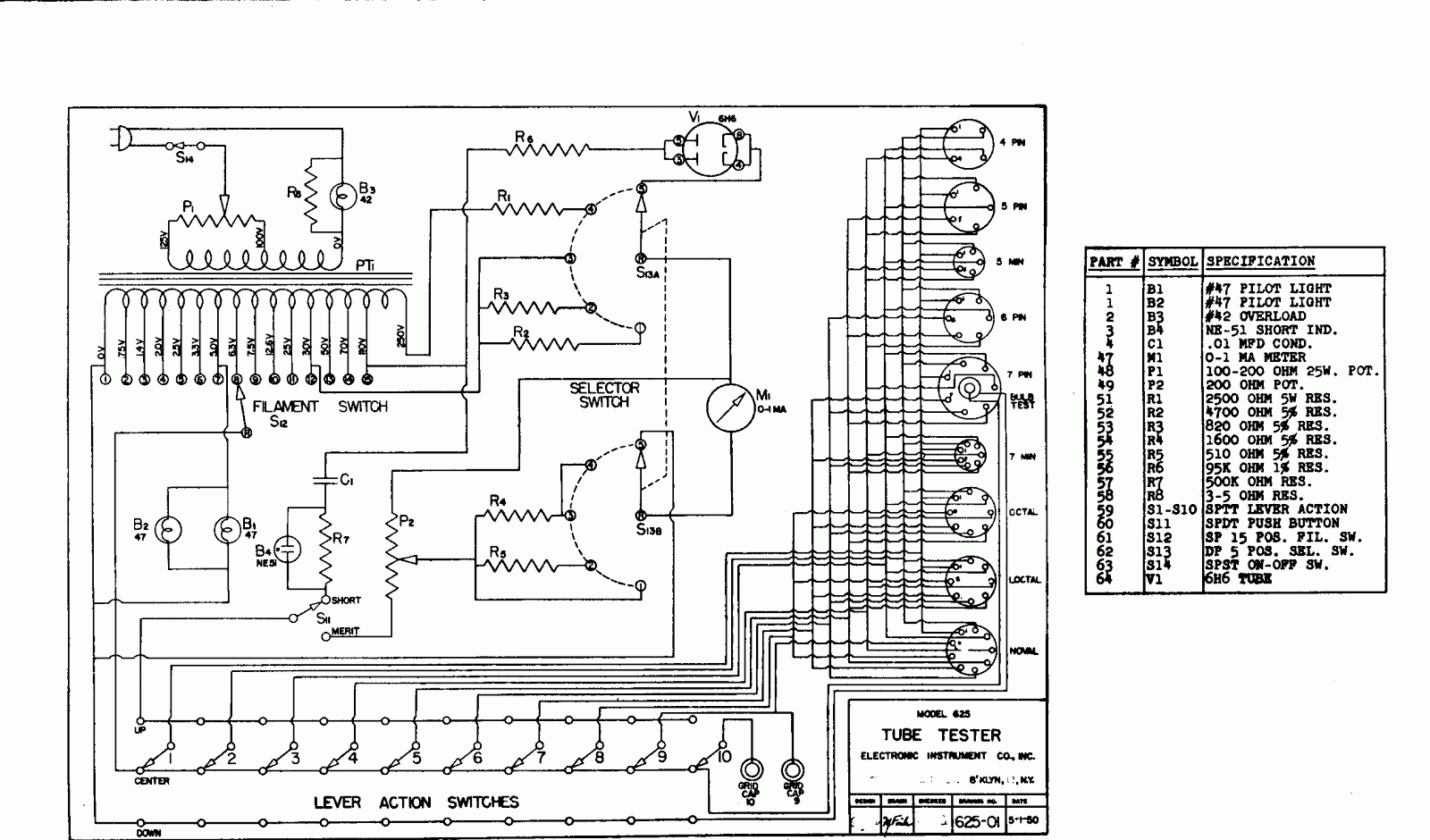 |
| EICO Model 625 circuit diagram |
Here is the complete TUBE TEST DATA 1/1/78 for the EICO Model 625 Tube Tester
Excellent information on servicing and calibrating your Classic emission tube tester.
Owen Morgan, KF5CZO, is a regular contributor to AmateurRadio.com and writes from Texas, USA. Contact him at [email protected].
W1GHZ 903-MHz TX Gain Compression
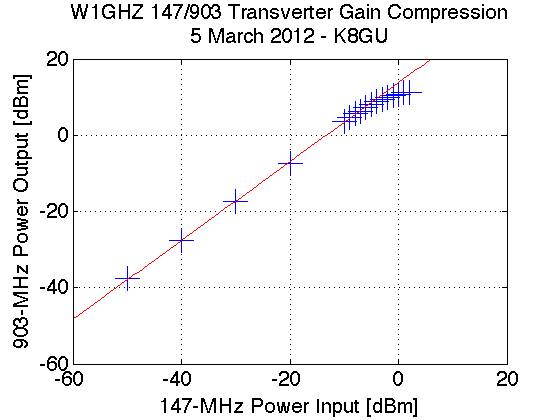
I managed to sneak into the lab again at lunch today for a few minutes and hooked up the now-packaged W1GHZ 903-MHz transverter to do a transmit gain compression test. This test is a quick and dirty way to find the linear operating region of the transverter in addition to the expected conversion gain on transmit. These two parameters determine the IF transmit level and what kind of power amplifier or driver stage will follow. It’s an easy test to run if you have the equipment. I locked the transverter in transmit by applying 8 volts to the TX MMICs and used a Rodhe and Schwarz SMR40 signal generator as the IF transmitter at 147.100 MHz. On the transverter TX output, I simply connected the HP 8565E spectrum analyzer that I’ve used in the past. Spectrum analyzers are not great power meters, but they give you a good enough idea of what’s going on. The 1-dB gain compression point (that is, the point where the actual device gain sags 1 dB from the linear gain) is at an input of -3 dBm or an output of just under 10 dBm. This compares favorably with the datasheet for the mixer and discussion with N3UM.
Ethan Miller, K8GU, is a regular contributor to AmateurRadio.com and writes from Maryland, USA. Contact him at [email protected].
LHS Episode #077: North of the Border
 Today Linux in the Ham Shack is graced with the appearance of an additional co-host: Harrison, VE2HKW, an amateur radio operator from Canada and sometimes host of the Mintcast, a podcast for Linux users from members of the Linux Mint community.
In the first segment, our hosts discuss three very useful Linux utilities for analyzing system performance on your desktop or server: iftop, ifstat and iotop. Get in-depth knowledge of how to use these tools in order to make your machine run better with fewer bottlenecks. And since Harrison is from a whole other country, it was decided he should tell all of us about amateur radio from a Canadian perspective, including licensing, regulations and operating practices.
Hamvention 2012 is coming up very soon. Please donate to the fund if you can. We hope to see everyone there!
73 de The LHS Guys (and Harrison, too)
Russ Woodman, K5TUX, co-hosts the Linux in the Ham Shack podcast which is available for download in both MP3 and OGG audio format. Contact him at [email protected].
 Ham Radio Deluxe |
 W5SWL Electronics |
 Ham Radio Prep |
 KB3IFH QSL Cards  Hip Ham Shirts  HamRadioAuctions HamRadioAuctions Reliance Antennas Reliance Antennas Enigma Shop Enigma Shop |  morseDX  Ni4L Antennas  R&L Electronics R&L Electronics antennas.us antennas.us QRV QRV |
- Matt W1MST, Managing Editor
