 |
 Gremlins
 28 March 2012 | by
 This year I have decided to focus on the high frequency bands – 10m and 6m – this spring and summer. The predictions for the peak of this solar cycle are not very good, as you can read in several blogs, but it’s all we’re going to get for the next 10 years so I may as well make the best of it.
To this end I have started WSPRing on 10m when I switch on in the morning, with the intention of moving up to 6m if there appears to be a chance of propagation. On the previous few days I have been rewarded with a two-way path to VK on 10m at quite decent signal strengths. Not bad for 5 watts to an attic dipole. But today I received not a single spot, not a single trace.
Although not the reason for the lack of spots today, I think there is a gremlin in the machine. Twice I have come up to the shack to see what is happening and found the K3 in transmit mode but with no RF output. The K3 monitor mode shows no audio is being sent to the radio, so it isn’t a radio problem. The WSPR software settings haven’t changed, and are correct. Restarting the program makes no difference. The only solution is that hoary old first resort of the computer technician: Switch it off and then switch it on again. Works every time. But I wish I knew why it is doing it.

Julian Moss, G4ILO, is a regular contributor to AmateurRadio.com and writes from Cumbria, England. Contact him at [email protected].
LHS Episode #079: Absolutely FABulous
 Welcome everyone to a very special episode of Linux in the Ham Shack. This week we had the immense pleasure of talking with Fabian “Fab” Scherschel of the Linux Outlaws podcast fame. We tried not to let our man crushes get in the way of the podcast and I think we succeeded for the most part. Fab is a very gracious guest and we had a fantastic time recording the show. When my (K5TUX) Audacity crashed, it was also Fab who came to the rescue and resurrected the show with his backup audio recording. So for lots of reasons, we are indebted to him. We do have to warn you though, our discussion ranges from Debian to software patent issues to pollution in northern New Jersey. It’s a fun journey, but it’s not exactly via the shortest path. Thanks again, Fab. It was a blast.
73 de The LHS Guys
Russ Woodman, K5TUX, co-hosts the Linux in the Ham Shack podcast which is available for download in both MP3 and OGG audio format. Contact him at [email protected].
And the winner of the Baofeng UV-5R is…
Well, it’s been a week and that means our March giveaway has come to an end. The good news: we get to announce a winner!
Matt Thomas, W1MST, is the managing editor of AmateurRadio.com. Contact him at [email protected].
Now I understand – Measuring capacitance with a micro-controller
The excellent article by Rajendra Bhatt explains not only how capacitance can be measured but also how a micro-controller can be interfaced to an analog circuit to create a useful piece of test equipment.
 |
| Capacitance meter by Rajendra Bhatt |
I found the explanation of the RC time constant method of measurement as interesting as the micro-processor project itself and congratulate Raj on demonstrating a practical and workable real-life example of what can normally be a dry textbook subject.
Owen Morgan, KF5CZO, is a regular contributor to AmateurRadio.com and writes from Texas, USA. Contact him at [email protected].
Great idea!
I try very hard not to needlessly duplicate the offerings of my fellow bloggers. However, I caught Chris KQ2RP’s post and felt that it needed amplification (pun intended).
Rex Harper W1REX, member of the QRP Hall of Fame and primary owner/operator of QRPme has come up with a great idea – the “QRP Kit of the Month Club”.
This is such a cool idea! Personally, I think it’s one of the best unexpected gifts a QRPer could find himself being on the receiving end of. Wow – bad sentence, but you know what I mean. 🙂
I’d much rather receive a QRP kit every month rather than a piece of fruit, or a cheese ball, or a beef log, or a jar of jam or jelly. You can opt into different subscription plans; but for the full boat of 12 months, it works out to 12 kits at $15 a clip – not bad at all. I know that sounds like a lot, but it really isn’t when you think of how it breaks down.
Kudos to Rex for coming up with an innovative idea! It will be interesting to see if any QRPers are gifted this way. I may have to start leaving some obvious hints myself, starting this coming October and November.
72 de Larry W2LJ
QRP – When you care to send the very least.

Larry Makoski, W2LJ, is a regular contributor to AmateurRadio.com and writes from New Jersey, USA. Contact him at [email protected].
CQ WPX SSB 2012
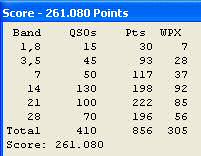
Like always this is my last contest before the summer and before I dismantle the horizontal loop antenna. Unfortenately I was a little exhausted from work last couple of weeks. No time for radio except once and a while with my little Baofeng HT on the bike. Besides that family life is getting more and more important as our little QRP Anneli is growing up fast, that means less time for the radio hobby. Anyway I had a difficult start at Saturday having no patience to work real DX, I was so tired I stopped at about 150 QSOs. Sunday was a lot better after a reasonable night sleep, although I didn’t have time till the afternoon I made 410 QSOs in the end with 80 DXCC in total on the list. Working a new DXCC (number 200) was my goal and at the end I managed that. I worked Z21BB (Zimbabwe) and TO7BC (Mayotte Isl.) both on 10m as “new” all band DXCCs. As the propagation was really good I concentrated my efforts on the high bands. I left 40, 80 and 160m for Sunday evening as I didn’t expect to hear many “new” DXCC for me at those bands. One thing did surprise me and that was a QSO with Japan on 20m Saturday evening I heard several VK stations as well on that time, very unusual and I guess it was all longpath propagation. I think I missed a lot of stations as well since I coudn’t be on the radio early in the morning, but as always I had a lot of fun in this DX contest.
You can find a log analysis here…
Some highlights:
10m: JA0JHA (Japan), B7P (China), V55V (Namibia), TR8CA (Gabon), PZ5P (Surinam), Z21BB (Zimbabwe), TO7BC (Mayotte), YB8Y(Indonesia),
15m: VP52V (Turks & Caicos Isl.), JT5DX (Mongolia), TO5K (Martinique), KP2TM (US Virgin Isl.), WH7M (Hawaii)
20m: JE1ZWT (Japan), 9Y4W (Trinidad & Tobago)
80m: UP2L (Kazakhstan)
Bas, PE4BAS, is a regular contributor to AmateurRadio.com and writes from Groningen, Netherlands. Contact him at [email protected].
No contest
At the weekend I noticed that the CQ WW WPX phone contest was on. I’m not a fan of phone contests – hollering your call into a mic over and over again is not my idea of fun – but I thought it might be interesting to see what I could hear or work on 10m when so many stations were on.
In the end I only made a handful of contacts. It was just too manic for my current state of mind. I couldn’t remember the serial numbers I was given before typing them into the log, so I would have to wait for the station I worked to make another contact and see what the next serial number was. I much prefer CW contests using a code reader to print up the exchange so that I can just double-click the information to enter it error-free in the log.
I’ve just started my final cycle of chemotherapy and it has knocked me back a bit. So I think I’ll stick to pastimes like WSPR and JT65 that have a more relaxed pace until I’m feeling better.

Julian Moss, G4ILO, is a regular contributor to AmateurRadio.com and writes from Cumbria, England. Contact him at [email protected].
 Ham Radio Deluxe |
 W5SWL Electronics |
 Ham Radio Prep |
 KB3IFH QSL Cards  Hip Ham Shirts  HamRadioAuctions HamRadioAuctions Reliance Antennas Reliance Antennas Enigma Shop Enigma Shop |  morseDX  Ni4L Antennas  R&L Electronics R&L Electronics antennas.us antennas.us QRV QRV |
- Matt W1MST, Managing Editor
