 |
 A Dark and Stormy Night
 23 April 2012 | by
 Brought to you by Don Keith N4KC, fellow blogger and Ham Radio wordsmith extraordinaire.
http://www.eham.net/articles/27962
Oh, to have the writing talent of Don N4KC or Jeff KE9V or Woody K3NG, fine writers one and all.
I hope you enjoy the story, I did!
72 de Larry W2LJ
QRP – When you care to send the very least!

Larry Makoski, W2LJ, is a regular contributor to AmateurRadio.com and writes from New Jersey, USA. Contact him at [email protected].
Foundation for Life?
But should that be the end of their radio adventure? I am wondering if there should be a nominal time limit that encourages the foundation licence holder to progress to the next level or the licence is rescinded. Does this sound harsh? Well, there are plenty of analogies - think of your teenager's moped licence.
Should you be able to remain aspirationally dormant at this level for life? Perhaps if you are visually impaired, for example, or face other similar restrictions, then this should be an absolute entitlement.
But has the proliferation of long term M3's and latterly M6's downgraded the quality of the hobby to some extent? For example, take two metres, with fewer of the 'older gentlemen of the air' as I like to call them, taking an active part in daily communications, has the lead example of how to behave been lost? I would say to an extent, yes. More senior operators still monitor two metres and will bemoan inwardly the way that newer operators seem to be making up their own rules of how to behave on the air without any mentoring or peer influence. Yes, I know there are examples of senior operators behaving appallingly, but I really would not want any young aspiring radio amateur to listen to some of the inane, irrelevant and wholly inappropriate conversations floating around the bands in my area - and we're in a comparative Narnia here in north Wales.
I admit to feeling my heart sink when I heard about a five year old girl passing the Foundation Exam recently. This is not an example of how clever the girl is, is it? Likewise the blood drained when I heard of the Belgians giving their novices fifty, yes fifty Watts to play with. Unless I've been reading this incorrectly, the RSGB have been reporting all this as 'good' news.
So where do we set the balance? Where is the incentive to learn, progress and perfect?
Suggestion: Foundation for five years, Intermediate for ten, Advanced for life. Too severe, or the only way to keep any credibility and dignity in the hobby?
Comments please.

Rob Law, MW0DNK, is a regular contributor to AmateurRadio.com and writes from Anglesey, Wales. Contact him at [email protected].
Sandpiper 23cm 19 Element Yagi
It didn't help that the elements were supplied in the wrong sequence with a couple of 'wild card' elements from another antenna design altogether. Marc, the manufacturer, was extremely apologetic and helpful in sending me the antenna measurements straight away by email. However, it meant the additional purchase of a metal rule and measuring callipers from our local excellent ironmonger to get cracking.
After what seemed an afternoon of measuring and re-measuring, the beam started to take form. This involved discarding one element and chopping down another to size. In the initial construction the reflector ended up as the first director. What was supposed as a reflector must have come from a 70cm design. No wonder the thing worked better sideways.
But now, all is well. Coupled with my 1W Alinco DJ-G7 I worked Stoke on Trent (2E0DDD) simplex from a local Anglesey hilltop thanks to a slight tropospheric enhancement. It seems to offer the best combination of gain and beam width. This means your calls will be heard reasonably widely with enough gain (17.1dBi). You won't be losing out too much due to de-pointing either. Its size also means that it can be supported by a modest pole/guys or tripod without offering too much windage.
I think it's possibly the most optimal solution for hilltop and portable operating.
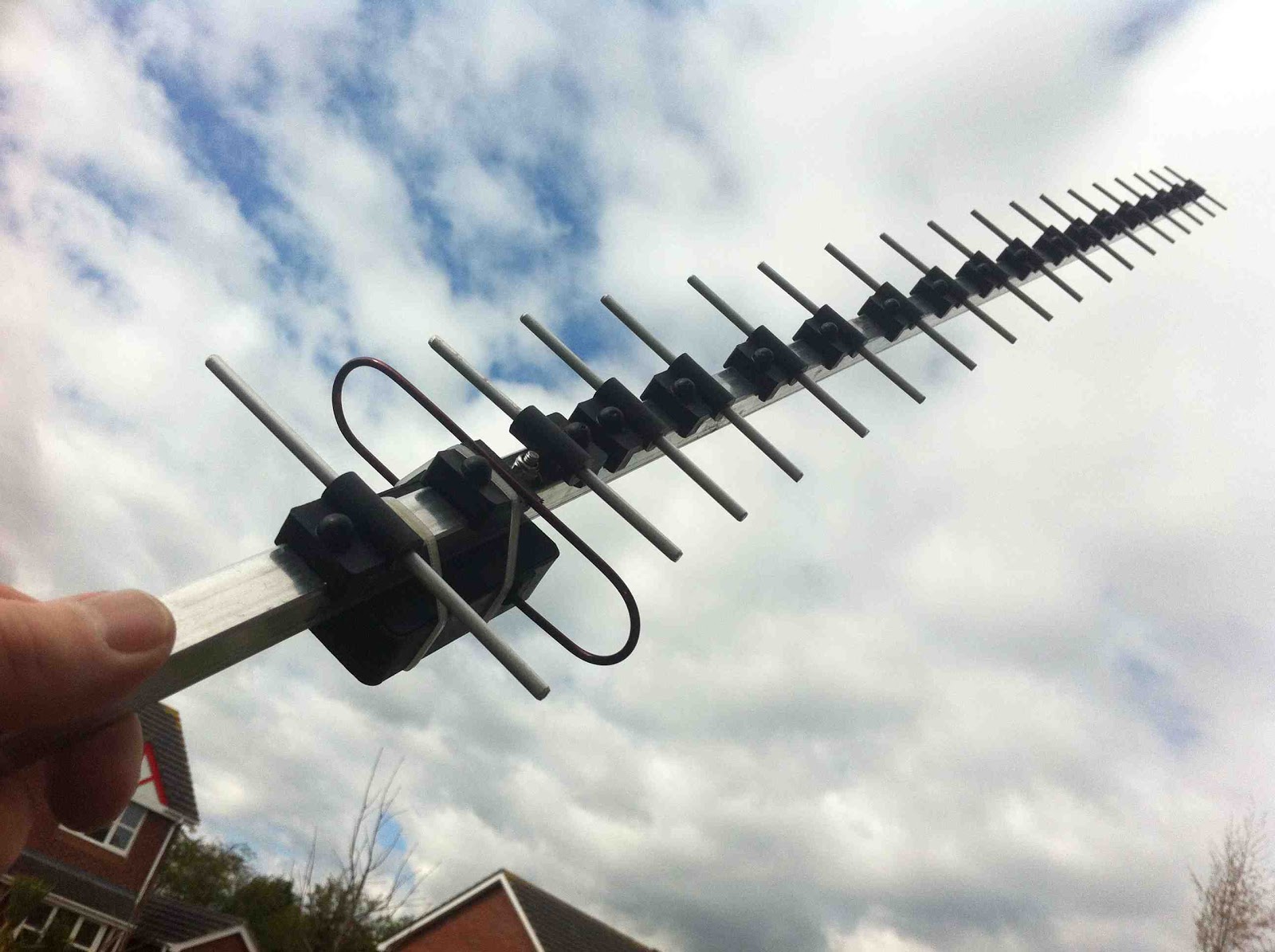 |
| The completed 19 element 23cm Sandpiper yagi |

Rob Law, MW0DNK, is a regular contributor to AmateurRadio.com and writes from Anglesey, Wales. Contact him at [email protected].
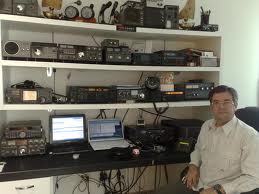
Great Propagation forecast but that’s it…..

Mike Weir, VE9KK, is a regular contributor to AmateurRadio.com and writes from New Brunswick, Canada. Contact him at [email protected].
Additional Q Signals Needed for Repeater Use
In today’s amateur world, VHF/UHF repeater communications are commonplace but the use of Q signals in repeater communications is sadly diminished.
The use of “Q” signals is an amateur radio practice that goes back as early as 1915. When Morse code was the exclusive means of communicating, Q signals were a handy way of shortening common sentences into three letter groups.
Q signals have changed with time but are still widely used in voice communications as a kind of shorthand, especially on the HF bands. QSX originally meant, “Shall I change my spark frequency?” Now we use QSY instead.
In the world of repeaters, we don’t QRM people; we “double”. We don’t use QSB or QSA. Instead we say you have full quieting or white noise or bacon frying (ugh!). We rarely are at a QTH where we can QRT or QRV. We are usually at home, work or some other place. We no longer QRX, QSY or QRZ. In the D-star world, we use R2D2 to describe when a signal loses intelligibility.
Q codes are an important aspect of amateur communications. I use them liberally when there are non-hams visiting. It helps to create curiosity about ham radio. Usually, something like, “What the heck did you say?”
QSO’s on repeaters tend to have a lot more local and personal content, in order to revive the use of Q Signals on VHF/UHF, what we need is a set of Q codes more appropriate for this mode of communication.
Q Signals for Repeater Use:
QWK Going to work. Are you going to work?
QHO Are you headed for home? I’m headed for home.
QTF Is traffic is bad? Traffic is terrible!
QBQ Know a good BBQ place? I know a good BBQ place
QCF I am going for coffee. Are you going for coffee?
QGA I am stopping for gas. Are you stopping for gas?
QHG Do you have gas? Phew!
QBR I need a beer. Me too!
QHD Going to Home Depot (Lowes, Ace Hardware, Radio Shack)?
QLT Are you late? I am way late!
QTO Are you on the way to breakfast? QSL.
QNW No way! Way!
QDT Done that. Been there (Interchangeable with QBT)
QBT Been there. Done that (Another way to QDT).
QDW That Doesn’t Work. Yes it will.
QWW That Won’t Work! (QDW with emphasis).
QHF Going to the hamfest? I am/am not going.
QIX XYL is in the car. Don’t mention what I bought at the hamfest. QSL?
73,
Ron, K5HM
Ron Litt, K5HM, is a special contributor to AmateurRadio.com and writes from Texas, USA. Contact him at [email protected].
QST Digital Edition beta
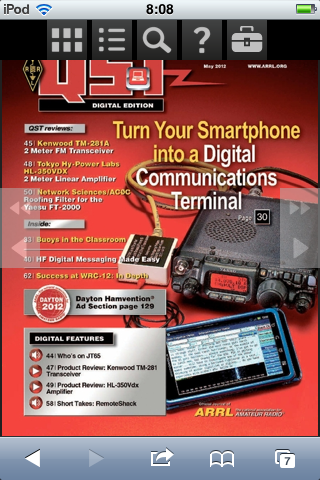
The other day I received, like some unknown number of others, an invitation to try the QST Digital Edition beta for the May 2012 issue. I am not a hard-core mobile/digital media user. But, Sarah is a librarian who has specialized in management and procurement of electronic journals and books. So, she gave me the low-down on what to look for. And, over the years, I’ve given her what-for about eBooks because, as I like to say, “I am willing to risk a single print copy of something by taking it places I wouldn’t risk taking an electronic reader.” That sums up the perspective I took when reviewing e-QST.
You can read about the Digital Edition on ARRL’s FAQ here. The desktop version requires Flash to use in-browser or Adobe Air and an enormous download to go stand-alone, neither of which really warmed my heart. But, it does work in the web browser of a mobile device. I have a 2nd generation iPod Touch running iOS 4 and it worked great in Safari. I now have a bit of insight as to why people might love their iPads (which I have always viewed as a more-expensive, less-convenient version of the iPod Touch or iPhone). There appear to be only two levels of zoom: fit page width and zoomed-in. No matter how good your eyesight, you need to be zoomed in to read because the characters don’t render legibly otherwise. I think iPad’s larger screen might make reading it easier.
Browsing page thumbnails was OK, but it’s difficult to actually know what you’re looking at before you select the page. It also would be nice if the pages were numbered in thumbnail view.
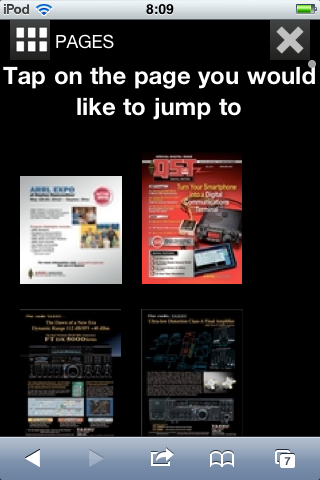
One of the big advantages of the Digital Edition is that you can do things you can’t do with the print version, like including audio of JT65. Granted, I think almost anyone who’s active on HF CW or digital knows what JT65 sounds like, but it’s a basic demonstration of the kinds of things that will be possible in the new format.
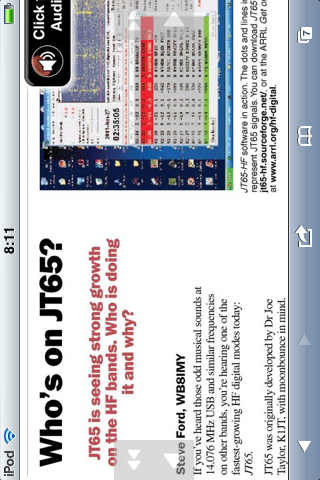
Given that I’m usually done with one month’s issue by the time the next one comes out, the Digital Edition is alright for basic browsing and reading. It’s much faster to skim the print issue, at least with my barebones 768 kbps DSL connection and the higher visual bandwidth of print (read Tufte’s essay The Cognitive Style of PowerPoint for more on this and other interesting reasons to hate slide decks). The mobile version also requires you to be connected to the Internet to browse. It turns out that an entire issue is on the order of 350 MB to download stand-alone on a computer. This makes it difficult to take places where I often want to read QST (on airplanes, for instance)… It is possible to print from the desktop version (I tried it using 32-bit Windows XP and Firefox), although it seems to be slower than the mobile version (not entirely unexpected).
Another thing that’s a bit different is that if you download the offline content to your desktop, you still need to authenticate to open it. It’s not clear whether this continues if you drop your ARRL membership. It is a bit different than owning boxes of back issues…even if you drop your membership, you still have the magazines. I don’t think this is a huge concern for most hams, who probably wouldn’t be interested in old QSTs if they dropped the membership.
In summary, I like the concept of the Digital Edition, but I wish I could carry off-line issues around on my mobile device. ARRL hints at this in the FAQ, so I am hopeful.
Ethan Miller, K8GU, is a regular contributor to AmateurRadio.com and writes from Maryland, USA. Contact him at [email protected].
Logs and QSL cards
Since I logged my first HF QSO back in 2005 I have been using one type or another of software logging. I have also enjoyed exchanging QSL cards but never developed a good system at keeping them organized. Jumping from one logging program to the next, managing the “sent” and “received” QSL card fields have been hit or miss. A good portion of my contacts were uploaded to eQSL. Some were pushed out to LoTW. But I am not at all certain that either accurately reflects all my logged contacts. Compounding the problem has been multiple moves and military facilitated DXpeditions to Iraq and Korea. So what I am left with is a filing cabinet drawer full of QSL cards and a hard drive full of various log files.
It would be nice to get this mess sorted out.
I taking a three-step approach to establish order out of chaos.
(1) Gather all my software based log files. Use a file format compatible with fldigi and convert all the log files accordingly… with the end result of one consolidated log.
(2) Organize all QSL cards by date. I have a few boxes that QSL cards fit in nicely as well as tabbed dividers. This will allow me to fairly easily crosscheck the cards I have against the digital log.

(3) Stick with fldigi as my logging program. Update the QSL card “sent” and “receive” fields as I mail out cards or receive them. File received cards by date of contact.
(BONUS) I am pretty sure I achieved DXCC back in 2007, but have never been able to sit down and pull out the 100 cards I need. With a consolidated log and QSL cards organized by date, I will be able to easily find my 100 cards.
Scott Hedberg, NØZB, is a regular contributor to AmateurRadio.com and writes from Kansas, USA. Contact him at [email protected].
 Ham Radio Deluxe |
 W5SWL Electronics |
 Ham Radio Prep |
 KB3IFH QSL Cards  Hip Ham Shirts  HamRadioAuctions HamRadioAuctions Reliance Antennas Reliance Antennas Enigma Shop Enigma Shop |  morseDX  Ni4L Antennas  R&L Electronics R&L Electronics antennas.us antennas.us QRV QRV |
- Matt W1MST, Managing Editor
