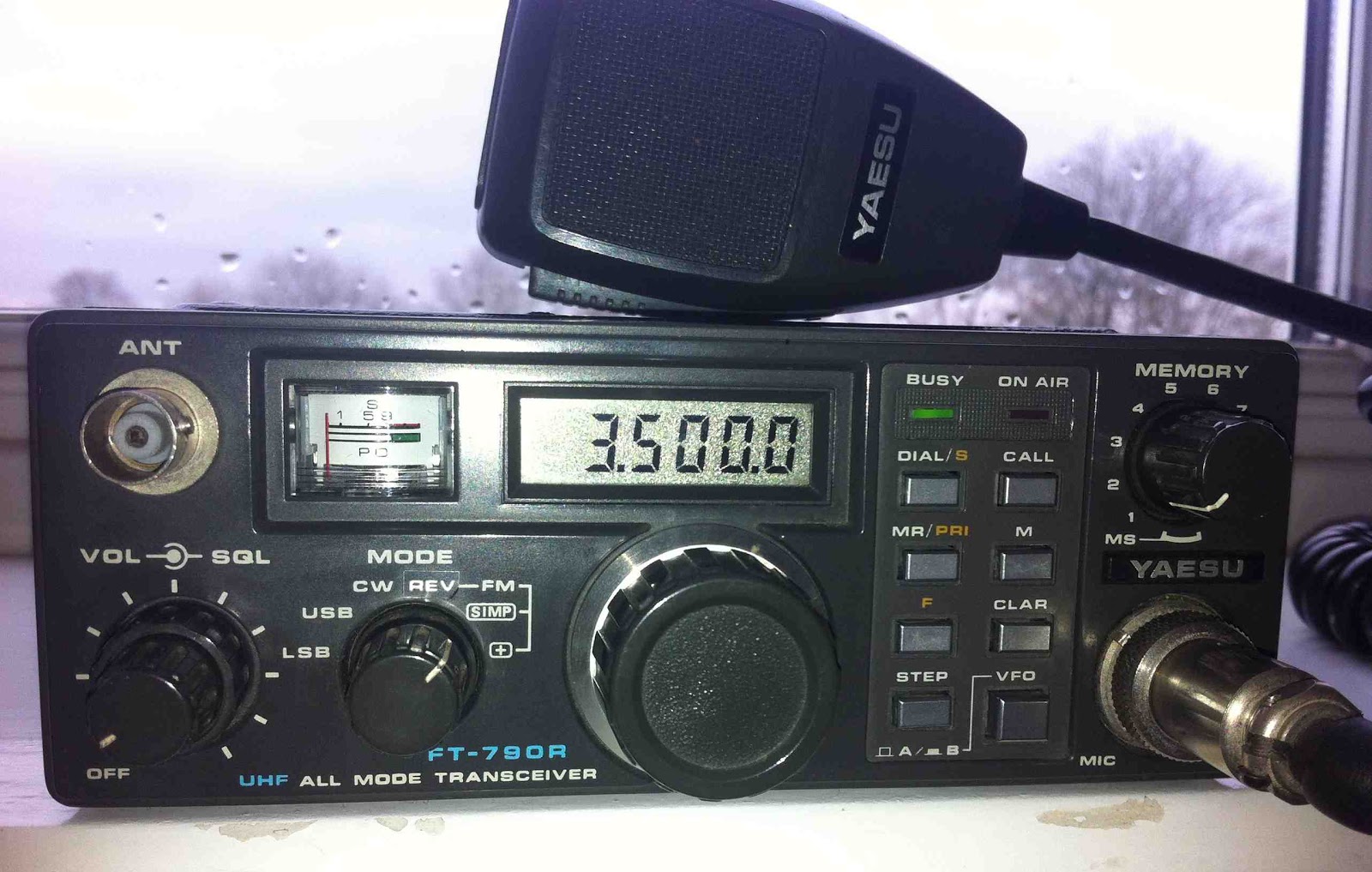
Something old, something new.

Something old …

As a young boy in Australia my two favorite hangouts were my grandfather’s shed or practically anywhere that electronics were sold. The two largest electronic component retailers in my home town were Tandy (Radio Shack) and Dick Smith Electronics. They both sold kits, tools, ‘100 in 1 Labs’ and other assorted gear but Dick Smith eventually became known as the experimenters store due to their greater range.

Original Radio Shack calculator
Tandy is now almost vanished after their aquisition by Woolworths (Despite also owning its competitor Dick Smith) and has converted or closed most of the locations. 
One of the things I have to remember Tandy by is a handy resistor color code calculator. It saw a lot of use in past years while I built kits and experimented but not so much nowdays.
This device also calculated inductor values when flipped over which was handy for some of the older equipment I came across.

If you would like to make one of these yourself then Adafruit Industries has created a PDF document you can print and cut out for create your own resistor value calculator.

The PDF file is available from Adafruit Industries or a copy is also here. Once you print it out, a little cutting and folding should produce something like the example of the right. The Adafruit design uses brass paper fasteners (remember those?) but any fastener could be used that would allow the wheel inside to rotate freely. It would be best to print on heavy card stock if you have the ability as it will give the calculator some strength.

Something new … 

If you happen to have one of those new fangled iDevices you can download Circuit Playground. It has a few more features than the old Radio Shack calculator and looks great on the iPad.

More features are being added but the list at the moment includes:

  • Decipher resistor & capacitor codes with ease
  • Calculate power, resistance, current, and voltage with the Ohm’s Law & Power Calc modules
  • Quickly convert between decimal, hexadecimal, binary or even ASCII characters
  • Calculate values for multiple resistors or capacitors in series & parallel configurations
  • Store, search, and view PDF datasheets
  • Access exclusive sneak peaks, deals & discounts at Adafruit Industries

You can download it from the iTunes Store or, if you have an Android, you can check out ElectroDroid for similar functionality.

As time goes on there are more and more useful utilities available for electronic experimenters on iOS and Android devices. Since more and more equipment today is becoming computerized do iOS and Android devices  represent the future of test equipment?

iMSO-104 iPad Oscilloscope


Owen Morgan, KF5CZO, is a regular contributor to AmateurRadio.com and writes from Texas, USA. Contact him at [email protected].

Is there an inexpensive kit for the Technician 10M phone band?

In the comments for the kit roundup, a reader asked me about this, so I looked through the list again, and found the lowest priced kit available that will cover at least a portion of the 28.300 to 28.500 range. The YouKits TJ2A seems to be the only choice, but only after adding the accessory crystal pack #2.  He pointed out the inexpensive MKARS80 as an example of a great SSB kit for very little money, but not covering a band available to a technician-class ham.  On a side note, I wonder if it is possible to create an MKARS10?  Here is my reply:

I’m not sure why there aren’t more SSB kits for 10 meters. In the list here you can try the Youkits TJ2A (http://youkits.com/ or the eBay store) and build it for 10 meters by ordering crystal option package #2. They only show one optional package on the website, but two in their eBay store for some reason.  According to their specs this will give you 28.326 – 28.420.  You might have luck contacting them directly and trying to order one with the correct BPF components for 10 meters with the initial kit package and save a few $$.

Another suggestion is to step up to general. I started studying as soon as I got my tech, and took the test about 6 weeks later. Tech-to-general is a pretty easy jump (mush easier than general-to-extra) and will give you the ability to use some of these other kits (like the aforementioned bargain-basement MKARS80).

A third option is to pick up a used Radio Shack HTX-10 or HTX-100 rig on eBay or at a hamfest. I have a Magnum-257 in the car (same rig as the HTX-10) that I picked up for $125. That rig with a modified 11 meter whip has been heard in Europe, Africa, and all over South America from here with 25 watts. In fact, my first contact on HF as a new ham was with France! I wish that good fortune on any new ham. It certainly got me interested in getting more great contacts.

Whatever path he chooses I’m sure it will be enjoyable.  Once you make that first contact you catch the fever, and can’t wait for more.

–Neil W2NDG

EDIT:  Andrew AC8JO reminded me about the Softrock RX/TX SDR kits, which can be built with 17, 12, and 10 meters at 1 watt. (you select the bands when you build, the kit comes with parts necessary for all). The kits are $89 when available. See http://www.kb9yig.com to order, or the Yahoo Group Softrock40 for announcements of upcoming availability or units to purchase.  I hear that it is a moderately difficult build for a newbie, but there is PLENTY of info online to assist you.


Neil Goldstein, W2NDG, is a regular contributor to AmateurRadio.com and writes from New York, USA. Contact him at [email protected].

DCS: Also Reflecting Our National Traits

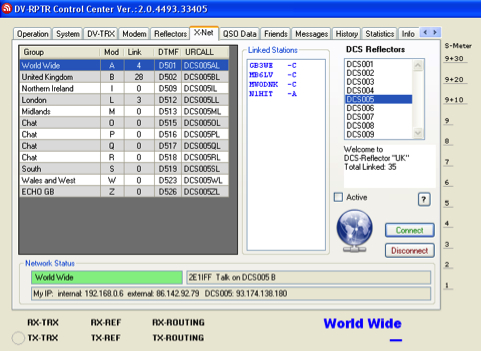
Sometimes I find how we use new technology is as interesting as the technology itself. You may not know or care what DCS reflectors are, but the way they’re developing tells us a little about ourselves, I think. DCS reflectors are basically a new generation of servers or chat rooms we use with digital amateur radio to link repeaters, nodes and individuals together. They were developed recently by some very clever enthusiasts in Germany and are growing in an organic way. A bit like dandelions. Each DCS reflector has modules from A to Z, which are a blank canvas. The way in which these are being filled is like a group of sugar drink-fueled children scrambling to choose their bunk-beds in a large dormitory at summer camp. Let me explain: The first two DCS reflectors, DCS001 and DCS002 were hosted by the Germans. They had neatly and orderly divided up the entire globe into modules. It was a good start. For their own country they had a national module of course, with additional modules for north, south, east and west Germany respectively. But anyone who knows a little about Germany should not be surprised to see that Bavaria has broken away and formed its own module. The states of Hessen and Baden-Wuettenberg followed suit, of course. The states of the former East remain quiet for the moment, it seems. There are now nine DCS reflectors at the time of writing, all now hosted by different countries who wanted their own national servers. The Dutch are fastidious in their egalitarianism. They’ve gone and divided their reflector into nation-wide, north, mid and south Netherlands as well as – wait for it - thirteen different regions including the colonies of the Dutch Antilles. The inhabitants of Flevoland must be ecstatic. The Swiss, however, have no national module at all. No, they’ve divided their piece of DCS cake in language-slices: German, French and Italian. I’m also sure it will be the most reliable DCS reflector ever known to man. The Italians seem a little less self-assured. They have a record number of four test channels, just in case. The US reflector is well-ordered, with a couple of the noisier states, like Texas, having their own module. Even the Canadians are accommodated. And as for my lot, the Brits? Well, we would have to be a little bit different, wouldn’t we? At the time of writing there is a national UK module, with a Northern Ireland, Wales & West, Midlands and South module. No Scotland so far. Maybe it’s the expense. And uniquely in the new DCS community, the city of London has decided that it is elevated enough among the great and good capitals of the world to merit its very own module. I think we can rightly take most pride in the four inconspicuous modules simply labelled as ‘chat’. You can transfer to these modules for your one-to-one conversation without tying up the repeaters of an entire small country. I have heard less-than-scintillating conversations occupy worldwide reflectors for some considerable periods. The pace of development is astonishing. An idea whispered in the ear of a developer is often embodied overnight. And we’re just one month into the story…..
UK DCS005 shown on he excellent (German) DV-RPTR Control Centre software

Rob Law, MW0DNK, is a regular contributor to AmateurRadio.com and writes from Anglesey, Wales. Contact him at [email protected].

The bands are dead but can a WSPR defibrillator get results
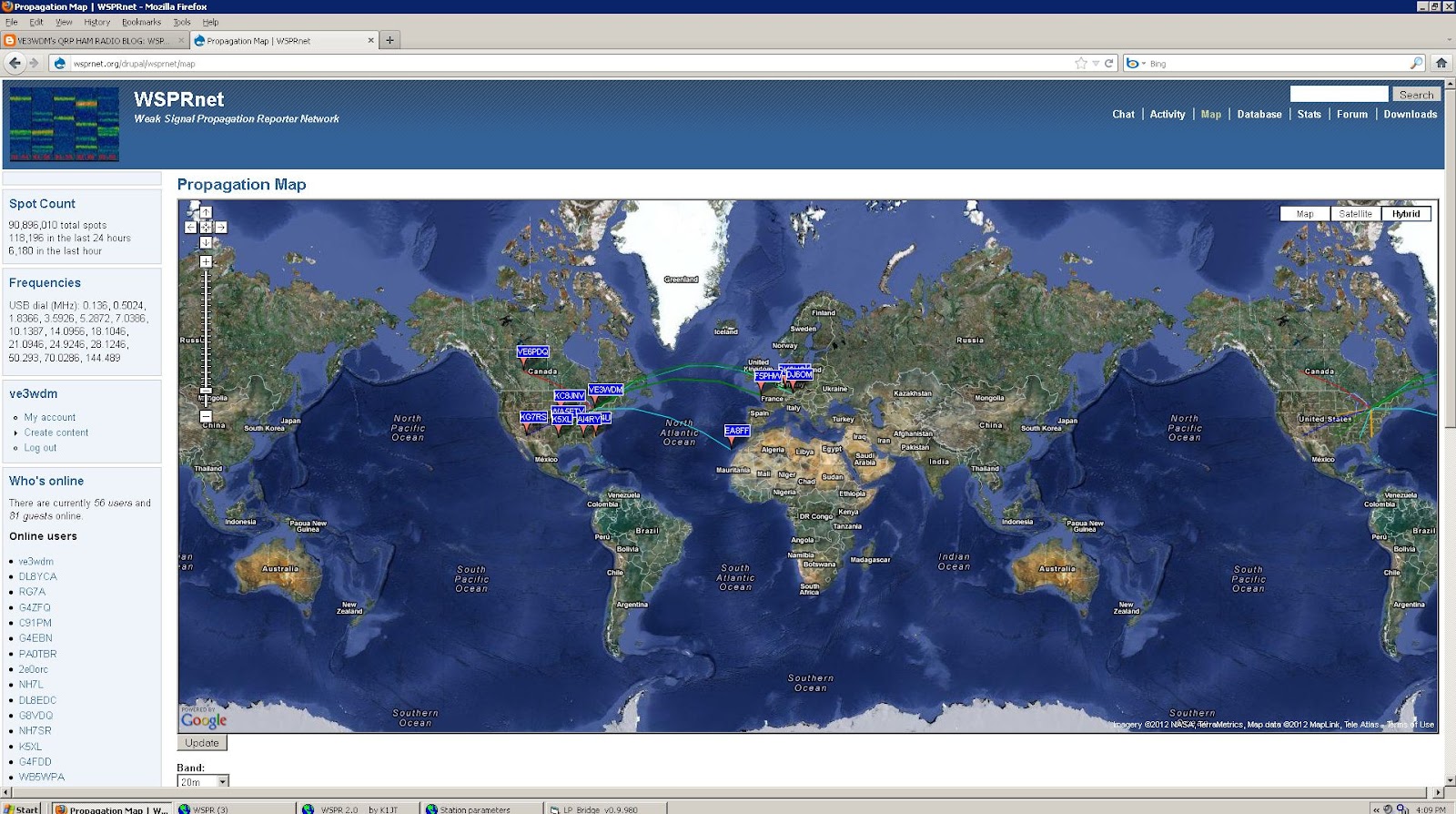
20m WSPR results
As most of you know the conditions on HF over the last week have been dismal at the best of times. Over the weekend I found 20m to be flat and 40m was just more or less local stuff. So Monday I thought it was time to give WSPR a go again. I set the output to 1 watt and gave 40, 30 and 20m's  a go. I was surprised that 20m was alive on WSPR. It was odd that I was unable to hear any CW on 20m's but using WSPR at one watt I was heard overseas.  My fan dipole in the attic is not really setup for 30m's but with the tuner in the K3 I
30m's was local only
am able to fool the rig to see a flat match. The SWR on the other side of the K3's tuner for 30m's is about 9:1 (according to my LP100A) so with one watt from the K3 and a 9:1 match what type of power is getting up to the antenna. With the help of this calculator I can enter my feed line type, power input, frequency and SWR this will get me a rough idea of the power at the antenna. So at 1 watt with an SWR of 9:1 using 30ft of  LMR-400 on 30m's the output at the antenna is around 892mW's of  raw power!! That raw power got me local responses on WSPR.  As for 40m's with one watt........it was more or less dead.

40m's was dead


Mike Weir, VE9KK, is a regular contributor to AmateurRadio.com and writes from New Brunswick, Canada. Contact him at [email protected].

Ham Nation 45

Joe Rudi Trades His Baseball Glove For A Morse Code Key

Video URL: 

http://dts.podtrac.com/redirect.mp4/twit.cachefly.net/video/hn/hn0045/hn0045_h264b_864x480_500.mp4

Video URL (mobile): 

http://dts.podtrac.com/redirect.mp4/twit.cachefly.net/video/hn/hn0045/hn0045_h264b_640x368_256.mp4

MP3 feed URL: 

http://www.podtrac.com/pts/redirect.mp3/twit.cachefly.net/hn0045.mp3

Hosts: Bob Heil (K9EID), Gordon West (WB6NOA), and George Thomas (W5JDX)

Former MLB player Joe Rudi tells his ham story, Bob visits the Southwest Missouri Amateur Radio Club, free CAD software for designing PC boards, and more.

Guests: Joe Rudi (NK7U), Amanda Alden (K1DDN), and Cheryl Lasek (K9BIK)

Download or subscribe to this show at http://twit.tv/hn.

We invite you to read, add to, and amend our show notes at wiki.twit.tv.

Thanks to Joe Walsh who wrote and plays the Ham Nation theme.

Thanks to Cachefly for the bandwidth for this show.

People: 

Dr. Bob Heil, K9EID, is the founder of Heil Sound and host of TWiT.tv's Ham Nation which streams live each Tuesday at 6:00pm PT (9:00pm ET) at http://live.twit.tv. Contact him at [email protected].

K7AGE goes to Las Vegas for NAB

Randy, K7AGE, attended the National Association of Broadcasters convention in April. Randy took along his camera and has posted three new videos.

Randy explains his day job-

In this video Randy was interviewed by Kirk Harnack host of This Week in Radio Tech as seen on the TWiT.tv netcast network.

This Week in Radio Tech, TWiRT, with Randy K7AGE, from NAB 2012

Wednesday night a Ham Radio Reception is held sponsored by Bob Heil of Heil Sound and BSW.  The reception was also streamed live on TWiT.tv network. Randy provides coverage of the event and was interview by Scott Wilkinson, host of Home Theater Geeks, also another TWiT netcast.

Tour around NAB 2012 and the Ham Radio Reception

K7AGE Amateur Radio Videos

Checkout TWiT TV


Randy Hall, K7AGE, is a regular contributor to AmateurRadio.com , produces amateur radio videos, and writes from California, USA. Contact him at [email protected].

W5IG Cool Transmitter

A very creative way to add an important addition to your station. I would argue this may be essential for any radio amateur who find themselves in the hamshack for long periods.


Scott Hedberg, NØZB, is a regular contributor to AmateurRadio.com and writes from Kansas, USA. Contact him at [email protected].

Subscribe FREE to AmateurRadio.com's
Amateur Radio Newsletter

 
We never share your e-mail address.


Do you like to write?
Interesting project to share?
Helpful tips and ideas for other hams?

Submit an article and we will review it for publication on AmateurRadio.com!

Have a ham radio product or service?
Consider advertising on our site.

Are you a reporter covering ham radio?
Find ham radio experts for your story.

How to Set Up a Ham Radio Blog
Get started in less than 15 minutes!


  • Matt W1MST, Managing Editor