 |
 B&Q Beam
 30 April 2012 | by
 I’ve committed to ‘presenting’ the B&Q beam to the club in a couple of weeks so I better get on making it. The idea is one that has been done a few hundred if not thousand times over. Give some new / inexperienced hams the opportunity to build a perfectly adequate 3 element beam for 2m from parts found at a local hardware shop. In the UK B&Q is just about everywhere and it supplies just about everything, apart from the thing you want, generally.
Seriously the design is taken from any of your favourite calculators. I have found that they vary slightly against the original maths but I know my Sotabeam works very well so that’s a good starting point for dimensions.
Costs to date are in the region of a few quid but by far the most expensive parts are the nylon bolts used to hold the elements. I’ve bought a bunch so I’ll have a few attempts at drilling straight through the nylon without heating it up too much.
Alex Hill, G7KSE, is a regular contributor to AmateurRadio.com and writes from Cumbria, UK. Contact him at [email protected].
Bad day
For quite a while now I’ve not been able to get into the shack. Not because its stacked to the rafters with new gear but because I’ve had too much on to even think about it. Yesterday I managed to squeeze some time in and quite frankly I wish I hadn’t bothered.
My FT817 lives in a padded bag when its not in use along with its charger and an old Miracle whip. Now the Miracle whip no longer has a whip courtesy of my youngest who managed to snap it in half. Whilst it isn’t the finest antenna it was extremely useful for travelling. Now I need a replacement telescopic whip and I’m guessing they’re either hard to get hold of or unnecessarily expensive.
The other doom was the CI-V controller (mine is a G4ZLP USB digimater pro+) which has given some sterling service over the last couple of years but now has decided to read the frequency but not PTT or supply audio. Several wasted hours later the status quo remains. Reliability of kit in my shack isn’t that great at the best of times and this just confirms that a law based on expense and reliability. ‘No matter what it costs the chances are that it’ll stop working for no apparent reason’.
At this rate I’ll have nothing left either as a result of a 3 year old or its own suicidal components..
Alex Hill, G7KSE, is a regular contributor to AmateurRadio.com and writes from Cumbria, UK. Contact him at [email protected].
New Categories for ARRL VHF Contests
The April 25th issue of Contest Update from the ARRL had this item:
The ARRL Programs and Services Committee has approved a rule change for ARRL VHF+ contests effective beginning in 2013 (not this year) to create a Single-Op FM-only category (100 W max, 50/144/222/440 MHz) and a three-band Single-Op category (100 W PEP on 50 and 144 MHz, 50 W PEP on 432 MHz). These changes will apply to the January, June, and September contests – again, beginning with the 2013 January VHF Sweepstakes.
I am always looking for ways to get more people involved in VHF contests and these two new categories may help. The basic idea is to create categories for simpler stations to participate in the contests without having to be in the same category as The Big Guns.
73, Bob K0NR
Bob Witte, KØNR, is a regular contributor to AmateurRadio.com and writes from Colorado, USA. Contact him at [email protected].
Caught my first 50MHz opening of the year
It’s always good when the Es season starts. I associate Es contacts with the sun, being away in the Mediterranean – things I like!
Just after lunch I saw a tweet reporting some 70MHz activity from the Netherlands to Finland. I popped up and checked, finding 50MHz fairly quiet. However, an interesting beacon coming in was OY6BEC – quite short skip. Tried a few CQs on CW but no luck. Up on SSB SP3OCC was coming in, but couldn’t work him. I scraped a QSO with SP5SS before finding some CW activity.
Best DX over the next hour or so was into Estonia, but I had several contacts with SM, OZ, LY, OE, HA, E7 and IS0.
A good start to the season!

Tim Kirby, G4VXE, is a regular contributor to AmateurRadio.com and writes from Oxfordshire, England. Contact him at [email protected].
QRP TTF 2012
Great weather here in Orlando for a good afternoon of QRP Portable. The QRP To The Field contest is always a good time to get out and give out a few more points to the serious contesters. I enjoy the concentrated QRP contacts and hearing my virtual friends once again. Every QRP event has a few regulars that are almost always heard. This year the bands were only so-so in Florida with lots of QSB on 20m which was by far the best for the day. It was solid at times and then signals would suddenly drop to the noise level which made RST reporting fun!

Mt. Cedar Tree: Just above sea level
Because of band conditions, I spent most of the 4 hours on 2om, but I did check 15 and 10m on an hourly basis. To do that, I pulled out my Ten Tec Argonaut 509 and used a Buddistick with the base up about 12 ft. I called CQ about 50 times on 15 m but heard almost nothing on 10m all day. On 15m I heard a couple Eu (IV4 and DK) stations but was not getting a response to my calls and only heard 1 or 2 US stations so I assume the band conditions here weren’t quite right for those two bands.
Managed 18 QSO’s in 4 hrs of switching between my Wilderness Sierra to an EFHW, Delta Loop for 20m, and the Buddistick / Argonaut combo for 15 and 10m. 40 m was full of Florida QSO Party stations and a couple of nearby (within 4 miles) stations were pounding my receiver and causing the AGC to go nuts when I tuned across them so I only managed a single contact on 40 before retreating back to 20m.
I’ll be looking to give out more points in upcoming contests. So call CQ and I’ll be out there lookin’ fer ya!
72,
Kelly K4UPG

Buddistick on the way up
Kelly McClelland, K4UPG, is a regular contributor to AmateurRadio.com and writes from Florida, USA. Contact him at [email protected].
Have fun on digimodes and win an antenna analyzer

The Annual Digifest will be held on the first full weekend of June (2012 dates are June 2nd and 3rd ). This will be Digifest’s 5th year. Its popularity is growing with more than 200 logs received last year.
A peculiarity of this Contest is the great variety of different categories of participants in five digital modes: RTTY 75, BPSK 63, MFSK 16, HELLSCHREIBERand OLIVIA. The points calculation is based on the distance between the stations.
The contest consists of 3 convenient periods (8 hours each) during the weekend. To add more excitement those who like competing in real time will be able to see their results on a server.
There are lots of nice prizes, mostly RigExpert AA-230 and AA-30 Antenna Analyzers and RigExpert USB Interfaces. All prizes sponsored by RigExpert Ukraine Ltd.
As the number of the participants is relatively small and the most populated competing area is Europe, stations from NA, SA, Africa, Asia and Australia are at a great advantage. Last year those stations were the most prize winners. To support growing participation from Europe the sponsors have doubled the prizes so separate main prizes are now offered both for Europe and the rest of the world.
For those won’t be able to win a main prize there will be a lot of small gifts like T-shirts and paper awards. All the prizes will be mailed to participants’ home addresses. The results are usually available just 2 weeks after the end of the Contest, So, lets meet on the first weekend of June and have fun!
Complete rules can be found at http://www.mixw.net/misc/DigiFest/index.html and http://www.rigexpert.com/index?s=main&f=digifest

Julian Moss, G4ILO, is a regular contributor to AmateurRadio.com and writes from Cumbria, England. Contact him at [email protected].
First Sporadic-E of 2012
A DX Sherlock VHF propagation alert popped into my mailbox this afternoon to warn me about a possible Sporadic-E opening on 6 metres.
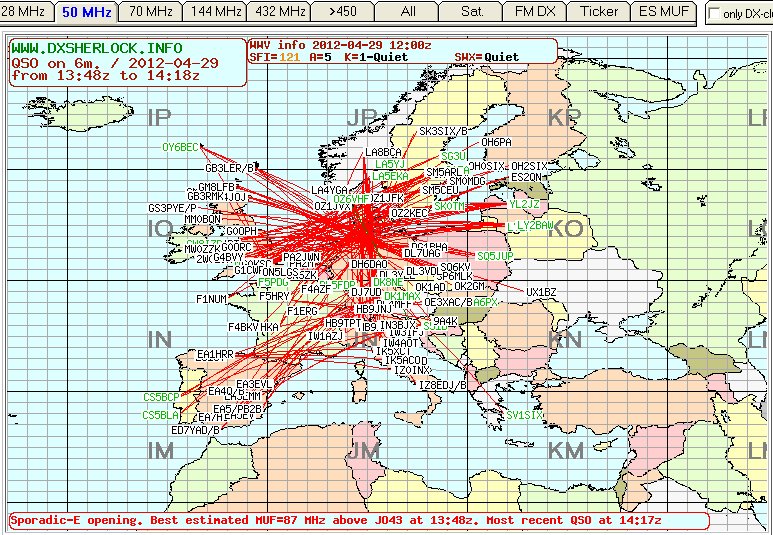 |
| 6m Sporadic-E opening 29 Apr 2012 |
My K3 was WSPRing on 10m at the time and when I went to look several new stations had been spotted indicating the presence of short skip propagation.
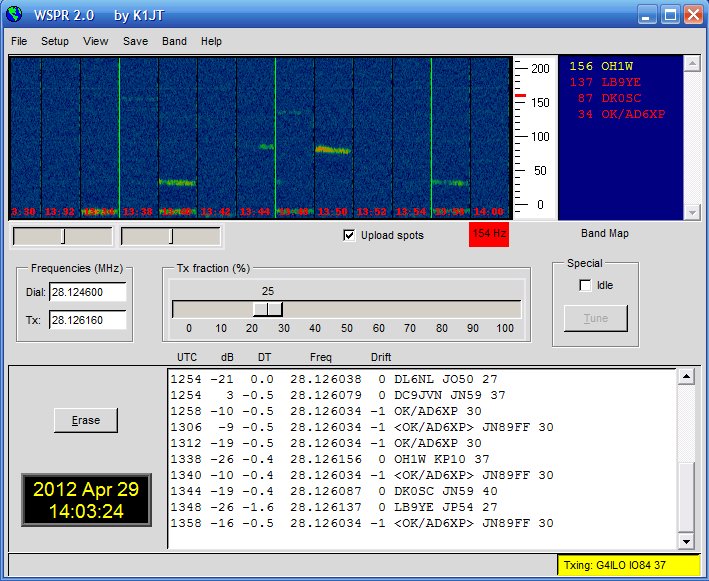 |
| 10m WSPR spots at G4ILO |
I switched to 6m but very few WSPR stations were active and no spots were made or received. I tuned the receiver and heard a weak Polish station on SSB but the opening was over and no contacts were made.
Still, it is good to see some activity on the “magic band.” Things can only get better!

Julian Moss, G4ILO, is a regular contributor to AmateurRadio.com and writes from Cumbria, England. Contact him at [email protected].
 Ham Radio Deluxe |
 W5SWL Electronics |
 Ham Radio Prep |
 KB3IFH QSL Cards  Hip Ham Shirts  HamRadioAuctions HamRadioAuctions Reliance Antennas Reliance Antennas Enigma Shop Enigma Shop |  morseDX  Ni4L Antennas  R&L Electronics R&L Electronics antennas.us antennas.us QRV QRV |
- Matt W1MST, Managing Editor
