 |
 ‘Twas the night before Dayton…
 18 May 2012 | by
Well, in just a few hours we’ll mark the “official” start of the festivities at Hamvention 2012 in Dayton, Ohio. To celebrate, I thought I’d call on our readers to share some special memories of past Hamventions.
So let’s hear them! Tell us about a great (or not-so-great) deal you got. The friends you’ve made. The food you’ve eaten (and the Bratwurst you wish you hadn’t). The portable toilets. And possibly all of those — in that order.
Who wants to start?
Matt Thomas, W1MST, is the managing editor of AmateurRadio.com. Contact him at [email protected].
The bands improve slow but sure………

Mike Weir, VE9KK, is a regular contributor to AmateurRadio.com and writes from New Brunswick, Canada. Contact him at [email protected].
Ham Nation 48

http://dts.podtrac.com/redirect.mp4/twit.cachefly.net/video/hn/hn0048/hn0048_h264b_864x480_500.mp4
http://dts.podtrac.com/redirect.mp4/twit.cachefly.net/video/hn/hn0048/hn0048_h264b_640x368_256.mp4
http://www.podtrac.com/pts/redirect.mp3/twit.cachefly.net/hn0048.mp3
Hosts: George Thomas (W5JDX) and Don Wilbanks (AE5DW)
Top 5 essentials for your ham shack, Joe Eisenberg talks about photographing hamventions, Soundcard Oscilloscope, and more.
Guests: Joe Eisenberg (K0NEB), Amanda Alden (K1DDN), and Cheryl Lasek (K9BIK)
Download or subscribe to this show at http://twit.tv/hn.
We invite you to read, add to, and amend our show notes at wiki.twit.tv.
Thanks to Joe Walsh who wrote and plays the Ham Nation theme.
Thanks to Cachefly for the bandwidth for this show.
Dr. Bob Heil, K9EID, is the founder of Heil Sound and host of TWiT.tv's Ham Nation which streams live each Tuesday at 6:00pm PT (9:00pm ET) at http://live.twit.tv. Contact him at [email protected].
The Joy of Elmering (with Congratulations to KK4FKM for His First QSO!)
I got some good news and some bad news Tuesday. The bad news came when Dean, NYØI, let me know he couldn’t get into my EchoLink station. A little investigation proved that my radio is deaf; the problem is either the feedline or the antenna itself. What a disappointment.
But the good news I got that day was so good that it more than made up for the bad news. I got a taker on my offer to be a CW Elmer! Michael, KK4FKM, found me listed over at the SKCC Elmer Page and sent me an email. Great timing — I easily pushed my antenna woes to the back of my mind and set up a SKED with him for yesterday afternoon on 20m.

The Key I Used to Work KK4FKM: The Kent SP-1
At the appointed hour I called KK4FKM KK4FKM KK4FKM DE NØIP NØIP NØIP KN. I wasn’t sure I’d hear him since the band was unusually noisy and KK4FKM was running QRP. But sure enough, there he was!
He was buried pretty deep in the QRN; I quickly flipped on my CW filter to isolate his signal. I managed nearly solid copy on the first go-around, but I couldn’t make out his subsequent transmissions. I was booming in there, though, so he had the opportunity to copy plenty of code.
Afterward we chatted by phone. I was moved when Michael told me this was his first QSO! What an honor to be his first contact. Impressive, too, that Michael’s first QSO was by CW, especially considering that he has his General — he could have gone straight to HF SSB if he wanted to, but instead he went the extra mile and tapped out his first QSO on a straight key, QRP no less. Well done!
It turns out that Michael and I have even more in common than our appreciation for CW. He is a police officer in a department about the same size as the one in which I served, and he is a Baptist, too. After a delightful conversation, we set up another SKED before bidding one another farewell.
This is one QSL that I would send if it cost me a hundred stamps! It’s in the mailbox. Congratulations, KK4FKM!
If you ever have a chance to Elmer, go for it. And if you could use an Elmer, don’t hesitate to seek one out. You’ll be doing him a favor. Of all the things we can do in this hobby, Elmering might just be the most delightful one of all.


Todd Mitchell, NØIP, is a regular contributor to AmateurRadio.com and writes from Minnesota, USA. He can be contacted at [email protected].
70MHz transatlantic beacon WF9XRU
I spoke with Dave WW2R last night and he tells me that the 70MHz beacon from the US will be active again this year. Callsign will be WF9XRU.
I believe that all other details will be as before; frequency 70.005 from FM07.
Many thanks as ever, to Brian WA1ZMS for putting the beacon on.

Tim Kirby, G4VXE, is a regular contributor to AmateurRadio.com and writes from Oxfordshire, England. Contact him at [email protected].
Godspeed !
To all my friends headed to Dayton Hamvention and to all my friends headed out to FDIM, I wish you Godspeed – safe journeys there and back home.
Enjoy the friendship and camaraderie and please fill up the e-mail reflectors with bits of news, please!
72 de Larry W2LJ
QRP – When you care to send the very least!

Larry Makoski, W2LJ, is a regular contributor to AmateurRadio.com and writes from New Jersey, USA. Contact him at [email protected].
Handiham World for 16 May 2012
Welcome to Handiham World.
You can do it!
Today, just as we did last week, we are going to begin with Troubleshooting 101 as part of our initiative to help new ham radio operators (and even some of us older ones) learn how to do some basic troubleshooting for ourselves. Yes, it can be tempting to ask someone else to do things for us. This can become a bad habit when it keeps us from learning new things, especially things that we could – with a bit of practice – learn to do for ourselves. Knowing these basic things can serve us well in the future when no help is available.
Troubleshooting 101

Let’s get to today’s troubleshooting question:
I sometimes use my handheld radio in the car. I can hear the repeater just fine, but I have had complaints that other stations can’t hear me. What’s going on here? Is there something wrong with my HT?
Yes, I’m afraid there is a problem with your radio. The problem is that it has a terrible antenna. Before you complain that the radio has always worked quite well when you used it around the house, let me explain.
Handheld radios are meant to be portable so that they are easy to carry around. Haven’t you noticed that people prefer smaller, lighter electronic devices? So what was once referred to as “a brick” – the venerable 2 meter HT – has evolved to a multiband miniaturized wonder that fits in the palm of your hand. The antenna on the old brink was just about the same length as the one on your new radio, though. These flexible “rubber duck” antennas are the ones that come as standard equipment with a new handheld radio. They have always been terrible antennas, but they are designed to be flexible so that they can bend without breaking and generally survive being dumped into a backpack, stuffed into a pocket, or crammed into a purse. A quarter-wave antenna for the 2 meter band should be around 19 inches long (48 cm), but the radio would hardly be portable with that big antenna, would it? The rubber duck antenna is inductively loaded so that it can be physically shorter but still act like an electrical quarter wave.
This seems like a great solution because now you have the equivalent of 19 inches of antenna in a tiny, convenient flexible stick. Ha, ha, that is a good one. Most of these rubber antennas are more like a “dummy load on a stick”. They are inefficient and lossy. A rubber antenna that came with the HT is probably okay if you are in a good location and not far from the repeater and are not moving around. The rubber antenna can receive okay but is not going to win any awards, but transmitting efficiently is just plain not a happening thing. When you move the antenna around, every slight cancellation of signal from multipath reception becomes a near-dropout. It is even worse inside a car, where the body of the car can block part of the signal and you are nearly always moving. No wonder your friends are complaining about your signal – because it is terrible!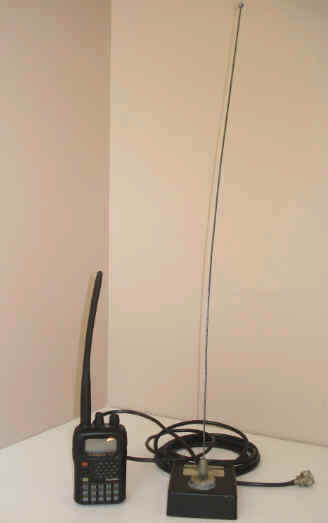
I placed my tiny Yaesu VX5R HT with the somewhat bent from years of carrying it in my pocket next to an old Larson 1/4 wavelength magnet mount antenna. The ACTUAL quarter wave mag mount towers over the HT with its wimpy rubber antenna. If only there were a way to use a quarter-wave magnet mount antenna, or even a 5/8 wavelength mag mount antenna, with my HT it would sure solve my transmitting problem and make the HT more useful as a temporary mobile radio.
Of course there is a way; you just need to get the right adapter to mate the mag mount antenna’s connector to your HT and you are in business, right?
Well, no – it’s not quite that easy. For one thing, you might not have a mag mount antenna. And you may not be familiar with these kinds of temporary antennas, especially if you are not a driver yourself and you ride with a spouse or a friend. Here are some things to consider:
- If you are going to move the antenna around a lot, such as using it on a friend’s car then removing it after you get where you are going, there are tiny, highly-portable miniature mag mount antennas with small diameter coax (RG-174U) with a connector to fit directly onto your HT. Actually, I prefer these antennas over other mag mounts because the light, flexible coax will not put extra stress on your radio’s SMA connector. MFJ makes the MFJ-1722 dual-band mag mount antenna and it is only around $15 – an accessory to your HT that is well worth the money.
- If you already have a more conventional larger mag mount with RG-58 coax, I recommend an adapter with a short piece of RG-174U coax so that the flexibility of the cable allows for comfortably moving the HT about as you use it. Stiff coax will put excessive pressure on the HT’s antenna connector and may eventually break it.
- If you are using an HT with an SMA connector, you may want to consider a special connector adaptor that seats against the body of the radio, taking pressure off the antenna connector.
- Pay attention to the routing of the feedline out the door. It may run through the gap between the door and the car’s frame, but choose a spot where the rubber gasket around the door frame will close gently against the wire.
- Avoid sharp bends when running coax.
- For longer term installations, test the water seal around the coax entry point with a garden hose.
- Place the antenna on the roof of the vehicle or on the deck of the trunk lid if the cable is to be run through the back seat and out into the trunk.
- Be sure the magnet has a serious grip on the metal car body!
- Avoid long, flapping runs of wire across the roof or trunk.
- If you have an antenna that screws onto a magnetic base, be sure it is screwed on tightly before traveling!
- Consider a small, easy to remove antenna that is placed just outside and above a back door. You can easily grab it off the roof and shove it on the back seat floor under a mat when you want to conceal the fact that you have a radio in the car or if you need the extra clearance to get into the garage. While you’re at it, unhook the HT and put it in the glove box or take it with you.
- If you are serious about using an HT in the car, you might also pop for the optional car charger. All the HT manufacturers offer them, and they can be in the glove box with an extra rubber duck antenna when not in use. You will likely need high power while operating mobile, and that can run your battery down quickly.
Once you start using a “real” antenna mounted outside the vehicle, you will wonder how you ever got by with an HT and the rubber antenna.
Email me at [email protected] with your questions & comments.
Patrick Tice, WA0TDA
Handiham Manager

Pat Tice, WA0TDA, is the manager of HANDI-HAM and a regular contributor to AmateurRadio.com. Contact him at [email protected].
 Ham Radio Deluxe |
 W5SWL Electronics |
 Ham Radio Prep |
 KB3IFH QSL Cards  Hip Ham Shirts  HamRadioAuctions HamRadioAuctions Reliance Antennas Reliance Antennas Enigma Shop Enigma Shop |  morseDX  Ni4L Antennas  R&L Electronics R&L Electronics antennas.us antennas.us QRV QRV |
- Matt W1MST, Managing Editor
