 |
 Handiham World for 16 May 2012
 16 May 2012 | by
 Welcome to Handiham World.

You can do it!
Today, just as we did last week, we are going to begin with Troubleshooting 101 as part of our initiative to help new ham radio operators (and even some of us older ones) learn how to do some basic troubleshooting for ourselves. Yes, it can be tempting to ask someone else to do things for us. This can become a bad habit when it keeps us from learning new things, especially things that we could – with a bit of practice – learn to do for ourselves. Knowing these basic things can serve us well in the future when no help is available.
Troubleshooting 101

Let’s get to today’s troubleshooting question:
I sometimes use my handheld radio in the car. I can hear the repeater just fine, but I have had complaints that other stations can’t hear me. What’s going on here? Is there something wrong with my HT?
Yes, I’m afraid there is a problem with your radio. The problem is that it has a terrible antenna. Before you complain that the radio has always worked quite well when you used it around the house, let me explain.
Handheld radios are meant to be portable so that they are easy to carry around. Haven’t you noticed that people prefer smaller, lighter electronic devices? So what was once referred to as “a brick” – the venerable 2 meter HT – has evolved to a multiband miniaturized wonder that fits in the palm of your hand. The antenna on the old brink was just about the same length as the one on your new radio, though. These flexible “rubber duck” antennas are the ones that come as standard equipment with a new handheld radio. They have always been terrible antennas, but they are designed to be flexible so that they can bend without breaking and generally survive being dumped into a backpack, stuffed into a pocket, or crammed into a purse. A quarter-wave antenna for the 2 meter band should be around 19 inches long (48 cm), but the radio would hardly be portable with that big antenna, would it? The rubber duck antenna is inductively loaded so that it can be physically shorter but still act like an electrical quarter wave.
This seems like a great solution because now you have the equivalent of 19 inches of antenna in a tiny, convenient flexible stick. Ha, ha, that is a good one. Most of these rubber antennas are more like a “dummy load on a stick”. They are inefficient and lossy. A rubber antenna that came with the HT is probably okay if you are in a good location and not far from the repeater and are not moving around. The rubber antenna can receive okay but is not going to win any awards, but transmitting efficiently is just plain not a happening thing. When you move the antenna around, every slight cancellation of signal from multipath reception becomes a near-dropout. It is even worse inside a car, where the body of the car can block part of the signal and you are nearly always moving. No wonder your friends are complaining about your signal – because it is terrible!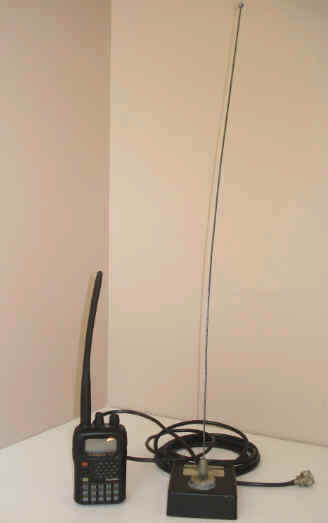
I placed my tiny Yaesu VX5R HT with the somewhat bent from years of carrying it in my pocket next to an old Larson 1/4 wavelength magnet mount antenna. The ACTUAL quarter wave mag mount towers over the HT with its wimpy rubber antenna. If only there were a way to use a quarter-wave magnet mount antenna, or even a 5/8 wavelength mag mount antenna, with my HT it would sure solve my transmitting problem and make the HT more useful as a temporary mobile radio.
Of course there is a way; you just need to get the right adapter to mate the mag mount antenna’s connector to your HT and you are in business, right?
Well, no – it’s not quite that easy. For one thing, you might not have a mag mount antenna. And you may not be familiar with these kinds of temporary antennas, especially if you are not a driver yourself and you ride with a spouse or a friend. Here are some things to consider:
- If you are going to move the antenna around a lot, such as using it on a friend’s car then removing it after you get where you are going, there are tiny, highly-portable miniature mag mount antennas with small diameter coax (RG-174U) with a connector to fit directly onto your HT. Actually, I prefer these antennas over other mag mounts because the light, flexible coax will not put extra stress on your radio’s SMA connector. MFJ makes the MFJ-1722 dual-band mag mount antenna and it is only around $15 – an accessory to your HT that is well worth the money.
- If you already have a more conventional larger mag mount with RG-58 coax, I recommend an adapter with a short piece of RG-174U coax so that the flexibility of the cable allows for comfortably moving the HT about as you use it. Stiff coax will put excessive pressure on the HT’s antenna connector and may eventually break it.
- If you are using an HT with an SMA connector, you may want to consider a special connector adaptor that seats against the body of the radio, taking pressure off the antenna connector.
- Pay attention to the routing of the feedline out the door. It may run through the gap between the door and the car’s frame, but choose a spot where the rubber gasket around the door frame will close gently against the wire.
- Avoid sharp bends when running coax.
- For longer term installations, test the water seal around the coax entry point with a garden hose.
- Place the antenna on the roof of the vehicle or on the deck of the trunk lid if the cable is to be run through the back seat and out into the trunk.
- Be sure the magnet has a serious grip on the metal car body!
- Avoid long, flapping runs of wire across the roof or trunk.
- If you have an antenna that screws onto a magnetic base, be sure it is screwed on tightly before traveling!
- Consider a small, easy to remove antenna that is placed just outside and above a back door. You can easily grab it off the roof and shove it on the back seat floor under a mat when you want to conceal the fact that you have a radio in the car or if you need the extra clearance to get into the garage. While you’re at it, unhook the HT and put it in the glove box or take it with you.
- If you are serious about using an HT in the car, you might also pop for the optional car charger. All the HT manufacturers offer them, and they can be in the glove box with an extra rubber duck antenna when not in use. You will likely need high power while operating mobile, and that can run your battery down quickly.
Once you start using a “real” antenna mounted outside the vehicle, you will wonder how you ever got by with an HT and the rubber antenna.
Email me at [email protected] with your questions & comments.
Patrick Tice, WA0TDA
Handiham Manager

Pat Tice, WA0TDA, is the manager of HANDI-HAM and a regular contributor to AmateurRadio.com. Contact him at [email protected].
FT-790R, 1W of Forlorn Hope? Part II
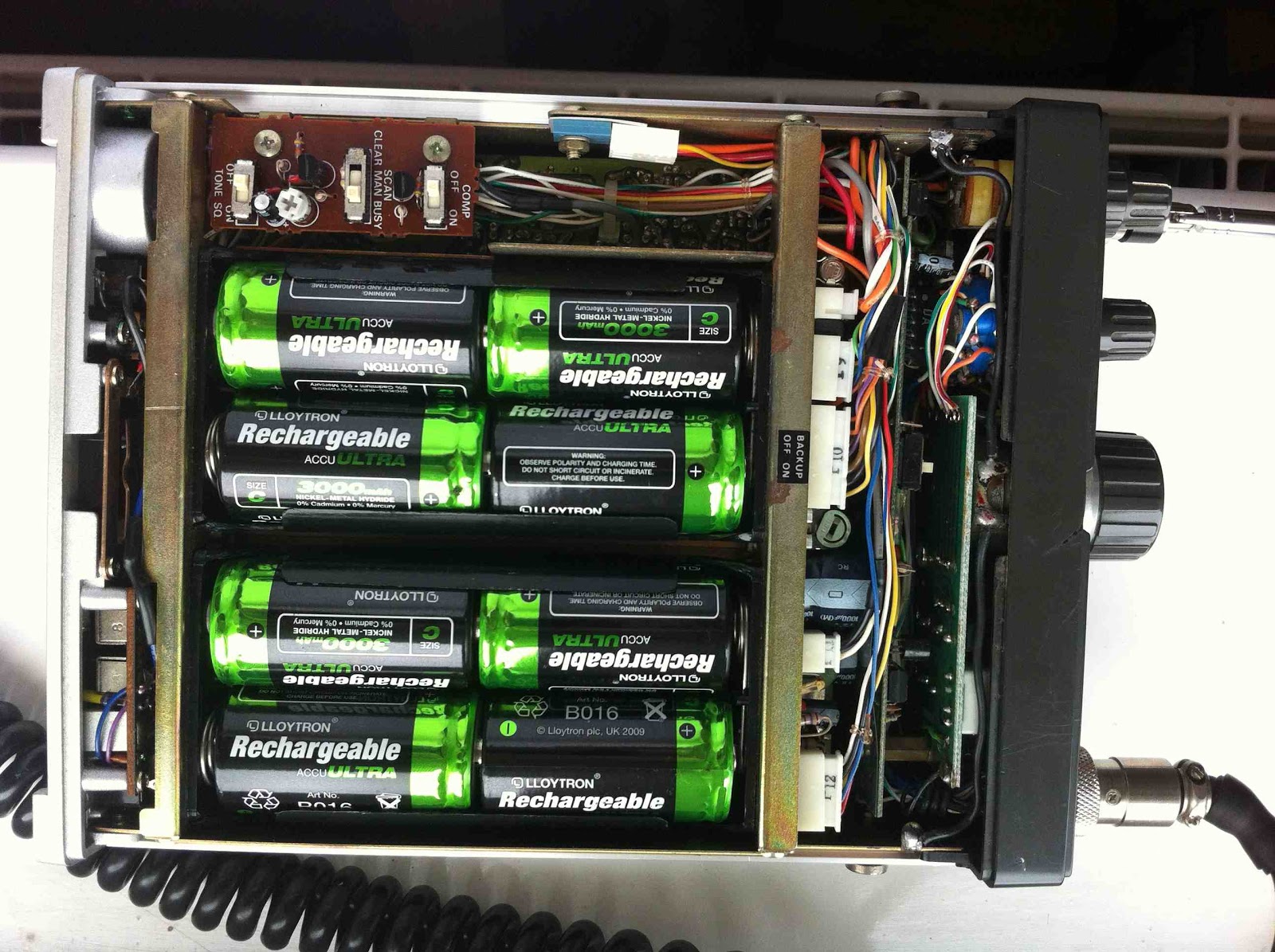 |
| Powered by 8 'C' cells |
 |
 |
| Anglesey to the Isle of Man |

Rob Law, MW0DNK, is a regular contributor to AmateurRadio.com and writes from Anglesey, Wales. Contact him at [email protected].
My Comments on FCC Proceeding 12-91
 At the direction of Congress, the FCC opened up Proceeding 12-91: COMMISSION SEEKS COMMENT ON EMERGENCY COMMUNICATIONS BY AMATEUR RADIO AND IMPEDIMENTS TO AMATEUR RADIO COMMUNICATIONS.
I decided to file my comments with the Commission, which can be read in full here. I’ll also provide the short version here:
1. The contributions of amateur radio operators during disasters and emergencies is substantial and well documented.
2. The key attributes that make the Amateur Radio Service so valuable in an emergency or disaster situation include the large number of trained operators available, the tendency for many amateur radio operators to prepare their stations for emergency operating conditions, the high degree of flexibility due to the wide range of spectrum and emission types available, and the ability of amateur radio operators to adapt to adverse operating conditions,
3. Restrictions from homeowners associations banning all external antennas is a serious and pervasive impediment to amateur radio emergency communications.
4. Limitations on emission type in Part 97 should be relaxed or eliminated.
5. There is the potential to improve the use of the Amateur Radio Service within the overall planning and organization of the federal government.
There are many different issues that could be highlighted but I decided to focus on these…with an emphasis on restrictive covenants.
What do you think? File your comments with the FCC here.
73, Bob K0NR
Bob Witte, KØNR, is a regular contributor to AmateurRadio.com and writes from Colorado, USA. Contact him at [email protected].
Thank you so much!
Thanks to all of you out there, who have so kindly shared your thoughts, prayers, kind comments here and elsewhere as well as e-mails that I have received during this difficult time. I am so blessed to have so many friends because of Amateur Radio, and this blog. Even if we’ve never formally met, I consider you all to be truly great friends. Please know you have my utmost appreciation and gratitude and that I will, in turn, be remembering you all in my prayers.
72 de Larry W2LJ
QRP – When you care to send the very least!

Larry Makoski, W2LJ, is a regular contributor to AmateurRadio.com and writes from New Jersey, USA. Contact him at [email protected].
A good 70MHz day
Some nice 70MHz Es today – mostly to the south east. Around lunchtime I worked IK0SMG (JN61) and IK5YJY (JN53). Later on, just before 1600z I was listening to a weak signal on 70.200 – I think an I4 which I was struggling to copy. Mark, CT1FJC heard me and called me at great strength. Really delighted to work Mark on a new band! Following that, Mark faded out and I was able to work another two Italian stations IZ5EME (JN52) and I0DLP (JN61). Conditions when I worked I0DLP were just perfect – he was a huge signal and very easy to work.

Tim Kirby, G4VXE, is a regular contributor to AmateurRadio.com and writes from Oxfordshire, England. Contact him at [email protected].
Another Birthday for PARP
When I started the practical amateur radio podcast on May 8th 2008, I really had no idea how long it would last or how big it would grow. Four years later (and my 5th season podcasting) I still continue to receive emails thanking me for doing what I do. I’m also frequently reminded of why I podcast, when I receive emails letting me know a new ham has his or her license as a result of the podcast. I very much enjoy creating the audio podcast, the video supplements and blogging. I consider it an extension of the hobby.
This blog post is what I referred to in episode 55 (just released today), as part of the PARP Birthday Trifecta. In other words, I typically use my Podcast, my YouTube Channel and this Blog to Elmer and promote amateur radio to anyone who will listen, watch and read. These avenues are referred to as new media.
Pacificon 2012

Speaking of new media, I’ve been invited to attend the 2012 ARRL National Convention and Pacificon in October of this year. I will participate in a panel discussion titled, “Amateur Radio New Media Elmering”. I’m very excited to share the stage with other “Big Names” in the new media elmering space. I’m sure you’ve heard of all three…
Chris Matthieu, N7ICE is the founder/creator/developer of the amateur radio social networking site 73s.com.
Randy Hall, K7AGE. Randy is best known as that YouTube guy. Randy is approaching his 6th year of using his YouTube channel to Elmer. His total video views surpass the 2 million mark.
FInally, the three of us will be joined by Mr. Elmer himself…Gordon West, WB6NOA. Gordo has helped thousands earn their technician license (and upgrade to general and extra) through his exam prep guides and excellent audio material. I’m proud to say I’m a three time graduate of Gordo’s material.
I’m truly honored to have the opportunity to meet these three gentlemen and share the stage to discuss our share passions for helping others and promoting this wonderful hobby. I’ll make certain to continue to provide updates as we get closer to the October timeframe. I hope to see you at Pacificon.
A Gift to You
In an effort to help celebrate PARP’s 4th birthday, I asked three popular amateur radio vendors to help me celebrate. In return, each have provided coupon codes you may use for a limited time to save money when purchasing items from their website. Consider it a gift to you.
It just so happened I was able to tie each of these three vendors into the educational/discussion segment in episode 55 of the practical amateur radio podcast. The topic of episode 55 is about programming your radio.
I would like to thank Nifty Ham Accessories, RT Systems Inc. and RFinder – The Worldwide Repeater Directory for helping me celebrate the 4th birthday of the practical amateur radio podcast. Please listen to episode 55 to learn about the coupon codes from Nifty Ham Accessories, RT Systems Inc. and RFinder – The Worldwide Repeater Directory.
Until next time…
73 de KDØBIK
Jerry Taylor, KD0BIK, is a regular contributor to AmateurRadio.com and writes from Colorado, USA. He is the host of the Practical Amateur Radio Podcast. Contact him at [email protected].
Reading about QSOs at unfeasibly high frequencies
Having been off work today with a stupid cold, I’d been doing a little reading around. I was enthused reading Roger G3XBM’s ever-interesting blog about the experiments that he is making at optical frequencies with 481THz experiments using LEDs. I remembered I’d had a QSO with Gordon G8PNN last year when he mentioned these experiments. Fascinating stuff!
What intrigued me is that these experiments have been going on for a while and that Australian amateurs have quite a history of experimentation in the field. I found and enjoyed ‘Optical Communication for the Amateur’ written by Chris Long in 1979 and later revised. Back in the UK, Eddie G0EHV has an interesting page on the optical experiments in the North East of England.
I wondered whether Dave WW2R/G4FRE had done any optical experiments. It turns out that he hasn’t, but his website contains details of some fascinating ‘First’ UK QSOs on 134GHz and 142GHz which I think you will also find fascinating.
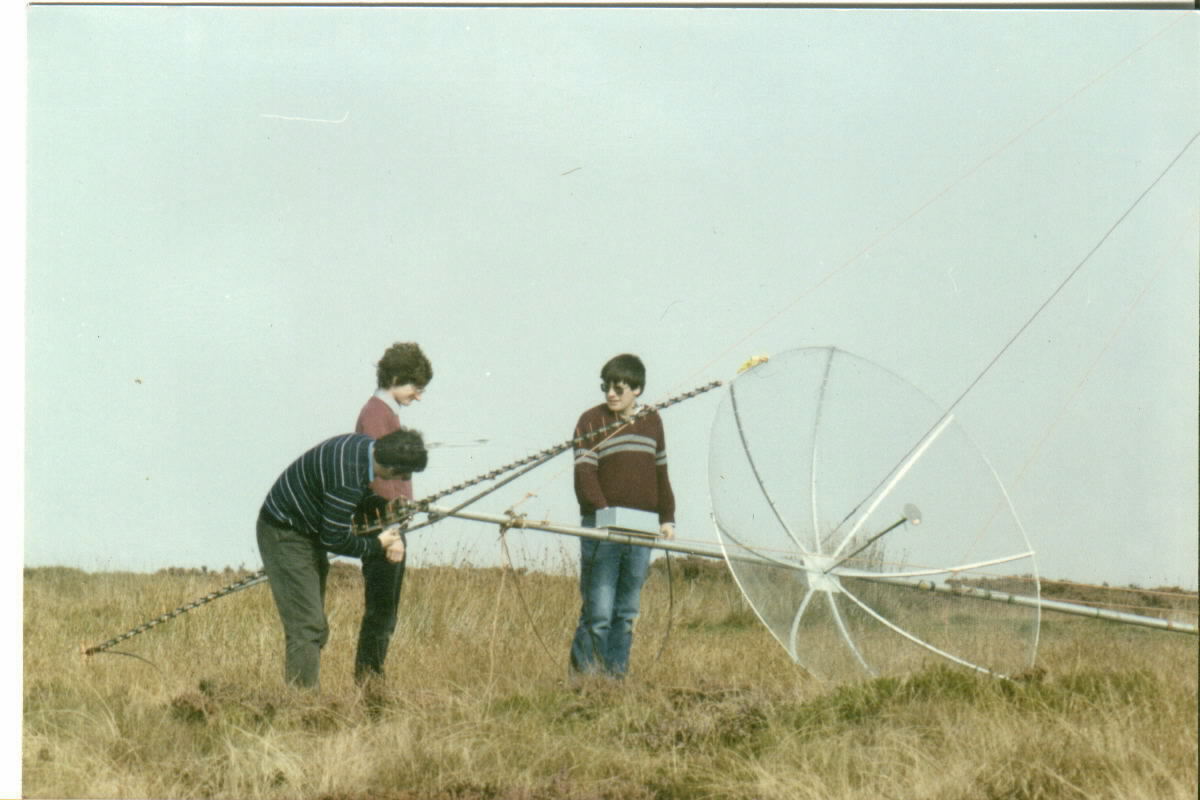
Oh and the picture? I took it off Dave’s website (Dave, I hope you don’t mind!). It shows a very youthful G4VXE in the middle (doing nothing, apparently), Kelvin GW4TTU to the left and Dave G4FRE on the right. We were on Mynydd Maen in South Wales preparing for a microwave contest. I’m guessing 1986 or 1987.

Tim Kirby, G4VXE, is a regular contributor to AmateurRadio.com and writes from Oxfordshire, England. Contact him at [email protected].
 Ham Radio Deluxe |
 W5SWL Electronics |
 Ham Radio Prep |
 KB3IFH QSL Cards  Hip Ham Shirts  HamRadioAuctions HamRadioAuctions Reliance Antennas Reliance Antennas Enigma Shop Enigma Shop |  morseDX  Ni4L Antennas  R&L Electronics R&L Electronics antennas.us antennas.us QRV QRV |
- Matt W1MST, Managing Editor
