 |
 Here in the USA
 16 June 2012 | by
 we are celebrating Father’s Day tomorrow. So from W2LJ to all my Ham friends around the world who are dads – Happy Father’s Day!

Being a dad has come a long way from what it was when I was a kid. Not to say that my Dad wasn’t involved, he was. But back in the day, Dad’s primary role was “The Provider”. He put in his time at work and when he came home, Mom made sure we didn’t bug him too much! He did his share of chores (yardwork and such) but Mom always made sure he got a chance to unwind and relax at the end of the day.
Today, I find myself way more involved with my kids, than my Dad was ever involved with me. This IS NOT a complaint, as I wouldn’t have it any other way – but it can be exhausting, especially when a school project or a game or whatever comes up after a long, hard day at work.
But you know what? This is exactly what I signed up for when I said, “I do”. My kids are the apples of my eye and I don’t ever want to go back to the life I had before they came. Not to say that it was bad, as it wasn’t; but the two of them have made life so much better.
Getting back to radio, that double CME that was foretold by Spaceweather.com didn’t seem to really put any damper on the bands. After a multitude of chores were completed, I got to relax at the end of the day down in the shack. I worked David MI0VKO in Northern Ireland on 17 Meters and on 30 Meters, had a very nice rag chew with Jeff, K8CQ who lives down on St. Simons Island, GA. The KX3 continues to impress, especially its ability to really dig super weak signals out of the background.
I did something the other day with it that really surprised me. And it was something very simple. I plugged in ear buds instead of using the internal speaker. Wow! The difference was amazing. I can only liken it to listening to a broadcast radio in the “old days” and switching from AM to FM. The change in fidelity and richness of the audio is remarkable. I’ve never experienced this with any other rig, including my K1 and K2. Eric and Wayne HAVE hit a home run here, and I’m tempted to say it was a Grand Slam.
Again, to all of you who are dads out there – Happy Father’s Day! And of course, my prayers go out to all the Dads who have gone before us and can’t be with us tomorrow.
72 de Larry W2LJ
QRP – When you care to send the very least!

Larry Makoski, W2LJ, is a regular contributor to AmateurRadio.com and writes from New Jersey, USA. Contact him at [email protected].
Show Notes #084
Introduction:
- No music this time; just one hour jam-packed with LHS goodness!
Announcements:
- Remember to sign up for the following LHS services:
- The LHS SubReddit
- The LHS Mailing List
- The LHS Mobile app. Follow our updates via the mobile applications available for iPod, iPhone, iPad and Android devices.
- Be an LHS Ambassador! Please join our Ambassador program. The event calendar has expanded quite a bit and we need your help. These events are now world-wide, so we could use some help outside the US as well as all over the country from California to Maine.
- YFKtest: Yes, there really does seem to be a problem. It’s been confirmed by John, EI7IG, that the program does not log contacts for the ARRL Field Day contest. Other contests work fine. Russ plans on emailing the developer, DJ1YFK, with these observations.
- From the “Yes, It’s an Antenna” File: Multi-band HF dipole made from horse fencing.
- Pulling a Lunduke: Holding Source Code Hostage. Our hosts discuss this blog post by Tom Nardi about Bryan Lunduke’s recent move to open source his software. Bryan is one of the hosts of The Linux Action Show.
Topics:
- Software Defined Radio (SDR)
- A common topic Russ encountered at Dayton was about the available Linux options for software defined radios.
- GNU Radio Project
- Version 3.6.0 released in early May, 2012.
- Version 3.2.2 is in the Debian Sid repository.
- The latest version can be retrieved with git. (Install git with the command “apt-get install git”.) To download the software, issue the command “git clone git://gnuradio.org/gnuradio”.
- Build instructions are available for most of the major Linux distributions.
- SDR Hardware
- Ettus USRP series works with the GNU Radio Project software. There are various models ranging in price from $700 to $2000, depending on the frequency range and options. Various modules allow receive and/or transmit on bands from 30kHz to 5.9GHz. Unfortunately, power output appears to be just 50-200mW, depending on the bands provided by the transmitter daughter board chosen.
- Funcube Dongle costs £128 (~$200) and is a receiver only. The Funcube Dongle is a “radio receiver designed to allow anyone to try their hand at reception of satellites like FUNcube”. It covers 51.5MHz – 1.7GHz, less the region from 1.1GHz to 1.2GHz.
- Perseus SDR costs $1000 and is also receive-only. It receives 10kHz to 40MHz.
- SoftRock SDR is a kit available in various models from $20 to $90. Most are receive-only, but the Ensemble is a 1W HF transceiver. Some models are unavailable at the moment. The SoftRock RXTX Ensemble Transceiver Kit will allow you to build a 1W transceiver for one of the following bands or band groups: 160m, 80m/40m, 30m/20m/17m, or 15m/12m/10m.
- RTL-SDR Devices range in price from $20 to $200 and are receive-only. More on the RTL-SDR project in an upcoming episode.
Feedback:
- Stewart, VA3PID, wrote to say that Russ was the first person, possibly ever, to correctly place his Scottish accent at Hamvention. He also remarked (in reference to a discussion in episode 71) that Chirp has come a long way; it can now program his Yaesu FT-857D!
- Jonas recently re-discovered LHS and expressed his appreciation for the show. Thanks, Jonas!
- Stefano, IZ3NVR/KD2BGM, asks for more help getting so2sdr built on his Linux machine. Russ suggests installing the compiler with “apt-get install g++ build-essential”, installing Qt and several other packages as described in Episode 83, then try building the so2sdr program again.
- Lastly, David Dominicki left a mostly unintelligible comment in response to Episode 78. Um, thanks… we think.
Contact Info:
- Contact Richard at [email protected], Russ at [email protected], or both at the same time at [email protected].
- Listen to the live stream every other Tuesday at 8:00pm Central time. Check the LHS web site for dates.
- Leave us a voice mail at 1-909-LHS-SHOW (1-909-547-7469), or record an introduction to the podcast.
- Sign up for the LHS mailing list.
- Sign up for the MAGNetcon mailing list.
- LHS merchandise is available at the Merch link on Web site. Check out the Badgerwear or buy one of the other LHS-branded items at PrintFection.com/lhs or Cafe Press. Thanks!
- Thanks to Dave from Gamma Leonis for the theme music.
Music:
- None.
Russ Woodman, K5TUX, co-hosts the Linux in the Ham Shack podcast which is available for download in both MP3 and OGG audio format. Contact him at [email protected].
Sending a message to Bletchley Park
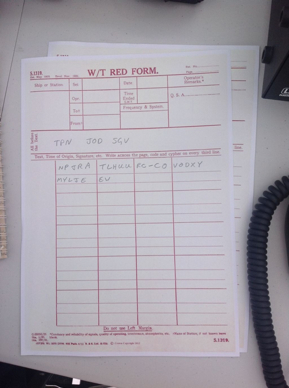
A couple of weeks ago when I was out for a walk I had a nice QSO with Giles, G0NXA who told me that the Cheltenham Amateur Radio Association were planning an interesting event in conjunction with the Milton Keynes Amateur Radio club as part of the Cheltenham Science Festival.
The plan was to establish a station in Imperial Gardens in Cheltenham where the public could write messages which would then be encrypted by an Enigma machine (owned by GCHQ!). The messages would then be sent to Bletchley Park using morse code. A special NOV was required for the messages to be sent in encrypted format.
At Bletchley Park, the messages would be received by members of the Milton Keynes radio club, where they would be transcribed and passed to the ‘Bombe Team’ who would try to decrypt the message using a replica of Alan Turing’s Bombe.
Decrypted messages would then be passed back to Cheltenham by Twitter.
This morning as I was going to the allotment, I worked the special event station in Cheltenham, GB5CSF and wished them well for the day. Then this afternoon, I was watching tweets from both Cheltenham and Milton Keynes clubs. Somewhat tongue in cheek, I asked if I could send a message to be encrypted, by Twitter. Very kindly, the Cheltenham team agreed.
I wasn’t sure what to send but settled on ‘LONGWORTH SENDS GREETINGS TO M-K’. I was later told this was one of the longer messages of the day!
I had a tweet back to say that the message had been successfully encrypted by the Enigma machine and was ready to be sent to Bletchley Park. I was able to see that the morse traffic between Cheltenham and Bletchley (GB5AMT and GB2BP respectively) was on 7.035 so I was fascinated to listen and copy the morse transmissions.
On Twitter, I saw that the Bletchley team had received the signals successfully and were collating them ready to be decrypted by the Bombe Team! Exciting.
After a very brief period of about 15 minutes, Bletchley tweeted the decrypts, including my message – to which they were kind enough to reciprocate the greetings! Fascinating and my very grateful thanks to everyone involved in the project for their efforts.
And of course, though it made for a fun afternoon, this was once very serious business. I remember with respect and admiration, teams of people, including Alan Turing who made this work when it really counted.
(Photo of my encrypted message is courtesy of Cheltenham Amateur Radio Association)

Tim Kirby, G4VXE, is a regular contributor to AmateurRadio.com and writes from Oxfordshire, England. Contact him at [email protected].
What’s Going On?
For the past several weeks I’ve been using my keyboard tapping, when not working on IT projects, mainly for coding, so my blogging has suffered a bit. Here’s what I’ve been up to in the Radio Artisan laboratory recently:

My Arduino CW Keyer code now supports six separate transmitter keying and PTT outputs and it’s no longer necessary to use PTT lines for transmitter keying line multiplexing. K1EL Winkey emulation mode has been enhanced to support Winkey 2 commands and has been tested successfully for SO2R operation. I’m currently working on LCD display code that will use the Adafruit RGB LCD Shield. This unit is really sharp looking and uses only two I/O pins for interfacing using the I2C protocol. I’m planning to use I2C a lot more in all of my projects in the future.
I have added to my Arduino Rotator Controller software brake control and “slow start” capability, and rotators with any starting azimuth and rotations of up to 719 degrees can be configured. If you’re not familiar with this project, you can interface nearly any rotator to any logging or control program. Experimental code for using the HMC5883L digital compass and ADXL345 accelerometer is included if you want to homebrew your own rotator and not use pots for reading azimuth and elevation. On the roadmap is support for the LSM303DLHC combination digital compass and accelerometer and the Adafruit RGB LCD Shield.
I’m currently working on an Arduino controlled balanced antenna tuner. I won’t go into all of the gory details here, but needless to say it’s going to be commercial grade, very configurable, and have QRP and QRO versions. No stepper motors or expensive roller inductors. This is going to be fun.
 If you subscribe to CQ magazine, be sure to check out my article in the June 2012 issue entitled “Summit Expeditions – Outdoor Radio Adventure Close to Home“. I talk about operating from Summits On The Air (SOTA) locations and give some thoughts on equipment choices and the benefits of outdoor operating. If anyone wants to invite me to a big time DXpedition in a cold, high latitude QTH, please send me an email :-)
So that’s what’s been going on here. Keep your software updated, your beverages cold, and your rig warm. 73

Getting in some operating time
tonight, because according to Ron WB3AAL and a post he made to the Polar Bear reflector, band conditions might turn into a mess this weekend:
Space Weather News for June 14, 2012
http://spaceweather.com
DOUBLE CME: Active sunspot AR1504 is facing Earth and hurling coronal mass ejections (CMEs) in our direction. A fast-moving CME that left the sun on June 14th is expected to scoop up another CME already en route and deliver a double-blow to Earth’s magnetic field on June 16th. Weak-to-moderate geomagnetic storms are possible when the clouds arrive. Check http://spaceweather.com for images and updates.
Tonight, band conditions are nice and I am having a blast. I had a very brief QSO with TJ W0EA and this ended up being my first KX3 to KX3 QSO. I am also hearing a lot of European stations and am able to work quite a few. But this just goes to show you ………..
My QSO with TJ was very brief because my signal to him was exceptionally crappy. I looked down and realized that I was still on the EDZ for our QSO. After signing with him, I switched over to the Butternut, called CQ again and got a 559 from OM7DX in the Slovak Republic.
The other night was a first for me. I heard my very first VU station – ever! For whatever reason, I have never even heard a station from India before. Hearing one the other night was an exciting first for me.
Ah, yes …. it’s Friday night, the work week is done, the weather is nice and I get to go on the radio. Great way to start Father’s Day weekend!
72 de Larry W2LJ
QRP – When you care to send the very least!

Larry Makoski, W2LJ, is a regular contributor to AmateurRadio.com and writes from New Jersey, USA. Contact him at [email protected].
My Son Passed His Tech!
My 16-year-old son, Antonio, has been studying hard for his Technician license, and yesterday evening three VE’s — Dean, NYØI, Scott, KBØNLY, and Terry, KCØQED — paid us a house call. When they showed up, I was out in the driveway installing a dual-band antenna on my pickup. They crowded around, watching me, helping where they could, and chatting while Antonio grilled steaks in the back yard. Pretty soon the aroma of grilled ribeye had our mouths watering!

Terry, KCØQED, left, and Antonio (nervously contemplating the exam), right
After one of the biggest feasts we have ever had, the testing began. Antonio was pretty nervous at first, but he breezed through the test easily. Terry scored it, turned to me and gave me a thumbs up! While the other two VE’s scored Antonio’s test, I went and got the Wouxon KG-UV6D HT (with leather case, high-gain antenna, speaker-mic, and emergency AA-battery pack) I’ve had waiting for him. He smiled as he opened the box and started taking things out and putting them together.  Antonio called Grandpa Mitchell, NØARQ, to share the good news. Just for fun he also took the General exam, and surprised himself by coming closer to passing than he expected — now he wants to study for that!
Antonio is interested in ARES® (he got an ARES vest yesterday, too), but he’s also interested in other aspects of amateur radio. Yesterday evening he said he would like to start up our CW lessons again so he can work HF CW, and he also wants to join the ARRL and the West Central MN Amateur Radio Club.
Here’s a slide show with a few more snapshots from yesterday evening. Congratulations, Antonio!


Todd Mitchell, NØIP, is a regular contributor to AmateurRadio.com and writes from Minnesota, USA. He can be contacted at [email protected].
Interesting night on 20 Meters
I kept the radio tuned to 20 Meters for the evening and had a variety of QSOs.
The first was with CO6RD, Reynaldo in Cuba. This wasn’t a long QSO as Reynaldo was working “contest style” racking up the QSOs. But I did get him on the first shot, even though a lot of stations were calling.
Next up was a busted QSO with Mike AA6WQ, who was operating from TN. We got through the QSO basics, only to have the band pull the rug out from under us. One minute we were going at it, next minute we couldn’t hear each other anymore. I guess that’s the way the cookie crumbles, sometimes.
With two short QSOs under my belt, I was thinking that might be how the evening was going to go. But my fears turned to be for nothing as the next QSO was an almost hour long rag chew with Paul W4KLY in Stone Moutnain, GA. This was an Elecraft to Elecraft QSO. Paul was using his K1 and (of course) I was on the KX3. QSB had a role to play; but in all honesty, when the band was not in fade mode, our signals were 599 both ways. We talked about rigs, portable ops and antennas and summer vacation plans. It was very enjoyable and it is truly amazing to see how fast an hour can go by on you when you’re having fun.
The last QSO for the night was with Rumi LZ2RS in Bulgaria. He was calling “CQ QRP” and I was lucky enough to be heard on my first call. Rumi was at 5 Watts; but what really made the QSO was his Yagi at 12 meters up, pointed my way. I was on the 88′ EDZ pumping out 5 Watts from my end also. Signals were a legitimate 559.
The bands have been so good lately! Not the best I’ve ever witnessed; but after the past few pitiful years, this is like Heaven (comparatively). I sure hope it stays this way for a while and doesn’t take a fast dive off a cliff into oblivion.
On another note, this new 9 cell battery that I got for the Acer is fantastic! I got it Monday and attached it to the netbook for charging. I’ve used it Tuesday, Wednesday, and tonight – about two to three hours per night. The indicator says it still has about another two hours left in it. Of course, I have Windows set for “Max Battery Life” through the control panel, but even so, this is way outlasting the old battery. That one gave me about two hours computer time, tops. This battery should be able to get me through a four hour sprint (outdoors) without breaking a sweat.
72 de Larry W2LJ
QRP – When you care to send the very least!

Larry Makoski, W2LJ, is a regular contributor to AmateurRadio.com and writes from New Jersey, USA. Contact him at [email protected].
 Ham Radio Deluxe |
 W5SWL Electronics |
 Ham Radio Prep |
 KB3IFH QSL Cards  Hip Ham Shirts  HamRadioAuctions HamRadioAuctions Reliance Antennas Reliance Antennas Enigma Shop Enigma Shop |  morseDX  Ni4L Antennas  R&L Electronics R&L Electronics antennas.us antennas.us QRV QRV |
- Matt W1MST, Managing Editor
