 |
 The Six Metre vertical is full of surprises!
 18 June 2012 | by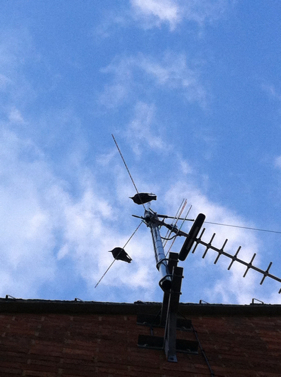
With the IARU Region 1 50MHz contest over the weekend, I heard a few grumbles that conditions weren’t that good. Certainly it wasn’t end-to-end Es but I thought it was interesting.
For me, I worked a few 9A, YU, E7 and S5 stations at the outset and then it went quiet. Actually, that was interesting as I could concentrate on working some of the more distant UK stations on ‘tropo’. GJ6YB/P was a nice one – I waited for signals to fade up and worked them on CW on a peak of QSB. Typically, their signals were much louder on Sunday! Whilst I was listening to them GM2T called and worked them. What propagation was that? Not Es or MS, but very solid. Tropo scatter? Impressive copy on the vertical.
GW2OP/P in IO71 was another nice one over a decent distance, as was the Five Bells Group, G5B.
On Sunday morning IF9/I2ADN came up and caused a stir (and some not great operating from people who clearly spend their time in HF pileups. Nuff said).
By the time we got back from family visiting, the contest was over, but there was a little Es with 4O3A, 4O4A and IW4AOT worked amongst others and a weak IK4 heard on 70MHz.
And the birds find the vertical useful too.

Tim Kirby, G4VXE, is a regular contributor to AmateurRadio.com and writes from Oxfordshire, England. Contact him at [email protected].
I Love It When a Plan Comes Together

Three of Mr. Fagen’s beautifully-restored, award-winning aircraft. Photo copied from fagenfighters.com.
Weeks ago I called Fagan Fighters & Warhawks, Inc. inquiring if they could use help with communications at the Ray Fagen Memorial Airshow on Saturday, June 16. The answer was yes! They had a gap in their communications between the airport and their remote parking lots. I put out a request for volunteers and started doing some tests. The challenges I faced were:
- Terrain and distance: The first overflow lot was at a casino located quite close to the airport but down in a valley. The other overflow lots were located in the City of Granite Falls itself, down in a valley and far enough away to make it impossible for handhelds to communicate with the airport.
- Intermod: The AWOS (Automated Weather Observing System) station on the airport blows away my handheld on some 2 meter frequencies.
- Manpower: Out here in the sticks finding ham-volunteers is not easy.
Repeater coverage is patchy out here and not an option for handhelds at the airport. It quickly became apparent that to conquer terrain and distance we would need to set up a station on high ground running either as a net control station or as a cross-band repeater. Since I wanted to run a net anyway, I elected to simply run a simplex net. CTCSS would be necessary to combat intermod at the airport. I drove around until I found a likely spot at the top of a bluff roughly midway between the airport and the City of Granite Falls (where some overflow lots were located), and I secured permission from the property owner to set up a net control station for the airshow. After tests demonstrated significantly better performance on 70cm than 2m, I settled on 70cm, specifically MN ARES simplex channel HU-CHARLIE, 443.000 PL 203.5. I worked with a fellow at the airport and tested to make sure we would not interfere with their radios, then announced the plan by email to the group of volunteers who were forming up.
I was overwhelmed by the willingness of these volunteers (KCØPMF, ABØRE, KDØQEA, KCØQNA, KØNUT, KCØYBG and KCØYFY) to drive all the way out here, especially considering that they knew they’d be stuck in parking lots during the airshow. We needed their help since there aren’t very many active hams around here that I know of. Including myself we had eight hams lined up for Saturday morning.
After filling a cooler with water bottles, pop and ice I zipped over to the airport early on Saturday to find out who was in charge of parking. When I introduced myself to him I found out he had not heard anything about our involvement. I gulped, then explained that a ham would be assigned to shadow him and relay messages between him and remote lots. I encouraged him to ask anything he wanted of his shadow and we’d try to get it done for him.
 When I set up as net control high on the bluff around 10:30 A.M., I assigned tactical call signs to make things easier: the ham shadowing the parking-director was AIRPORT-1, his partner was AIRPORT-2, the hams at the hayfield lot were HAYFIELD-1 and HAYFIELD-2, the hams at the gate were GATE-1 and GATE-2, and the ham at the casino was CASINO-1. At first I wasn’t sure just how helpful we would really be, but pretty soon we were very busy! Without us the parking-director had no way of knowing how full the lots were getting (information he needed to redirect traffic to the next lot) nor where the greatest demand for buses was at any given moment. We helped him with these things as well as a couple of miscellaneous tasks, including a search for two missing children (who were soon found). We finally shut down at 4:00 P.M. after the flow of traffic died, and then we all met at the airport office for a debriefing.
The parking-director said that at first, when I introduced myself to him that morning, he was a little irritated because he had no idea we were coming. I don’t blame him! My fault for not tracking him down. But after having worked with us, he said, “I don’t ever want to do another airshow without you guys!” He was positively glowing as he continued to praise us. I credited the volunteers who did the real work that day, and I encouraged the parking-director to spread the news about what we can do. This was a great opportunity to demonstrate our capabilities and work out some kinks in communicating in this area, too.
So many things came together to make this happen. Not only did these volunteers drive in from up to 80 miles away, but several others helped me prepare. Alfio Levy, KJ6JGS, went the extra mile and priority-shipped the Kenwood TM-V71A rig I bought from him last week so that I could get it installed in my pickup in time for the airshow. Caleb Streblow, the fellow who is courting my daughter, machined a bracket for me last week so that I could get a dual-band antenna mounted on my pickup. And Andrew Rosenau, KCØYFY, lent me his crimper, supplied me with Anderson Powerpole connectors, zipcord and fusing, and helped me with testing our radios around the area prior to the event. My thanks to all!


Todd Mitchell, NØIP, is a regular contributor to AmateurRadio.com and writes from Minnesota, USA. He can be contacted at [email protected].
How Not to Do a SOTA Activation
This weekend my wife and I were out exploring the San Juan Mountains near Ouray, Colorado. We found ourselves on a Jeep road to Engineer Pass. When we got to the pass, we stopped to have lunch and I examined the high peaks nearby. I saw some people on the summit of one of the peaks, which I determined was Engineer Mountain by looking at a topo map.
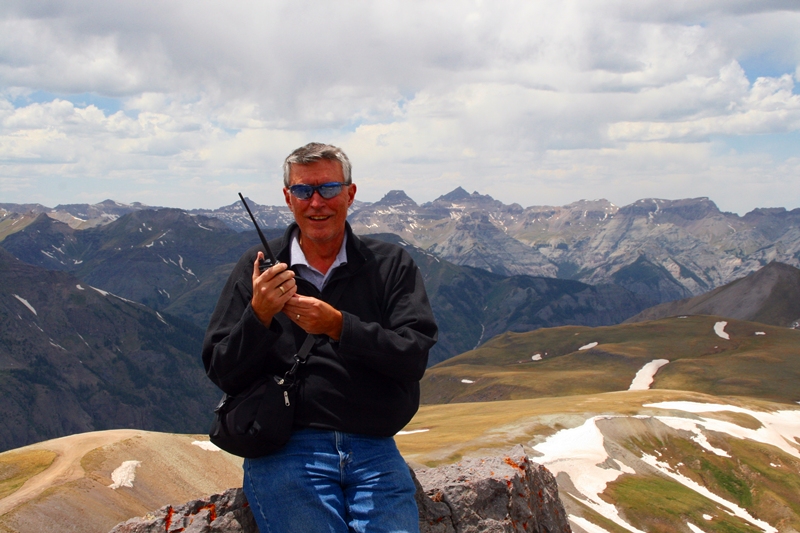
Hmmm, I said to myself, Engineer Mountain is a valid peak (W0/SJ-011, 12968 feet elevation) for a Summits On the Air (SOTA) activation. The only portable radio I had with me was a Yaesu VX-8GR with the stock rubber duck antenna. Not a great SOTA station. But if I could whistle up 4 contacts on 2M FM simplex, I would have a legitimate activation. We had already decided to climb to the summit, so any radio activity was just icing on the cake.
So off we went up the mountain. I got to the top and started calling on 146.52 MHz FM. Now it hits me that we are in the middle of a national forest, away from population centers and, to top it off, no one is expecting a SOTA activation here today. This might be a bit of a challenge to make 4 contacts. Then Thomas, KRØNK, answered my CQ. OK, there’s one contact. A little bit later Dave, AKØMR, comes on frequency and gives me a second contact. Both of these guys were in Grand Junction, CO, which is about 100 miles from Engineer Mountain. Not bad for a peanut-whistle HT using a standard rubber duck antenna.
I needed two more contacts. I tuned around for a repeater in the area and came across the 147.27 MHz machine which turned out to be a stones throw away from my location. It requires a CTCSS tone, so I fumbled around until I figured that out. No, I did not have a repeater directory with me…that was safely stored in the Jeep at the bottom of the mountain. I gave a quick call with my location and Ben WB5ITS came back to me. We QSY’d over to 146.52 to make my third contact. Anticipating a rough go of it, I asked my wife Joyce K0JJW to descend off the peak while I remained at the top, so she could be my fourth contact. (SOTA rules do not allow contacts between parties on the same peak.)
Somewhere along the way, I reach for a piece of paper to log the contacts, only to find that I did not have a writing utensil with me. Duh. I would have to remember the times and callsigns of the contacts and write them down later.
I completed the fourth contact and headed down. Later that evening I checked the ListsofJohn database and found that there are actually two peaks in the area called Engineer Mountain. Go figure. The SOTA database only recognizes one of them…of course, you guessed it, not the one I was on. It turns out that the Engineer Mountain I was on is subordinated by an adjacent peak: Darley Mountain (W0/RG-034, 13260 feet). However, since I operated from 13,218 feet on my Engineer Mountain, it is within the 75 foot vertical activation zone for Darley Mountain. So, this does count for a SOTA activation of Darley Mountain.
This is where I could claim that incredible skill, flexibility and a little luck ruled the day. I think a more appropriate analysis is to concede that a complete lack of planning and preparedness produced a marginal result.
What can we learn from this?
- Do your homework concerning the SOTA peak that you intend to activate before you start the climb. Make sure you know where it is and that you are really on it.
- Always keep a notepad and pen/ pencil in your backpack
- Even for casual hikes, take along a decent antenna for the HT. A half-wave vertical is way better than a stock rubber duck.
- Plan in advance so you can post your intended SOTA activation on sotawatch.org
- Have a repeater directory (or equivalent) available to identify repeaters in the area.
- And don’t forgot the normal hiking Ten Essentials
Beyond doing a SOTA activation, some of these items could be important if an emergency should occur. It runs out there was no mobile phone coverage in the area. I used to be pretty vigilant about taking an HT with spare batteries and extended antenna along on hikes but have gotten sloppy lately. See Rescue on Uncompahgre Peak, which describes an incident years ago when my radio turned out to be very useful during an emergency.
In the end, I did complete my first SOTA activation, so I can be happy about that. And it gave me the opportunity to relearn a few things about planning and being prepared.
73, Bob KØNR
P.S. The WØ SOTA guys recently created a great W0 SOTA page.
Bob Witte, KØNR, is a regular contributor to AmateurRadio.com and writes from Colorado, USA. Contact him at [email protected].
Live MUF by G7RAU
Whilst I was scanning the 6m band during my white noise listening experience (or UKSMG 50Mhz Summer Es contest) I started a little googling and came across a tool that I hadn’t used before. From the website description it calls itself a ‘DX cluster (DXC is its name by those in the know) telnet client which attempts to resolve propagation modes from spots and also attempts to calculate sporadic e possibilities purely based on incoming data from the cluster’
It uses a great circle map and a the ON4KST telnet client as well all from the comfort of a single simple desktop. A little screenshot is below for reference based on my settings and a bit of ‘personalisation’

The software seems to be developed for those with an interest in 2m really but works well for 6m as well as I found out to my surprise on Friday evening when I was hit by a wall of QSO’s from all round me. Live MUF showed a whole range of spots almost like a cloud on the screen moving from the south east of the great circle map up to just below me on the south coast where the yellow patches in some cases had turned red.
Whilst I am increasingly sceptical of propagation prediction tools I think as this is based on actual data it has saved me quite a bit of time and heartache having this running in the shack telling me if I am likely to be lucky enough to be involved in any QSO’s.
If this is your thing and you’ve already come across it then this won’t be news to you, but if like me you’re gun is more like a 99p water pistol (And I’m talking about it in a radio sense before we get carried away) then give it a try. As far as I can tell there is no installation as such it just runs an executable file and so could be used portable from a USB drive if you desire. There is also a web based version for those who might like to take a look when away from the shack. Have a look here (ps the site seems to be down at the moment but hopefully not for long).
Alex Hill, G7KSE, is a regular contributor to AmateurRadio.com and writes from Cumbria, UK. Contact him at [email protected].
Packs and Crowds
We humans are a strange breed. We all need to be member of a pack, but at the same time stand out from the crowd. I am no different and I am happy to belong to the pack of radio amateurs. Standing out of that crowd of hams is a bit more difficult: I have a modest station, don’t do terribly exciting things, am not an inventor nor innovator, I just enjoy the hobby in my own quiet way, including collecting QSL cards.
Now there is something you can be different in! Most QSL cards nowadays are very non-personal, run-of-the-mill photo cards, designed and printed by a handful of companies. Not for me, I want it special. Very special.
I am a man of many trades and skills, but drawing is not one of them. Really, it is not. Has never been, will never be. But how much more personal can you get if you can draw your own card, with yourself in it? So there is a challenge, but quite a fun one.
I started of by brainstorming: I live in Longtan, which means “Dragon Lake”. Maybe the dragon is not too happy with me filling the airwaves, so he emerges from the lake. Next step, search the internet for pictures of dragons, lakes, mountains, radio operators and myself. I then started the GIMP (that’s Photoshop for you non-free software users) and made a composition with the images I had found. Now that’s where I shine: within an hour I had my idea on screen and it wasn’t too bad either.
Of course, there were 10 different styles of drawing in that composition. But I work in a school with many talented children and I happened to have beef with a kid who is very good at drawing. So when he had to report himself to the office little did he know that after a stern speech from me I asked him to make up his wrong-doing by doing something right for me. He agreed and I showed him my computer generated composition. He said he could make it into something better, so he did and a few weeks later he had it done. I scanned it in, cleaned it up and used Scribus (that’s QuarkXpress for you non-free software users) to add text to the design.
So here it is, finally, the new BX2ABT QSL card………

Printed in beautiful black and white, on elephant tusk paper (can’t help it, that’s how it is called), double sided, for a mere 15 Euro/20 US$ for 500 cards. That is where Taiwan still shines: cheap and fast printing. Want one my cards? You will have to work me and that won’t be easy because the coming month we will be in the Netherlands. BX2ABT is transforming into PA2BX again. So where did I put those QSL cards…..?
Hans "Fong" van den Boogert, BX2ABT, is a regular contributor to AmateurRadio.com and writes from Taiwan. Contact him at [email protected].
Cool Field Day Visit
 A few days ago I received this announcement from the ARRL Eastern PA Section Manager, Bob Famiglio, K3RF:
“As EPA Section Manager, I have received a number of invitations to visit the field day sites of ARRL affiliated clubs. As an ARES District Emergency Coordinator for many years, I enjoyed visiting field day sites in my five county district from time to time. The challenge now, however, is how do I visit sites throughout the EPA section during the actual operations? I would have to sprout wings. But wait, maybe I can.
As some of you know I hold an FAA private pilot certificate. I am
fortunate to be acquainted with another ham pilot, Jim Goldman, W3JG.
Jim is not only an experienced pilot, but also owns his own late-model
Cessna 182 aircraft. What’s more, Jim’s aircraft was professionally
fitted with an extra antenna for 2 m and 70 cm. Having had the pleasure
of flying with Jim in the past, I suggested that we plan a field day
trip as a salute to as many ARRL club sites as we could comfortably
visit from the air. Jim likes the idea so we are on. Naturally,
weather, flight restrictions and safety considerations may limit what
we can do in certain instances. However, our tentative plan is to fly
over as many field day sites as practical, perhaps dip a wing in salute
and provide a contact as aeronautical mobile as well.”
Jim goes on to talk about frequencies, logistics, and how to request a fly-by visit. I think this is a wonderful idea. It’s great to see such creative thinking in amateur radio and ARRL leadership.

Dad’s Sony (re-post for Father’s Day)
 My father was not a technical guy. He knew numbers. In the early days of our family business, my mother kept the books, and answered the phone at the house, while dad revolutionized the dental products business in the northeast. My brother Paul ran the stockroom, and I would help, usually reluctantly in the beginning, with some of the basic tasks that a nine-year-old could handle. My oldest brother Lee joined later, and became, and still is, one of the best Dental Equipment specialists in the business. You see, dad took his skills as a supermarket manager, and combined it with the business model of SnapOn Tools, and created MoDent, and for more than 15 years, made the competition wonder how he pulled it off. Dad passed away in California in 2009, and in his honor today, I would like to re-post something radio-related from my own blog I wrote about him. Happy Father’s Day dad!
(Dad’s Sony was originally published here at my blog Fofio! in April of 2011)
My father grew up in the ‘Radio Era’ which made him more radio-aware than my children are now. He  was by no means a hobbyist, but knew enough to tell good from bad. He knew that AM radios had to be turned for best reception, and a good swiveling whip antenna was necessary for FM reception. For him, the radio needed to be able to pick up his NPR stations, WCBS-AM, and get the Mets games when he was on the road.
I ran a sales territory for our family business. As Dad got older, he eventually came off the road, and ran the company from inside. Every now and then though, he would schedule to ride with one of his salespeople to keep an eye on things. He rode with me for few days once on my Northern New Jersey run. Thursdays on that run, I would sometimes stop at the offices of Gilfer Shortwave, and chat with the Jeanne Ferrell & Paul Lannuier. I had purchased several radios there over the years, and would buy the various shortwave books and guides from them as they were released.
That one Thursday that Dad came along, he got a kick out of Gilfer, and all of the radios. He and Paul talked for a bit, and he purchased a Sony ICF-SW20. Partly because he really liked the quality of the little radio, and partly because I think he liked the folks at Gilfer as much as I did.
Dad had this radio from then, till he passed away in December 2009. It was his main radio. I saw it on his nightstand, in the bathroom, and on trips back east to visit us. Even with all of the selling and swapping I’ve done lately with my radio collection, I will never get rid of this radio. To me it was an acknowledgment from dad that my interests in radio were appreciated, and is a memory of the man I miss. It currently lives on my desk at work, sometimes called to duty for news, and music. Thanks for the radio Dad! I’ll pass it down the line someday to Alec.
The Sony is still on my desk at work. Another note here: Dad always wanted me to get my ham license, and even bought me the equipment when I was a kid to encourage me. I wish he was around to see how much I enjoy this hobby, and how it has helped me find some of the best people I have ever met. 73 dad!
Neil Goldstein, W2NDG, is a regular contributor to AmateurRadio.com and writes from New York, USA. Contact him at [email protected].
 Ham Radio Deluxe |
 W5SWL Electronics |
 Ham Radio Prep |
 KB3IFH QSL Cards  Hip Ham Shirts  HamRadioAuctions HamRadioAuctions Reliance Antennas Reliance Antennas Enigma Shop Enigma Shop |  morseDX  Ni4L Antennas  R&L Electronics R&L Electronics antennas.us antennas.us QRV QRV |
- Matt W1MST, Managing Editor
