 |
 Hot, hot, hot!
 29 June 2012 | by
 Years ago, that was the title of a song by Buster Poindexter. That title is very apropos for this coming weekend. Just to give you a little of our flavor – here it is 10:20 PM and it’s still 82F (28C) outside. When I got to my car to come home from work, the Jeep’s thermometer read 101F (38C). I thought to myself, “Yeah, that’s because the car was sitting in the sun, it will cool down as I move and I’ll get the real reading in a few minutes”. Ten minutes later, the temperature did indeed drop, all the way down to 100F. One degree!
This weekend is going to be brutal as this is supposed to last right through Monday. It’s a good thing we had the air conditioning fixed last week. At least we’ll be able to sleep in relative comfort. No matter how bad it gets, though, in my mind this is better than 6 inches of snow and 22F outside. I’ll deal with this any day of the week!
Two cool (pardon the pun) events took place tonight. First, yours truly, one of the most inept people on the face of the Earth when it comes to figuring out COM ports and such stuff, managed to download the KX3 utility from Elecraft. Not only that; but I got it to work! I downloaded from the Elecraft server and then uploaded into my KX3, the latest version of firmware. And I discovered that using the KX3 utility, that you can enter a start up banner. So now, when I turn the rig on, where the secondary VFO display normally is, you see “W2LJ’s KX3” for a few seconds before that changes over to the normal VFO display.
Second cool event:
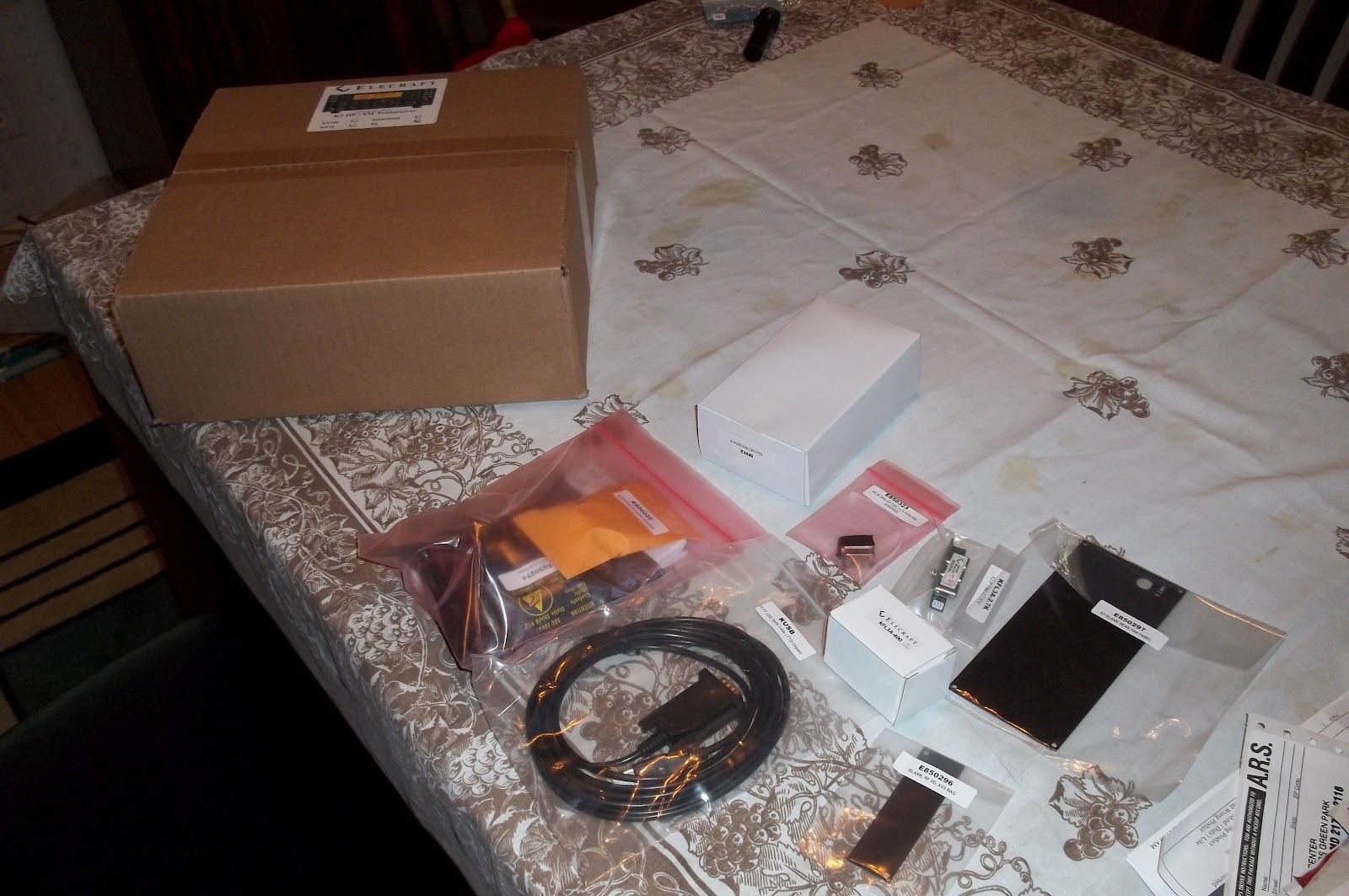
I completed the K3 inventory. Everything was there! Well, just about everything – I am missing three #6 split ring washers. But I can pick those up (or an equivalent) at a local hardware store. None of the screws were missing. In fact, there was OVER the amount needed and that does NOT include the extras that can be found in the Elecraft spare hardware bag. The picture above does not do the situation any justice. When I opened up that big cardboard box, it was jam packed with bags, envelopes, static bags and other things. By the time I was done, the entire table was covered with Elecraft goodies – you couldn’t even see the table cloth.
I am hoping to start the build tomorrow night after all Saturday’s chores are done. I am also hoping for a chance to run over to the park on Sunday with the KX3 a battery and some wire, If I get the opportunity, I will post myself on QRPSPOTS and maybe we’ll run into each other on the air!
By the way, we’re up to 75 Skeeter numbers given out for the NJQRP Skeeter Hunt to be held on Sunday, August 12th, I’ll be handing out numbers right up to the day before; but don’t be part of the last minute rush! Get yours today by sending an email to [email protected]
And no, to answer all of you out there who are concerned about FOBB – I have not heard anything new. I have no inside information; and in fact, there may be more of you out there who have better info than I do!
72 de Larry W2J
QRP – When you care to send the very least!

Larry Makoski, W2LJ, is a regular contributor to AmateurRadio.com and writes from New Jersey, USA. Contact him at [email protected].
Arduinos in Space and On The Air
Recently the Arduino has been making its way into the skies. ArduSat is a project to build and launch an Arduino-powered satellite into space. Here’s a video describing the project:
 A little closer to Earth, Michael Doornbos, N4LNX and founder of Evadot, is working on an Arduino-based board for using in balloon payloads. The unit is called FireFly and features wireless capabilities, a data acquisition and storage subsystem, and is solar power ready. It’s intended to pack a lot of functionality in one easy-to-use unit and save time and effort for those building payload computers for high altitude balloon experiments.
Here’s a short video showing reception of data bursts from a FireFly on a Yaesu FT-857:
This project is really timely considering the recent increase in interest in balloon experiments in amateur radio.

AlexLoop teams up with KX3
Just a few days after I wrote that the AlexLoop WalkHam is a great companion for the Elecraft KX3 and here is a video by Steve WG0AT showing the combo in action.
5 and 9 using QRP SSB! I can’t wait until I’m fit enough to take the KX3 and loop to the outdoors myself.

Julian Moss, G4ILO, is a regular contributor to AmateurRadio.com and writes from Cumbria, England. Contact him at [email protected].
KX3 is extremely Fox worthy
I used my KX3 for the first of the 2012 Summer 20 Meter Fox hunts tonight – and it was great!
Using the K2, you hit the “split” button and you tune each, VFO A and VFO B with the same main tuning knob. You have to switch back and forth between the two VFOs in order to tune each one.
Not so with the KX3! Hit “split” and tune VFO A with the main knob and tune VFO B with the smaller, side tuning knob. No need to keep switching between VFOs to tune each one! This made things so much easier.
I worked Paul K4FB pretty much right off the bat. Don NK6A in California was more of a challenge. He was weak, but was picking up in signal strength as the hunt progressed. Nabbed each pelt using the Butternut vertical.
This was a great way to start the Summer season. Hope it stays this good!
72 de Larry W2LJ
QRP – When you care to send the very least!

Larry Makoski, W2LJ, is a regular contributor to AmateurRadio.com and writes from New Jersey, USA. Contact him at [email protected].
A visit to the Wythall Club and some 50MHz bicycle portable….
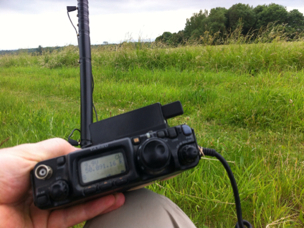
On Tuesday evening, I made the 80 minute or so trip up the M40 to visit the Wythall club in south Birmingham to present the ‘My World of VHF’ talk to them. It was a very enjoyable evening – the meeting was well attended and there seemed to be more interest in VHF matters than there sometimes is. Thank you to all everyone at Wythall for their warm welcome and a fun evening. It’s always interesting presenting the talk as it’s a reminder to me of the various aspects of VHF/UHF operation. Somehow talking about simple 50MHz portable activity struck a chord with me.
And so it was this morning that I headed out on my bike with the FT-817, the ATX Walkabout antenna and the Baofeng UV-5R. I rode up onto Windmill Hill, a couple of miles from here.
I knew 50MHz had been in and out as I’d made some QSOs from home before I headed out. Although I didn’t make any 50MHz QSOs, it’s always interesting to listen on the little whip antenna – and to hope that signals will come up. The furthest I heard was an LZ2 station and the strongest was an EA5, but not really strong enough for a low power QSO. Once again the GB3MCB beacon from Cornwall was audible and I heard a station from the South West (IO70) – so it’s a fair path over the Ridgeway.
Funnily enough as I was packing up, I overheard a QSO on a 145MHz repeater about how there was never any activity on 50MHz. Really?

Tim Kirby, G4VXE, is a regular contributor to AmateurRadio.com and writes from Oxfordshire, England. Contact him at [email protected].
What can you do?
When your PSU gives in, a replacement part costs an arm and a leg and 6m is up?
Not a lot it seems. My ft817 was hearing a lot of eastern and western European stations but with 5w max and a home made antenna you’re not going to get far despite some patient operators on the other end.
Still it was worth a go and thanks to DL5EL for letting me have more than my fair share of attempts.
Alex Hill, G7KSE, is a regular contributor to AmateurRadio.com and writes from Cumbria, UK. Contact him at [email protected].
A QRP Family Holiday on Prince Edward Island, Canada

VY2 portable K4SWL!
This year, during our family’s summer holiday, I’m enjoying the hospitality of Prince Edward Island, Canada (hence, the lack of recent posts). This is our family’s second visit to the maritime island, and each time we’ve been fortunate to stay at the same off-the-grid cabin on the eastern coast, less than twenty meters from the water.
Of course, staying in an off-grid cabin comes with its radio challenges—namely, supplying power—but also comes with one supreme advantage: no noise from the typical electrical devices that plague most of our homes. What’s more, this cabin sits on 60 acres, so not even a neighbor’s home appliances disturb my RX ears.
On our previous visit, I brought my (then) Yaesu FT-817, a 9aH gel cell, Micro M+ charge controller, 10W Solarex PV panel, some 300 ohm window line, loads of 22 AWG wire and an LDG ATU. Unfortunately, I found I had very little time for radio, and propagation was dismal. Indeed, it was during that trip that I discovered my FT-817’s finals had blown, so part of the time I was transmitting less than QRPpppp levels.
This year, since I knew the site well, I came better prepared.
My full 2012 setup consists of the following:
- An Elecraft K2/10
- An Elecraft KX1 (4 band w/built-in ATU)
- Elecraft T1 ATU
- LDG 4:1 Balun
- One 35 aH gel cell
- Two 9.5 aH gel cells
- Two PowerFilm Solar foldable 5 W PV panels
- My radio toolbox with various connectors, crimpers, cutters, wires, caps, multi-tester, etc.
- Enough wire and 300 ohm antenna line to make a couple of wire antennas
So…how’s it all working out? Brilliantly!
In the past few years I’ve done a lot of QRP CW—mainly rag-chews with some buddies on the lower bands. I’ve done less QRP SSB phone. When I first arrived at the cabin and began the process of unpacking, I couldn’t find the jumper cable to attach to my Vibroplex single-lever paddle (the paddle being a Dayton 2012 find, by the way). So, I plugged in a microphone and tuned to the phone portion of the 17 meter band.
Talk about radio fun!
I’ve once again re-discovered the joy of operating QRP SSB. It’s challenging to make those DX contacts and to transmit a long call sign (“VY2 portable K4SWL”) across the ether, but occasionally the propagation gods smile upon you, and you’re able to participate in a good rag-chew or quick DX with a 57 to 59 signal report.
Being 20 meters from the salt water is a bonus I don’t usually enjoy in my US hermitage. Due to its excellent propagation characteristics, despite my lower power set-up, I have easily worked stations from Russia to North Africa, from the Caribbean to Japan. I am thoroughly reveling in it, and the process has re-connected me with my ham radio roots.
As Gunter, VA3GA, told me in a recent Canadian rag-chew, “ham radio holidays give you a chance to explore areas of the hobby you don’t normally think to enjoy.”
So true, Gunter. That’s what I love about ham radio in general– the hobby is so broad, you constantly discover and re-discover favorite elements about it.
Tom Witherspoon, K4SWL, is a regular contributor to AmateurRadio.com and writes from North Carolina, USA. Contact him at [email protected].
 Ham Radio Deluxe |
 W5SWL Electronics |
 Ham Radio Prep |
 KB3IFH QSL Cards  Hip Ham Shirts  HamRadioAuctions HamRadioAuctions Reliance Antennas Reliance Antennas Enigma Shop Enigma Shop |  morseDX  Ni4L Antennas  R&L Electronics R&L Electronics antennas.us antennas.us QRV QRV |
- Matt W1MST, Managing Editor
