 |
 FOBB for 2012 is on!
 1 July 2012 | by
 Read all about it and apply for your FOBB number here:
http://www.ARSqrp.blogspot.com
Thanks to Rich Fisher KI6SN and the Adventure Radio Society for keeping this fun Summertime QRP tradition going!
72 de Larry W2LJ
QRP – When you care to send the very least!

Larry Makoski, W2LJ, is a regular contributor to AmateurRadio.com and writes from New Jersey, USA. Contact him at [email protected].
Portable on White Horse Hill (Simplex DSTAR QSOs)
In the middle of last week, I thought it would be nice to have some time off, climb some hills and sit by some rivers. These sorts of places help me to relax.
Yesterday, I went up White Horse Hill which is located on the Ridgeway and about 10 miles or so south east of Swindon or around 12 miles from here. I took the UV-5R and also the Palstar KH-6 50MHz portable. Sadly nothing was heard on the KH-6. I think without a proper 50MHz antenna it is rather deaf! A few CQ calls on 145MHz didn’t yield any contacts although I heard GB6AFD a special station for Armed Forces Day in Nuneaton, an M6 in Frankley (Birmingham) and a GW6 who was on a hilltop – sadly I couldn’t attract his attention before he packed up and went home!
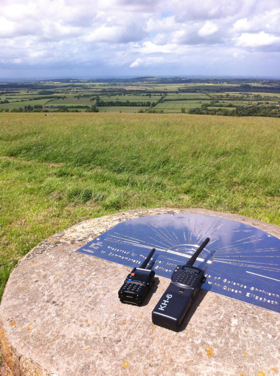
On 433MHz though, I called CQ on 433.500 and was surprised to be called by Stewart G0LGS in Cheltenham. We had a nice QSO although being a blustery day, I could not face the correct direction and avoid wind noise! Once I’d worked Stewart I signed and tuned around a little and came across Des G0RBD in Chippenham. We were able to have a QSO. Des asked if I had my D-STAR radio as he wondered if it would be possible to work. I didn’t have it, but promised that if I had the chance to go up the hill the next day (Sunday) then I would.
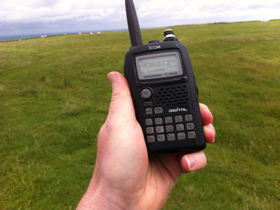
I got my jobs out of the way and set off for the hill around 1115 this morning. As I was driving to the hill, I spoke with Des on GB3TD our local 433MHz repeater. I parked up and started to climb the hill. I quickly heard Des calling CQ on 144.6125 the DSTAR simplex frequency. I responded straight away but he didn’t seem to copy. I was conscious that he was running more power than me, so to get a better signal I needed more height!
Once I had climbed about 30 feet or so, Des started to hear me with some digital breakup (R2D2). We exchanged reports but I kept climbing. As I approached the ramparts of Uffington Castle Des report that my signal was solid with no breakup. Once I got to the very top, Des was end stop and he reported me as S6-7. Signals were good enough that we thought we would try 430MHz. Des called me on 438.6125 the DSTAR simplex frequency. Signals were excellent and perhaps a little stronger than on 144MHz. We then thought we would reduce power. I could hear Des with solid signals with him running the lowest power his IC9100 would go, around 2W and he was able to hear me with just a little R2D2 on the SuperLow setting on the E92.
Fascinating results and we are now keen to try over some longer paths on DSTAR and see what we can do. Thanks Des for the suggestion and a lot of fun!
Before coming down the hill, I tried a CQ on 145.500 FM and was called by Paul G6UAJ in West Swindon. We had an interesting QSO and Paul mentioned that he was returning to the hobby after about a 12 year break. His prime interest is microwaves and in particular 10 and 24GHz. I promised I would try and put him in touch with people active on the higher bands.
A nice couple of portable sessions and it was great to watch the views across the valley and the rainclouds scurrying by to the north.

Tim Kirby, G4VXE, is a regular contributor to AmateurRadio.com and writes from Oxfordshire, England. Contact him at [email protected].
K8GU/5 Field Day 1B1Op Battery
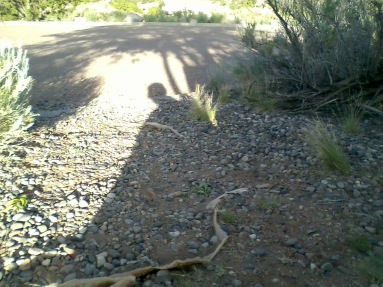
I found myself in Santa Fe, NM, for Field Day this year to attend a conference. As I have shared before, I have mixed feelings about Field Day, but this was a genuinely good time. I first checked ARRL’s Field Day finder map and the local club’s web site for activity. Zilch. So, I remembered staying at the Fort Marcy Hotel Suites on several previous visits to Santa Fe. These condos are up on a hill overlooking town. Across the street is Hillside Park, with a couple of scraggly trees that might be suitable for antennas.
Instead of bringing the “usual” portable station, I brought a Small Wonder Labs SW-40, a K1EL K12 memory keyer (assembled especially for this trip), Palm Mini paddles, a 40-meter dipole, and a AA battery pack. The whole station took up less space in my luggage than my notebook computer and set up in 15 minutes. I got the dipole center about 4-5 meters off the ground and the ends sloped down to about 2-3 meters high…just enough to allow cars and small trucks to pass under them in the parking lot. Apologies for the photographs…they were taken with my cell phone (which is a regular old “dumb” phone).
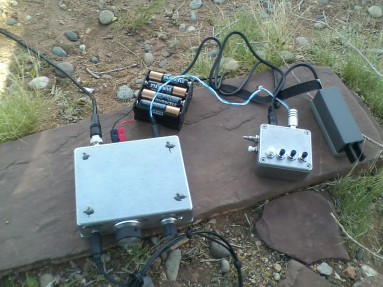
The SW-40 did not appear to be transmitting correctly when I first hooked everything up. So, I pulled the cover off (packing a Leatherman tool is another good reason to check a bag) and wiggled some wires around until it fired up. Not an auspicious sign.
But, I did manage to operate for about an hour and make 12 or 15 QSOs. They’re logged in a notebook, but I haven’t looked at it since making the contacts. Virtually every QSO was a struggle. Low power (1.5 watts), wrong band (20 meters would have been better), a low antenna, and the fact that I hadn’t used the SW-40 for any QSOs in over 10 years, conspired to make thing difficult. Most operators pulled me right out once I was in the clear and zero beat (which I think was a serious challenge with the slightly drifty and definitely touchy SW-40).
My final QSO was with my old radio club from my college days, W8FT. The operator was my good friend Bill, AD8P, who worked hard to pull me out once he got my call right. After I packed up, I noticed that I had a missed call on my phone…sure enough it was from Bill. So, I gave him a call and we talked for a couple of minutes. “When he answered the phone, he said, `New Mexico?!?! I told Kelsey (N8ET) that’s what I had copied.’” We had a nice chat as I hiked back down the hillside into town and he pulled into his driveway after his FD shift.
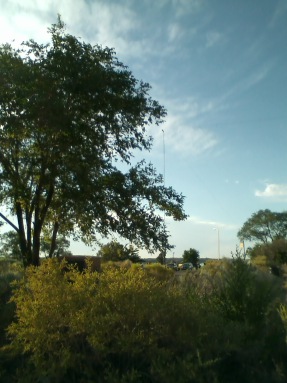
I don’t think I’ve ever been so delighted with a Field Day effort of so few QSOs (except maybe my first Field Day, which was much more work for about twice the number of QSOs). Including the walk from my hotel to the park, setup, tear-down, and operating, I think the whole exercise took about 3 hours, and was tremendously FUN.
Ethan Miller, K8GU, is a regular contributor to AmateurRadio.com and writes from Maryland, USA. Contact him at [email protected].
ICQ Podcast S05 E14 – Amateur Radio Worldwide Sailor (1 July 2012)
Series Five Episode Fourteen of the ICQ Podcast has been released. News Stories include :-
- Vatican Radio: New Communications Strategies
- VK7RRR - Tasmania's First Public D-Star Repeater is On the Air!
- German radio hams gain access to 472-479 kHz
- Segment of 2m to be used for Olympics
- New Amateur Extra Class Question Pool effective
- Insurance scheme for UK Radio Amateurs
- Sending a message to Bletchley Park
- 10th Anniversary of OSCAR 7's Return To Life
- Students build Supercapacitor battery for next ARISSat
- Encouraging science, technology, engineering and mathematics
- ARRL Executive Committee Approves Resource Grants for 11 Schools
- 100 memory buttons and more for Flex PowerSDR
- Le Tour de France 2012 - GB4TDF
Ed Durrant, VK2ARE reports from Australia including an interview with VK2BAA, Worldwide Amateur / Ham Radio sailor.
Colin Butler, M6BOY, is the host of the ICQ Podcast, a weekly radio show about Amateur Radio. Contact him at [email protected].
Now that’s what I call an opening!
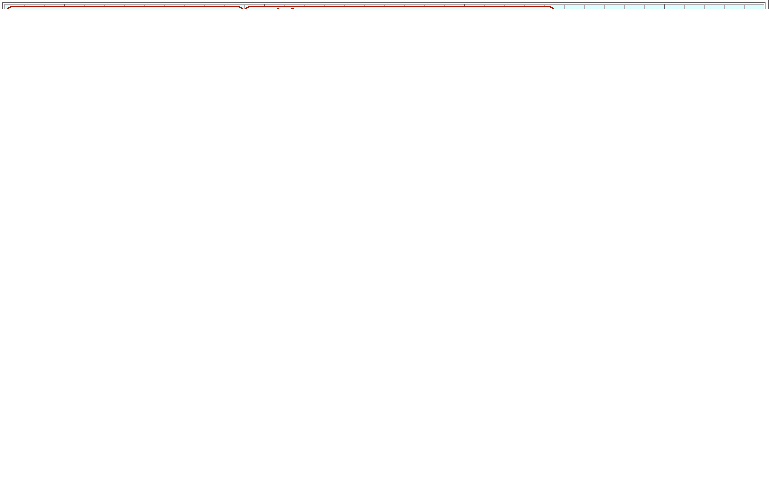 |
| 2m on 1-7-2012 at 10:20z from DX Sherlock |
Going on right now, on 2m. Why don’t we get such openings here?

Julian Moss, G4ILO, is a regular contributor to AmateurRadio.com and writes from Cumbria, England. Contact him at [email protected].
2012 Challenge – Half Way There
The KD0BIK 2012 Challenge which is at least one QSO per day is still going strong at the half way point. I guess technically I’m really not to the 50% mark for another day or two, but I’ve completed two full quarters or six consecutive months of a QSO each and every day and I’m dang proud of the accomplishment.
The month of June started off with a bang with three new DXCC’s logged on 2 June 2012. These new DXCC’s were Austria, Bosnia-Herzegovina and Serbia. 20 meters had been incredible that evening and those three new DXCC entities just seemed to fly into the logbook. This makes 61 DXCC for me. I have about 56 or 57 confirmed.
Of course, the month of June also included ARRL Field Day. I logged 117 QSO’s just on Field Day weekend as a 1 delta station. I hope to finish my 2012 Field Day blog update in the next few days.
Once again I’ve mapped my QSO’s for June. I’m using a web tool created by K2DSL called ADIF to Map to create the image below. The first image is the QSO map for June 2012.

The second QSO map includes all QSO’s for 2012 to date (January – June 2012)

I must also add that the month of June was a very successful and productive month in working on the new basement ham shack. I’m late on a blog update and will try to get one completed in the next week. But essentially, the painting of the walls and ceiling is completed. I also started on the laminate floor on 30 May. I’m actually on vacation (or as my wife and I are calling it a staycation) the week of Independence Day (4th of July) and I plan to complete the floor and begin the trim work.
I also expect delivery of the cabinets. I ordered desk height cabinets to go underneath my desk and then will have wall cabinets above the operating position. The idea is for neat and organized storage which I hope will help keep a tidy and more functional desk.
The QSO breakdown for June is as follows:
Mode
Number QSO’s
JT65
56
SSB
79
PSK31
46
Additional notes of interest:
DX Stations Worked in June – 19
New DX Entities in June – 3
Total QSO’s for 2012 – 758
Total consecutive QSO days – 182
Days left in 2012 – 184
Until next time…
73 de KD0BIK
Jerry Taylor, KD0BIK, is a regular contributor to AmateurRadio.com and writes from Colorado, USA. He is the host of the Practical Amateur Radio Podcast. Contact him at [email protected].


 Ham Radio Deluxe |
 W5SWL Electronics |
 Ham Radio Prep |
 KB3IFH QSL Cards  Hip Ham Shirts  HamRadioAuctions HamRadioAuctions Reliance Antennas Reliance Antennas Enigma Shop Enigma Shop |  morseDX  Ni4L Antennas  R&L Electronics R&L Electronics antennas.us antennas.us QRV QRV |
- Matt W1MST, Managing Editor
