 |
 Handiham World for 11 July 2012 (early release)
 10 July 2012 | by
 Welcome to Handiham World.
The band police
Recently I got an e-mail from a new amateur radio operator who told me about an encounter with an unpleasant character on the bands. This new operator was following all the rules of identification while enjoying an EchoLink contact with a DX station. Someone jumped in and told him he should get off the air if he wasn’t going to identify. Interestingly enough, the guy with this unsolicited advice didn’t identify his station at all. The whole incident confused and worried our new amateur radio operator. It wasn’t exactly a way to feel welcomed on the amateur radio bands, was it?
Let’s deconstruct this incident.
First off, our new amateur radio operator says that he was following all of the rules of identification and I believe him. Because it was an EchoLink contact, it is possible that because of delays in the various interconnected systems and possible packet loss, the station that broke in with the comment about identification may not have been able to hear all of the conversation. So there could be a technical issue here, but there is certainly no need to break into a conversation to rudely chastise someone with unsolicited advice. After all, all identifications were being done properly and sometimes band conditions or Internet connectivity can change what a third station might hear. Even if there is a compelling need to break in, the best way to do so is with one’s callsign, not with an unidentified scold.
What our new amateur radio operator had the misfortune to experience was a visit from one of the lower life forms on the amateur radio bands: the band police. Who knows if they even hold valid amateur radio licenses? If they do, do they think the rules about identification do not apply to them when they are busy butting into another conversation to complain about something they don’t like? Well, I suspect that these “band police” are pretty under socialized in other respects. I’d be willing to bet they are blowhard know it all’s at the Field Day site and at the radio club meetings. For them it’s “my way or the highway”, and that probably extends to other areas of life aside from amateur radio!
We all know that there are unpleasant and even downright toxic personalities out there, so in amateur radio as in the rest of life we need to have a strategy. Just as you would avoid contact as much as possible with an unpleasant and unreasonable neighbor or a pushy bully at the office, you can devise a strategy to minimize your contact with unpleasant people on the amateur radio bands. You may wonder how this is possible when they break in with unsolicited comments, but the best advice is the long-standing recommendation from experienced operators: simply ignore them. Don’t acknowledge them. Like Internet trolls, they like to interrupt and disrupt with off-topic and controversial or unsolicited comments. The more you engage them, the more you feed their egos. Ignoring the band police may not be as satisfying as telling them to mind their own business, but if you go down that road you are asking for trouble. Yes, there may be times when the situation gets so bad that you may need to escalate it by bringing it to the attention of the ARRL official observers in your area. One thing you should NOT do is let an incident like this spoil your enjoyment of the amateur radio bands. Almost all amateur radio operators are friendly, helpful, and understanding – and especially so when it comes to welcoming new amateur radio operators to a lifetime of fun on the bands.
This is a reminder that the Handiham office is open only with very limited services and hours this week. No renewals or new membership requests can be processed until July 16.
Email me at [email protected] with your questions & comments.
Patrick Tice, WA0TDA
Handiham Manager
Handiham remote base stations up & running, but…
…there are a couple of issues.
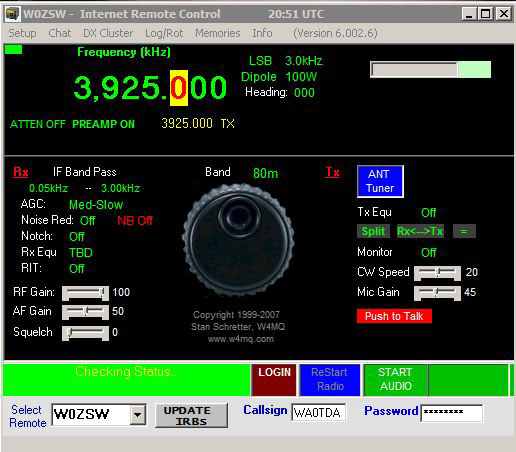
While W0EQO has returned to complete service following severe storms which took down over 20 trees at Courage North, W0ZSW remains only marginally useful. The problem is the internet connectivity and network problems at the Handiham headquarters office at Camp Courage. I do plan to spend some time working on these problems this week, which unfortunately means even less time to answer phone calls and emails or to work on the new Extra Class lecture series. Both stations remain accessible via Echolink for receive, but with occasional dropouts on W0ZSW.
Pat Tice, WA0TDA, is the manager of HANDI-HAM and a regular contributor to AmateurRadio.com. Contact him at [email protected].
TWiT’s HAM Nation Schedule Change
If you’re a big fan of TWiT’s weekly amateur radio broadcast, HAM Nation, then you’ll want to note that the program is now on WEDNESDAY evenings at 8pm Central Time (GMT -5:00).
Matt Thomas, W1MST, is the managing editor of AmateurRadio.com. Contact him at [email protected].
Ask The Audience: Mobile Antenna Mount?

A longtime reader, Chris K9ROC (Blog | Twitter), wrote me looking for some advice. Please take a moment to leave your great ideas, friendly suggestions, or dire warnings in the post comments. I know Chris will appreciate them!
2M/ 440 antenna mounts for a 2009 Dodge Grand Caravan? …
For many months I had a 1/4 wave 2m mag-mount antenna on the roof of the minivan and it worked very well with respect to both transmitting and receiving.
But I took it off for a couple reasons. First, a whip on the roof of the minivan hit everything in the parking garage at work. Second, the coax went through the rear of the van, the large door. Every time my wife opened the rear door it was grinding at the coax. And of course the mag-mount itself wasn’t great for the roof. 😉
I’ve been told to install an NMO mount on the roof with a hole (I have a great elmer experienced with this). But when I mentioned the idea to my wife I realized that discussion was a non-starter. 😉
Soooo … what other options do I have? Through-the-glass on a side window? I’ve read that that’s not a good idea with modern auto glass.
What about something that would clip-on to the front fender? At the last couple RARA events I saw a lot of cars that appeared to have some kind of fender mount.
Or should I really let myself get talked into the NMO?
Thanks very much in advance,
Chris K9ROC
Matt Thomas, W1MST, is the managing editor of AmateurRadio.com. Contact him at [email protected].
Just like fishing
This QRP thing is just like fishing. Yesterday, it was like I had magic bait. Every time I cast my call out upon the waters, I had a hit. Every time I called a station, I had a hit.
Today was the antithesis of yesterday. No one answered my CQs and also wasn’t able to raise anyone that I called. Reverse Beacon Network said I was getting out just fine …. no strikes, though. The difference between yesterday on today? Nothing except that yesterday was Sunday and today is Monday.
As much as we would like it to be, this Amateur Radio thing is not an exact science. I think tomorrow I will head out somewhere nature like and will try the EFHW. I had good luck with that “fishing pole” last year.
72 de Larry W2LJ
QRP – When you care to send the very least!

Larry Makoski, W2LJ, is a regular contributor to AmateurRadio.com and writes from New Jersey, USA. Contact him at [email protected].
KX3 – SOTA Style
Posted by Todd., W7TAO on the KX3 e-mail reflector. Todd, like Steve WG0AT is also quite the portable ops devotee. He also has pack goats that he brings along on his adventures; but not this time.
The sheer beauty of this SOTA site is magnificent. I think you will agree
72 de Larry W2LJ
QRP – When you care to send the very least!

Larry Makoski, W2LJ, is a regular contributor to AmateurRadio.com and writes from New Jersey, USA. Contact him at [email protected].
Tripod for a WalkHam
Having got an AlexLoop WalkHam antenna I needed some way of holding it up whilst it was in use. After considering ideas like a guyed mast made from plastic pipe I decided the best solution would be a photographic tripod, if only I could devise a way of mounting the antenna on it.
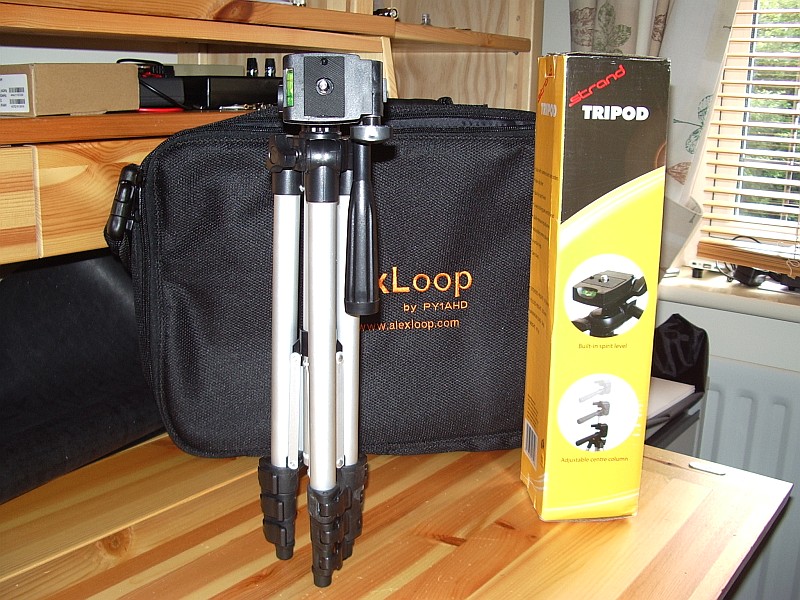
After scouring eBay for a suitable tripod I came across this one from British firm Strand Europe. Unfortunately this won’t be much help if you’re not in Britain as the seller will only post to the United Kingdom.
The tripod is short enough when collapsed to fit inside the WalkHam carrying case – the stumbling block for most of the ones I looked at which were just a bit too long. What’s more, the panning handle can be secured in the vertical position and fits inside the WalkHam’s mounting pole like it was made for it! So no modifications are needed and you can still use the tripod for photography if you want.
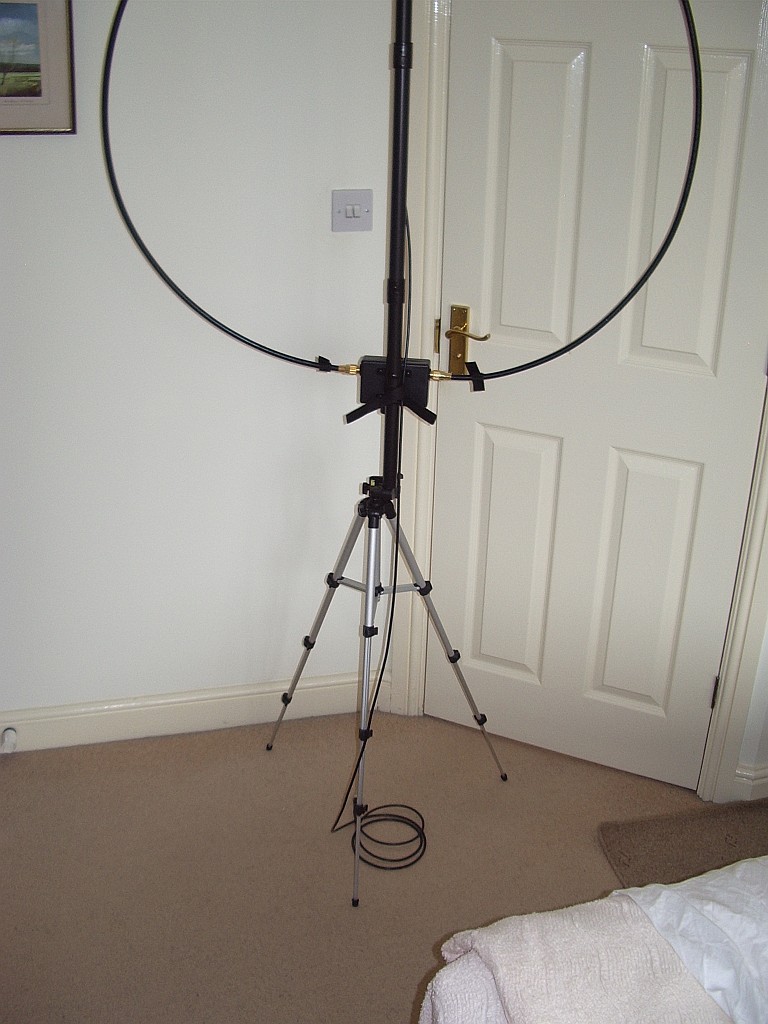
The same day that the tripod arrived I received an email from Alex giving details of his own tripod recommendation. He wrote:
“The perfect tripod is the VIVITAR VIV-VPT-1250. It is a 50” unit and the lightest and most inexpensive VIVITAR unit that can be found for less than U$ 10.00. The secret is take off the camera head with a Phillips screwdriver and leave the aluminum tube on the top. It must be marked with a pencil at 4 inches (12 cms): that is the maximum extension that can be used to introduce something to avoid any pressure on the antenna elements. Without the camera head the tripod can be collapsed and carried inside the antenna bag.”
I couldn’t find the Vivitar for as little as $10 in the UK so I’m content with my purchase. My only reservation is that the tripod is much lighter than the antenna (a good point for the person carrying it of course) and might be inclined to blow over if used in much of a breeze. I’ll find out when I manage to try it! I can’t say whether Alex’s recommended model would be any better in that respect.

Julian Moss, G4ILO, is a regular contributor to AmateurRadio.com and writes from Cumbria, England. Contact him at [email protected].
The $20 Software Defined Radio
Despite my interest in boat-anchors I do find myself peeking ‘over the wall’ from time to time and taking a look at new and emerging technologies. After several demonstrations from friends I had become convinced of the incredible potential of software defined radios and even found thinking about owning one … one day.

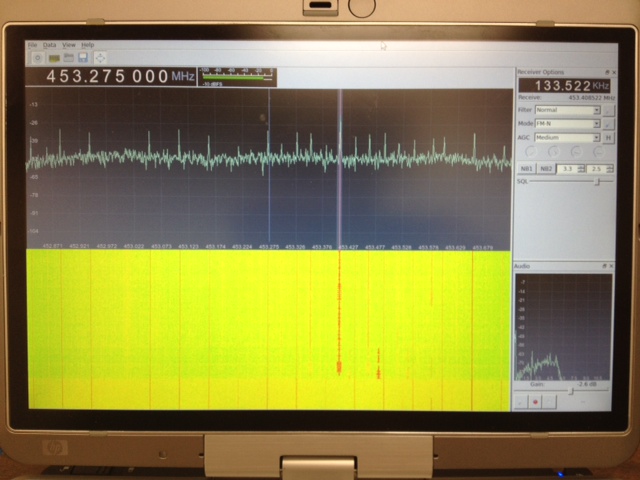
Software (Linux) : After poor results with the software running on MS Windows I moved across to Linux and got it working well there. I can’t point you to a single howto for this because I used several different guides and tried a few things before it started working. The most helpful, and probably all you really need, are the build-gnuradio script which gets hardware support and gnu-radio running and the “Getting Started With RTL-SDR” page by Tom Nardi which covers installing Gqrx. All the software used is in development and requires familiarity with the command line to install and use at the moment.
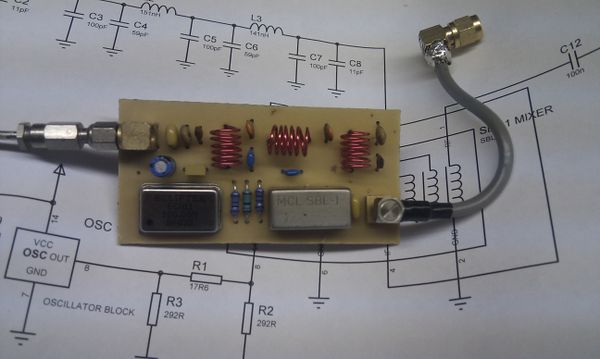
Update : Thanks to a link from Neil W2NDG to an EBay sale I’ve been able to track down a pre-assembled HF up-converter on this page : New HF Converter Kit for the SDR Fun Cube Dongle The price seems to be 45 euros, or about $55 US.
Owen Morgan, KF5CZO, is a regular contributor to AmateurRadio.com and writes from Texas, USA. Contact him at [email protected].
 Ham Radio Deluxe |
 W5SWL Electronics |
 Ham Radio Prep |
 KB3IFH QSL Cards  Hip Ham Shirts  HamRadioAuctions HamRadioAuctions Reliance Antennas Reliance Antennas Enigma Shop Enigma Shop |  morseDX  Ni4L Antennas  R&L Electronics R&L Electronics antennas.us antennas.us QRV QRV |
- Matt W1MST, Managing Editor
