 |
 Sad news – W5PG (SK)
 19 July 2012 | by
 Fellow blogger, Chuck W5PG passed away suddenly, yesterday.
http://pc4t.blogspot.nl/2012/07/chuck-w5pg-silent-key.html
In hist last post, Chuck talked about working up towards doing a Century (100 mile bike ride) later this summer.
Chuck was a good guy and will be missed. Prayers and condolences are with his family.
Larry W2LJ

Larry Makoski, W2LJ, is a regular contributor to AmateurRadio.com and writes from New Jersey, USA. Contact him at [email protected].
Waxing nostalgic

43 years ago, this week, I was a 12 year old geek (of course) in love with the United State’s Manned Spaceflight program. Some of my earliest TV memories were of watching the Mercury launches of Alan Shepard and John Glenn.
43 years ago, this week, the epitome, the apex, the goal was reached. On Wednesday, July 16th we watched as Apollo 11 was launched from Pad 39A from Cape Kennedy.

Three days later, on July 20th, we listened (breathlessly) and Neil Armstrong broadcast, “Houston, Tranquility Base here, the Eagle has landed”. As kids we were ready to go to bed as the EVA (moon walk) was scheduled for the next day. But Neil Armstrong and Buzz Aldrin must have been on an adrenalin high, however, as they asked Houston for permission (and received it) to begin the moonwalk within hours of landing. Our parents suspended bed time rules and allowed my sister and I to stay up and watch all the history being made.


And watch, we did! We watched the TV spellbound as ghostly images appeared on our screens. Walter Cronkite and Wally Schirra were our guides as Neil Armstrong uttered those now famous words, “That’s one small step for man, one giant leap for mankind”. I specifically remember the cameras cutting to Walter Cronkite as events unfolded. He understood the significance of the moment and was almost in tears.

Looking back on it, the accomplishment is even more amazing! The Lunar Module landed on the moon with an on board computer that had less processing power than a scientific calculator or cell phone of today’s vintage. Those were the days when the sky was the limit, we had the national will to do great things and the horizon looked endless. I miss the enthusiasm, the attitude and the ambition of those heady days.
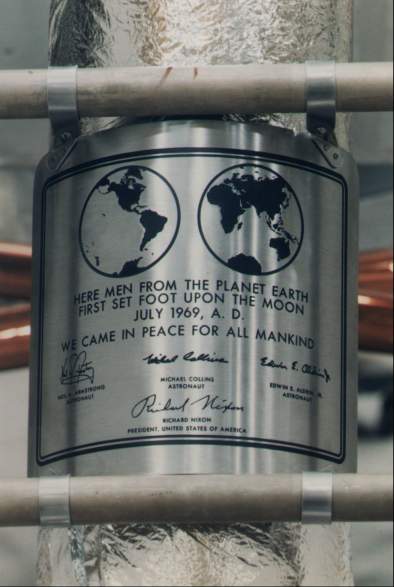
To this day, when I find myself outdoors at night and the moon is out – I still look up there and think to myself, “Wow! We actually went there!”.
72 de Larry W2LJ
QRP – When you care to send the very least!

Larry Makoski, W2LJ, is a regular contributor to AmateurRadio.com and writes from New Jersey, USA. Contact him at [email protected].
Anyone for 10m AM?
By way of something different, I listened to AM CB on the way home. It’s always interesting to hear signals fading up and down and to work out where they’re from. This, for me, is all about DXing – regardless of band or mode.
I’m not sure I have ever listened to AM before – at least narrowband AM! What great quality – almost melodious.
So, does anyone operate 29MHz AM? It could be fun 🙂

Tim Kirby, G4VXE, is a regular contributor to AmateurRadio.com and writes from Oxfordshire, England. Contact him at [email protected].
Kits for the club
Monday night was club night
I must have been a bit tired from the long bike ride I did at the weekend but I offered to run a construction evening based on a simple kit. This was really to help build confidence in soldering and making ‘stuff’ that might be handy for the up and coming ham’s shack.
Anyone who knows me will know that I can build a kit but can’t design a circuit for toffee. So the hunt for a suitable kit began, Julian, G4ILO happened to mention at nerly the same time that a QRSS TX is available through Hans Summers which looks like a cheap and simple one to go for and a company called radio kits do a simple needle based SWR kit or a digital one.
The crucial thing is to be able to talk around the principle of operation as well as the construction otherwise the exercise is missing a trick. I’ll be ordering the bits very shortly and making sure I know they work long before I let myself in for an overly complicated explanation to a bunch of blank faces. Especially if they are wielding soldering irons.
Price is obviously an issue as the club has members with a variety of incomes, but if there are other kits about that could be made up. I would really like to hear of an 4m FM TXRX’s that can be built. For some reason most of the members have an obsession with that band. Otherwise its a suitable SSB HF rig for a long term project. First off though is the easy one. Famous last words?
Alex Hill, G7KSE, is a regular contributor to AmateurRadio.com and writes from Cumbria, UK. Contact him at [email protected].
Chinglish!
I have just found a wonderful example of “Chinglish” on the base of the desk charger for a Baofeng UV-5R.

Let me know if you find any better ones!

Julian Moss, G4ILO, is a regular contributor to AmateurRadio.com and writes from Cumbria, England. Contact him at [email protected].
Antenna Restrictions on Mt. Evans?
I activated Mt. Evans for Summits on the Air (SOTA) on July 15th. I took the route from Summit Lake to the top early in the morning since thunderstorms were in the forecast for the afternoon. I had the peak to myself for almost half an hour which was unexpected, considering that there is a road all the way to the top. I setup my vertical Buddipole for 20m and started my activation – so far nothing out of the ordinary besides the bad band conditions due to the recent CME.

I was talking to ACØA in Kansas when I spotted a National Forest Ranger running up the path from the parking lot. I could not understand what he was saying since I was
distracted by my ongoing QSO and the lack of oxygen combined with his running up the mountain made his signal about a 22, with highly distorted audio.
He arrived at the summit breathless and stood next to me, courteous enough to let me finish my QSO (or just to catch his breath?). He then introduced himself and informed me that I have to take down the antenna immediately.
My first thoughts were that the antenna was considered some sort of a safety hazard for other visitors but NO. The reason is, he informed me, that you cannot build a structure on Nation Forest land without a permit. Sounds like a sensible rule to me…. who wants to see cabins etc. erected on public land everywhere. I argued that my antenna can hardly be considered a structure and my short survey among the few visitors on the summit (~10 people) came to the same conclusion – nobody considered my antenna a structure but he insisted. Furthermore he instructed me to drive to the Clear Creek Ranger District HQ in Idaho Springs to get a permit. Needless to say that I was not planning to make a ~60 mile round-trip to get a permit for my activities. I already had enough contacts for my Mt. Evans SOTA activation and the fact that I had planned another activation for later in the day I did not want to waste my time arguing and started to pack up. Luckily I had my tape-measure YAGI with me for my next activation and I was hoping it would pass the NOT BEING A STRUCTURE test by the National Forest (to make sure I did not ask).
I tried to follow up with the person in charge for the Clear Creek Ranger District… she is on vacation. Sure glad I did not drive all the way to Idaho Springs.
GOOGLing, I found Forest Rules You Need to Know, published by the Secretary of Agriculture. On page two, under the chapter OTHER PROHIBITED FACTS it indeed prohibits “Constructing, placing, or maintaining any kind of communication equipment without a special use authorization“. Again, that makes sense to me to avoid that every Tom, Dick and Harry sets up his own repeater on public land… it does however not make sense to me for a temporary, mobile/portable antenna as I was using.
It would certainly put a damper on SOTA activations and the upcoming 14er event. I am almost certain that on Field Day a lot of antennas go up on NF land.
I would be interested in your experience and/or opinion and I am planning to follow up with the Clear Creek Ranger District. Maybe I was just dealing with an overly eager Ranger? Stay tuned…
Matt/KØMOS
Matt Schnizer, KØMOS, is a special contributor to AmateurRadio.com and writes from Colorado, USA. Contact him at k0mos at schnizer.com.
Handiham World for 18 July 2012
Welcome to Handiham World.
Bucket list!

Photo: I found the problem. The confabulator gear is stripped. You’ll need a new one if you want this Vega to make it back to Podunk.
Hey, readers and listeners! It is certainly high summer here in North America and the temperature is so high and the humidity so oppressive that we are definitely not thinking clearly. That is why we have come up with this “bucket list” which we hope to complete before we die.
1. Landing a single engine plane on the beach.
2. Changing the transmission in a Chevrolet Vega.
3. Making yogurt from scratch.
4. Setting the tone and frequencies on a mobile radio while driving.
Well, if you are like me you have probably done the first three of these things without any particular problem, but you have never been able to safely program a mobile VHF/UHF radio while driving a car. In fact, programming a radio while driving can be a frighteningly dangerous experience, much worse than sampling that first icky-looking spoonful of homemade yogurt or dropping a Vega transmission on your toes. That is why the radio programming is not checked off my bucket list. In fact, programming a radio while driving instead of watching the road is a good way to assure that you will probably die before completing most of the items on your bucket list.
I started thinking about this particular problem when I read the correspondence section of the August QST wherein astute letter writer K2GW talks about making the programming process for VHF/UHF radios more user-friendly. The use of subaudible tones on repeater systems is so common as to be expected, and most of us will have to admit that these systems do an excellent job of preventing the repeater from ever actually being used for anything, but mostly from ever being successfully accessed by anyone trying to keep a car between the ditches while traveling through the area supposedly served by the repeater.
Of course the subaudible tones might be necessary to prevent interference from distant repeaters should there be a band opening or from other nearby RF sources or an alien invasion where the flying saucers transmit on the repeater input. I get that. But the problem remains that unless you are able to preprogram your radio for the repeaters along your route, you are likely going to be out of luck when you try to simply access them by punching a receive frequency into the VFO and letting the radio’s built-in offset function set the transmit frequency according to the band plan. One possible workaround is to listen for activity on the repeater in question and then punch the tone scan function button to try to locate the correct subaudible tone. If this works and you do not end up in the ditch (especially dangerous in Florida where hungry alligators find the ditches quite attractive), then you might be in business. The more likely outcome is that you will drive entirely through the repeater’s coverage zone without hearing any activity.
The ARRL TravelPlus® repeater directory on CD-ROM does provide a way to map and program radios along a planned route, so it is a good resource that allows you to program your radio well in advance of your trip. Programming your radio while sitting in the driveway is one heck of a lot safer than meeting an alligator for lunch. Still, you may need to program a radio while in motion. The safe way to do this is for you to pay full attention to the radio by letting someone else do the driving. When my wife and I take car trips, I feel safe enough fiddling with the radio while she pilots the car. While this division of labor keeps the car out of the ditch, it does not necessarily ensure that one will be able to access or make a contact on a repeater.
One time, on a trip through alligator-free central Illinois, I tried a repeater that I really, really wanted to use and that was programmed into my radio already, because I had looked it up in my repeater directory. I heard the repeater identify and decided to throw out my call sign.
Silence.
Okay, so I upped the power and tried again.
Silence.
Obviously, the subaudible tone that I had programmed was incorrect. So I set the radio to tone scan and hoped for someone to transmit on the repeater. Well, that didn’t happen. I guess I probably could have gone through every possible subaudible tone while kerchunking the repeater and throwing my call sign out, but somehow that didn’t seem to be worthwhile. Instead, I switched to VFO mode and 146.52 MHz where I had a nice QSO with a truck driver who was passing through. The subaudible tone system had certainly done its job of preventing interference and any actual use by mobile stations, that’s for sure. Later, after we got back home from vacation, I discovered that the subaudible tone for that particular repeater was incorrectly listed in the directory.
I’m not sure what the answer to this partly technological and partly behavioral issue is with VHF/UHF repeater systems. All I know is that you cannot make things that difficult to use because prospective users have many other alternative means to communicate and they will vote with their feet and go somewhere else. For example, I can easily bring up the node of my favorite repeater on my Android phone by using the EchoLink application. I recommend doing this while you are sitting in the passenger seat rather than trying to steer the car. Once I am connected on EchoLink, all I need for reliable communications is a cell phone data signal. I can talk to my friends who are regulars on my preferred EchoLink-enabled repeater system.
Would I prefer to use the radio in my car to make a local contact? Certainly! But hey, repeater owners out there – you might consider connecting your repeaters with the world via IRLP or EchoLink and make sure that your frequency and tone information are correctly listed in repeater databases and on your club website. And if any of you local stations are listening on the repeater and hear a mobile station give a call, take a minute to have a short conversation and make a new friend! Maybe the technology will improve to the point that radios will be easy enough to use while driving so that one day I will be able to actually use repeaters I encounter along my mobile route.
Today’s safety tip: Don’t feed the alligators. Also, but not safety-related, the QST audio digest in DAISY format is now available for our blind members in the DAISY section. You can hear me read the correspondence section with the K2GW letter.
The long-range forecast: Speaking of Podunk, localism is an endangered species. As applications for mobile devices like smartphones proliferate, people will listen to the broadcast stations they prefer, avoiding the local stations – especially when they are on the move, traveling by car. When the typical car driver would one time tune around for the local yokel stations along the route, the trend will favor simply staying tuned to the internet station they have always liked. Satellite radio is already making such inroads into localism. The same thing is going to happen to local repeater systems. If the repeater system is not linked, it may be doomed to obscurity. Repeater owners who think EchoLink “isn’t real radio”, take note.
Pat Tice, WA0TDA, is the manager of HANDI-HAM and a regular contributor to AmateurRadio.com. Contact him at [email protected].
 Ham Radio Deluxe |
 W5SWL Electronics |
 Ham Radio Prep |
 KB3IFH QSL Cards  Hip Ham Shirts  HamRadioAuctions HamRadioAuctions Reliance Antennas Reliance Antennas Enigma Shop Enigma Shop |  morseDX  Ni4L Antennas  R&L Electronics R&L Electronics antennas.us antennas.us QRV QRV |
- Matt W1MST, Managing Editor
