 |
 A Great Weekend on VHF
 23 July 2012 | by
  One of the things that makes a VHF contest so much fun is that you never know how its going to play out. One of the major factors is sporadic-e propagation which is, well, sporadic. Sometimes we get rewarded with decent propagation and sometimes we get completely skunked.
In the morning, before the 2012 CQ World Wide VHF Contest started, the 6 Meter band was open from Colorado to the east. The band continued to be open to various locations for most of Saturday, even late into the evening. I made my last contact on 6 Meters to the Pacific Northwest after 10:30 PM local time.
On Sunday morning, 6 Meters gave us some more fun but it was not nearly as good as Saturday. Instead of strong signals and consistent runs, the signals were variable and QSOs were often a challenge. Sometimes it was like pulling teeth. This contest only uses two bands: 6 Meters (50 MHz) and 2 Meters (144 MHz). As 6 Meters pooped out, the action moved to 2 Meters. Fortunately, we had a number of rovers out that helped activate some of the rarer grids. Thanks W3DHJ, AB0YM, KR5J and W0BL.
This is probably my best score ever in the CQ WW VHF Contest, due to the excellent propagation on Saturday and some station improvements I’ve made over the past couple of years.
     Band       QSOs X pt =  QSO pts.  X   Grids   =     Points
---------------------------------------------------------------
     50         337    1      337           130           43810
     144        34     2      68            13            884
---------------------------------------------------------------
     TOTALS     371           405           143           57915

                            Claimed score =  57915
All in all, a great weekend on the VHF bands.
73, Bob K0NR
Bob Witte, KØNR, is a regular contributor to AmateurRadio.com and writes from Colorado, USA. Contact him at [email protected].
Dear Yaesu, Please Make a VHF FT-950
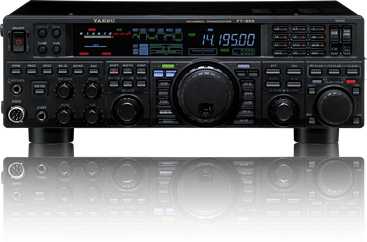 About a year ago, I bought a Yaesu FT-950 transceiver with HF through 50 MHz. I’ve really enjoyed that radio. This weekend I am working the CQ WW VHF Contest and giving it a good workout on 6 Meters. It is set up quite nicely for contesting with a decent receiver, built-in antenna tuner, DSP processing, dual VFOs, built-in voice and CW keyers, etc. For 2 Meters, I use my trusty old FT-847, which has always been one of the favorite rigs. I have to admit that the 847′s receiver is a bit wimpy when it comes to operating on a crowded band with strong signals, and it only puts on 50 Watts on 2 Meters.
So here’s my request:
Dear Yaesu,
Please add 2 Meters to the FT-950 transceiver. When you obsoleted the FT-847, you left a big hole in the ham radio market. The FT-847 was supposed to be a satellite rig, which is nice but not required. I really just want a radio that can put out 100W on 2 Meters, with the great features of the FT-950. Note that I am not asking for 70 cm operation, but if you want to toss that in, it would be cool. You can even leave out some of the HF bands if that would make it easier.
Thanks and I await your reply.
73, Bob K0NR
Bob Witte, KØNR, is a regular contributor to AmateurRadio.com and writes from Colorado, USA. Contact him at [email protected].
ATS Sprint
There was a new QRP operating event taking place on the HF airwaves tonight – the ATS Sprint. Meant mostly for operators of Steve KKD1JV’s famous little trail radios, it was open to all QRPers, no matter the rig chosen to use.
I snagged six participants on 20 Meters including G4ISJ/P in England. Band conditions weren’t the best and I spent a goodly amount of time trying to track down Dale WC7S, who was a big promoter of the event. I heard a few stations successfully work Dale; but I never heard him myself.
Most of the activity seemed to stay on 20 Meters. I switched over to 40 Meters and there was a lot of RTTY around 7.040 MHz, but no QRPers that I was able to hear. I thought I heard Nick WA5BDU calling “CQ ATS” somewhere around 7.039 MHz. If that was Nick the QSB was bad and he was in and out.
I sure hope that the organizers feel that they had a decent enough turn out so that they will schedule this event again. Even though I wasn’t using a KD1JV rig to participate, it was a lot of fun. I hate seeing QRP Sprints go the way of the Dodo bird. Some folks feel there are too many; but my philosophy is “The more, the merrier!”. These contests are usually very friendly and are never cut throat affairs. I tend to think of them as on the air QRP community gatherings rather than out and out contests.(That may be because I never place highly!). It’s through these events that I’ve gotten to know and become friends with so many other QRPers over the years.
72 de Larry W2LJ
QRP – When you care to send the very least!

Larry Makoski, W2LJ, is a regular contributor to AmateurRadio.com and writes from New Jersey, USA. Contact him at [email protected].
How the £13 SDR project became the £26 SDR project
I mentioned that I had a suspicion that I’d blown the first SDR dongle up as it wasn’t hearing much. I ordered another one last weekend and it arrived in mid week. Certainly the new one is behaving much better! No handhelds or across the shack transmissions have been made with the SDR on – just in case! I have connected the dongle up to the 50/144/432MHz collinear using the adapter I built last weekend and it seems to be working fine. I’ve heard GB3WH and plenty of stuff on airband including aircraft, ground and ACARS. On airband – the panadapter approach was excellent for determining the frequencies to listen to. The most fun I ever had with a scanner was with my old Yaesu FRG9600 with Ray Withers HF mods when I lived back in Cheltenham. Heard loads on that thing. I think the SDR dongle is easily the most cost effective scanner I have ever had. Wondering if I can use the dongle to decode ADS-B on 1090MHz. I can see some software to do it running under Linux. But I really don’t want to go there! I have to play enough computers at work – at home I want computing to be as simple as possible! Yes, I could make Linux work, but….

Tim Kirby, G4VXE, is a regular contributor to AmateurRadio.com and writes from Oxfordshire, England. Contact him at [email protected].
Ping!
WSPRing on 6m this afternoon and I captured this trace:
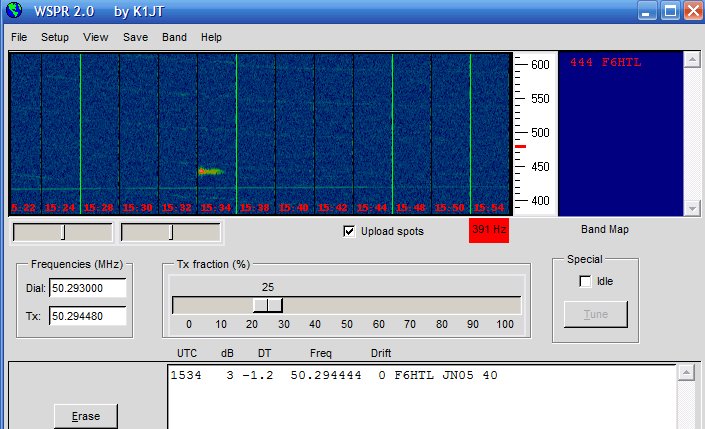
I’m not seeing anything else, though F6HTL spotted my transmission 2 minutes later. I wonder what type of propagation that was?
(Interesting that WSPR decoded the transmission even though the signal was only present for half a cycle.)

Julian Moss, G4ILO, is a regular contributor to AmateurRadio.com and writes from Cumbria, England. Contact him at [email protected].
Show Notes #086
Introduction:
- Tonight’s episode is proof that LHS is at least as popular as the All-Star Game.
Topic:
- Interview with Bob Finch, W9YA, principal maintainer of yfktest.
- Bob got involved with the yfktest project because he was looking for a logging program like the old DOS program, WR9R.
- His ideal logger did not use graphics, did not require a mouse, and was very easy to learn. yfktest was close, but had a few problems, so Bob began submitting fixes and improvements.
- Over the past year, Bob began submitting code changes and eventually became the principle maintainer of the program, and has made over 150 patches in that time.
- Russ described his problem with the program for Field Day logging. Bob explains that the issue was due to the error checking, and had Russ not tried to enter the signal report into the Class field, it would have worked fine. Russ suggests having a line of text above the fields that provides hints as to what each field should contain. Bob added that to his To-Do list.
- yfktest is written in Perl, so no compilation is necessary to install.
- Bob is working on a version that is completely contained on a USB stick that would be operating system agnostic.
- Rudimentary networking features are in the code now, but disabled. So, it’s possible that networking might be a future enhancement.
- Get your copy of the latest version of yfktest by following the instructions in the README.NOW link at bfinch.net.
- Bob then describes another of his interests, rocketry, and is involved in the open source/open hardware rocketry project Altus Metrum.
Feedback:
- Rich, KD0BJT, of the Low SWR podcast writes to tell us of a Field Day logging program called fdlog. It’s written in Python and has networking capabilities for multiple stations. Rich also mentions the Java-based logging program JL. Thanks, Rich. fdlog is a graphical Field Day logging program written in Tcl/Tk, but hasn’t been updated in about a year.
- Leif, KC8RWR, sends us a link to a series of Youtube video tutorials for GNU Radio, the open source software project for RTL Software Defined Radios. He wonders if he could use an NE602 at the front end of the radio for HF, and use a Raspberry Pi to run GNU Radio. Our hosts discuss this and the Signetics NE602, a balanced mixer and oscillator on a chip.
- Dave, M0DCM, has been catching up on LHS episodes while convalescing. He describes his system for listening, and some experiences with the Ettus SDR, Funcube Dongle, and digital modes with his new Yaesu FT-817ND.
- David, KE0AZ, tells us that the power output of the Ettus transmitter daughterboards is anywhere from 50 to 200 mW.
Contact Info:
- Contact Richard at [email protected], Russ at [email protected], or both at the same time at [email protected].
- Listen to the live stream every other Tuesday at 8:00pm Central time. Check the LHS web site for dates.
- Leave us a voice mail at 1-909-LHS-SHOW (1-909-547-7469), or record an introduction to the podcast.
- Sign up for the LHS mailing list.
- Sign up for the MAGNetcon mailing list.
- LHS merchandise is available at the Merch link on Web site. Check out the Badgerwear or buy one of the other LHS-branded items at PrintFection.com/lhs or Cafe Press. Thanks!
- Thanks to Dave from Gamma Leonis for the theme music.
Music:
- “Ancient (The Deepest Sky I’ve Ever Seen)” by Olga Scotland from the album Castles Under the Water, courtesy of Jamendo.
Russ Woodman, K5TUX, co-hosts the Linux in the Ham Shack podcast which is available for download in both MP3 and OGG audio format. Contact him at [email protected].
WOO HOO BY5WJ…..China with QRP!!!

is a self-governing territorial overseas collectivity of France and is just outside of Canada, some Canadian hams were there making contacts on 20m!!! It was a DXCC I did not have and it's more or less local....easy peasy.............so I thought. The pileup was huge and I never did make the contact. Later in the evening they were on 40m but I was not able to hear them at all. It seemed I was the only one not able to hear them by the size of the pileup. Oh but earlier China BY5WJ was on the cluster and I thought "what the heck " and holy cow there were LOUD AND CLEAR....I gave them a go but again the pile up was big but I wanted to stick with it as they were just blasting in. While others were making contact I went to QRZ.COM to get some info as I always do...........this is what I found........
I'm sorry but either I sent the wrong call or your ears are defective. In fact
you worked 6Y5WJ in sunny Jamaica. If I sent the wrong call then I'm
sorry I need, to practice, a new key, a keyer or radio :) :), either of which
can be sent to me at the above address. If however you wrote down the
wrong call then I will send YOU either a new pair of headphones, a new
rig or a syringe of warm soapy water:)

Mike Weir, VE9KK, is a regular contributor to AmateurRadio.com and writes from New Brunswick, Canada. Contact him at [email protected].
 Ham Radio Deluxe |
 W5SWL Electronics |
 Ham Radio Prep |
 KB3IFH QSL Cards  Hip Ham Shirts  HamRadioAuctions HamRadioAuctions Reliance Antennas Reliance Antennas Enigma Shop Enigma Shop |  morseDX  Ni4L Antennas  R&L Electronics R&L Electronics antennas.us antennas.us QRV QRV |
- Matt W1MST, Managing Editor
