 |
 The other thing I wanted to talk about tonight
 3 August 2012 | by
 is the new book out by Don Keith N4KC. If you haven’t read about it on his blog, then I am going to tell you about it here.
The name of the book is “Riding the Shortwaves: Exploring the Magic of Amateur Radio“
.jpg)
I purchased it the other day, and this book is fantastic, IMHO!
If you have someone that you know is thinking of becoming a Ham, has inclinations about becoming a Ham, or is actively studying to become a Ham, or recently became a Ham – direct them to this book! Don is an accomplished, published author – and this book showcases his writing skill.
It is written in friendly, plain language, with just the right amount of Ham jargon infused (fully explained) that is perfect for those who are getting into or just got into the hobby. And the primary focus of this book is getting on the HF bands. How many new Hams do you know that get their license and then just seem to stagnate on VHF/UHF, get bored and leave the hobby?
That situation vexed Don N4KC also, and this is his effort to solve that problem. The first thing he does (and does it really well!) is to inform the prospective or new Ham just how great operating on the HF bands is. He puts “The Magic” that is HF into words better than I’ve ever read before. Then he builds upon that by covering how to set up your station, how to choose and set up an antenna, which are just a few of the topics covered in this book. I have to tell you, that in all honesty, I wish this book was out 34 years ago when I first got started.
This book has all the stuff that we OT HF operators learned the hard way. Now it’s written down in a book that is a delightful and very entertaining read. Hey, there’s even stuff in here that’s a good review for us OT’s, too! Learning and having fun while doing it – what could be better than that?
72 de Larry W2LJ
QRP – When you care to send the very least!

Larry Makoski, W2LJ, is a regular contributor to AmateurRadio.com and writes from New Jersey, USA. Contact him at [email protected].
Ham Radio T-shirts
Rem K6BBQ sent me an e-mail letting me know about Ham Radio T-shirts available on Cafe Press. Right now, through August 5th (Pacific Time) Cafe Press is running a 50% off sale. All you have to do is enter the Promo Code “BIYEARLY” (no quotes) when you check out. Look at some of the cool shirts they offer:




If you like Ham Radio t-shirts (like I do!), just go on over to Cafe Press and search on “Amateur Radio” – there are tons of great designs on there!
72 de Larry W2LJ
QRP – When you care to send the very least!

Larry Makoski, W2LJ, is a regular contributor to AmateurRadio.com and writes from New Jersey, USA. Contact him at [email protected].
Colorado 14er Event This Weekend

Just a quick reminder that the Colorado 14er Event is happening this Sunday. I am going to try to make it up Mt Sneffels down in the San Juan range and operate 2 Meters and 70 cm. This will also be a SOTA activation (W0/UR-001).
For more information, see http://www.k0nr.com/wordpress/2012/07/colorado-14er-event-now-with-sota/
73, Bob K0NR
Bob Witte, KØNR, is a regular contributor to AmateurRadio.com and writes from Colorado, USA. Contact him at [email protected].
Ham Nation 58

http://dts.podtrac.com/redirect.mp4/twit.cachefly.net/video/hn/hn0058/hn0058_h264m_1280x720_1872.mp4
http://dts.podtrac.com/redirect.mp4/twit.cachefly.net/video/hn/hn0058/hn0058_h264m_864x480_500.mp4
http://dts.podtrac.com/redirect.mp4/twit.cachefly.net/video/hn/hn0058/hn0058_h264b_640x368_256.mp4
http://www.podtrac.com/pts/redirect.mp3/twit.cachefly.net/hn0058.mp3
Hosts: Bob Heil (K9EID), Gordon West (WB6NOA), and George Thomas (W5JDX)
Learn about the B-29 bomber Fi-Fi, Quantum Sphere batteries, grounding revisited, and more.
Guests: Loney Duncan W0GZV, Don Wilbanks (AE5DW), and Cheryl Lasek (K9BIK)
Download or subscribe to this show at http://twit.tv/hn.
Submit your own video to Ham Nation! See the Video Guidelines, http://www.frozen-in-time.com/guide/
We invite you to read, add to, and amend our show notes at wiki.twit.tv.
Thanks to Joe Walsh who wrote and plays the Ham Nation theme.
Thanks to Cachefly for the bandwidth for this show.
Dr. Bob Heil, K9EID, is the founder of Heil Sound and host of TWiT.tv's Ham Nation which streams live each Tuesday at 6:00pm PT (9:00pm ET) at http://live.twit.tv. Contact him at [email protected].
Vertical antenna on a turf roof
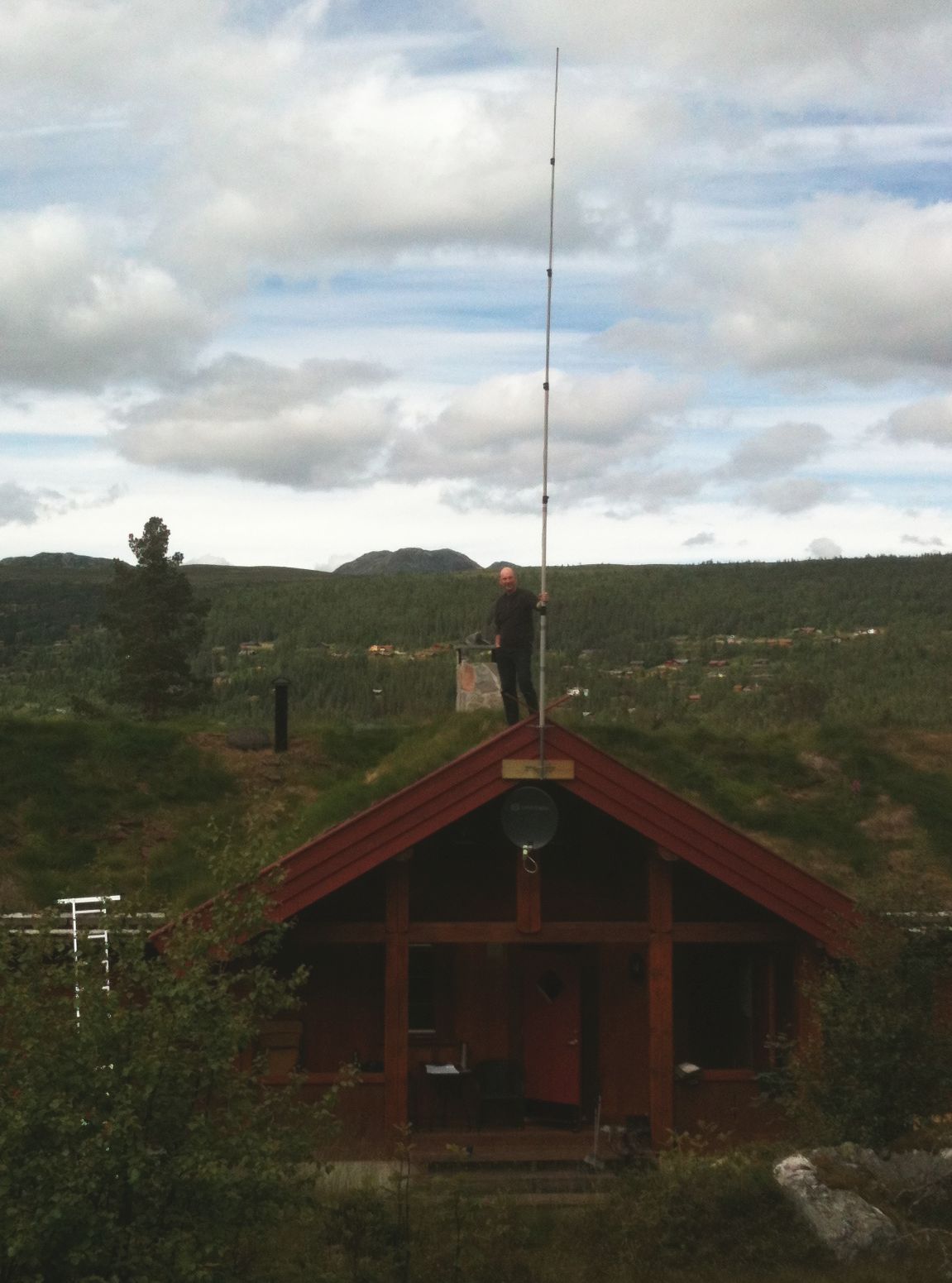
A vertical wire antenna based on a MFJ-1904H 6.7 m (22 feet) telescopic fiberglass pole as shown here is easily tuneable for all bands from 40 m to 10 m. Here it is placed on top of a turf (sod) roof with quarter wave radials for all the 7 bands going to each of the two sides sloping down as they follow the contour of the roof. The antenna seems to work satisfactorily at least on the 30, 20, and 17 m bands which I have been able to test so far.
A turf roof is a traditional Scandinavian type of green roof covered with grass. It dates back to the Viking age and before. In modern times it has seen a renaissance in e.g. mountain cabins.
But how does the turf affect the antenna or to pose the question more precisely: Can it be used to improve the ground plane and the antenna’s performance?
Sverre Holm, LA3ZA, is a regular contributor to AmateurRadio.com and writes from Norway. Contact him at [email protected].
Handiham World for 01 August 2012
Welcome to Handiham World.
Troubleshooting 101
Last week’s problem showed up when I was using my shack’s two meter rig, which is powered by a switching power supply. Let’s just recap: It’s the one that’s typically used for the Handiham net each day. I’m located some distance from the N0BVE repeater system. (It’s in the western part of the Twin Cities Metro while I am in the east.) That means my reception of the N0BVE signal is not exactly perfect. I can hear an annoying hiss in the background when the repeater is active, but that’s easily eliminated with a flip of the switch on my external ClearSpeech speaker. This handy device has almost magical properties – really a very smart algorithm – that digitally cleans up the signal, virtually eliminating the noise. I don’t like to leave it turned on all the time because I also enjoy listening to Minnesota Public Radio with the extended receive feature of the transceiver, and MPR has enough signal to be rock-solid perfect. It sounds best with the external ClearSpeech speaker’s processing turned off.
One day I encountered an interesting problem. I had been listening to MPR when I last used the radio, and when I turned it on, that’s the station I heard. Since I wanted to monitor the repeater instead, I flipped the memory to the stored two meter channel. Then, noticing that the ClearSpeech speaker was turned off, I slid its power switch to “on”. At that very moment, the radio went dead – no power. I pushed the power button on the radio and everything was back to normal. I put up with this for weeks before finally getting the gumption to track it down.
The challenge was to guess what was going on. Rick, W0IS, was right on the money when he wrote:
My educated guess is that the negative power lead for the speaker had gotten disconnected, but it still got power because it was grounded through the radio, either through the speaker connection, or just from the two chassis touching somewhere. But my guess is that the radio’s negative power lead does not go directly to the chassis of the radio. There is some electronics between the black power wire and the chassis, and this electronics did not like the current running through it. I don’t remember the details, but I had something similar happen with my FT-817 (or maybe it was a different rig). The black wire came loose, but it was still connected to the negative side of the power supply through the chassis. It worked, but there were some flukes, since the black wire did not go directly to the rig’s chassis. Did I guess right? 73, Rick W0IS
Yes, and it turned out that the fault was in the ground side of one of those popular snap-together connectors in common use today. The connector was probably not properly installed in the first place, or else the spring tension inside was just so weak as to allow the ground side to lose contact if the connector was bumped or the power supply cable got moved in just the wrong way. It’s worth noting that had the powered speaker had a grounded metal cabinet with a common grounding lug and had both the radio and the speaker been grounded to a common station ground, this problem would likely not have even shown up. As it was, the ground had been completed through the speaker’s 3.5 mm audio plug’s grounded side to the radio. Obviously this is not the ideal way to power things! In any case, the fix was as simple as it could be – just repairing the power supply DC cabling fixed the problem.
Station grounding is important, though. Grounding equipment to a common station ground can help eliminate RF circulating in places where it shouldn’t be as well as protecting equipment from static discharges and keeping the gear at the same potential to avoid electrical shock hazards.
Email me at [email protected] with your questions & comments.
Patrick Tice, WA0TDA
Handiham Manager
Pat Tice, WA0TDA, is the manager of HANDI-HAM and a regular contributor to AmateurRadio.com. Contact him at [email protected].
2012 Challenge – Another Month Down
Another month in the logbook and a QSO each day in 2012 has been successfully worked and logged. This goal has truly been a lot of fun and while I still have a ways to go, I can honestly say that I’m focused to make sure I successfully complete it.
July started out a bit slow. The first week of July my wife and I were on a staycation (stay at home vacation) and I spent much of that week working on the new basement ham shack. I did take one day and completed a SOTA activation of Mt. Evans. During my staycation, I managed to install the tile flooring and complete the baseboard trim work in the shack.
Around the middle point of the month I had not worked any new DX and I was concerned that July would come and go and be the first month in 2012 where I didn’t work at least one new DX entity. But, I shouldn’t have worried…on 15 July I was active in the shack and I heard and worked Poland and before I knew it I had also worked and logged Ecuador, Costa Rica and Chile all within about an hour. Then later in July, 20 July…I worked Honduras for the first time. So July earned me five new DX and a grand total of 19 new DX entities logged for 2012. My total DXCC count is 66. With about 60 confirmed.
My QSO breakdown for July produced a higher ratio of SSB QSO’s compared to JT65. I’ve actively worked more contest QSO’s and more special event stations in July. While I didn’t work any PSK or RTTY in July, I did manage one 2m FM QSO. I don’t usually log 2m QSO’s, but the one 2m FM QSO I logged was a station I chased on a local Colorado SOTA summit. Since I logged that QSO for SOTA Chaser points, I also logged it in my main logbook.

The QSO breakdown for July is as follows:
Mode
Number QSO’s
JT65
35
SSB
62
PSK31
0
2m FM
1
Additional notes of interest:
DX Stations Worked in July – 16
New DX Entities in July – 5
Total QSO’s for 2012 – 856
Total consecutive QSO days – 213
Days left in 2012 – 153
Until next time…
73 de KD0BIK
Jerry Taylor, KD0BIK, is a regular contributor to AmateurRadio.com and writes from Colorado, USA. He is the host of the Practical Amateur Radio Podcast. Contact him at [email protected].
 Ham Radio Deluxe |
 W5SWL Electronics |
 Ham Radio Prep |
 KB3IFH QSL Cards  Hip Ham Shirts  HamRadioAuctions HamRadioAuctions Reliance Antennas Reliance Antennas Enigma Shop Enigma Shop |  morseDX  Ni4L Antennas  R&L Electronics R&L Electronics antennas.us antennas.us QRV QRV |
- Matt W1MST, Managing Editor
