 |
 And you’ve got to have friends ……
 24 July 2012 | by
 as the old song goes. And thanks to Amateur Radio, I have a bunch!
Here’s what some of them have been up to:
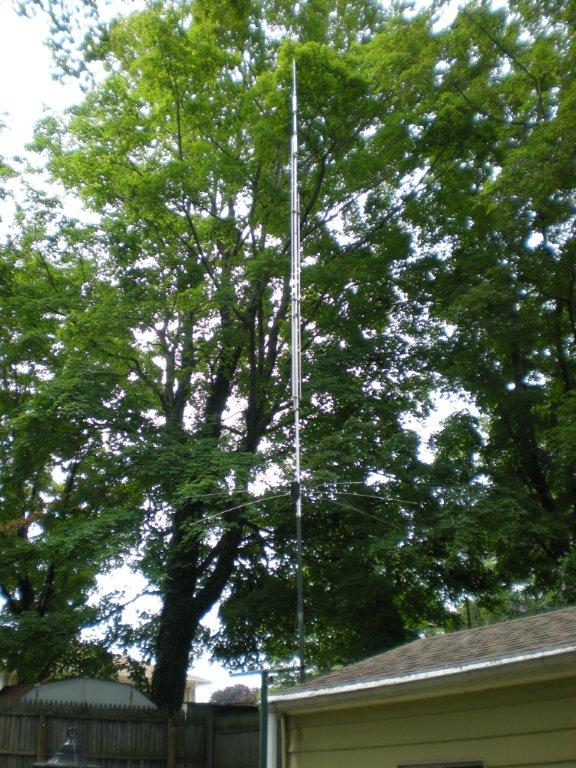
Bob W3BBO has put up his new Cushcraft R6000; and reports that it is working fine.
Jim W1PID had another great portable QRP outing (this one is complete with a video):
http://www.w1pid.com/dam2/dam2.html
And my friend Brian KB9BVN reported on Facebook that his Indianapolis Colts tickets arrived.
Good things DO happen to good people!
By the way – don’t forget that Flight of the Bumblebees is this coming Sunday. I am really stoked! The forecast for Central NJ (so far) is for sunny weather with temps in the high 80s, with a chance of thunderstorms as the afternoon progresses. Hope it’s not like it was a couple years ago when boomers shortened my outing and I came home to find the neighbor’s pine tree on fire from a lightning hit.
There’s still time to get your very own Bee number. Don’t be part of the last minute rush!
http://arsqrp.blogspot.com/2012/07/adventure-radio-society-2012-flight-of.html
72 de Larry W2LJ
QRP – When you care to send the very least!

Larry Makoski, W2LJ, is a regular contributor to AmateurRadio.com and writes from New Jersey, USA. Contact him at [email protected].
A first time for everything.


Mike Weir, VE9KK, is a regular contributor to AmateurRadio.com and writes from New Brunswick, Canada. Contact him at [email protected].
The new shack desk

I thought I’d catch it before it all goes wrong with too much stuff on it! The only enhancement it needs is a full size rig (or two)
Alex Hill, G7KSE, is a regular contributor to AmateurRadio.com and writes from Cumbria, UK. Contact him at [email protected].
A new addition to the shack
I seem to suffer with the same addiction that so many other hams have. One hand held is just not enough.
It was my birthday the other day and seeing as I’m officially really old according to my kids I thought I could treat myself to a 2m hand held that I could happily take with me when I’m out on my mountain bike (Its full suspension, which goes with my old age, apparently!). I’ve never been too keen on taking the excellent Yaesu VX8-G that is my primary summit radio. I don’t regularly come off but I wouldn’t want to come off with that in a back pack. So like many others a Baofeng UV5 was ordered through eBay. After a 3 week wait it landed on my doorstep, out of the XYL’s view and was quickly moved into the garage retreat.
The specs are well known and whilst you shouldn’t expect too much for 30 quid I was quiet surprised when I sneaked it into the car when we had a trip to Mirehouse at the weekend. Even with the short and doubtful antenna I got a good signal report from M0YDH on Robinson from Keswick.
Now then what about one for 4m?
Alex Hill, G7KSE, is a regular contributor to AmateurRadio.com and writes from Cumbria, UK. Contact him at [email protected].
RTL-SDR Adventures

DVB-T Dongle from eBay seller digitalhome88
I received my DVB-T dongle from eBay finally about a week ago. Here’s a link to the vendor I purchased from. After getting the drivers loaded in Windows 7 on my aging Dell D630, I was able to get the SDR running. Using the instructions here at rtlsdr.com, I finally got things up and running. There was one mistake that made me lose several minutes. I missed the instruction: If your dongle doesn’t automatically show up, select Options then List all Devices. Read carefully! I’ve found that in my case, SDR# is the better choice of software. For some reason HDSDR causes the dongle to lock up after changing bands. I’m sure I’ll find out why because I see many others having good luck with it. The old Dell was able to keep up, but seemed a bit choppy. I dropped the sampling rate down a bit, and everything was fine.
My first tests were a little disappointing, yet this was with the cheesy antenna the dongle arrived with, and then with MacGuyver-ing an antenna adapter together. The DVB-T dongles have a PAL-female connector on them, and nothing in my tin-o-connectors seemed to work. Radio Shack carries an adapter that is PAL-male on one side and F-female on the other. I went out and picked one up, as well as an extra F-to-BNC adapter. Then I was able to go from the dongle to my simple outdoor antenna.
With a solid connection to my outdoor wire antenna (just a wire thrown into a nearby tree, and a counterpoise out on the roof slope), I was able to get all of the local repeaters, as well as repeaters in Manhattan, and much farther. 4 different NOAA stations came in, and aircraft traffic from the whole tri-state area. I even grabbed a couple of 2 meter USB contacts, and quickly switched over to the TR-9000 to speak with one of them. Performance with this setup was much, much better than I had expected.
My Elmer had stopped by Sunday to deliver a rig he repaired for me on his way out to Eastern Long Island, and I gave him a quick demo. After playing with it for about 20 minutes he said “Send me the info. I need to get one of these!” Here is a quick video I took of some local repeaters, including a Ham ordering coffee from a McDonald’s drive-thru. Sorry for the shaky video.
Click here for video: RTL SDR with SDR#
–Neil W2NDG
Neil Goldstein, W2NDG, is a regular contributor to AmateurRadio.com and writes from New York, USA. Contact him at [email protected].
Baofeng brothers
Back in February I bought a Baofeng UV-3R+. It came after an unusually long wait for products from China, in March. In that time, eBay vendors had begun advertising the new Baofeng UV-5R which had double the output power and a key-pad that could be used for DTMF. To add insult to injury the price of the 5R was less than I paid for the 3R+.
As the months passed the knowledge that the UV-5R could still be bought for an absurdly low price niggled away at me, until eventually I gave in and ordered one. Unlike its little brother the 5R got here in little more than a week. So now I have two Baofeng HTs. A ham can never have too many radios, especially at this price!
 |
| Baofeng UV-3R+ and UV-5R |
After I sold my original UV-3R to make way for the Plus I had a few regrets. The original had the advantage of being lightweight and tiny. Although the Plus was only a few millimetres larger and a few grams heavier the difference felt more marked. It lacked the cuteness of the earlier model. But the drop-in desk charger was a nice standard accessory. The accessory port was the same as used by Kenwood and Wouxun, enabling some standardization. It is a nice little radio but functionally almost identical to the original 3R.
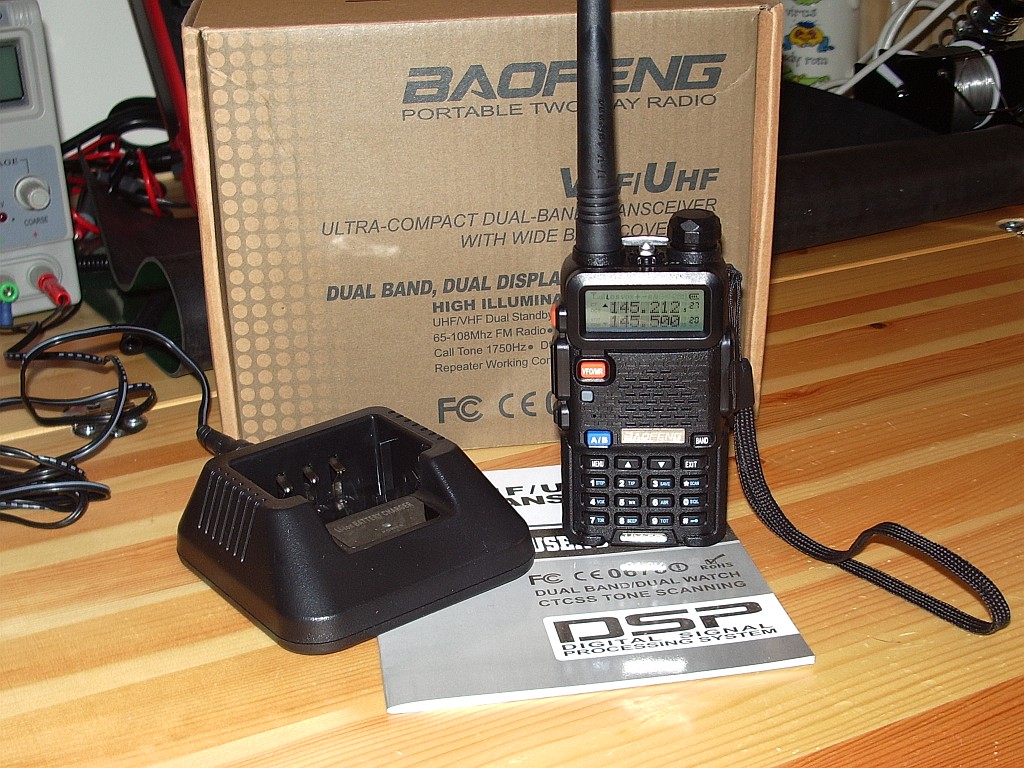 |
| Baofeng UV-5R unboxed |
The UV-5R is quite a big improvement over its little brother. It isn’t a lot bigger or heavier than the 3R+ but the extra size and weight gains you double the output power (4W compared with 2W) and a keypad which supports both frequency entry and DTMF. The latter makes the radio much more useful on Echolink.
The 5R feels solid and well built like the 3R+. In fact it feels like a radio that cost three times the price. I think Baofeng has hurt sales of the basic handhelds made by the Japanese “big 3.” Only rigs with ham radio specific extras like supporting D-Star or APRS will be able to justify a higher price. As neither of those things are useful for the typical Chinese business buyer of these radios I can’t see Baofeng starting to compete in that area. So Yaesu, Icom and Kenwood can breathe a sigh of relief.
Other things I like about the UV-5R are:
- 4W maximum power out
- Alphanumeric names for memory channels
- Backlit keypad – a classy touch
- DTMF – ideal for Echolink
- Analogue volume control with proper on-off switch .
I like the way the display (and keypad) lights up when a signal breaks the squelch and stays lit for a few seconds after the signal has finished. If you have more than one handie in use this feature lets you know which radio received the call. My Wouxun also does that.
There are a lot of other things to like, such as the voice announcement (my ham rigs don’t have that) and the fact that accessories and spare parts being really cheap. The same computer interface cable works with both Baofengs and the Wouxun. Headsets and speaker-mics work with two Kenwood radios as well.
Judging by the comments of some buyers in the user groups, “Baofeng quality” is still an oxymoron. You are taking a chance that the radio you receive will not have any faults. Sending the set back to Hong Kong But if you are prepared to take that risk (or pay a bit more and buy from a local dealer) then the Baofeng UV-5R is worth a lot more than you pay for it.

Julian Moss, G4ILO, is a regular contributor to AmateurRadio.com and writes from Cumbria, England. Contact him at [email protected].
A Great Weekend on VHF
 One of the things that makes a VHF contest so much fun is that you never know how its going to play out. One of the major factors is sporadic-e propagation which is, well, sporadic. Sometimes we get rewarded with decent propagation and sometimes we get completely skunked.
In the morning, before the 2012 CQ World Wide VHF Contest started, the 6 Meter band was open from Colorado to the east. The band continued to be open to various locations for most of Saturday, even late into the evening. I made my last contact on 6 Meters to the Pacific Northwest after 10:30 PM local time.
On Sunday morning, 6 Meters gave us some more fun but it was not nearly as good as Saturday. Instead of strong signals and consistent runs, the signals were variable and QSOs were often a challenge. Sometimes it was like pulling teeth. This contest only uses two bands: 6 Meters (50 MHz) and 2 Meters (144 MHz). As 6 Meters pooped out, the action moved to 2 Meters. Fortunately, we had a number of rovers out that helped activate some of the rarer grids. Thanks W3DHJ, AB0YM, KR5J and W0BL.
This is probably my best score ever in the CQ WW VHF Contest, due to the excellent propagation on Saturday and some station improvements I’ve made over the past couple of years.
     Band       QSOs X pt =  QSO pts.  X   Grids   =     Points
---------------------------------------------------------------
     50         337    1      337           130           43810
     144        34     2      68            13            884
---------------------------------------------------------------
     TOTALS     371           405           143           57915

                            Claimed score =  57915
All in all, a great weekend on the VHF bands.
73, Bob K0NR
Bob Witte, KØNR, is a regular contributor to AmateurRadio.com and writes from Colorado, USA. Contact him at [email protected].
 Ham Radio Deluxe |
 W5SWL Electronics |
 Ham Radio Prep |
 KB3IFH QSL Cards  Hip Ham Shirts  HamRadioAuctions HamRadioAuctions Reliance Antennas Reliance Antennas Enigma Shop Enigma Shop |  morseDX  Ni4L Antennas  R&L Electronics R&L Electronics antennas.us antennas.us QRV QRV |
- Matt W1MST, Managing Editor
