 |
 Bunny box woes
 30 July 2012 | by
 I belong to a small group of transmitter hunters here on Long Island. My Elmer originally got me involved by having me navigate for him, and as I learned the technique, I graduated to running my own vehicle along with my better half, KD2CHE. The last few hunts, she has been driving while I watch the signal strength and maps.
Most of the hunters use doppler equipment, from various vendors. Jill and I have had great luck just using our maps, and a good assortment of receivers. We watch the signal strength on my best receiver, a Kenwood TR-9000, and then keep two HTs set to different levels of sensitivity. I hang the HTs in locations so that I can hear them come on. One with no antenna at all, and the other with a mismatched stubby antenna. This combination has gotten us to the bunny box before many of the doppler-equipped cars.
Friday night we had a hunt. The box was to be hidden within 3.5 miles from the Republic Airport in Farmingdale, NY. The box itself is managed by my Elmer, WA2CDL. It’s an old Radio Shack HTX-202, controlled by a custom PIC controller, powered by an external rechargeable battery, all contained in a surplus ammo box. We set out in our new Kia Soul, with me in the back seat. I folded half the back seat so as to have a kind of desk next to me. There I had the TR-9000 and a Dell laptop with the RTL-SDR setup, and Google Maps. Internet was provided by a hotspot on my T-Mobile HD7. We waited.
Unfortunately no one could hear the transmitter. It was mentioned that it might be operating on low power, since it had not been charged. So we drove around till we heard it. Each time it transmitted (30 seconds on, 30 seconds off), we would get a signal, and as we drove in the direction I though it would be in, the signal got weaker. As I plotted all of the vectors around the area where we heard the signal, it seemed that it was simply nowhere. Every time we chased the signal, it got weaker.
Eventually we were given a hint, and once found, I have to admire the location (about 15 feet off of a trail, in a nature preserve, up in a tree). Only some of the doppler-equipped cars were able to locate the box. As it turned out, my eternally fading signal was caused by the low battery. WA2CDL did some measuring after the hunt and told me that it was starting out transmitting just over a Watt, and finishing the 30 second transmission with about 250 Milliwatts. That explained why we always seemed to be heading away from it.
In practical use, what does this mean? If we were trying to find a lost hiker, for example, who had a radio with a dying battery, we would need to take the fading signal into account. I think if I had known that the signal was fading out each time we heard it due to the battery running low, I would have altered my technique. I think if we had simply moved at one minute intervals and marked the signal strength at each location just for the beginning of the transmission, I would have been able to plot the location. I guess I need to ask what the charge on the bunny box battery is in advance next time, or stay put for a couple of transmissions, and see if the signal fades.
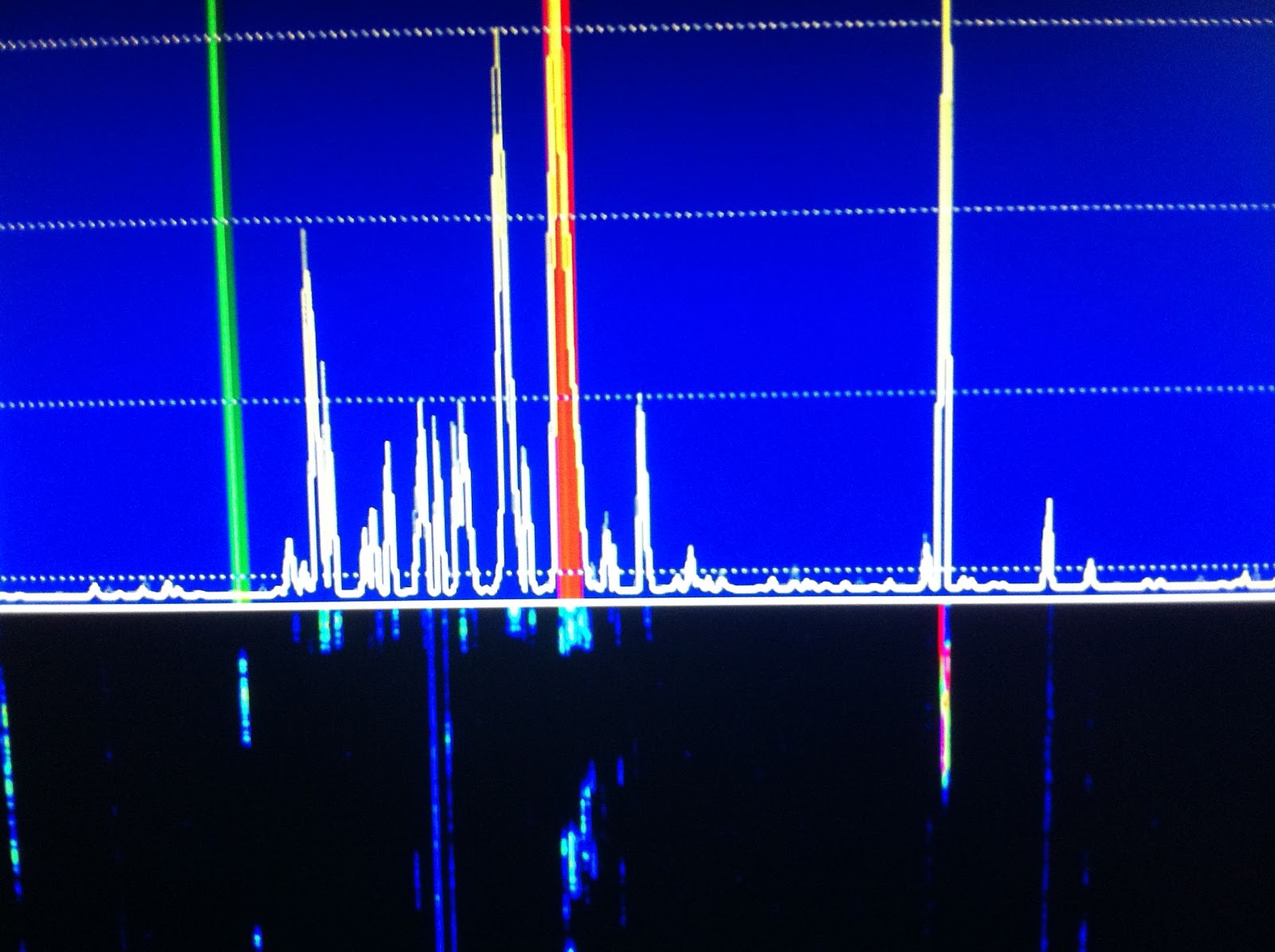
How did the RTL-SDR do? Well, if we had steady signal, or if I had known to compensate, it would have been fantastic. I could see the signal before we could hear it, and signal strength was more visual. The battery quit before the end of the hunt though, because of the difficulty in finding the box. I hope to try it again.
Neil Goldstein, W2NDG, is a regular contributor to AmateurRadio.com and writes from New York, USA. Contact him at [email protected].
Show Notes #087
Introduction:
- Promo: Ohio LinuxFest 2012 will be held September 28-30, 2012, at the Greater Columbus Convention Center in downtown Columbus, Ohio.
- LHS community sends their good wishes to the victims and their families in Aurora, CO.
- Our hosts recommend Etherpad for collaborative document editing.
Announcements:
- Ham Holiday Oklahoma City, Oklahoma, July 27-28, 2012, Biltmore Hotel.
- Texas Linux Fest, San Antonio, Texas, August 3-4, 2012, Norris Conference Center.
- Texoma Hamarama Ardmore, Oklahoma, October 26-27, 2012, Exit 33 – I-35: Ardmore Convention Center.
- Watch the Events Schedule on the LHS website for more events!
- Click the Amabassadors link on the website and volunteer to be an LHS Amabassador at a Linux or ham-related event.
- 20th annual Gainesville Hamfest Gainesville, Texas, Saturday, August 25, 2012, Civic Center.
- Joplin Hamfest, Joplin, Missouri, August 24-25, 2012, Holiday Inn Convention Center. Look for Russ and Cheryl!
- Russ is anxiously waiting for delivery of two (okay, three) Raspberry Pi computers. Call the LHS voice line 909-547-7469, or send an email to [email protected], and tell Russ what to do with his Rasperry Pis. Wait, that doesn’t sound quite right, but you get the drift.
Feedback:
- Bruce, VE2GZI, writes to express his appreciation for the episode about GNU-Radio (Episode 84). It inspired him to try getting it to work under Linux Mint 11, but it’s been a struggle, and he asks for help. Russ managed to compile it on Linux Mint Debian Edition. Jlindsay in the chat room said he ignored the build script, and just did a cmake and make. Also make sure you have the proper version of portaudio installed. Bruce also tells us he’s waiting for his Hong Kong Dongle. ’nuff said.
- Scott, N9LJX, says he’s always had trouble with rig control, via Hamlib, and his FT-900, and wonders if that’s been improved. He’s happy to hear that yfktest works with Winkey USB. Russ looked at the Hamlib website about Yaesu radios, and saw the status listed as “.1 untested”, which indicates poor, if any, support for that radio. Richard suggests avoiding the USB or USB-to-serial adapter. Instead, buy an inexpensive serial port card for the computer and connect the radio to a real serial port.
- Someone in the chat room asked about a good personal cloud storage solution. Russ likes ownCloud. and has described it in episode 9 of his QSK Netcast.
- Jeremy, KB7QOA, sends a long email thanking us for the show, discussing his gradual move toward Linux, and wonders if he could have a version of the podcast without the music. Well, Jeremy, if you’re willing to subscribe to the show, you’ll soon have the option of a music-free feed.
- Grant, AA9LC, has embarked on a project to establish a Linux computer in his hamshack. He met Russ at the recent Dayton Hamvention, and has been trying to boot the LHS disc he received there, but it wants a username and password. He’s also tried Linux Mint 11 and is “mostly impressed.” As the disc contains nothing more than Linux Mint Debian Edition, Russ suggests the username may be one of “root”, “mint”, or “linuxmint”, and no password. However, it should boot directly into a “live” mode desktop without ever asking for a username or password. If that doesn’t help, Grant, let us know and provide a few more details about when you’re asked for the username and password. Russ and Richard also provide some hints about managing sound card audio.
- Look for Russ on Episode 124 of the Mintcast.
Contact Info:
- Contact Richard at [email protected], Russ at [email protected], or both at the same time at [email protected].
- Listen to the live stream every other Tuesday at 8:00pm Central time. Check the LHS web site for dates.
- Leave us a voice mail at 1-909-LHS-SHOW (1-909-547-7469), or record an introduction to the podcast.
- Sign up for the LHS mailing list.
- Sign up for the MAGNetcon mailing list.
- LHS merchandise is available at the Merch link on Web site. Check out the Badgerwear or buy one of the other LHS-branded items at PrintFection.com/lhs or Cafe Press. Thanks!
- Thanks to Dave from Gamma Leonis for the theme music.
Music:
- “I’m Doin’ Fine” by Lorenzo’s Music from the album Solamente Tres Palabras, courtesy of Jamendo.
- “We All Fall Down” by Lorenzo’s Music from the album Just Had to Let You Know, courtesy of Jamendo.
Russ Woodman, K5TUX, co-hosts the Linux in the Ham Shack podcast which is available for download in both MP3 and OGG audio format. Contact him at [email protected].
CY9M in the log!

On 30 Meters tonight at 00:52 UTC. Figured out that he was creeping up a few kHz after each station worked. Got in his path, and got in the log!
A good end to a pretty good day!
72 de Larry W2LJ
QRP – When you care to send the very least!

Larry Makoski, W2LJ, is a regular contributor to AmateurRadio.com and writes from New Jersey, USA. Contact him at [email protected].
FOBB 2012
Ol’ Man Murphy seemed to be my constant companion today! I foolishly thought I had everything under control. I was given yet another lesson in humility today.
I got to the park right at about 12:45 – a lot later than intended. Some home things came up, and I had to take care of them first. Really no biggie, but still, an unintended delay.
So I get to the park, and get out the wrist rocket. Load the pouch with my 1 ounce fishing weight, pull back and aim for a convenient branch. Instead of “BWWWWAAAANG”, I got a loud “SNAP”. One of the elastic bands broke. OK, take a deep breath, examine the situation. Thanks to the Swiss Army Knife that I always carry, I was able to make some field repairs that would hold me over. I finally got the wire up like I had it last year. I hooked up the KX3 and could not get a decent match! I have no idea why; but I figured I would worry about that later as I was already seriously into the first hour of the contest.
ALWAYS have a back up! I ran over to the Jeep and pulled out the Buddistick. W3FF’s antenna literally saved my bacon this afternoon. I got it set up and got going, one hour into the proceedings.
After that, the afternoon went well and was a success. I’m never in these things to win – just to have fun and rack up some QSOs. In all, I made thirty contacts. Twenty six were on 20 Meters and four were on 40 Meters. I was a bit disappointed with the lack of activity on 40 Meters. I thought there would be a lot more, especially as the afternoon wore on. I kept checking 7.040 MHz as well as 7.030 MHz, but except for the four QSOs that I made, there was nothing to be heard.
Something to do before the Skeeter Hunt in two weeks.
Figure out why the wires wouldn’t match. AND, make new wires out of something more flexible and light. I was using some wire that I had gotten from an SK’s estate sale that would have been more appropriate for a permanent wire antenna. I need to get something better for portable ops.
The little blue LiPO battery held up great! No problems with it going low voltage on me. By making sure the KX3’s LCD backlight was off, I was able to stay at the full “QRP Gallon” of 5 Watts out for the entire time I operated.
The filtering in the KX3 made an easy job out of working stations that were right on top of each other. In fact, at one point, John K4BAI came back to me informing me that we had already worked each other. John, if you’re reading this, I was working someone else who was so close to you, it was ridiculous. Yet, the KX3 was able to single the other op out for me with no problem.
Even though there was some frustration, the day turned out well. And, no more than a half hour after I got home, the skies got dark, the lightning and thunder started and we had real heavy downpours. But by that time, I was already adding my QSOs to AC Log on this netbook.
Hope you had a great time with FOBB today! Looks like Jim W1PID did – here’s his report:
http://www.w1pid.com/fobb12/fobb12.html
72 de Larry W2LJ
QRP – When you care to send the very least!

Larry Makoski, W2LJ, is a regular contributor to AmateurRadio.com and writes from New Jersey, USA. Contact him at [email protected].
IOTA contest and CY9M DXpedition

On all my contacts I tried with the lowest power possible and worked my way up until I made contact. If I was at full output (5 watts) and still could not make contact it was time to move along.
 |
| Pile up for CY9M on my P3 |

Mike Weir, VE9KK, is a regular contributor to AmateurRadio.com and writes from New Brunswick, Canada. Contact him at [email protected].
ICQ Podcast S05 E16 – RSGB Future & Foxhunting (29 July 2012)
Series Five Episode Sixteen of the ICQ Podcast has been released. News Stories include :-
- Olympics frequency regulations start taking effect
- UK Olympics special events satellite operations
- GB2012RA active from Olympic Shooting venue
- Satellite contact between Cuba and Alaska
- SST-US and Virgin Galactic small satellite launches
- Executive Order poses no threat to the Ham Radio service
- Busy month for North Cork Radio Club
- Give kids a Radio Ham Pi - minister
- Raspberry Pi sends live images from near space
- Low-cost Amateur Radio balloon repeater
- CBer fined for interfering with Air Traffic
- From Bermuda to the moon and back
- RF filters and diplexers - Cross Country Wireless
- Transverter for 472 kHz band
- ZL9HR DXpedition to Campbell Island
Listener mailbag and Colin (M6BOY) analysises the RSGB Future document and Martin (M1MRB) gives an introduction to Foxhunting, radio sytle.
Colin Butler, M6BOY, is the host of the ICQ Podcast, a weekly radio show about Amateur Radio. Contact him at [email protected].
LHS Episode #087: King Jeremy the Wicked
 Hello, listeners! Welcome to the 87th installment of Linux in the Ham Shack. The past couple of episodes have been full of interviews, logic, and information. In short, we’ve totally jumped off our normal bandwagon. In order to fix that, we’ve put together an episode that contains a lot of banter, insight, musing, laughing, music and good times. Somewhere in the middle you’ll find information on Linux, Open Source software, ham radio logging applications, answers to listener feedback, compile instructions for source builds and mention of a secret recording where Russ takes over another podcast and rules the world. Make sure to listen from beginning to end. You’re not going to want to miss a single second.
73 de The LHS Guys
Russ Woodman, K5TUX, co-hosts the Linux in the Ham Shack podcast which is available for download in both MP3 and OGG audio format. Contact him at [email protected].
 Ham Radio Deluxe |
 W5SWL Electronics |
 Ham Radio Prep |
 KB3IFH QSL Cards  Hip Ham Shirts  HamRadioAuctions HamRadioAuctions Reliance Antennas Reliance Antennas Enigma Shop Enigma Shop |  morseDX  Ni4L Antennas  R&L Electronics R&L Electronics antennas.us antennas.us QRV QRV |
- Matt W1MST, Managing Editor
