 |
 2012 Challenge – Another Month Down
 1 August 2012 | by
 Another month in the logbook and a QSO each day in 2012 has been successfully worked and logged. This goal has truly been a lot of fun and while I still have a ways to go, I can honestly say that I’m focused to make sure I successfully complete it.
July started out a bit slow. The first week of July my wife and I were on a staycation (stay at home vacation) and I spent much of that week working on the new basement ham shack. I did take one day and completed a SOTA activation of Mt. Evans. During my staycation, I managed to install the tile flooring and complete the baseboard trim work in the shack.
Around the middle point of the month I had not worked any new DX and I was concerned that July would come and go and be the first month in 2012 where I didn’t work at least one new DX entity. But, I shouldn’t have worried…on 15 July I was active in the shack and I heard and worked Poland and before I knew it I had also worked and logged Ecuador, Costa Rica and Chile all within about an hour. Then later in July, 20 July…I worked Honduras for the first time. So July earned me five new DX and a grand total of 19 new DX entities logged for 2012. My total DXCC count is 66. With about 60 confirmed.
My QSO breakdown for July produced a higher ratio of SSB QSO’s compared to JT65. I’ve actively worked more contest QSO’s and more special event stations in July. While I didn’t work any PSK or RTTY in July, I did manage one 2m FM QSO. I don’t usually log 2m QSO’s, but the one 2m FM QSO I logged was a station I chased on a local Colorado SOTA summit. Since I logged that QSO for SOTA Chaser points, I also logged it in my main logbook.

The QSO breakdown for July is as follows:
Mode
Number QSO’s
JT65
35
SSB
62
PSK31
0
2m FM
1
Additional notes of interest:
DX Stations Worked in July – 16
New DX Entities in July – 5
Total QSO’s for 2012 – 856
Total consecutive QSO days – 213
Days left in 2012 – 153
Until next time…
73 de KD0BIK
Jerry Taylor, KD0BIK, is a regular contributor to AmateurRadio.com and writes from Colorado, USA. He is the host of the Practical Amateur Radio Podcast. Contact him at [email protected].
An old friend returns, and arrives with a mystery item

Sony ICF-2010
I’ve owned many of the classic shortwave receivers throughout the roughly 40 years that I have been a SWL. Most of these I passed on to friends and relatives, while others were sold at hamfests, and on eBay. I know that my beloved Panasonic RF-2200, is still used by my sister-in-law Alice. My late brother Paul kept it prominently displayed on the counter for years. My Sony ICF-6500 lives in Wisconsin, in the hands of a good friend that wanted to get in to shortwave listening. Others, I’m not so sure as to the whereabouts, but hopefully they are still in use (with exception given to my National HRO-60 which I know was lost in a flood).
Of all of these, the one I frequently regret selling was my Sony ICF-2010. The 2010 is still considered to be one of the best portable shortwave receivers around, and rivals many tabletops. I sold mine on eBay during what we’ll call a dark time in my life a number of years back. I purchased the 2010 new at Gilfer Shortwave in NJ, in-person. Now, as I see working examples sell for upwards of $350 on eBay, I have relegated the replacement of this radio to a status of someday, along with several other things that I want but do not need at the moment. It would be a nice addition to my collection though, considering it is a great receiver. It has a synchronous detector, separate USB/LSB modes, and 100Hz resolution, and portability.
Last week while watching new postings on eBay I saw one come up. This example was listed as for parts or not working. Upon reading the description, I noticed that the seller indicated the radio to be completely dead. Now, in the world of radio repair, completely dead is usually better than many other states of being. Especially in the case of the 2010, which is known to have battery compartment issues. Anyway, I grabbed the radio immediately for a VERY reasonable price. It arrived last night, and as I suspected, the problem was battery compartment related. The 2010 runs on 3 D-cells, and 2 AA-cells. The AA cells are listed as the computer batteries. One thing about the 2010: If you want to run it on AC power alone, you still HAVE TO have the AA-cells in place. One of the plastic supports for the AA battery contacts had broken from the housing. It is still held in place with a ribbon-
sized piece of plastic though, causing it to tilt at an angle back and forth like a loose tooth. I temporarily fixed it with a piece of compressed foam and some plastic tubing. The radio works great! Better I think than my early example from years ago. I have a couple of questions for the radio community though.First of all, what should I glue the AA-cell support back in place with? I would try crazy-glue (or any generic cyanoacrylate), but I know that it will sometimes react with some commercial plastics, making the problem even worse. I was thinking of using Gorilla Glue, but I would need to devise a clamping method. I know some of you out there have dealt with such things before. What do you use?
Second, the radio arrived with a loop antenna of some kind. I have put pictures below. It is approximately 21 inches long, made from PVC pipe with two endcaps. On one end is an F connector and on the other end, an eye-hook. I scrounged in my adapters and was able to hook it up. It definitely improved reception on a few bands. Has anyone seen one of these before? Is it a commercial product, or homebrew? What is the bandwidth? And, if no one knows, what is the best method for determining its properties? Feel free to answer in the comments.


Neil Goldstein, W2NDG, is a regular contributor to AmateurRadio.com and writes from New York, USA. Contact him at [email protected].
WGØAT and FOBB
Steve WGØAT posted this to the KX3 reflector this afternoon – as usual, Steve’s videos are super cool!
72 de Larry W2LJ
QRP – When you care to send the very least!

Larry Makoski, W2LJ, is a regular contributor to AmateurRadio.com and writes from New Jersey, USA. Contact him at [email protected].
The Skeeters are multiplying!
As of tonight, we are up to 93 brave souls who have volunteered to be Skeeters for the inaugural NJQRP Skeeter Hunt this August 12th.

You don’t have to have a Skeeter number to participate – but it’s way more fun to have one! Get yours by e-mailing yours truly at [email protected].
Two places to view the rules:
http://w2lj.blogspot.com/p/njqrp-skeeter-hunt.html
and
Still plenty of time to get a number, so don’t be shy! Was there something that you did during FOBB that you would like to try and improve upon for next year? New antenna? Different location? Different key? Use the Skeeter Hunt as a “proving ground” – we certainly don’t mind!
The goal is to get up, get out and have some fun with that gear that you’ve built (although the use of commercial gear is certainly not discouraged). Come out and play!
72 de Larry W2LJ
QRP – When you care to send the very least!

Larry Makoski, W2LJ, is a regular contributor to AmateurRadio.com and writes from New Jersey, USA. Contact him at [email protected].
Do LCDs wear out?
Do LCD displays wear out or fade with age?
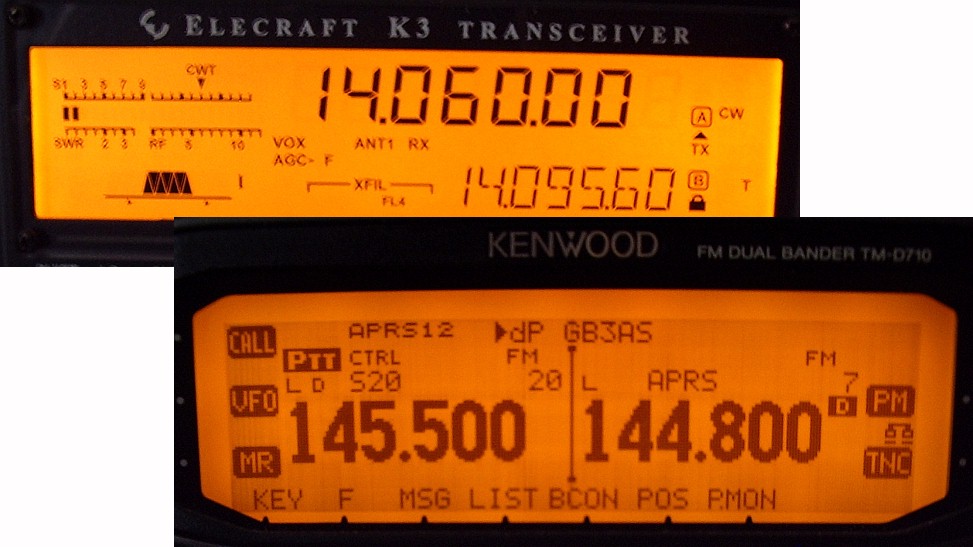
The picture above shows the displays of my Elecraft K3 transceiver and my Kenwood TM-D710 VHF rig. The Elecraft display is sharp with good contrast and characters look almost black against the orange background. The Kenwood display is much less contrasty. The backlight is not as bright as the K3’s but the characters look more murky brown than black no matter how I set the brightness and contrast. It’s quite noticeable when the two radios are side by side.
I don’t think the Kenwood’s display was ever as bright as the K3’s but I don’t recall it being as murky as it is now. Whenever I look at it I keep wanting to turn the contrast up. I’ve taken to turning the backlight off altogether so it doesn’t bug me but there is no option to have it turn on automatically when a button is pressed. (AUTO BRIGHTNESS: ON appears to do nothing.)
My D710 has been running 24/7 for more than a year (with a brief hiatus when I went into hospital until I felt like running the APRS gateway again.) Could the display have faded (for want of a better way to describe it) over time? Or is my recollection that the text used to look more black than brown faulty?

Julian Moss, G4ILO, is a regular contributor to AmateurRadio.com and writes from Cumbria, England. Contact him at [email protected].
Knock me over with a feather!
I had two nice DX QSOs tonight on 20 Meters and you could have knocked me over with a feather. Both ops actually carried on somewhat “normal” QSOs with me! Ivan EA2NN and Jean F6HFX (who was also QRP, BTW).

Now mind you, due mainly to QSB, these weren’t long rag chews by any means; but we did exchange (besides RST), rig, antenna, weather information – that kind of thing. Wow! DX QSOs that were heckuva lot longer than “TU 599 QRZ?” !!!
Man, that takes me back to my Novice days when QSOs with DX stations were like any other. In fact, I still have QSLs where in addition to the card, I got letters and photos!
I really, really miss that; and it was nice to get just a teeny taste of that again, tonight.
72 de Larry W2LJ
QRP

Larry Makoski, W2LJ, is a regular contributor to AmateurRadio.com and writes from New Jersey, USA. Contact him at [email protected].
OK, OK! I Will Write that Ham Radio Book!
Ever since I began writing articles about my hobby of choice–amateur or “ham” radio–for my ham radio web site and several others, people have been asking me when I was going to do an amateur radio book. The truth is, I have just been too darn busy to even think of such a thing. And I also knew, in my heart of hearts, that it be would difficult indeed to get any kind of decent book contract for such a niche book. I presented my idea of a half-fiction/half-nonfiction book to the ARRL and they passed, so that confirmed my feelings. If they had no interest, I doubted anyone else who published books would either.
Fast-forward to July 2012. Things have changed, both in my personal life and in the wild and woolly world of big-time book publishing.
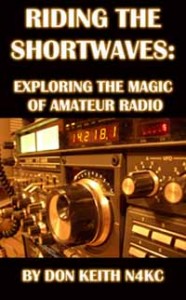
Don Keith N4KC has just published his new book of short stories, articles, advice, and more about ham radio.
First, I retired from my 60-hour-a-week day job back in May. And as I shuffled through the articles I had in the can, several more I was working on, and a few still in my head, I realized I was closer to a book than I had thought. And I truly believed I had something that would be different and could find a readership.
Secondly, as I investigated Kindle Direct Publishing at Amazon.com for the re-issue of a couple of my previous now-out-of-print books, I realized that I should absolutely pull the ham radio book together for that outlet–Kindle and some other e-book readers–at least. Amazon has become a real threat to traditional publishing companies–especially when it comes to e-books–as the old-line publishing houses struggle to figure this newfangled thing out. At the very least, it gives me the opportunity to make my book available at a very reasonable price to those interested in amateur radio. No, I don’t make much money at the price I set, even if I actually sell some downloads of the book, but that is not really the object anyway. As I have said many times, and not totally facetiously, if I wanted to make a fortune writing books, I would write pornography (See FIFTY SHADES OF GREY).
Then, as I considered other options, I realized that Amazon offers a truly unique opportunity for works like this one that allows me to offer the book in a traditional paperback format with minimal investment up front. Remember, I’m retired, on a fixed income these days! Amazon’s is a print-on-demand deal, but they seem to have it down to a science. I ordered some copies as soon as I got the book and cover uploaded and accepted for publication. The very next day I got the email that they were being shipped that day. Wow!
Again, this was with very little upfront cost and minimal hassle. Now, the paperback will be available not only via Amazon.com, but through major distributors, for order by libraries, and even in many European markets. We will see how good the print job is, but believe me on this: the major houses don’t necessarily produce the highest quality book any more either. They have to cut where they can to make a profit and printing, binding, and warehousing is a big drain on them.
Talk about rapid technological change and its effect on society and the media! Broadcast radio, TV, the Internet and telephone communications are not the only things evolving at a dizzying pace. Include the anachronistic business of book publishing in that mix, too!
Realistically, will tons of booksellers and all the Barnes & Noble stores order a box full of the books each? Or will hundreds of thousands of libraries order up a couple dozen copies each? Of course not. The big publishers do have sales staff to encourage that sort of thing. But a) no big publishing house was going to do a contract for RIDING THE SHORTWAVES: EXPLORING THE MAGIC OF AMATEUR RADIO and b) even if they did, it would be somewhere near the bottom of the sales staff’s sample case, so c) Amazon’s various self-publishing options are perfect for this kind of book.
By the way, if you have any interest in the dynamic and rapidly growing hobby of ham radio–believe me, it ain’t your weird uncle’s past-time any more!–then you may want to stop by Amazon.com and take a look “Inside the Book,” read the description, and maybe buy a copy or two…for yourself or someone you know and want to spark the interest in our amazing hobby.
See, right there in that last sentence, I did more publicity for RIDING THE SHORTWAVES than the big publishers do for most of the books they print up and ship out!
73,
Don Keith N4KC
www.donkeith.com www.n4kc.com
Don Keith, N4KC, is a regular contributor to AmateurRadio.com and writes from Alabama, USA. Contact him at [email protected].
 Ham Radio Deluxe |
 W5SWL Electronics |
 Ham Radio Prep |
 KB3IFH QSL Cards  Hip Ham Shirts  HamRadioAuctions HamRadioAuctions Reliance Antennas Reliance Antennas Enigma Shop Enigma Shop |  morseDX  Ni4L Antennas  R&L Electronics R&L Electronics antennas.us antennas.us QRV QRV |
- Matt W1MST, Managing Editor
