 |
 Handiham World for 15 August 2012
 15 August 2012 | by
 Welcome to Handiham World.
Changing times, changing Radio Camp
Radio Camp has been a core part of the Handiham program, but it has not always been the same over the years. How can it change with the times? How is ham radio changing?
For the two decades plus that I have worked for Courage Center, the Handiham Radio Camps have been changing, but they have always included licensing classes and have been around a week long. I think the shortest was five full days; most were seven or even eight if you counted the two halves of the travel days. We offered a California camp and a Minnesota camp each year. The last California session was in 2008, just as the Great Recession was peeking above the horizon. Little did we know at that time how devastating that recession would be and how it would cause us to pull back some of our services. California camp was an early casualty, but we have managed to keep the Minnesota camp intact. Now, with the June 2012 camp session behind us, we must consider what we can do to make Radio Camp successful in 2013.
Before I tell you my ideas, I’d like to take a look at some trends in ham radio and life in general, so bear with me. Remember that what constitutes a “trend” isn’t always easy to define. Sometimes things change gradually over a long period of time – many years or decades, even centuries or millennia – while others change over a matter of months or a few years. It can be hard to tell when something is a short term trend or whether it is “permanent” for all practical purposes. Here are some trends that I have noticed:
- It is harder than ever to get people to commit to club meetings and organized group activities.
- The city parks and playgrounds are often nearly empty on a nice summer day.
- There are many two meter amateur radio repeaters with almost no activity.
- It seems as if every driver I see is talking on a cell phone.
- Two things that are getting hard to find are cassette tapes and photographic film.
- “LOL” has entered the vernacular.
- There is a lot of gray hair at ham club meetings.
- There is a lot of gray hair at lots of non-ham meetings.
- Most of us throw stuff out rather than getting it fixed.
- Social networks like Facebook are growing.
So what do I make of this and how does any of it relate to ham radio today and Radio Camp in particular?
Community:
Consider this: Ham Radio is a social network, and it predates Facebook by nearly a hundred years. It has many of the elements that web-based social networks do, including making friends and communicating with them on a regular basis, sharing news and information about other interests, and building technology. The “Amateur’s Code” was originally written by Paul M. Segal, W9EEA. in 1928. One of its main tenets is that the amateur is “BALANCED… Radio is a hobby never interfering with duties owed to his family, job, school or community.” Even in the early days of Amateur radio, it was observed that one could go overboard and miss out on real life by becoming too engaged in radio. Perhaps this wisdom should be applied to the digital distractions that empty out the city parks and playgrounds, and drain away participation from civic engagement. People are really, really connected these days. They cannot even drive around the block without making a phone call. Children have cell phones, and they communicate through interactive features in video games.
Computers:
Digital technology has married portability with computing. And NOTHING has escaped the long reach of the computer. It has gobbled up technologies like cassette tapes and photographic film and replaced them with digital audio and digital photography. It has transformed most areas of human endeavor. It has even changed our language to accommodate the compactness of texting. And with digital cellular service, all of this is available to nearly everyone near urban areas (which is most of us), at any hour of the day or night.
Overload!
Yes, we are digitized and connected. We can stay in touch with our circle of friends without ever being in the same place.
Is that good?
Well, yes, to a point. But the problem is that we are so connected that we get overloaded. No wonder we don’t look forward to a club meeting or a night out to dinner with friends. No wonder the playground is empty when the kiddos are thumbing away at their video game controllers in the family room. And no wonder the age of amateur radio operators is on the rise – there is lots of competition for engagement by other social networks and our ever-connected culture. Other clubs – not just radio clubs – have also seen their average age go up and up as young people just don’t engage as much as they once did in a pre-digital era.
How has ham radio changed?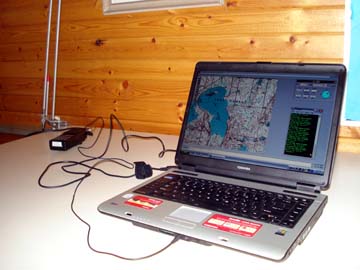
Ham radio is still a social network, but it is augmented by web-based social networks. Every ham radio operator on Facebook or Google Plus eventually uses these networks to discuss ham radio. Computing has transformed ham radio, with rig control, VoIP communications linking repeaters and computer users with smartphone users, and much more – too much to mention here. Digital technology has also made things cheap enough to replace rather than repair – and sometimes even to replace just because the new gear is magnitudes better, even though nothing is wrong with the old rig! All in all, while digital technology has been good to ham radio, it has sometimes been bad for ham radio in that it has buried everyone in constant connectivity that saps our will to participate in yet more communications. This gives us dead repeaters and sometimes poorly-attended meetings and events.
What about Radio Camp?
Radio Camp is quite a commitment for the campers, who have to take a week of their time at sometimes considerable expense if a lot of travel is involved, to attend. The camp session is also expensive to host, considering the preparation and camp rental along with a laundry list of other costs. Volunteers also incur similar expenses. Clearly this is a high-stakes event, so we need to make sure we are understanding the trends here. Is increased ever-connectedness growing and here to stay? It seems so. Is digital technology here to stay, along with increasing miniaturization and consolidation of functions? That seems a solid long-term trend as well. Is the marriage between ham radio and computing going to last? I’d say yes to that one, too. As I type this, I’m listening to 2O12L special event station calling CQ. The signal is being received by the Handiham TS-590S radio, remotely controlled via the internet.
Trending at Radio Camp…
So what seems to be trending at Radio Camp? For at least 10 years we have seen interest in the Operating Skills courses grow while in recent years it has become obvious that licensing courses are struggling. 2012 became a year without anyone attending camp to earn the Extra Class license. Operating Skills campers far outnumbered those who attended to study for a first license or upgrade. Let’s summarize and speculate on two camp trends:
- It is harder to attract campers who are interested in the licensing courses. We have to be careful here because we can’t assume that our Handiham members are no longer interested in licensing and upgrades to higher licenses, but they are less interested in doing so at a camp session and more likely to do it by using the on line audio lectures we offer at Handiham.org.
- There is growing interest in Operating Skills. This is at least a 10 to 15 year trend, and it may be driven by the new technologies and the desire to learn more about them as well as the need to simply meet other Handiham members in person and to have a week of fun. Camp has always been a place to meet old friends and make new ones, and our electronic connectivity can keep us connected after the camp session ends. Campers understand the balance between the real and the virtual and know that virtual cannot be a substitute for the real-life experience of attending camp in person. People are wanting to build real communities again!
A possible response:
So what do we learn from these trends?
Let’s put it this way: “The customer is always right”, as the old saying goes. Smart businesses listen to their customers and give them more of what they want. And what our campers want is more ham radio fun and less studying for licenses. What I propose is this:
- We continue to serve all of our Handiham members with our audio lectures for licensing or upgrades. Even those without computers can get our audio on Library of Congress digital player cartridges.
- This frees us to build and expand Operating Skills in the camp sessions.
- With more classrooms free because we don’t offer licensing classes, we can get our op skills people into separate spaces in small groups that make it easier to use the radios or have a discussion.
- Our instructors don’t have to worry about cramming an entire licensing class into a week and can concentrate on teaching operating procedures.
- We will have more time for traditional camp activities and the pontoon boat, plus field trips.
- We can set up more stations so that people with different skill levels and interests can get on the air more without waiting so long for a seat at the operating position.
- The Technician course would be replaced with a “Technician study group”. This would be a way to include a small number of unlicensed Handiham members in the week of Radio Camp, but it would only be a study group, not a complete course. There would be no more “Go to camp and get your license in a week.” Everyone there would have to be studying elsewhere prior to camp.
- VE Session: Maybe we have one, maybe not. We will see how this idea develops, but dropping the VE session gives us more time on the last day of camp to do our regular activities. The low pass rates in recent years do show that our traditional model of licensing classes is not effective. It might be better to review at camp and send the Tech students home to finish their studies and take the exams from their local VE teams.
- The emphasis will be on having fun through the week and being part of a community of friends. Learning can be fun, so we will learn about new things in Amateur Radio and learn how to be better radio operators.
Email me at [email protected] with your questions & comments.
Patrick Tice, WA0TDA
Handiham Manager
Pat Tice, WA0TDA, is the manager of HANDI-HAM and a regular contributor to AmateurRadio.com. Contact him at [email protected].
The changing seasons – with an eye on propagation
Living where we do in the country, we feel the change of the seasons quite intensely. Far more so, I think, than when I lived in a town. Here, I have cried with happiness to see the first blossom on the cherry tree signalling that the darkness of the Winter is behind us – and the first sighting of a swallow or swift back from Africa in the Spring is something that never fails to bring me joy.
From a radio point of view, just as welcome, in the Spring, is the return of the Sporadic E propagation and I realise that it is a milestone of the year which makes me happy. So, since May I have been happily employed working as many Es openings as I could on 50 and 70MHz and have been thrilled by the contacts I’ve had. It’s a form of propagation that continues to fascinate me year in and year out. This year, having 27/28MHz in the car to monitor propagation as provided extra interest.
But the Es openings though not gone, are less frequent than they were a month ago. Over the last week, I have noticed, not only a changing quality of light, but a changing in the propagation in the morning on 144/433MHz. As the nights are cooling down a little bit more, the first couple of hours or so after sunrise see some ‘local’ enhancements with VHF/UHF repeaters 50 to 100 miles away coming through better and then fading as the temperature of the day rises.
Like it or not, and I must say, I do not, Autumn is on the way.

Tim Kirby, G4VXE, is a regular contributor to AmateurRadio.com and writes from Oxfordshire, England. Contact him at [email protected].
Pikes Peak to Mt Sneffels – 160 Miles
Here’s a video of my contact from Mt. Sneffels with Stu W0STU on Pikes Peak during the Colorado 14er Event. The QSO was made on 2M FM with 5W of transmit power on both ends.
Bob Witte, KØNR, is a regular contributor to AmateurRadio.com and writes from Colorado, USA. Contact him at [email protected].
Slow on the uptake
That’s me …. W2LJ …. incredibly slow on the uptake at times.
For FOBB and again yesterday for the Skeeter Hunt, I ended up using my Whiterook single lever paddle instead of my American Morse Dirt Cheap Paddle. Not because I don’t like the DCP, in fact I love its action and feel. The problem was that every time I would go to pick the paddle up with my big, hammy hands, I would inadvertently squeeze it and start sending unwanted dits or dahs.
This paddle is too good to not use – so tonight I had a “V8 moment” where I hit my forehead as the obvious solution occurred to me. And actually, I ended up killing two birds with one stone.
I carry my ear buds in an old Velamints tin. It occurred to me that the tin could do double duty – carry my ear buds AND serve as a base for my paddles.
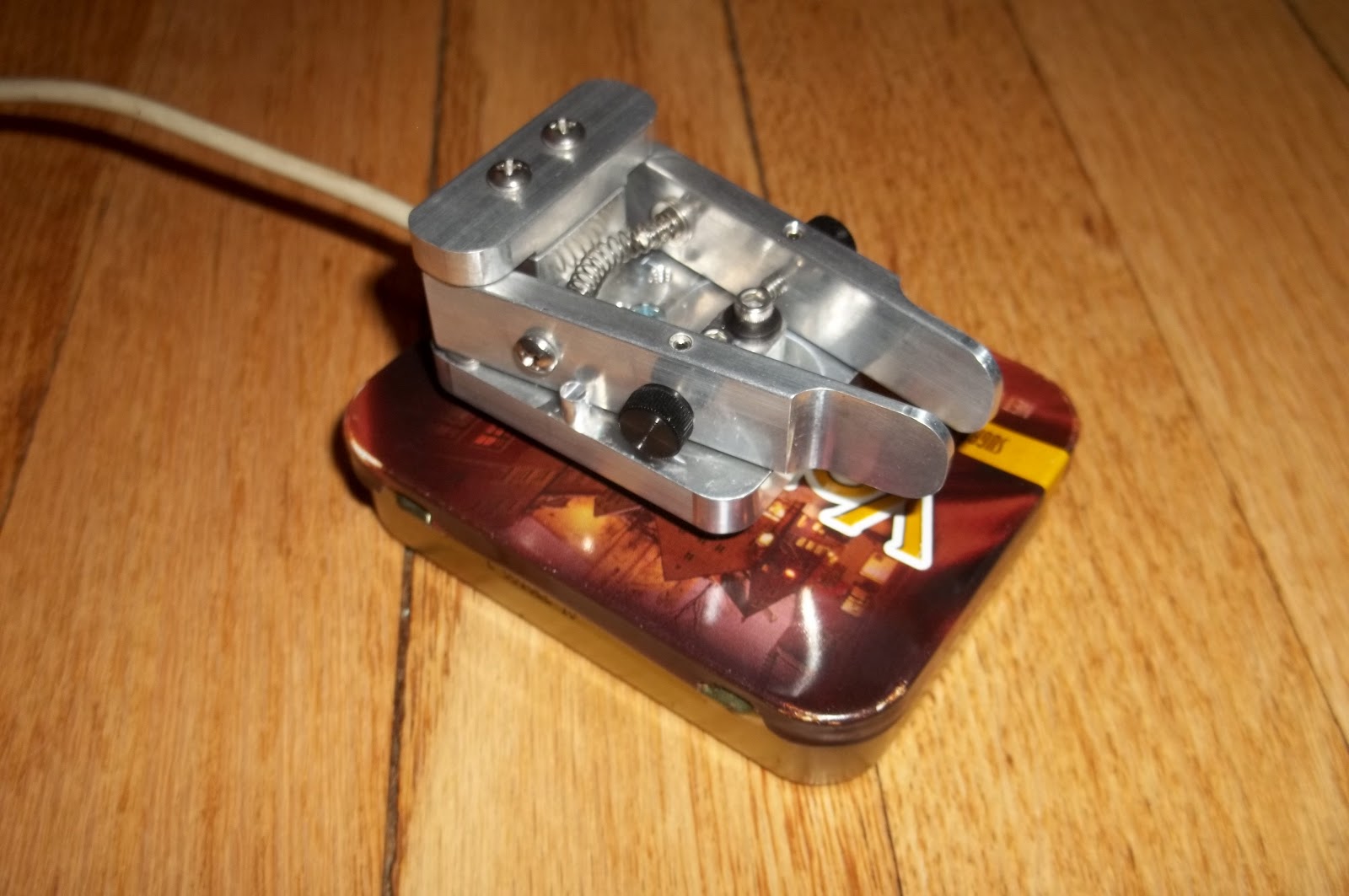
I punched a hole through the top of the tin and secured the paddle to the top lid with a #4 screw, lockwasher and nut.
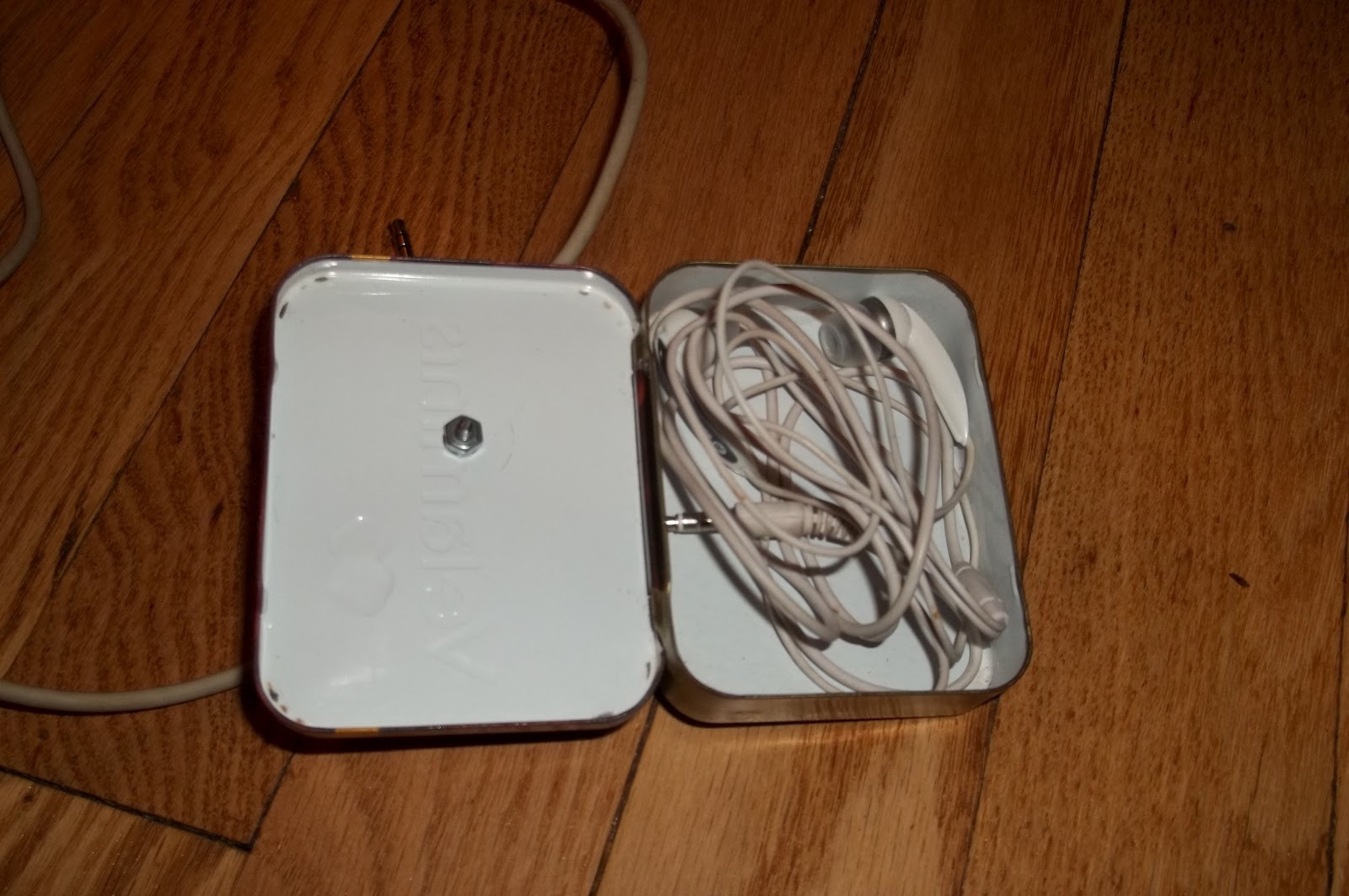
Now the tin does double duty, perfectly! And when I put my big mitts on the tin, I am no longer accidentally squeezing the paddle levers and generating unwanted Morse. Not a good thing in the middle of a sprint (or anytime for that matter!).
72 de Larry W2LJ
QRP – When you care to send the very least!

Larry Makoski, W2LJ, is a regular contributor to AmateurRadio.com and writes from New Jersey, USA. Contact him at [email protected].
Chirp update
I had the chance to try Chirp, simplex on a couple of PMR446 radios with Julie this evening. We still didn’t manage to exchange Chirps on air. Having tried the test simplex, that’s eliminated the audio circuitry of the repeater from the first test. My guess is that we’re not getting the audio bandwidth we need.
However, the lovely people from the Chirp team have been in touch, so we’ll see what we can come up. It would be exciting to get something working.

Tim Kirby, G4VXE, is a regular contributor to AmateurRadio.com and writes from Oxfordshire, England. Contact him at [email protected].
Perseids 2012 – part 2
After the Olympics closing ceremony had finished at around 0030 local time 13th August, I set the WSJT gear up monitoring 144.370 for a second night.
As to be expected a bit less activity but still some nice reflections:
SP4K
I8KEV (Best reflections of the night!)
DL0HOF
ON1IM (Probably tropo or backscatter)
S51AT (Great consistent reflections)
Very encouraging to have copied all these stations. I’ve got the 2m PA available again now, so ought to be able to run enough power for some MS tests, even with the little antenna. I think it will be something fun to try over the quieter conditions of autumn and winter.

Tim Kirby, G4VXE, is a regular contributor to AmateurRadio.com and writes from Oxfordshire, England. Contact him at [email protected].
Double Dip Weekend August 2012

Homebrew Buddipole inspection
Great weekend of QRP Portable fun. Saturday our Central FL QRP group had some new ops join us and we had a good time comparing antennas and rig setups at Sylvan Lake Park in Sanford, FL. As is typical, we did more talking than operating but did manage to sneak a few qso’s in on 20 and 17 meters. The contesters in Europe were hot and heavy on 15 m too so made for a fun day despite the heat and high humidity. I was a bit disappointed to not be able to snag any fellow Polar Bear QRP ops on 30m but the band did not stay open long and the other stations were operating on alternative bands.
Sunday after church was the first annual NJQRP Skeeter Hunt. So glad to work Skeeter Hunt promoter and fellow Polar Bear, Larry, W2LJ before the lightning ran me off. Larry was my last QSO of the day as a thunderstorm started making LOTS of noise and it was my signal to pull down the 31 ft Jackite and wire and get out from under the shade of the 50 ft tall pine trees down by the lake! YIKES… just made it too!
I ran my Sierra at 2.4 watts out into an end fed half wave suspended as a sloper from the 31 ft Jackite pole in a WNW direction. I normally use the trees to get a bit more height for my wire, but the Jackite goes up and down faster and with storms coming, I chose the simple and fast way to git ‘er done. Turned out to be a good choice. Band conditions were pretty good on 20m and I was hearing a good bit of activity. After 1800 the Caribbean, Central and South American SSB stations were causing a good bit of QRM down here in FL. They all seem to run power and gain antennas so we learn to listen through the chatter here in FL. The approaching storm was obvious as QRN increased with distant lightning stirring up the noise and crashes. Nonetheless, the signals were pretty good despite the distractions and there were some SKCC, FISTS and other cw fans out there having fun too which made the band busy.
I built a simple key and am posting a photo of my K4UPG Knee Cap Key. Used the lid of a bulk black peppercorn jar and made a simple non-iambic key with paper clips, standoff and a bit of wire. It actually worked fairly well, but not good enough to use for the whole contest. As a long time CPG (Contest Point Giver) I decided that was a good way to give myself some points so took advantage of the bonus points! It did inspire me to try a more substantial lid and make a strap to use it as a leg key for portable ops.


Umbrellas for the rig and the op!
It was fun to hear so many familiar calls and work a few of our fellow Polar Bear Ops who were out for the fun too. Sure appreciate the effort to put this event on the calendar and process the results. Thanks to the NJQRP group for the support of our niche in the hobby and to you Larry for the time you devote to contests, blogs and getting us all out and on the air.
Here’s my results before the storm drove me for cover:
| Date | Time | Call | Band | Pwr | RST | RCV | SPC | Nr | |
| 8/12/2012 | 17:12 | N0SS | 20 | CW | 2.4 | 559 | 579 | MO | #122 |
| 8/12/2012 | 17:17 | W0EA | 20 | CW | 2.4 | 559 | 559 | IA | #22 |
| 8/12/2012 | 17:23 | NK9G | 20 | CW | 2.4 | 559 | 559 | WI | #75 |
| 8/12/2012 | 17:25 | VE3WDM | 20 | CW | 2.4 | 559 | 559 | ON | #15 |
| 8/12/2012 | 17:37 | KQ2RP | 20 | CW | 2.4 | 449 | 439 | NJ | #27 |
| 8/12/2012 | 17:39 | AB4PP | 20 | CW | 2.4 | 579 | 599 | NC | #79 |
| 8/12/2012 | 17:42 | N0JRN | 20 | CW | 2.4 | 559 | 559 | MO | 5W |
| 8/12/2012 | 17:46 | N3AO | 20 | CW | 2.4 | 449 | 559 | VA | #109 |
| 8/12/2012 | 17:49 | W4MPS | 20 | CW | 2.4 | 599 | 559 | NC | 5W |
| 8/12/2012 | 18:00 | KR9Z | 20 | CW | 2.4 | 449 | 449 | IL | #10 |
| 8/12/2012 | 18:06 | AA4GA | 20 | CW | 2.4 | 579 | 569 | GA | #2 |
| 8/12/2012 | 18:08 | N7UN | 20 | CW | 2.4 | 579 | 559 | NJ | 5W |
| 8/12/2012 | 18:14 | WF4I | 20 | CW | 2.4 | 559 | 559 | NC | #71 |
| 8/12/2012 | 18:18 | K3RLL | 20 | CW | 2.4 | 449 | 339 | PA | #21 |
| 8/12/2012 | 18:31 | KX0R | 20 | CW | 2.4 | 449 | 359 | CO | #69 |
| 8/12/2012 | 18:36 | W2LJ | 20 | CW | 2.4 | 579 | 599 | NJ | #4 |
A good time was had by me!
72,
Kelly K4UPG
Kelly McClelland, K4UPG, is a regular contributor to AmateurRadio.com and writes from Florida, USA. Contact him at [email protected].
 Ham Radio Deluxe |
 W5SWL Electronics |
 Ham Radio Prep |
 KB3IFH QSL Cards  Hip Ham Shirts  HamRadioAuctions HamRadioAuctions Reliance Antennas Reliance Antennas Enigma Shop Enigma Shop |  morseDX  Ni4L Antennas  R&L Electronics R&L Electronics antennas.us antennas.us QRV QRV |
- Matt W1MST, Managing Editor
