 |
 It has been a Captchas morning!!!
 26 August 2012 | by
  |
| Its been one of those days |

Mike Weir, VE9KK, is a regular contributor to AmateurRadio.com and writes from New Brunswick, Canada. Contact him at [email protected].
Planning My New QTH (Ham Radio Station) Part I Of III: Taking Inventory Of My Evolving Interests
We moved to Glade Park, Colorado last November and, unusual for me, I’ve been planning my new QTH before commencing construction (QTH = ham radio ‘Q code’ for ‘location’ which hams use to as a catch all term for their home and ham station). I’ve had pretty big ‘antenna farms’ over the years in Malibu, California, Tiffany, Colorado and East Topsham, Vermont. Each time my enthusiasm to get back on air led me to ‘plan’ as I built. Although each of these stations performed very well on the air, I eventually realized that each station could have been better. So this time, it’s different…
My inspiration to be patient and plan has been the detailed and thoughtful strategic planning that my friend Tom Taormina, K5RC, is employing in the updating of his potent ‘contest station’ (a ham radio station optimized for radio contesting a/k/a ‘radio sport’) near Reno NV. Tom has a club callsign that he uses in contests, W7RN. If you’re a radio contester you no doubt recognize this callsign.
Tom was a NASA executive during the Project Apollo glory days and today is an author and ‘Forensic Business Pathologist’ using his NASA expertise to advise corporations on employing rocket science – literally – to operate their businesses better. Tom’s contest station planning is extraordinary in scope and detail. (Tom’s business Website is www.itwasrocketscience.com and you can learn more about his contest station at www.w7rn.com.)
Since re-entering the amateur radio hobby in 1989 I have spent most of my ‘on air’ time operating radio contests on the HF bands (HF is technically ‘High Frequency’ 3 to 30-Mhz, but most hams consider the Medium Frequency 1.8-MHz ham band to also be part of the HF spectrum) and in between contests making contact with as many countries as I could on each different amateur radio band between 1-MHz (’16o meters’) and 50-Mhz (’6 meters’).
By 2003 I passed 2,800 total ‘band-countries’ (total number of countries contacted on each band added together). 2003 was the year my daughter was born and also when my professional responsibilities – then in the music business – multiplied. Fatherhood and career conspired to soak up my ham radio time and my station, we were living in Vermont at the time, gathered dust for 8 years by which time I had changed careers and moved the family back west.
Most mornings I wake up and gaze at the sun rising east of our 35 high desert acres in Glade Park CO, where we moved late last year. Glade Park is a small community perched on a high plateau west of Grand Junction. Its rural, scenic, private, dry, sunny and as far as I can tell, a great place to ‘grow some aluminum’ and ‘work the world.’ Sipping my morning coffee I frequently wonder what signals are being refracted down all around me from the solar energized ionosphere and ponder what antennas I should build to find out. I’ve also been taking careful of the moon as it traverses the sky above our property, especially moonrises (more on that later). Gradually, day by day as the sun and moon rise and fall, a station plan has come into focus.
The first step in the planning process was taking inventory of my evolving ham radio interests. This hobby is a big tent with close to a million licensees in the U.S.A. alone. Some hams enjoy providing communications as a public service during natural (and man made) disasters – ‘when all else fails amateur radio gets through,’ others enjoy long, ‘rag chew’ conversations with friends old and new around the world, some enjoy building and tinkering with gear, some ‘chase DX’ (make contact with odd bits of geography, the further away and more obscure the better), and some focus their energy on radio contesting.
In the past radio contests and DXing motivated me to get on the air. My years away from operating my station have given me time and space to meditate on exactly why I love this hobby. I eventually realized that it wasn’t so much the contest scores or the growing list of countries contacted, although there was pleasure in these accomplishments, my core interest is my fascination with the physics of what makes a radio signal propagate around the world. Take the energy used by a common household lightbulb, push it down a coax cable connected to a bit of aluminum and, voila! electromagnetic waves are launched into the ether coming back to earth thousands of miles away. This has intrigued me since I was a teen age ham radio operator in the 1960s.
DXing and contesting activities tend to reveal the most extraordinary radiowave propagation; this I have come to realize is why I enjoy DXing and contesting and why I will continue to contest and chase DX but with changed focus – some of the most extraordinary propagation modes and paths are revealed during radio contests and while chasing DX.
My passion for antennas is direct by product of my passion for propagation. Better antennas allow you to explore more exotic propagation modes and paths. At this point perhaps you shouldn’t be surprised to learn that I became a partner in an antenna company last year – InnovAntennas, Ltd. of Canvey Island, England – after becoming enthralled by the groundbreaking antenna designs company founder Justin Johnson (also a ham, callsign G0KSC) was creating. My passion now = my career. (More info: www.InnovAntennas.us for North America and www.InnovAntennas.com for Europe and ROW.)
I’ll now steer this blog entry back to my station planning. The ham radio band with the most exotic propagation is the 50-MHz (6 meter) band. This is adjacent in the electromagnetic spectrum to TV Ch. 2. Can you imagine tuning into 100+ countries and all continents on your living TV set via its rooftop antenna? Well, that’s the challenge of 50-MHz. Most of the time radio waves on this band propagate ground wave, maybe 100 miles, and not much further. Whereas other ham allocations such at the 14-MHz (’20 meter’) band routinely offer up global contacts, long distance contacts on 50-MHz are always special and much of the propagation at this part of the spectrum is not well understood.
There have been midsummer 50-MHz contacts between Japan and the southern USA – nearly half-way around the globe – in recent years and the propagation mechanism for these contacts is not well explained by the known physics of the ionosphere, yet these contacts are real and happening. My friend Dr. Lew Sayre, W7EW, made over a hundred contracts all across Europe on 50-Mhz from Oregon late last June. This is a long, long way and traverses the northern polar regions – usually death for such high frequency radiowaves – how did those radiowaves take that trip? Incredible! Dr. Jim Kennedy, KH6/K6MIO, a physicist and a ham, has been presenting papers on ‘extreme’ 50-MHz propagation at ham radio conventions in recent years which are utterly fascinating due to both what is explained and what remains mysterious.
Thus, my new station will be well-equipped with antennas for 50-MHz. I want to have the capability to access exotic propagation modes that a pedestrian system would never detect. My friend Dennis Motschenbacher, K7BV is building a MASSIVE 50-MHz antenna system at his Turkey, NC home: a stack of six ’11 element LFA Yagi’ antennas (InnovAntennas models, thanks Dennis!) nearly 70-feet long apiece spread across a nearly 200-foot tall radio tower. Dennis and I, it should be obvious, are lucky to married to women who in addition to being beautiful are tolerant of our hobbies. I am thinking about building something similar.
I’m splitting this blog entry into three parts. This first missive shows how I put a big 50-MHz antenna system on the top of my priority list. The next two parts will cover (a) why the new Flex-Radio 6700 transceiver (a device that transmits and receives radio signals) has caused me to put all of my other ham radio transcievers – except for my beloved Elecrafts – for sale and motivated my business partner Justin Johnson to develop a new antenna design which will find a home at my station, and (b) why I have become so interested in the moon and why I will be building at least four antennas systems which will be aimed at our planet’s lone natural satellite.
73
Bill AA7XT
Bill Hein, AA7XT, is a regular contributor to AmateurRadio.com and writes from Colorado, USA. He is co-owner of Force 12 and InnovAntennas. Contact him at [email protected].
Robust Packet Radio
A couple of days ago Chris, HB9DDF sent me an email asking how to configure APRSIS32 to work with the SCS Tracker / DSP TNC. Digging through my configuration files to get the information he needed I thought: why not put the 30m APRS gateway back online? It had been off since I went into hospital last year and the K2 and magnetic loop were hardly ever used.
 |
| SCS Tracker DSP TNC and Elecraft K2 at G4ILO |
I don’t know if propagation is lousy or whether things have changed since I was last on HF APRS but there seemed to be a lot less activity on the 30m APRS frequency today. An hour went by without my receiving anything. I did, however, hear quite often the “whooshing” sound of Robust Packet Radio (RPR) stations a few hundred Hz down. So I decided to configure the TNC to work in RPR mode.
Robust Packet is a mode obtainable in 300baud and 600baud versions that has been designed to take advantage of the capabilities of digital signal processing (DSP) in order to obtain reliable communication over a normal less than perfect HF path. To anyone who has experience only of traditional 300baud FSK packet RPR has too be seen to be believed. Packet after packet was decoded and displayed by APRSIS32 while conventional packet transmissions on the adjacent channel just flickered the DCD lamp and were discarded due to errors.
Robust Packet is a proprietary mode developed by SCS and is only supported by SCS TNCs. As far as I know no description exists that would enable someone to develop a PC implementation that uses a sound card. In that respect it is pretty much like Icom and D-Star. I would much rather use an open standard.
 |
| G4ILO-10 joins the Robust Packet Network |
But RPR works where the old-fangled 300baud FSK invented to work on the analogue modems of 30 years ago doesn’t. I think it is in keeping with the spirit of ham radio to use state of the art technology where it provides clear benefits to communication.
So G4ILO is now part of the Robust Packet Network.

Julian Moss, G4ILO, is a regular contributor to AmateurRadio.com and writes from Cumbria, England. Contact him at [email protected].
ICQ Podcast S05 E18 – South London Amateur Radio Roundtable (26 August 2012)
Series Five Episode Eighteen of the ICQ Podcast has been released. News Stories include :-
- New Section Boundaries for Ontario
- Radio Exam Question Updates
- Floods in the Philippines hit Manilla
- Father and Son complete SOTA England
- Vanity call sign fee to increase
- Retaining New and Young Radio Amateurs
- QST Managing Editor killed in house fire
- SU30ASR Special Event
- QST Managing Editor killed in house fire
- Amateur Radio Technical Article Archive
- Radio Amateur reaches Mongolia in Fiat Panda
- Operations at 2O12L
Listener mailbag and Ed Durrant VK2ARE reports from Australia and Martin (M1MRB) and Colin (M6BOY) are joined in a South London Amateur Radio Roundtable with John Stacy, Chris Howard (2E0CTH) and Martin Rothwell M0SGL).
Colin Butler, M6BOY, is the host of the ICQ Podcast, a weekly radio show about Amateur Radio. Contact him at [email protected].
SD memory cards…great when they work!!!
 |
| Missing fingers on SD card |
Just like a sore tooth that gets better just before the dentist visit....the camera would work just fine at the camera store. Today the camera worked great and when I go home I wanted to email a contacts I had that turned into a very nice QSO.
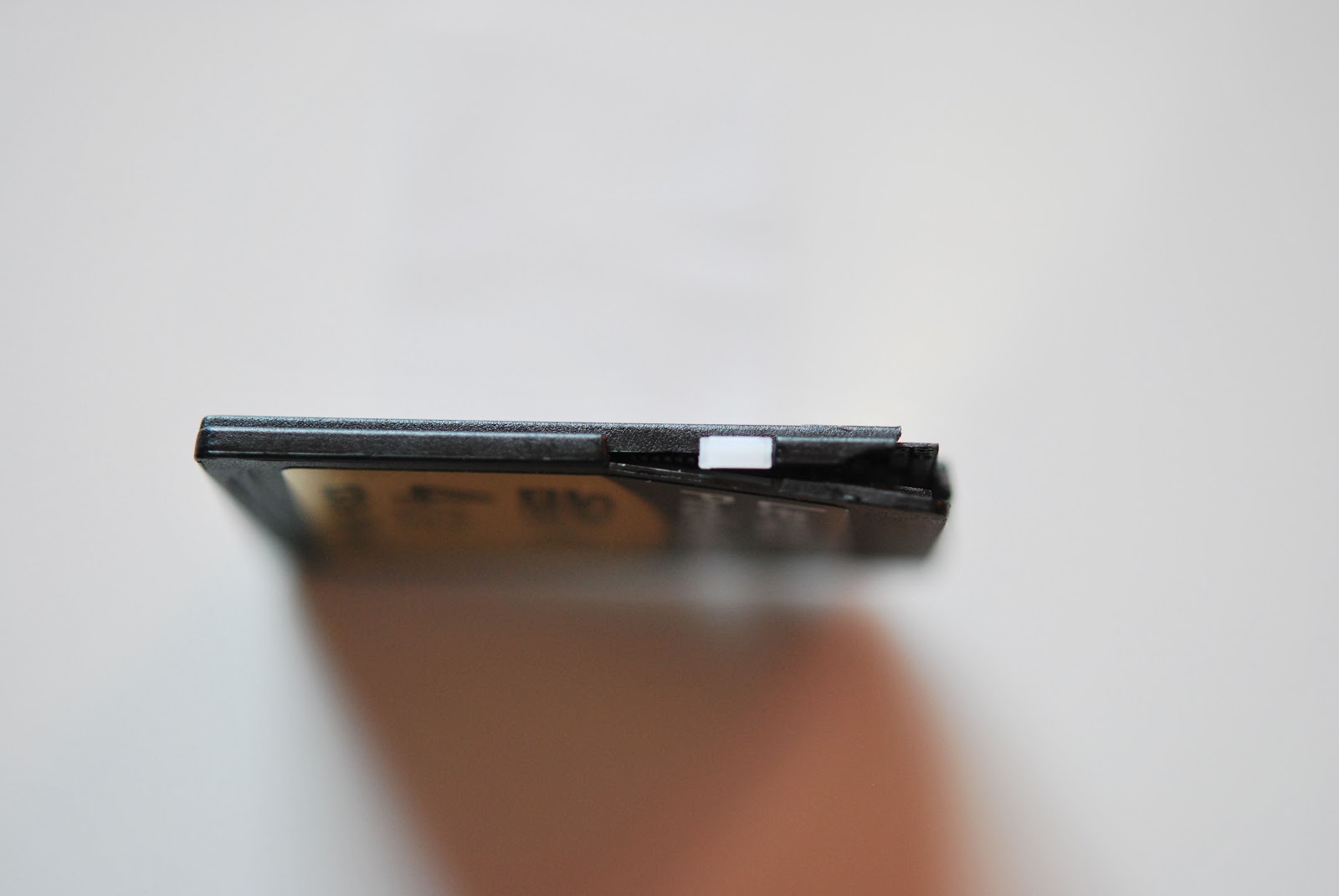 |
| Seam problem |
Seemed the SD card knew I was in a hurry and wanted pictures to add to an email. The computer told me it could not recognize the memory card. The card was then put back in the Nikon D60 but now it too would not recognize the card either. GREAT here we go again I thought but after close examination I found the card to have some damaged fingers at the far right!!! I went on the internet and downloaded some programs that claimed they could recover pictures from damaged SD cards. I didn't have any luck with these programs other than them taking up space on my hard drive. I still was getting a
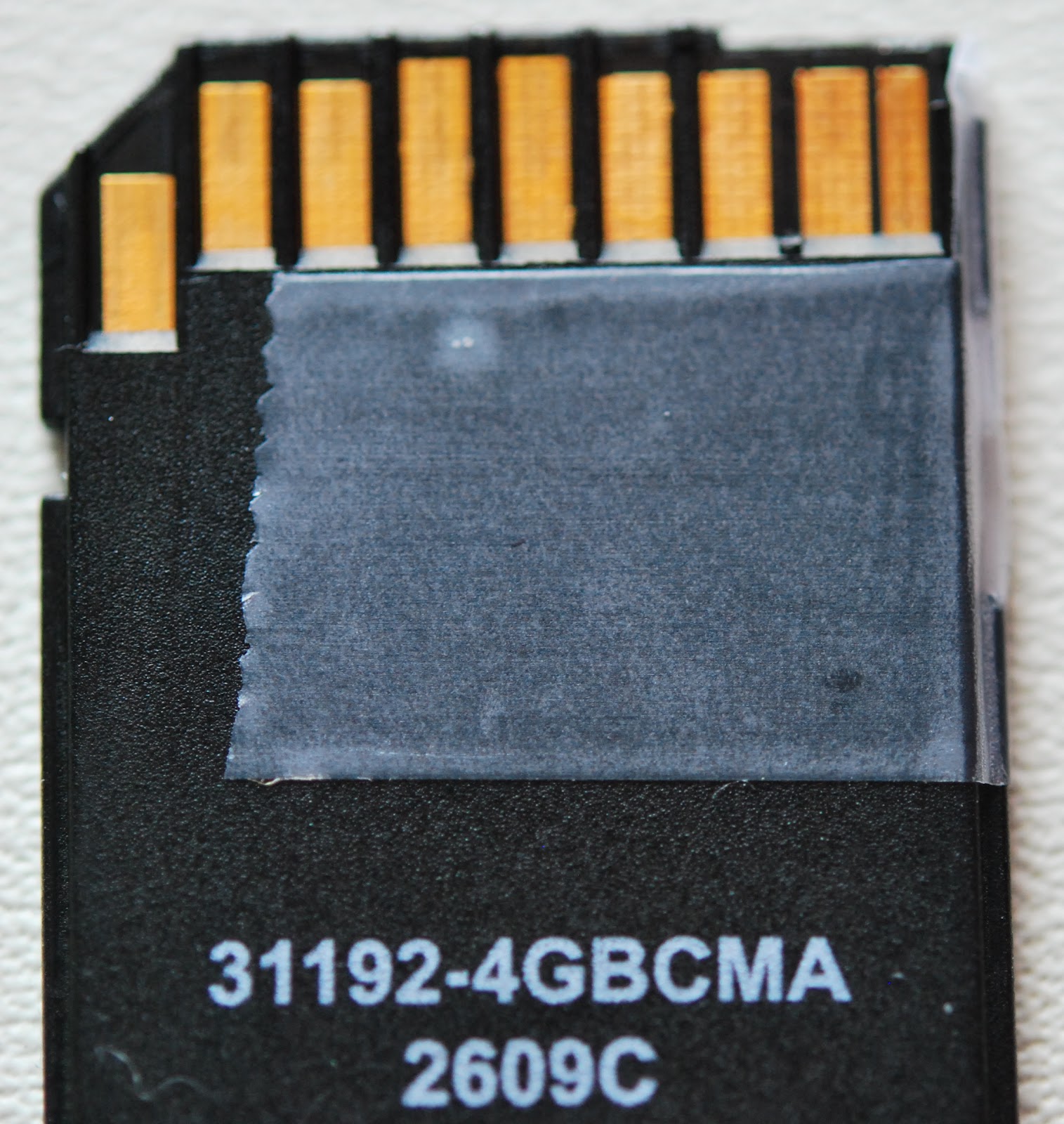 |
| The fix until all was downloaded |

Mike Weir, VE9KK, is a regular contributor to AmateurRadio.com and writes from New Brunswick, Canada. Contact him at [email protected].
RIP Neil Armstrong

Neil Armstrong, the first man to set foot on the surface of the Moon, died today at the age of 82. The cause of death was from complications from heart bypass surgery which occurred earlier this month.
Neil Armstrong was a humble hero, who did not seek the limelight; and was always eager to praise those who shared in the efforts to land an American on the moon.
You will be sorely missed, Neil. You were larger than life to those of us who grew up with Mercury, Gemini and Apollo.
72 de Larry W2LJ
QRP – When you care to send the very least!

Larry Makoski, W2LJ, is a regular contributor to AmateurRadio.com and writes from New Jersey, USA. Contact him at [email protected].
Antenna Restrictions on Mt. Evans? The Conclusion
I finally received a letter from the Clark Creek Ranger District regarding my encounter on Mt. Evans (read the first part of the story if you are not familiar with it). It took me almost six weeks and several e-mails to get an official statement from the Ranger District. I guess an underfunded federal agency has more pressing issues to deal with.
The good news is that it was an over-eager FS employee who kicked me off the mountain.
The bad news is that, according to the letter, the Federal Code of Regulation [36 CFR 261.10(a)], which applies to communication equipment, is written with some built-in ambiguity and might be interpreted differently in other Forest Service units.
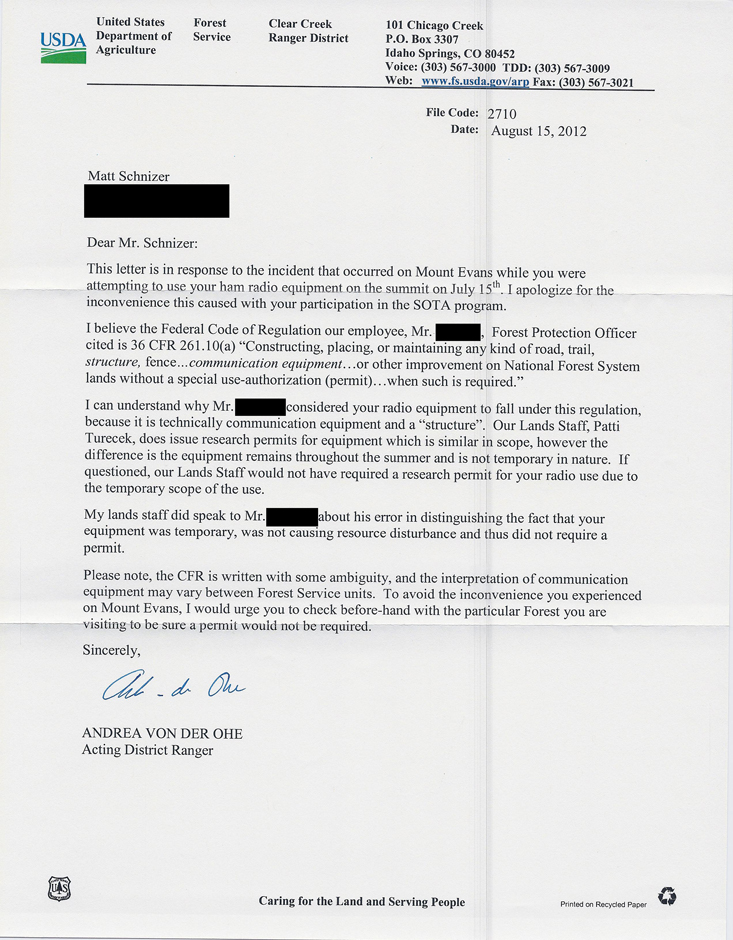
Official Response
Well, I will deal with another interpretation if and when I run into another issue. The Clear Creek Ranger District interpretation however makes sense to me – chapter closed!
I really appreciate the clarification.
Read the entire letter by clicking on the thumbnail to the right.
That’s my last post from Mt Evans but there are two more pictures I wanted to share. The first one was shot at the Summit Lake trail-head early in the morning. The trail starts on the right side of the picture, goes up the ridge to Mt. Spalding and over to Mt. Evans.
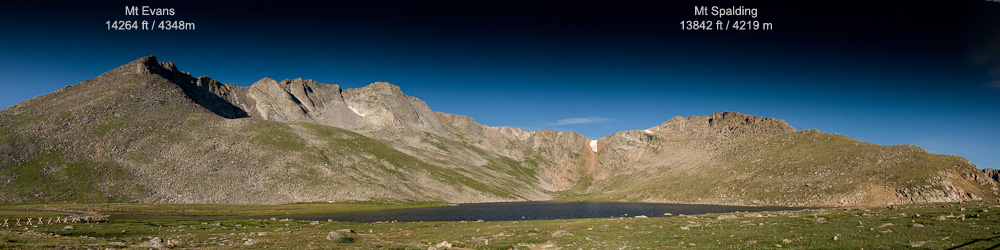
Panorama of the Mt. Evans Area
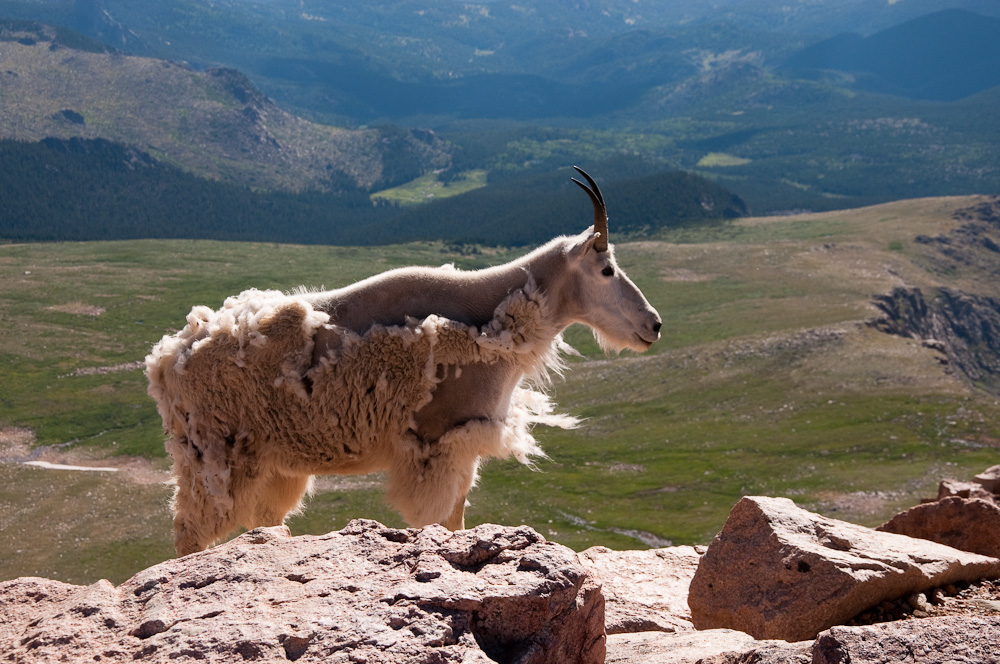
Mountain goat on Mt. Evans
The second picture is from a close encounter of the third kind… well, not quite but is was remarkable. This unflinching mountain goat approached me. The picture is shot with a 52mm lens, not a tele-photo lens. He came up to me at arms lengh… too close for my taste. I normally try to keep a save distance between wild animals and myself, but this guy was not shy at all. Since I had never heard about occurrences of rabies in mountain goats and since I received some goat combat lessons earlier in the year (courtesy of Rooster) on my trip to Mt. Herman, I took the chance to take some real close-up shots instead of retreating.
73, Matt/KØMOS
Matt Schnizer, KØMOS, is a special contributor to AmateurRadio.com and writes from Colorado, USA. Contact him at k0mos at schnizer.com.
 Ham Radio Deluxe |
 W5SWL Electronics |
 Ham Radio Prep |
 KB3IFH QSL Cards  Hip Ham Shirts  HamRadioAuctions HamRadioAuctions Reliance Antennas Reliance Antennas Enigma Shop Enigma Shop |  morseDX  Ni4L Antennas  R&L Electronics R&L Electronics antennas.us antennas.us QRV QRV |
- Matt W1MST, Managing Editor
